PUBLISHER: Mordor Intelligence | PRODUCT CODE: 2113970

PUBLISHER: Mordor Intelligence | PRODUCT CODE: 2113970
Europe Energy Bar - Market Share Analysis, Industry Trends & Statistics, Growth Forecasts (2026 - 2031)
According to Mordor Intelligence, the European energy bar market size was valued at USD 1.10 billion in 2025 and estimated to grow from USD 1.18 billion in 2026 to reach USD 1.68 billion by 2031, at a CAGR of 7.33% during the forecast period (2026-2031).
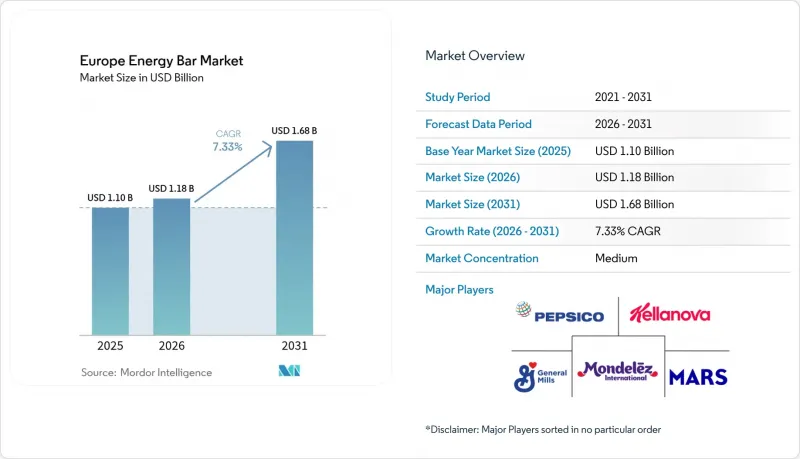
This report is Segmented by Product Type (Protein Bars, Cereal and Granola Bars, and MOre), Flavor Profile (Chocolate-Based Bars, Fruit-Based Bars, and More), Price Range (Mass and Premium), Distribution Channel (Supermarkets/Hypermarkets, Convenience Stores, and More), and Country (United Kingdom, Germany, France, Italy, Spain, and More). The Market Forecasts are Provided in Terms of Value (USD).
Europe Energy Bar Market Trends and Insights
Shift toward reduced sugar and high-fiber diets
The growing focus on healthier eating habits is driving demand for energy bars with less sugar and more fiber in Europe. According to the European Food Safety Authority, as of September 2025, around 34% of Europeans prioritize healthier diets. This trend is prompting manufacturers to reduce added sugars in their products and incorporate soluble fibers that help regulate blood sugar levels. Challenges in the sugar market are contributing to this shift. With EU sugar production expected to decline, products that rely heavily on sugar are facing higher costs. To meet consumer preferences for low-sugar, high-fiber options, manufacturers are increasingly using alternative sweeteners, such as stevia, erythritol, and allulose. These are often combined with ingredients such as inulin or chicory root fibers, which not only improve digestion but also help consumers feel fuller for a longer period.
Expanding fitness and sports culture in Europe
Growing awareness about fitness and health across Europe is driving the demand for energy bars designed to enhance performance. Consumers are increasingly focusing on nutrition as a key part of their wellness routines. According to the Agriculture and Horticulture Development Board as of January 2025, 90% of consumers believe that maintaining a healthy diet is essential for overall well-being, while 86% consider fitness equally important. This highlights a strong and ongoing interest in products that support active and healthy lifestyles. The rising number of people joining gyms further boosts this trend, as energy bars are seen as convenient options for pre- and post-workout nutrition, offering quick protein intake and aiding in recovery. Additionally, large fitness chains are contributing to market growth by selling these products through in-club retail outlets, vending machines, and loyalty programs.
Growing competition from healthier snack alternatives
The European energy bar market is facing growing competition from healthier, whole-food snacks, as consumers increasingly prefer minimally processed options, such as roasted almonds, mixed nut blends, dried fruits, seed mixes, and protein-fortified crisps. The strong availability of these alternatives in the region supports this trend. For instance, the European Union is expected to contribute approximately 10% of global almond production for the 2024-2025 period, according to the United States Department of Agriculture, ensuring a steady supply and competitive pricing for nut-based snacks. These whole-food options are perceived as more natural and healthier due to their clean-label appeal, which resonates with consumers seeking simpler and less processed products. These snacks often provide a more cost-effective source of protein compared to many energy bars, especially in discount retail stores.
Other drivers and restraints analyzed in the detailed report include:
- Popularity of high-protein diets and weight management routines
- Rising adoption of energy bars as meal replacements or healthy snacking options
- Rising concerns about artificial sweeteners, preservatives and additives
For complete list of drivers and restraints, kindly check the Table Of Contents.
Segment Analysis
Protein bars maintained their leadership position in the European energy bar market in 2025, accounting for 58.10% of the market share. These bars have become a staple for consumers seeking products that support sports recovery, muscle building, and high-protein snacking. Their widespread appeal is driven by their alignment with health and fitness trends, a broad range of flavors, and their availability across various retail channels, including supermarkets, drugstores, and e-commerce platforms. Manufacturers are increasingly focusing on product innovation, such as cleaner ingredient labels, higher protein content, and improved textures, to meet the growing demand. These factors collectively reinforce the role of protein bars as a key driver of growth and consumer engagement in the energy bar market.
Meal-replacement bars are projected to witness a significant compound annual growth rate (CAGR) of 7.41% through 2031, reflecting their growing popularity as convenient meal alternatives. This segment is gaining traction among busy professionals, students, and travelers who prioritize portion-controlled options that offer a balance of macronutrients and functional ingredients. Enhanced taste profiles and claims of better satiety are further broadening their appeal to a wider audience beyond fitness-focused consumers. These developments position meal-replacement bars as a rapidly expanding segment with the potential to reshape the competitive landscape of the energy bar market in the coming years.
Chocolate-based formulations dominated the European energy bar market in 2025, accounting for 64.20% of total sales. This dominance is attributed to their widespread consumer appeal, offering indulgent flavors that effectively mask the taste of fortified proteins. These formulations cater to both mainstream consumers and fitness enthusiasts, making them a versatile choice across various demographics. Manufacturers continue to innovate with premium chocolate pairings, unique textures, and diverse inclusions, ensuring sustained consumer interest and strong retail presence. As a result, chocolate-based energy bars remain a cornerstone of the market, driving significant sales and consumer loyalty.
Nut- and seed-based energy bars are projected to grow at a robust CAGR of 8.3% from 2026 to 2031, reflecting a shift in consumer preferences toward plant-based nutrition and clean-label products. These bars appeal to health-conscious consumers seeking natural sources of fats, fiber, and minimally processed ingredients. The growing popularity of vegan and flexitarian diets further supports the demand for nut- and seed-based formulations. With their alignment to trends in wellness, sustainability, and simplicity, this segment is poised for rapid expansion, offering significant opportunities for manufacturers to capture a larger share of the evolving energy bar market.
Complete Report Scope:
- By Product Type
- Protein Bars
- Cereal and Granola Bars
- Meal-Replacement Bars
- Others
- By Flavor Profile
- Chocolate-Based Bars
- Fruit-Based Bars
- Nut and Seed-Based Bars
- Others
- By Price Range
- Mass
- Premium
- By Distribution Channel
- Supermarkets/Hypermarkets
- Specialist Retailers
- Convenience Stores
- Online Retail
- Others
- By Country
- United Kingdom
- Germany
- France
- Italy
- Spain
- Netherlands
- Sweden
- Poland
- Switzerland
- Rest of Europe
List of Companies Covered in this Report:
- General Mills Inc
- Kellanova
- PepsiCo Inc.
- Mondelez International, Inc.
- KBF Enterprises (Warrior)
- Atlantic Grupa
- Mars Inc.
- Carbery Group
- PowerBar Europe GmbH
- Probar LLC
- Oatein Ltd
- The Ferrero Group
- Pulsin Ltd.
- Nutrend D.S. a.s.
- Vitamin Well Group
- Glanbia PLC (Optimum Nutrition)
- Nupo SA
- THG plc (Myprotein)
- Koninklijke Prinsen B.V. & Gustav Berning GmbH & Co. KG.
- OTE Sports Nutrition
Additional Benefits:
- The market estimate (ME) sheet in Excel format
- 3 months of analyst support
TABLE OF CONTENTS
1 INTRODUCTION
- 1.1 Study Assumptions and Market Definition
- 1.2 Scope of the Study
2 RESEARCH METHODOLOGY
3 EXECUTIVE SUMMARY
4 MARKET LANDSCAPE
- 4.1 Market Overview
- 4.2 Market Drivers
- 4.2.1 Shift toward reduced sugar and high-fiber diets
- 4.2.2 Rising adoption of energy bars as meal replacements or healthy snacking options
- 4.2.3 Expanding fitness and sports culture in Europe
- 4.2.4 Popularity of high-protein diets and weight management routines
- 4.2.5 Increasing preference for clean-label, natural and plant-based ingredients
- 4.2.6 Demand for allergen free bars due to prevalence of lactose intolerance and gluten sensitivity
- 4.3 Market Restraints
- 4.3.1 Growing competition from healthier snack alternatives
- 4.3.2 Premium pricing of high-quality or protein-rich bars
- 4.3.3 Rising concerns about usage of artificial sweeteners, preservatives and additives
- 4.3.4 Increasing sustainability expectations are pressuring brands
- 4.4 Regulatory Outlook
- 4.5 Supply Chain Analysis
- 4.6 Porter's Five Forces
- 4.6.1 Threat of New Entrants
- 4.6.2 Bargaining Power of Buyers
- 4.6.3 Bargaining Power of Suppliers
- 4.6.4 Threat of Substitute Products
- 4.6.5 Intensity of Competitive Rivalry
5 MARKET SIZE AND GROWTH FORECASTS (VALUE)
- 5.1 By Product Type
- 5.1.1 Protein Bars
- 5.1.2 Cereal and Granola Bars
- 5.1.3 Meal-Replacement Bars
- 5.1.4 Others
- 5.2 By Flavor Profile
- 5.2.1 Chocolate-Based Bars
- 5.2.2 Fruit-Based Bars
- 5.2.3 Nut and Seed-Based Bars
- 5.2.4 Others
- 5.3 By Price Range
- 5.3.1 Mass
- 5.3.2 Premium
- 5.4 By Distribution Channel
- 5.4.1 Supermarkets/Hypermarkets
- 5.4.2 Specialist Retailers
- 5.4.3 Convenience Stores
- 5.4.4 Online Retail
- 5.4.5 Others
- 5.5 By Country
- 5.5.1 United Kingdom
- 5.5.2 Germany
- 5.5.3 France
- 5.5.4 Italy
- 5.5.5 Spain
- 5.5.6 Netherlands
- 5.5.7 Sweden
- 5.5.8 Poland
- 5.5.9 Switzerland
- 5.5.10 Rest of Europe
6 COMPETITIVE LANDSCAPE
- 6.1 Market Concentration
- 6.2 Strategic Moves
- 6.3 Market Share Analysis
- 6.4 Company Profiles (includes Global-level Overview, Market-level Overview, Core Segments, Financials (if available), Strategic Information, Market Rank/Share, Products and Services, Recent Developments)
- 6.4.1 General Mills Inc
- 6.4.2 Kellanova
- 6.4.3 PepsiCo Inc.
- 6.4.4 Mondelez International, Inc.
- 6.4.5 KBF Enterprises (Warrior)
- 6.4.6 Atlantic Grupa
- 6.4.7 Mars Inc.
- 6.4.8 Carbery Group
- 6.4.9 PowerBar Europe GmbH
- 6.4.10 Probar LLC
- 6.4.11 Oatein Ltd
- 6.4.12 The Ferrero Group
- 6.4.13 Pulsin Ltd.
- 6.4.14 Nutrend D.S. a.s.
- 6.4.15 Vitamin Well Group
- 6.4.16 Glanbia PLC (Optimum Nutrition)
- 6.4.17 Nupo SA
- 6.4.18 THG plc (Myprotein)
- 6.4.19 Koninklijke Prinsen B.V. & Gustav Berning GmbH & Co. KG.
- 6.4.20 OTE Sports Nutrition
7 MARKET OPPORTUNITIES AND FUTURE OUTLOOK

