PUBLISHER: Mordor Intelligence | PRODUCT CODE: 2122354

PUBLISHER: Mordor Intelligence | PRODUCT CODE: 2122354
India Energy Bar - Market Share Analysis, Industry Trends & Statistics, Growth Forecasts (2026 - 2031)
According to Mordor Intelligence, the indian energy bar market size is expected to grow from USD 25.12 million in 2025 to USD 28.57 million in 2026 and is forecast to reach USD 54.36 million by 2031 at 13.74% CAGR over 2026-2031.
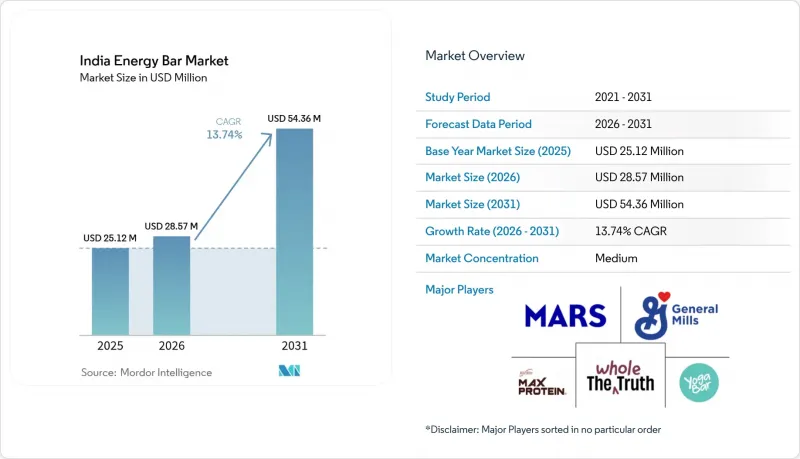
This report is Segmented by Product Type (Cereal/Granola Bars, Protein-Rich Bars, and More), Consumer Demographic (Children/Kids, Adults, and More), Flavor Profile (Chocolate-Based Bars, Fruit-Based Bars, and More), Distribution Channel (Supermarkets/Hypermarkets, Pharmacies/Drug Stores, and More), and Geography (East, West, North, and More). The Market Forecasts are Provided in Terms of Value (USD).
India Energy Bar Market Trends and Insights
Rising health-conscious consumer base and demand for on-the-go nutrition
The rising health-consciousness among urban consumers is driving significant growth in the energy bar market. Urban adults, averaging 1,943 Kcal daily, face notable protein and micronutrient intake gaps, positioning energy bars as a practical supplement. This heightened nutritional awareness is underscored by Sodexo's findings: Indians, especially 60% of millennials aged 25-44, are leading the charge in adopting healthy eating habits, with a pronounced commitment to sustainable food choices in 2024 . This trend isn't confined to metropolitan areas; tier-2 cities, contributing nearly half of India's online shoppers, signal a broader geographic embrace of health-conscious behaviors. The post-pandemic landscape has seen consumers increasingly willing to pay a premium for health-centric products, particularly those targeting weight management and stress relief. As busy lifestyles intertwine with heightened health awareness, the demand for convenient, nutritious snacks like energy bars remains robust. Brands such as YogaBar are seizing this momentum, offering protein-rich, clean-label bars designed for the urban fitness enthusiast. This alignment of shifting consumer lifestyles with a deepening health consciousness propels the Indian energy bar market, suggesting its growth is not merely a fleeting trend. Innovations in packaging and the surge of online sales further broaden access, propelling the market's expansion beyond traditional urban confines.
Growth of fitness centers and gyms
The expansion of fitness infrastructure serves as a key driver for energy bar consumption through direct distribution channels and increased adoption among fitness enthusiasts. The Sports Authority of India (SAI) manages 24 National Centres of Excellence and 69 training centers, supporting over 3,240 athletes with specialized nutrition programs in 2022-23, establishing a foundation for performance nutrition adoption . Besides, private fitness chains like Gold's Gym, Cure.fit, and Talwalkars continue to expand across urban areas, increasing the consumer base for energy bars. Corporate wellness programs have also integrated energy bars into their offerings, extending market reach to working professionals. The COVID-19 pandemic accelerated digital transformation in the fitness sector, resulting in hybrid models that combine physical facilities with online services. This evolution has expanded access to nutrition products beyond traditional gym members. Companies like The Whole Truth have capitalized on these expanded consumer touchpoints by offering protein and energy bars that appeal to both athletes and recreational fitness enthusiasts. Hence, the development of this fitness ecosystem, comprising government sports facilities, commercial gyms, corporate wellness programs, and hybrid delivery models, provides structural support for sustained market growth. This integration of fitness infrastructure and nutrition products aligns with changing consumer lifestyles in urban and semi-urban regions.
High price point versus traditional snacks
Price sensitivity presents a significant challenge in the energy bar market. Traditional snacks, priced between INR 5-20, are considerably cheaper than energy bars, which range from INR 45 to INR 540. This 5-10 times price difference creates a substantial barrier to both trial and repeat purchases, particularly in price-sensitive tier-2 and tier-3 cities. While energy bars offer superior nutritional value, consumers in these regions often opt for cheaper local snacks that provide immediate satiation. As a result, retailers prioritize faster-moving, lower-priced items, reducing shelf space and visibility for higher-margin energy bars. Efforts by companies to lower costs through value engineering are constrained by the need to maintain nutritional integrity, as compromising product quality risks eroding consumer trust and brand value. Brands such as Healthkart and Sproutlife Foods, despite their popularity, must carefully balance premium pricing with delivering genuine nutritional benefits to appeal to urban fitness enthusiasts and the growing semi-urban consumer base. As the market expands beyond metro areas, the economic disparity in pricing remains a critical obstacle, requiring targeted strategies to ensure affordability without diluting core health attributes. This ongoing tension between premium pricing and the affordability of traditional snacks continues to shape distribution and marketing strategies in the rapidly growing energy bar segment.
Other drivers and restraints analyzed in the detailed report include:
- Rising sports and recreational participation
- Innovation in flavors and nutrient composition
- Negative perception of high sugar bars among health-conscious consumers
For complete list of drivers and restraints, kindly check the Table Of Contents.
Segment Analysis
Protein-rich bars accounted for a dominant 43.47% market share in 2025 and are projected to grow at a robust 14.98% CAGR through 2031. This trend highlights a shift in consumer focus from indulgent snacking to functional nutrition. The widespread protein deficiency in Indian diets, often lacking adequate protein, drives sustained demand for convenient protein supplementation. Endorsements from fitness professionals and sports figures further enhance the appeal of the protein bar category. For instance, Axar Patel has both invested in and become the brand ambassador for FitFeast, a brand promoting protein-rich snacks to a broader audience beyond fitness enthusiasts.
Moreover, cereal and granola bars, traditionally dominant in the snacking segment, now face challenges as consumer preferences shift toward functional nutrition. Meanwhile, fruit and nut bars attract consumers seeking natural ingredients and familiar flavors. Competitive dynamics within product categories reveal a premiumization trend, with 20-30g protein bars commanding higher prices than 10g variants, reflecting consumer willingness to pay for enhanced functionality. Manufacturers are accelerating innovation cycles by incorporating plant-based proteins, clean-label ingredients, and specialized formulations targeting specific needs, such as meal replacement or post-workout recovery. This growth trajectory aligns with the expanding fitness culture and increasing awareness of protein's role in weight management, muscle building, and overall health maintenance.
Adults account for a dominant 54.66% share of the market in 2025. Their established consumption patterns have seamlessly integrated energy bars into daily routines, serving as meal replacements, office snacks, and on-the-go nutrition. This dominance is supported by rising disposable incomes and heightened health awareness, enabling consumers to accept premium pricing for functional food products. The preference for convenience, combined with functionality, positions adults as the core customer base, ensuring consistent demand.
Sports and fitness enthusiasts represent the fastest-growing segment, with a robust CAGR of 15.06% projected through 2031. This growth is driven by the expansion of fitness infrastructure and a cultural shift toward active lifestyles. Also, government initiatives and celebrity endorsements have normalized performance nutrition, particularly among individuals who prioritize energy bars for performance enhancement and recovery. Additionally, children present an emerging opportunity, as parents increasingly seek healthier snacking alternatives to traditional confectionery and processed snacks. Brands like Mama Nourish are addressing this demand with kid-friendly products such as the Dryfruit Instant Energy LadduBar, which cater to nutritional needs while complying with FSSAI's stringent guidelines on health claims and ingredient safety. These demographic insights highlight varied consumption patterns and product preferences, driving diverse growth trajectories in the market.
Complete Report Scope:
- By Product Type
- Cereal/Granola Bars
- Protein-Rich Bars
- Fruit and Nut Bars
- By Consumer Demographic
- Children/Kids
- Adults
- Sports and Fitness Enthusiasts
- By Flavor Profile
- Chocolate-based Bars
- Fruit-based Bars
- Nut and Seed-based Bars
- Other Unique Flavors
- By Distribution Channel
- Supermarkets/Hypermarkets
- Pharmacies/Drug Stores
- Convenience/Grocery Stores
- Online Retail Stores
- Other Distribution Channels
- By Region
- East
- West
- North
- South
List of Companies Covered in this Report:
- Mondelez International, Inc.
- General Mills Inc.
- Mars, Incorporated
- Wholesome Habits Private Limited
- UNIBIC Foods India Pvt Ltd
- SproutLife Foods Private Limited
- Fitshit Health Solutions Pvt. Ltd (The Whole Truth)
- Zydus Wellness Limited (RiteBite Max Protein)
- Pure Snacks Private Limited (Mojo Bar)
- Wingreens Farms (Wingreens Harvest)
- Mensa Brands (MyFitness)
- Bright Lifecare Pvt. Ltd (MuscleBlaze)
- Swasthum Wellness Pvt. Ltd. (Getmymettle)
- Simpl Innovative Brands Pvt. Ltd. (Phab)
- Monkey Bar
- Adishtu
- Proathlix
- Beyond Food
- Britannia Industries
- Betterfoodfactory
Additional Benefits:
- The market estimate (ME) sheet in Excel format
- 3 months of analyst support
TABLE OF CONTENTS
1 INTRODUCTION
- 1.1 Study Assumptions and Market Definition
- 1.2 Scope of the Study
2 RESEARCH METHODOLOGY
3 EXECUTIVE SUMMARY
4 MARKET DYNAMICS
- 4.1 Market Overview
- 4.2 Market Drivers
- 4.2.1 Rising health-conscious consumer base and demand for on-the-go nutrition
- 4.2.2 Growth of fitness centers and gyms
- 4.2.3 Rising sports and recreational participation
- 4.2.4 Innovation in flavors and nutrient composition
- 4.2.5 Demand for plant-based and clean-label trends
- 4.2.6 Endorsement by influencers and fitness experts
- 4.3 Market Restraints
- 4.3.1 High price point versus traditional snacks
- 4.3.2 Negative perception of high sugar bars among health-conscious consumers
- 4.3.3 Limited consumer awareness in non-urban areas
- 4.3.4 Competition from other healthy snacks
- 4.4 Value Chain Analysis
- 4.5 Regulatory Landscape
- 4.6 Technological Outlook
- 4.7 Porter's Five Forces Analysis
- 4.7.1 Threat of New Entrants
- 4.7.2 Bargaining Power of Suppliers
- 4.7.3 Bargaining Power of Buyers
- 4.7.4 Threat of Substitutes
- 4.7.5 Intensity of Competitive Rivalry
5 MARKET SIZE AND GROWTH FORECASTS (VALUE)
- 5.1 By Product Type
- 5.1.1 Cereal/Granola Bars
- 5.1.2 Protein-Rich Bars
- 5.1.3 Fruit and Nut Bars
- 5.2 By Consumer Demographic
- 5.2.1 Children/Kids
- 5.2.2 Adults
- 5.2.3 Sports and Fitness Enthusiasts
- 5.3 By Flavor Profile
- 5.3.1 Chocolate-based Bars
- 5.3.2 Fruit-based Bars
- 5.3.3 Nut and Seed-based Bars
- 5.3.4 Other Unique Flavors
- 5.4 By Distribution Channel
- 5.4.1 Supermarkets/Hypermarkets
- 5.4.2 Pharmacies/Drug Stores
- 5.4.3 Convenience/Grocery Stores
- 5.4.4 Online Retail Stores
- 5.4.5 Other Distribution Channels
- 5.5 By Region
- 5.5.1 East
- 5.5.2 West
- 5.5.3 North
- 5.5.4 South
6 COMPETITIVE LANDSCAPE
- 6.1 Market Concentration
- 6.2 Strategic Moves
- 6.3 Market Share Analysis
- 6.4 Company Profiles (includes Global level Overview, Market level overview, Core Segments, Financials as available, Strategic Information, Market Rank/Share for key companies, Products and Services, and Recent Developments)
- 6.4.1 Mondelez International, Inc.
- 6.4.2 General Mills Inc.
- 6.4.3 Mars, Incorporated
- 6.4.4 Wholesome Habits Private Limited
- 6.4.5 UNIBIC Foods India Pvt Ltd
- 6.4.6 SproutLife Foods Private Limited
- 6.4.7 Fitshit Health Solutions Pvt. Ltd (The Whole Truth)
- 6.4.8 Zydus Wellness Limited (RiteBite Max Protein)
- 6.4.9 Pure Snacks Private Limited (Mojo Bar)
- 6.4.10 Wingreens Farms (Wingreens Harvest)
- 6.4.11 Mensa Brands (MyFitness)
- 6.4.12 Bright Lifecare Pvt. Ltd (MuscleBlaze)
- 6.4.13 Swasthum Wellness Pvt. Ltd. (Getmymettle)
- 6.4.14 Simpl Innovative Brands Pvt. Ltd. (Phab)
- 6.4.15 Monkey Bar
- 6.4.16 Adishtu
- 6.4.17 Proathlix
- 6.4.18 Beyond Food
- 6.4.19 Britannia Industries
- 6.4.20 Betterfoodfactory
7 MARKET OPPORTUNITIES AND FUTURE OUTLOOK

