PUBLISHER: Mordor Intelligence | PRODUCT CODE: 2114033

PUBLISHER: Mordor Intelligence | PRODUCT CODE: 2114033
United Kingdom Energy Bar - Market Share Analysis, Industry Trends & Statistics, Growth Forecasts (2026 - 2031)
According to Mordor Intelligence, the UK energy bar market size is expected to grow from USD 1.6 billion in 2025 to USD 1.72 billion in 2026 and is forecast to reach USD 2.43 billion by 2031 at 7.22% CAGR over 2026-2031.
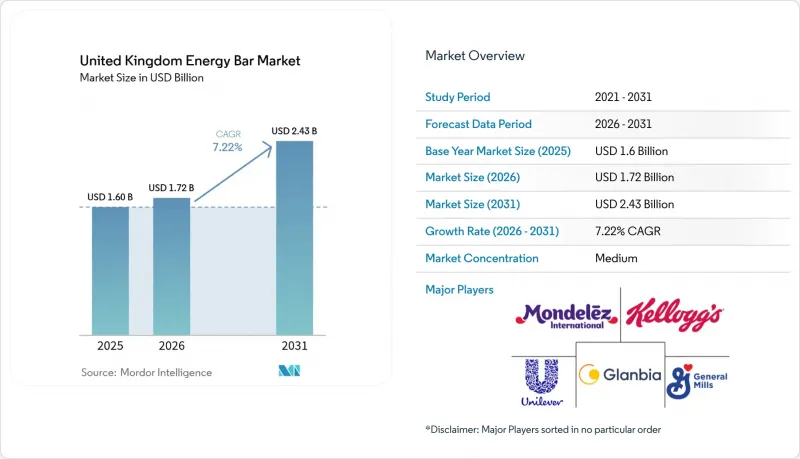
This report is Segmented by Type (Cereal/Granola Bars, Protein-Rich Bars, Fruit and Nut Bars), Distribution Channel (Supermarkets/Hypermarkets, Convenience Stores, Specialty Stores, Online Retail Stores, Other Distribution Channels), and Geography (England, Scotland, Wales, Northern Ireland). The Market Forecasts are Provided in Terms of Value (USD).
United Kingdom Energy Bar Market Trends and Insights
HFSS regulation accelerates demand for high-protein, low-sugar bars
HFSS curbs restrict non-compliant snacks from aisle-end and checkout displays, pushing manufacturers to reformulate energy bars so they score below 4 on the Nutrient Profiling Model. Grenade and Trek have introduced naturally sweetened ranges boasting up to 47% sugar reduction yet maintaining sensory quality, preserving eligibility for both in-store promotions and post-2025 advertising. Formulators increasingly double protein content and add fibers or chicory-root inulin to improve satiety and glycaemic response. Brands also invest in high-intensity natural sweeteners such as stevia or monk-fruit to minimize total sugars without compromising taste. Ingredient suppliers report a double-digit rise in UK inquiries for soluble corn fiber, reflecting the rush to secure compliant bulking agents that support clean-label claims.
On-the-go meal-replacement snacking culture
Remote working and hybrid commuting patterns shorten lunch breaks, encouraging 70% of adults to purchase lunch outside the home at least occasionally. Energy bars fit seamlessly into these new eating windows thanks to portability, portion control, and nutritional transparency. Brands target time-pressed Gen Z and millennial workers with "breakfast-to-desk" packs that bundle protein bars with ready-to-drink coffee. The growing popularity of high-protein breakfast biscuits signals further cross-category convergence that blurs lines between bars and bakery. Retailers capitalize by merchandising meal-replacement bars beside chilled smoothies, positioning the duo as a complete macro-balanced solution for commuters. Subscription platforms reinforce habitual consumption by auto-shipping thirty-count assortments calibrated to daily breakfast needs.
Volatile nut & cocoa input costs
Cocoa futures spiked to GBP 10,000 per tonne in April 2024, triple June 2023 levels, before stabilizing near GBP 7,600, squeezing gross margins on chocolate-coated bars. Almond and peanut markets face similar turbulence amid California droughts and Indian export levies. Brands with limited hedging capacity see unit costs rise 12% quarter-on-quarter, prompting either retail price hikes or reformulations that swap cocoa butter for palm kernel oil-steps that risk consumer backlash. Larger players diversify suppliers across West Africa, Latin America, and Southeast Asia while pre-buying inventory to lock in prices. Some launch SKUs featuring sunflower-seed or chickpea crisps to cut nut usage, retaining texture while moderating exposure to price swings.
Other drivers and restraints analyzed in the detailed report include:
- Growing sports & fitness participation
- Private-label price disruption in discounters
- HFSS promotion & placement restrictions
For complete list of drivers and restraints, kindly check the Table Of Contents.
Segment Analysis
Cereal bars commanded 41.07% of UK energy bar market share in 2025, but protein bars are on track for a 7.44% CAGR that could lift their slice of UK energy bar market size from 35.00% in 2025 to more than 40.00% by 2031. The protein surge aligns with mainstream fitness culture and HFSS incentives that reward high-protein density. Cereal formats remain vital in family baskets where familiar flavors and price points resonate, yet they suffer promotional disadvantages without reformulation. Fruit-and-nut bars ride the clean-label wave, though costlier almonds and dates compress margins unless offset by premium positioning.
Manufacturers layer vitamins D and B12 into protein bars to claim immunity and energy benefits, differentiating beyond macronutrients. Grenade's "Oreo White" limited edition sold 2 million units within six months, highlighting demand for indulgent taste wrapped in fitness credentials. Conversely, cereal bar reformulations grapple with fiber additions that can harden textures, triggering consumer complaints. R&D teams deploy enzymatic treatments to maintain chewiness. The UK energy bar market rewards brands that pair sensory indulgence with legitimate protein delivery, raising category expectations across all sub-types.
Complete Report Scope:
- By Type
- Cereal/Granola Bars
- Protein-Rich Bars
- Fruit and Nut Bars
- By Distribution Channel
- Supermarkets/Hypermarkets
- Convenience Stores
- Specialty Stores
- Online Retail Stores
- Other Distribution Channels
List of Companies Covered in this Report:
- Mondelez International, Inc. (Grenade)
- Glanbia plc
- General Mills, Inc.
- Kellogg Company
- PepsiCo, Inc.
- Post Holdings, Inc. (PowerBar, Inc.)
- Abbott Laboratories
- Oatein Limited
- HNC Healthy Nutrition Company (UK) Ltd. (Maximuscle)
- Ultimate Sports Nutrition (USN)
- Barebells Functional Foods
- Warrior (KBF Enterprises Ltd.)
- TRIBE Foods Ltd.
- Veloforte Ltd.
- High5 Nutrition Ltd.
- Natural Balance Foods Ltd. (Nakd)
- Graze (Unilever UK Ltd.)
- Misfits Health Ltd.
- Myprotein (THG Nutrition)
- Clif Bar & Company
Additional Benefits:
- The market estimate (ME) sheet in Excel format
- 3 months of analyst support
TABLE OF CONTENTS
1 Introduction
- 1.1 Study Assumptions and Market Definition
- 1.2 Scope of the Study
2 Research Methodology
3 Executive Summary
4 Market Landscape
- 4.1 Market Overview
- 4.2 Market Drivers
- 4.2.1 HFSS regulation accelerates demand for high-protein, low-sugar bars
- 4.2.2 On-the-go meal-replacement snacking culture
- 4.2.3 Growing sports & fitness participation
- 4.2.4 Private-label price disruption in discounters
- 4.2.5 Creatine-infused multifunctional bars capture supplement spend
- 4.2.6 AI-driven D2C personalisation & subscription bundles
- 4.3 Market Restraints
- 4.3.1 Volatile nut & cocoa input costs
- 4.3.2 HFSS promotion & placement restrictions
- 4.3.3 Ultra-processed food backlash
- 4.3.4 Plastic Packaging Tax & recycling-compliance costs
- 4.4 Value / Supply-Chain Analysis
- 4.5 Regulatory Landscape
- 4.6 Technological Outlook
- 4.7 Porter's Five Forces
- 4.7.1 Threat of New Entrants
- 4.7.2 Bargaining Power of Buyers
- 4.7.3 Bargaining Power of Suppliers
- 4.7.4 Threat of Substitute Products
- 4.7.5 Intensity of Competitive Rivalry
5 Market Size and Growth Forecasts
- 5.1 By Type
- 5.1.1 Cereal/Granola Bars
- 5.1.2 Protein-Rich Bars
- 5.1.3 Fruit and Nut Bars
- 5.2 By Distribution Channel
- 5.2.1 Supermarkets/Hypermarkets
- 5.2.2 Convenience Stores
- 5.2.3 Specialty Stores
- 5.2.4 Online Retail Stores
- 5.2.5 Other Distribution Channels
6 Competitive Landscape
- 6.1 Market Concentration
- 6.2 Strategic Moves
- 6.3 Market Share Analysis
- 6.4 Company Profiles {(includes Global level Overview, Market level overview, Core Segments, Financials as available, Strategic Information, Market Rank/Share for key companies, Products & Services, and Recent Developments)}
- 6.4.1 Mondelez International, Inc. (Grenade)
- 6.4.2 Glanbia plc
- 6.4.3 General Mills, Inc.
- 6.4.4 Kellogg Company
- 6.4.5 PepsiCo, Inc.
- 6.4.6 Post Holdings, Inc. (PowerBar, Inc.)
- 6.4.7 Abbott Laboratories
- 6.4.8 Oatein Limited
- 6.4.9 HNC Healthy Nutrition Company (UK) Ltd. (Maximuscle)
- 6.4.10 Ultimate Sports Nutrition (USN)
- 6.4.11 Barebells Functional Foods
- 6.4.12 Warrior (KBF Enterprises Ltd.)
- 6.4.13 TRIBE Foods Ltd.
- 6.4.14 Veloforte Ltd.
- 6.4.15 High5 Nutrition Ltd.
- 6.4.16 Natural Balance Foods Ltd. (Nakd)
- 6.4.17 Graze (Unilever UK Ltd.)
- 6.4.18 Misfits Health Ltd.
- 6.4.19 Myprotein (THG Nutrition)
- 6.4.20 Clif Bar & Company
7 Market Opportunities and Future Outlook

