PUBLISHER: Mordor Intelligence | PRODUCT CODE: 2113978

PUBLISHER: Mordor Intelligence | PRODUCT CODE: 2113978
North America Gas Turbine - Market Share Analysis, Industry Trends & Statistics, Growth Forecasts (2026 - 2031)
According to Mordor Intelligence, the North America gas turbine market size is estimated at USD 3.06 billion in 2026, and is expected to reach USD 3.66 billion by 2031, at a CAGR of 3.67% during the forecast period (2026-2031).
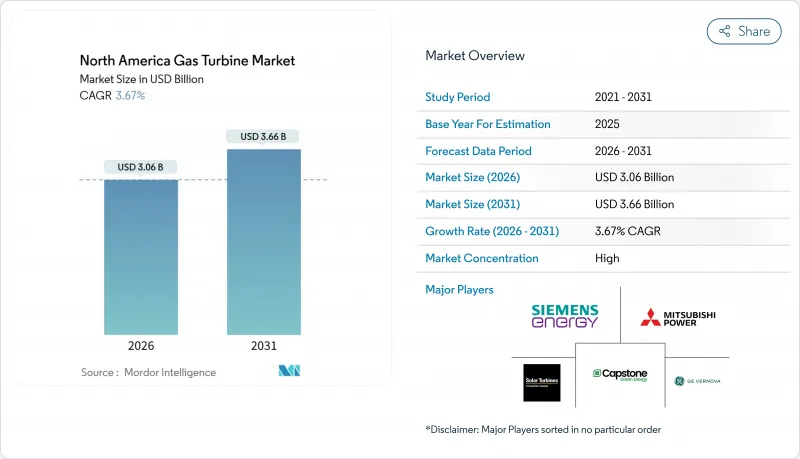
This report is Segmented by Capacity (Up To 30 MW, 31 To 120 MW, and Above 120 MW), Operating Cycle (Combined Cycle, Simple/Open Cycle, and Cogeneration/CHP), Fuel Type (Natural Gas, Liquid Fuels, and Other Fuel Types), End-User Industry (Power, Oil and Gas, and Others), and Geography (United States, Canada, and Mexico). The Market Sizes and Forecasts are Provided in Terms of Value (USD).
North America Gas Turbine Market Trends and Insights
Rising Renewable Penetration Drives Fast-Ramping Capacity Needs
Cumulative U.S. wind and solar capacity reached 295 GW in 2024, compelling grid operators to maintain generators that can ramp from zero to full load in under 10 minutes. ERCOT's operating-reserve demand curve prices scarcity events above USD 5,000 per MWh, rewarding aeroderivative turbines such as GE Vernova's LM2500XPRESS that can achieve full output within five minutes. PJM Interconnection applies a similar valuation to fast-start resources after its 2025/2026 auction reforms lifted clearing prices to USD 269.92 per MW-day. The International Energy Agency projects that grids surpassing 40% renewable penetration need dispatchable reserves equal to at least 15% of peak load, a threshold already exceeded in California. Consequently, simple-cycle and open-cycle installations, despite lower thermal efficiency, gain prominence because their capital cost per MW of peaking capacity is 30%-40% below combined-cycle equivalents.
Data-Center & AI Load Surges Creating Local Capacity Deficits
Hyperscale and AI-training facilities consumed roughly 50 TWh in 2024 and continue to grow, often outpacing local grid headroom. A December 2024 order for 29 GE Vernova LM2500XPRESS units illustrates how data-center operators procure on-site fast-start generation to guarantee uptime. Loudoun County, Virginia, saw utilities file for 2.3 GW of new interconnection capacity in 2024, much of it earmarked for gas-fired combined heat and power that can island during disturbances. Similar procurement patterns appear in Texas, where real-time price volatility encourages behind-the-meter deployment. The shift toward modular arrays values dual-fuel capability, black-start readiness, and rapid installation over absolute heat-rate performance.
Falling Battery-Storage Costs Undermine New Gas Peakers
Utility-scale lithium-ion prices continue to decline and are expected to cross the cost-parity threshold with 4-hour simple-cycle turbines in 2026, according to U.S. Department of Energy trend analyses. California ISO has already contracted more than 6 GW of storage, displacing planned gas peakers, and ERCOT added 4.2 GW in 2024. Batteries offer instantaneous response and qualify for investment tax credits, eroding the earnings outlook for assets that rely primarily on scarcity pricing. Yet limitations in duration and grid-forming capability still leave a reliability niche for synchronous gas turbines, especially for events exceeding four hours or requiring inertial support. OEMs counter by marketing hydrogen-ready burners and carbon-capture retrofit kits to differentiate against storage.
Other drivers and restraints analyzed in the detailed report include:
- IRA Hydrogen-Tax-Credit Pull-Through for H2-Ready Turbines
- Predictive-Analytics Upgrades Lowering Lifetime LCOE
- Tightening Net-Zero Regulations on Fossil Assets
For complete list of drivers and restraints, kindly check the Table Of Contents.
Segment Analysis
North America gas turbine market size for the 31-120 MW class reached USD 1.58 billion in 2025, representing a 53.3% share. The segment thrives on standardized engineering, compressed lead times, and suitability for both grid-connected and behind-the-meter customers. Industrial manufacturers adopt mid-range units for combined heat and power, while midstream gas operators use similar frames for compression stations. A second-order effect is risk mitigation: buyers can phase in capacity, limiting exposure to fuel-price swings and policy shifts. Maintenance intervals are shorter than those for microturbines, yet rebuilding costs remain manageable relative to heavy-duty frames.
Units above 120 MW, though smaller in count, are recording a 4.5% CAGR through 2031, a rate likely to lift their North America gas turbine market share to just under 30% by the end of the forecast horizon. Coal-to-gas replacement projects in the U.S. Southeast and Midwest predominantly adopt this size class because individual plants must replicate gigawatt-scale retiring baseload capacity. Duke Energy's 2024 coal retirements in the Carolinas triggered procurement of new GE Vernova HA-class turbines rated at 826 MW in combined-cycle configuration. Supply-chain stress for nickel-based superalloys exposes this class to longer lead times, prompting OEMs to vertically integrate forging capacity.
Combined-cycle configurations commanded 71.1% of 2025 revenue, equal to USD 2.11 billion, confirming the cost-of-fuel advantage derived from 60%-plus thermal efficiency. The operating cycle's higher capital intensity is offset by strong capacity factors under moderate gas prices, making it the preferred choice for utilities with mid-merit dispatch profiles. Recent builds pair gas turbines with supplementary duct firing and advanced HRSG designs, extracting incremental megawatts when reserve margins tighten.
Simple-cycle and open-cycle installations grow faster, at a 5.3% CAGR, even though their efficiency penalty can exceed 15 percentage points. The North America gas turbine market size for simple-cycle peakers is forecast to touch USD 1.25 billion by 2031 as capacity markets revise valuation for ramp speed and start reliability. ERCOT's 2024 scarcity events highlighted revenue upside for assets capable of reaching nameplate in under ten minutes. Grid operators now procure portfolios that segment by duty cycle, combined-cycle for shoulder periods, and simple-cycle for peaks, rather than forcing one technology to cover all load shapes.
Complete Report Scope:
- By Capacity
- Up to 30 MW
- 31 to 120 MW
- Above 120 MW
- By Operating Cycle
- Combined Cycle
- Simple/Open Cycle
- Cogeneration/CHP
- By Fuel Type
- Natural Gas
- Liquid Fuels (Diesel/Kerosene/LPG)
- Other Fuel Types (Hydrogen, Biogas)
- By End-User Industry
- Power
- Oil and Gas
- Other End-user Industries (Industrial, Marine)
- By Geography
- United States
- Canada
- Mexico
List of Companies Covered in this Report:
- GE Vernova
- Siemens Energy
- Mitsubishi Power Americas
- Rolls-Royce plc
- Solar Turbines (Caterpillar)
- Capstone Green Energy
- Kawasaki Heavy Industries
- Ansaldo Energia
- Harbin Electric International
- Wartsila Energy
- MAN Energy Solutions
- Vericor Power Systems
- Doosan Enerbility
- Centrax Gas Turbines
- OPRA Turbines
- Siemens AG (legacy units)
- Pratt & Whitney Power Systems
- Bharat Heavy Electricals (BHEL)
- United Engine Corporation
- EthosEnergy
Additional Benefits:
- The market estimate (ME) sheet in Excel format
- 3 months of analyst support
TABLE OF CONTENTS
1 Introduction
- 1.1 Study Assumptions & Market Definition
- 1.2 Scope of the Study
2 Research Methodology
3 Executive Summary
4 Market Landscape
- 4.1 Market Overview
- 4.2 Recent Trends & Developments
- 4.3 Market Drivers
- 4.3.1 Abundant shale-gas supply keeps fuel costs low
- 4.3.2 Rising renewable penetration drives fast-ramping capacity needs
- 4.3.3 Coal-to-gas fleet replacement programmes
- 4.3.4 Data-centre & AI load surges creating local capacity deficits
- 4.3.5 IRA hydrogen-tax-credit pull-through for H2-ready turbines
- 4.3.6 Predictive-analytics upgrades lowering lifetime LCOE
- 4.4 Market Restraints
- 4.4.1 Falling battery-storage costs undermine new gas peakers
- 4.4.2 Tightening net-zero regulations on fossil assets
- 4.4.3 Supply-chain bottlenecks for large forgings & nickel alloys
- 4.4.4 ERCOT & PJM capacity-price volatility
- 4.5 Supply-Chain Analysis
- 4.6 Regulatory Landscape
- 4.7 Technological Outlook
- 4.8 Porter's Five Forces
- 4.8.1 Bargaining Power of Suppliers
- 4.8.2 Bargaining Power of Buyers
- 4.8.3 Threat of New Entrants
- 4.8.4 Threat of Substitutes
- 4.8.5 Intensity of Rivalry
5 Market Size & Growth Forecasts
- 5.1 By Capacity
- 5.1.1 Up to 30 MW
- 5.1.2 31 to 120 MW
- 5.1.3 Above 120 MW
- 5.2 By Operating Cycle
- 5.2.1 Combined Cycle
- 5.2.2 Simple/Open Cycle
- 5.2.3 Cogeneration/CHP
- 5.3 By Fuel Type
- 5.3.1 Natural Gas
- 5.3.2 Liquid Fuels (Diesel/Kerosene/LPG)
- 5.3.3 Other Fuel Types (Hydrogen, Biogas)
- 5.4 By End-User Industry
- 5.4.1 Power
- 5.4.2 Oil and Gas
- 5.4.3 Other End-user Industries (Industrial, Marine)
- 5.5 By Geography
- 5.5.1 United States
- 5.5.2 Canada
- 5.5.3 Mexico
6 Competitive Landscape
- 6.1 Market Concentration
- 6.2 Strategic Moves (M&A, Partnerships, PPAs)
- 6.3 Market Share Analysis (Market Rank/Share for key companies)
- 6.4 Company Profiles (includes Global level Overview, Market level overview, Core Segments, Financials as available, Strategic Information, Products & Services, and Recent Developments)
- 6.4.1 GE Vernova
- 6.4.2 Siemens Energy
- 6.4.3 Mitsubishi Power Americas
- 6.4.4 Rolls-Royce plc
- 6.4.5 Solar Turbines (Caterpillar)
- 6.4.6 Capstone Green Energy
- 6.4.7 Kawasaki Heavy Industries
- 6.4.8 Ansaldo Energia
- 6.4.9 Harbin Electric International
- 6.4.10 Wartsila Energy
- 6.4.11 MAN Energy Solutions
- 6.4.12 Vericor Power Systems
- 6.4.13 Doosan Enerbility
- 6.4.14 Centrax Gas Turbines
- 6.4.15 OPRA Turbines
- 6.4.16 Siemens AG (legacy units)
- 6.4.17 Pratt & Whitney Power Systems
- 6.4.18 Bharat Heavy Electricals (BHEL)
- 6.4.19 United Engine Corporation
- 6.4.20 EthosEnergy
7 Market Opportunities & Future Outlook
- 7.1 White-space & Unmet-Need Assessment

