PUBLISHER: Mordor Intelligence | PRODUCT CODE: 2114029

PUBLISHER: Mordor Intelligence | PRODUCT CODE: 2114029
Automatic Tea Bag Packaging Machinery - Market Share Analysis, Industry Trends & Statistics, Growth Forecasts (2026 - 2031)
According to Mordor Intelligence, the automatic tea bag packaging machinery market size is expected to grow from USD 1.52 billion in 2025 to USD 1.62 billion in 2026 and is forecast to reach USD 2.21 billion by 2031 at 6.46% CAGR over 2026-2031.
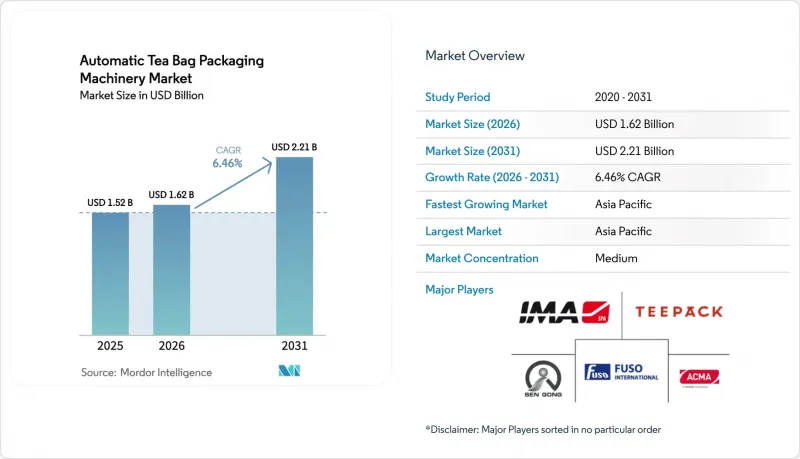
This report is Segmented by Material Type (Paper, Nylon, Plastic, Silk, and Other Material Types), Packaging Shape (Rectangular, Round, Pyramid / Triangle, and Other Packaging Shape), Automation Level (Fully Automatic, and Semi-Automatic), Line Capacity (less Than 60 Bpm, 61-120 Bpm, and More Than 120 Bpm), and Geography. The Market Forecasts are Provided in Terms of Value (USD).
Global Automatic Tea Bag Packaging Machinery Market Trends and Insights
Rising Global Tea Consumption and Premium Single-Serve Demand
Global tea intake is increasing by 3.3% each year, and a disproportionate share of that growth is directed towards premium single-serve formats that rely on reliable, high-speed packaging. Functional-herbal and organic blends now command shelf space in office pantries, hospitality amenities, and foodservice channels, all of which require individually wrapped bags that control portion size and preserve bioactive compounds. Premium brands often adopt pyramid shapes to showcase whole-leaf content, obliging converters to invest in machines that deliver precise volumetric dosing, as well as tight ultrasonic seals. Demand is particularly strong in the Asia-Pacific and North America regions, where processors are expanding high-throughput lines to match rapidly evolving consumer expectations.
Growing Requirement for End-to-End Automation in Tea Packaging Plants
Automation upgrades are yielding up to 15% gains in overall equipment effectiveness while trimming labor costs, scrap, and energy consumption. Servo-driven changeovers reduce downtime when switching between rectangular, pyramid, or round bags, and integrated vision modules verify seam integrity in real-time. Robotics and machine-learning algorithms now coordinate case packing and palletizing, creating a seamless flow from dosing to secondary packaging. Europe and the Asia-Pacific lead installations because exporters confront stringent traceability rules tied to food safety audits.
High Initial CAPEX For High-Speed Automated Lines
The entry ticket for a fully automatic, multi-format packaging cell surpasses USD 500,000, excluding plant retrofits and operator training. Although leasing and machinery-as-a-service contracts have emerged, many mid-sized processors in Southeast Asia, Africa, and South America still face significant financing hurdles. This cost barrier consolidates market power among large, well-capitalized exporters that can amortize investments over high volumes. Financial pressure hinders the diffusion of technology in cost-sensitive clusters, despite clear productivity benefits.
Other drivers and restraints analyzed in the detailed report include:
- Shift Toward Sustainable/Biodegradable Tea-Bag Substrates
- Brand Differentiation Via Pyramid/Visual-Format Tea Bags
- Scarcity Of Skilled Mechatronics Technicians and Costly Downtime
For complete list of drivers and restraints, kindly check the Table Of Contents.
Segment Analysis
Paper substrates held a 47.68% share of the automatic tea bag packaging machinery market in 2025, thanks to legacy equipment compatibility and shopper familiarity. Nevertheless, biodegradable PLA films are projected to post the quickest 9.21% CAGR through 2031 as governments tighten compostability rules and brands chase the eco-labeling advantage. Within the automatic tea bag packaging machinery market, the size of the materials segment is dominated by paper in cost-sensitive mass channels, whereas PLA is gaining momentum among specialty retailers that emphasize zero-plastic pledges. Machinery builders have extended sealing-bar profiles and nip-roller controls to accommodate lower-melting PLA, helping co-packers toggle between fiber and bio-polymer rolls without lengthy changeovers.
A residual niche persists for nylon and silk wraps catering to ceremonial and high-grade leaf infusions, but scrutiny over microplastics and food-contact amendments limits their expansion. Investment, therefore, focuses on hybrid modules that can run paper, PLA, and nylon at the push of a touchscreen, securing processors against upcoming EU recyclability obligations. Line audits reveal that multi-material machines lift uptime by 4% and reduce film waste by 7%, signaling tangible paybacks that offset higher capital outlays.
Rectangular bags accounted for 46.12% of 2025 installations because they offer mature filling speeds above 200 bpm and rely on well-tested filter papers. Yet pyramid units, while slower per lane, deliver 8.45% CAGR as retailers curate artisanal lines featuring visible botanicals. The automatic tea bag packaging machinery market size, tied to pyramid lines, is expected to exceed USD 806 million by 2031, illustrating how premiumization accelerates capital rotation toward 3D forming stations.
To capitalize on both opportunities, converters utilize dual-lane frames that alternate between flat and pyramid bags within a single shift, ensuring minimal idle time and safeguarding per-SKU profitability. Vision sensors inspect apex formation and tea-weight uniformity, and quick-release mandrels simplify sanitation across shape changes. Momentum for windowed outer pouches, which spotlight pyramid geometry, further cements demand for vertically integrated primary and secondary wrappers.
Complete Report Scope:
- By Material Type
- Paper
- Nylon
- Plastic
- Silk
- Other Material Types
- By Packaging Shape
- Rectangular
- Round
- Pyramid / Triangle
- Other Packaging Shapes
- By Automation Level
- Fully Automatic
- Semi-Automatic
- By Line Capacity
- less than 60 bpm
- 61 - 120 bpm
- more than 120 bpm
- By Geography
- North America
- United States
- Canada
- Mexico
- South America
- Brazil
- Argentina
- Chile
- Rest of South America
- Europe
- United Kingdom
- Germany
- France
- Italy
- Spain
- Russia
- Rest of Europe
- Asia-Pacific
- China
- India
- Japan
- South Korea
- Australia
- Rest of Asia-Pacific
- Middle East and Africa
- Middle East
- Saudi Arabia
- United Arab Emirates
- Turkey
- Rest of Middle East
- Africa
- South Africa
- Nigeria
- Rest of Africa
- Middle East
- North America
Geography Analysis
The Asia-Pacific region accounted for 42.18% of 2025 sales and is growing at an annual rate of 8.27% as China and India integrate field-to-cup value chains with smart factories. Local OEMs, such as Xiamen Sengong, refine pyramid-forming heads and predictive maintenance toolkits to match global benchmarks while maintaining price agility. Indian packers retrofit vision modules to meet EU import tolerances for seal strength, and government subsidies help cushion the costs of automation.
Europe retains its role as an innovation test bed because Regulation (EU) 2025/40 compels the use of recyclable and compostable packaging, prompting machinery retrofits that adjust heat-seal bars, implement anti-static measures, and utilize inline chemical migration testers. Italian, German, and British converters upgrade to mono-material PLA or unbleached kraft film, resulting in double-digit drops in defect rates. North America follows with steady premiumization, aided by direct-to-consumer channels that valorize high-graphics envelopes and Instagram-ready pyramid sachets.
South America, the Middle East, and Africa are experiencing a surge in unit installations, driven by gains in disposable income and the growth of urban cafe culture, from a relatively small base. Multilateral development banks extend soft loans for food processing modernization, helping local firms import mid-range, fully automatic lines. Regional free-trade agreements incentivize processors in Mexico, Turkiye, and Kenya to adopt EU-compliant substrates for access to premium buyers, gradually aligning technical standards worldwide.
- TEEPACK Spezialmaschinen GmbH & Co. KG
- I.M.A. Industria Macchine Automatiche S.p.A.
- ACMA S.p.A.
- Xiamen Sengong Packing Equipment Co., Ltd.
- FUSO International
- Tecpacking Group (Tianjin) Co., Ltd.
- Packstec Machinery
- Sichuan KST Automatic Equipment Co., Ltd.
- Shanghai Fubo Packaging Machinery Co., Ltd.
- Quanzhou Deli Agroforestrial Machinery Co., Ltd.
- Hondon Packaging & Food Machinery Factory
- Grace Food Processing & Packaging Machinery
- Synda Pack
- Best Crown Machinery Co., Ltd.
Additional Benefits:
- The market estimate (ME) sheet in Excel format
- 3 months of analyst support
TABLE OF CONTENTS
1 INTRODUCTION
- 1.1 Study Assumptions and Market Definition
- 1.2 Scope of the Study
2 RESEARCH METHODOLOGY
3 EXECUTIVE SUMMARY
4 MARKET LANDSCAPE
- 4.1 Market Overview
- 4.2 Market Drivers
- 4.2.1 Rising Global Tea Consumption and Premium-Single-Serve Demand
- 4.2.2 Growing Requirement for End-To-End Automation in Tea Packaging Plants
- 4.2.3 Shift Toward Sustainable/Biodegradable Tea-Bag Substrates
- 4.2.4 Brand Differentiation Via Pyramid/Visual-Format Tea Bags
- 4.2.5 Industry 4.0 Predictive-Maintenance Integration
- 4.2.6 On-Demand Micro-Batch/D2C Flexibility Needs
- 4.3 Market Restraints
- 4.3.1 High Initial CAPEX For High-Speed Automated Lines
- 4.3.2 Scarcity Of Skilled Mechatronics Technicians and Costly Downtime
- 4.3.3 Supply-Chain Fragility for Specialty Filter Meshes and PLA Films
- 4.3.4 Evolving Food-Contact Rules On Novel Bio-Polymers
- 4.4 Industry Value Chain Analysis
- 4.5 Regulatory Landscape
- 4.6 Technological Outlook
- 4.7 Impact of Macroeconomic Factors
- 4.8 Porter's Five Forces Analysis
- 4.8.1 Threat of New Entrants
- 4.8.2 Bargaining Power of Suppliers
- 4.8.3 Bargaining Power of Buyers
- 4.8.4 Threat of Substitutes
- 4.8.5 Industry Rivalry
5 MARKET SIZE AND GROWTH FORECASTS (VALUE)
- 5.1 By Material Type
- 5.1.1 Paper
- 5.1.2 Nylon
- 5.1.3 Plastic
- 5.1.4 Silk
- 5.1.5 Other Material Types
- 5.2 By Packaging Shape
- 5.2.1 Rectangular
- 5.2.2 Round
- 5.2.3 Pyramid / Triangle
- 5.2.4 Other Packaging Shapes
- 5.3 By Automation Level
- 5.3.1 Fully Automatic
- 5.3.2 Semi-Automatic
- 5.4 By Line Capacity
- 5.4.1 less than 60 bpm
- 5.4.2 61 - 120 bpm
- 5.4.3 more than 120 bpm
- 5.5 By Geography
- 5.5.1 North America
- 5.5.1.1 United States
- 5.5.1.2 Canada
- 5.5.1.3 Mexico
- 5.5.2 South America
- 5.5.2.1 Brazil
- 5.5.2.2 Argentina
- 5.5.2.3 Chile
- 5.5.2.4 Rest of South America
- 5.5.3 Europe
- 5.5.3.1 United Kingdom
- 5.5.3.2 Germany
- 5.5.3.3 France
- 5.5.3.4 Italy
- 5.5.3.5 Spain
- 5.5.3.6 Russia
- 5.5.3.7 Rest of Europe
- 5.5.4 Asia-Pacific
- 5.5.4.1 China
- 5.5.4.2 India
- 5.5.4.3 Japan
- 5.5.4.4 South Korea
- 5.5.4.5 Australia
- 5.5.4.6 Rest of Asia-Pacific
- 5.5.5 Middle East and Africa
- 5.5.5.1 Middle East
- 5.5.5.1.1 Saudi Arabia
- 5.5.5.1.2 United Arab Emirates
- 5.5.5.1.3 Turkey
- 5.5.5.1.4 Rest of Middle East
- 5.5.5.2 Africa
- 5.5.5.2.1 South Africa
- 5.5.5.2.2 Nigeria
- 5.5.5.2.3 Rest of Africa
- 5.5.5.1 Middle East
- 5.5.1 North America
6 COMPETITIVE LANDSCAPE
- 6.1 Market Concentration
- 6.2 Strategic Moves
- 6.3 Market Share Analysis
- 6.4 Company Profiles (includes Global level Overview, Market level overview, Core Segments, Financials as available, Strategic Information, Market Rank/Share for key companies, Products and Services, and Recent Developments)
- 6.4.1 TEEPACK Spezialmaschinen GmbH & Co. KG
- 6.4.2 I.M.A. Industria Macchine Automatiche S.p.A.
- 6.4.3 ACMA S.p.A.
- 6.4.4 Xiamen Sengong Packing Equipment Co., Ltd.
- 6.4.5 FUSO International
- 6.4.6 Tecpacking Group (Tianjin) Co., Ltd.
- 6.4.7 Packstec Machinery
- 6.4.8 Sichuan KST Automatic Equipment Co., Ltd.
- 6.4.9 Shanghai Fubo Packaging Machinery Co., Ltd.
- 6.4.10 Quanzhou Deli Agroforestrial Machinery Co., Ltd.
- 6.4.11 Hondon Packaging & Food Machinery Factory
- 6.4.12 Grace Food Processing & Packaging Machinery
- 6.4.13 Synda Pack
- 6.4.14 Best Crown Machinery Co., Ltd.
7 MARKET OPPORTUNITIES AND FUTURE OUTLOOK
- 7.1 White-space and Unmet-need Assessment

