PUBLISHER: Mordor Intelligence | PRODUCT CODE: 2114048

PUBLISHER: Mordor Intelligence | PRODUCT CODE: 2114048
Solar Water Pump Systems - Market Share Analysis, Industry Trends & Statistics, Growth Forecasts (2026 - 2031)
According to Mordor Intelligence, solar water pump systems market size in 2026 is estimated at USD 2.68 billion, growing from 2025 value of USD 2.49 billion with 2031 projections showing USD 3.85 billion, growing at 7.55% CAGR over 2026-2031.
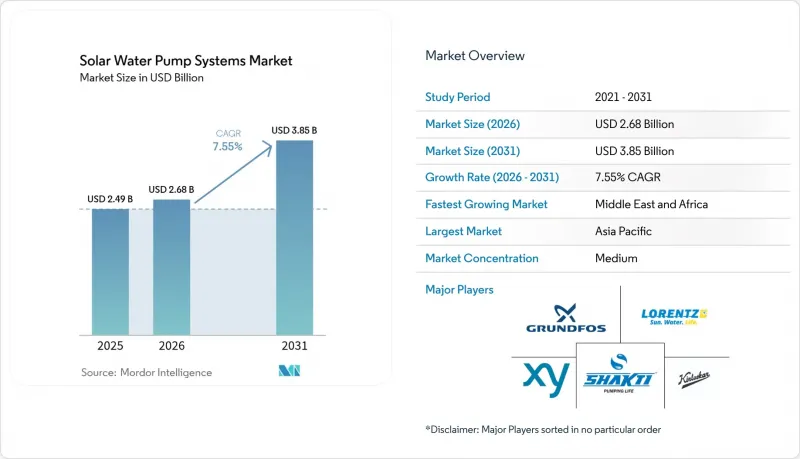
This report is Segmented by Pump Type (Surface Pump, Submersible Pump, and Helical/Positive-displacement), Power Rating (Up To 3 KW, 3 To 10 KW, and Above 10 KW), Drive Type (DC and AC/DC Hybrid), Application (Agriculture and Livestock, Drinking-Water Supply and Community Use, and Industrial and Mining Dewatering), and Geography (North America, Europe, Asia-Pacific, Middle East and Africa, and More).
Global Solar Water Pump Systems Market Trends and Insights
Declining PV Module Prices
PV module costs fell a further 12% in 2024, extending an 85% decline since 2010, as Chinese overcapacity and TOPCon cell efficiencies reached 23.1%. Payback periods have tightened below two years in high-irradiance belts, pushing diesel pump retirements. Bifacial modules capture reflected light from water bodies, trimming array footprints and freeing farm land. Suppliers now prioritise durability-such as dual-glass laminates and anti-soiling coatings-over raw cost cuts, supporting lifetime energy yield gains.
Government Subsidies & Rural-Electrification Schemes
India's PM-KUSUM Component-B supports 2 million standalone pumps with a 90% subsidy, reducing farm outlays to just 10% of the list price. Morocco's NOOR and Egypt's 250 MW irrigation corridors replicate blended-finance templates, combining upfront capital grants with skills training to curb post-installation failure rates. Fiscal prudence is vital; schemes that bundle technical support with subsidies avoid market distortions and keep private distributors engaged.
High Upfront CAPEX Despite Falling PV Costs
Complete systems span USD 2,100-5,000 per hectare, equivalent to two-plus years of smallholder cash income in the Philippines, even when the ROI exceeds 315%. Controllers, structures, and labour now account for 60-70% of the project cost, mitigating further PV price gains. PAYG leases and equipment-as-a-service lift adoption yet strain provider working capital and demand robust collection tech.
Other drivers and restraints analyzed in the detailed report include:
- Agricultural Water-Demand Surge and Shift to Micro-Irrigation
- IoT-Enabled Remote Monitoring & Predictive Maintenance
- Intermittent Solar Irradiance Leading to Output Variability
For complete list of drivers and restraints, kindly check the Table Of Contents.
Segment Analysis
Sales of submersible units increased to 41.60% of 2025 shipments, while surface pumps maintained a 47.90% revenue lead. The segment's 9.25% CAGR stems from deeper borehole drilling as surface water variability rises. Brushless DC motors and corrosion-resistant alloys simplify maintenance, while variable-frequency drives modulate speed to accommodate fluctuating irradiance, enhancing efficiency in the solar water pump systems market. In community schemes, low-flow positive-displacement pumps deliver steady head pressure, ideal for elevated storage tanks and day-night dispensing.
Embedded telemetry enables utilities to stagger pump starts, thereby flattening village load peaks. Suppliers bundle training so operators swap down-hole cartridges with basic tools, trimming service calls. Consistent flow also supports small aquaculture ponds, which diversify farmer income without requiring extra diesel consumption. With groundwater depth often exceeding 80 m in semi-arid APAC, submersibles prevail where suction limits hobble surface pumps.
Units of up to 3 kW dominate smallholder plots, yet the 3-10 kW slice registers the fastest 9.75% CAGR as cooperatives irrigate blocks of 8-20 ha. Declining per-kilowatt costs above 5 kW encourage growers to oversize arrays for morning and late-afternoon pumping windows, smoothing labour schedules in the solar water pump systems market. Modular designs allow owners to start with 5 kW and then add extra string inverters as acreage scales, avoiding stranded assets.
Industrial orchards and floriculture estates are piloting sets exceeding 10 kW to lift water from aquifers at depths of 150-200 m. Grid interconnection and protection relays inflate paperwork, but tariffs offset night-time top-ups when climate sensors trigger frost mitigation irrigation. Development banks in MEA now bundle concessional credit for 8-12 kW kits that serve shared pasture boreholes, cutting diesel haulage cost spikes after rainy-season road washouts.
Complete Report Scope:
- By Pump Type
- Surface (DC, AC/DC hybrid)
- Submersible (DC, AC/DC hybrid)
- Helical/Positive-displacement
- By Power Rating
- Up to 3 kW
- 3 to 10 kW
- Above 10 kW
- By Drive Type
- DC
- AC/DC Hybrid
- By Application
- Agriculture and Livestock
- Drinking-water Supply and Community Use
- Industrial and Mining Dewatering
- By Geography
- North America
- United States
- Canada
- Mexico
- Europe
- Germany
- United Kingdom
- France
- Italy
- NORDIC Countries
- Russia
- Rest of Europe
- Asia-Pacific
- China
- India
- Japan
- South Korea
- ASEAN Countries
- Rest of Asia-Pacific
- South America
- Brazil
- Argentina
- Rest of South America
- Middle East and Africa
- Saudi Arabia
- United Arab Emirates
- South Africa
- Egypt
- Rest of Middle East and Africa
- North America
Geography Analysis
Asia-Pacific generated 63.10% of 2025 revenue, underpinned by India's target for 3 million pumps by 2026 and China's integrated PV-pump packages that slash deployment times. State utilities in Maharashtra co-finance 3-7.5 HP submersibles, removing 90% of farmer CAPEX and fuelling bulk tender momentum. Concerns rise around groundwater overdraft, spurring pilots that pair metered pumps with prepaid smart cards to ration extraction sustainably.
The Middle East & Africa contributes a modest base today, yet logs the swiftest 10.10% CAGR to 2031. Morocco's NOOR irrigation loans and AfDB lines of credit unlock 2-5 kW PAYG pumps for cereal growers, while Kenya's distributors bundle mobile-money repayment plans that match harvest cashflows. Intense irradiance and erratic diesel supply chains accentuate the comparative advantage of the solar water pump systems market in this region. Capacity-building grants train local technicians, improving first-year service call resolution rates from 54% to 82%
North America and Europe mature steadily as they retrofit diesel backup wells and pursue net-zero farm mandates. California's SGMA groundwater rules and EU nitrate directives pressure growers to couple smart irrigation with solar pumping, thereby tightening accountability for the water-energy nexus. OEMs headquartered in these regions pilot satellite-linked asset clouds that fuse pump, soil, and weather analytics, exporting software licences to APAC dealers after market validation.
- Advanced Power Inc.
- Bright Solar Ltd.
- C.R.I. Pumps Pvt. Ltd.
- Kirloskar Brothers Ltd.
- KSB SE & Co. KGaA
- LORENTZ GmbH
- Shakti Pumps (India) Ltd.
- Tata Power Solar Systems Ltd.
- Grundfos Holding A/S
- Xylem Inc.
- Franklin Electric Co. Inc.
- Jain Irrigation Systems Ltd.
- Solartech Renewable Energy Co.
- Dankoff Solar Pumps
- SunPumps Inc.
- Waaree Energies Ltd.
- Apex Pumps
- Mono Pumps (NOV)
- DAB Pumps SpA
- Wilo SE
Additional Benefits:
- The market estimate (ME) sheet in Excel format
- 3 months of analyst support
TABLE OF CONTENTS
1 Introduction
- 1.1 Study Assumptions & Market Definition
- 1.2 Scope of the Study
2 Research Methodology
3 Executive Summary
4 Market Landscape
- 4.1 Market Overview
- 4.2 Market Drivers
- 4.2.1 Declining PV module prices
- 4.2.2 Government subsidies & rural-electrification schemes
- 4.2.3 Agricultural water-demand surge and shift to micro-irrigation
- 4.2.4 IoT-enabled remote monitoring & predictive maintenance
- 4.2.5 Pay-as-you-go (PAYG) micro-financing models in SSA
- 4.2.6 Hybrid AC/DC controller retrofits for legacy pumps
- 4.3 Market Restraints
- 4.3.1 High upfront CAPEX despite falling PV costs
- 4.3.2 Intermittent solar irradiance leading to output variability
- 4.3.3 Limited end-user awareness & O&M skill gaps
- 4.3.4 Emerging groundwater-extraction caps in water-stressed regions
- 4.4 Supply-Chain Analysis
- 4.5 Regulatory Landscape
- 4.6 Technological Outlook
- 4.7 Porter's Five Forces
- 4.7.1 Bargaining Power of Suppliers
- 4.7.2 Bargaining Power of Consumers
- 4.7.3 Threat of New Entrants
- 4.7.4 Threat of Substitutes
- 4.7.5 Intensity of Competitive Rivalry
5 Market Size & Growth Forecasts
- 5.1 By Pump Type
- 5.1.1 Surface (DC, AC/DC hybrid)
- 5.1.2 Submersible (DC, AC/DC hybrid)
- 5.1.3 Helical/Positive-displacement
- 5.2 By Power Rating
- 5.2.1 Up to 3 kW
- 5.2.2 3 to 10 kW
- 5.2.3 Above 10 kW
- 5.3 By Drive Type
- 5.3.1 DC
- 5.3.2 AC/DC Hybrid
- 5.4 By Application
- 5.4.1 Agriculture and Livestock
- 5.4.2 Drinking-water Supply and Community Use
- 5.4.3 Industrial and Mining Dewatering
- 5.5 By Geography
- 5.5.1 North America
- 5.5.1.1 United States
- 5.5.1.2 Canada
- 5.5.1.3 Mexico
- 5.5.2 Europe
- 5.5.2.1 Germany
- 5.5.2.2 United Kingdom
- 5.5.2.3 France
- 5.5.2.4 Italy
- 5.5.2.5 NORDIC Countries
- 5.5.2.6 Russia
- 5.5.2.7 Rest of Europe
- 5.5.3 Asia-Pacific
- 5.5.3.1 China
- 5.5.3.2 India
- 5.5.3.3 Japan
- 5.5.3.4 South Korea
- 5.5.3.5 ASEAN Countries
- 5.5.3.6 Rest of Asia-Pacific
- 5.5.4 South America
- 5.5.4.1 Brazil
- 5.5.4.2 Argentina
- 5.5.4.3 Rest of South America
- 5.5.5 Middle East and Africa
- 5.5.5.1 Saudi Arabia
- 5.5.5.2 United Arab Emirates
- 5.5.5.3 South Africa
- 5.5.5.4 Egypt
- 5.5.5.5 Rest of Middle East and Africa
- 5.5.1 North America
6 Competitive Landscape
- 6.1 Market Concentration
- 6.2 Strategic Moves (M&A, Partnerships, PPAs)
- 6.3 Market Share Analysis (Market Rank/Share for key companies)
- 6.4 Company Profiles (includes Global level Overview, Market level overview, Core Segments, Financials as available, Strategic Information, Products & Services, and Recent Developments)
- 6.4.1 Advanced Power Inc.
- 6.4.2 Bright Solar Ltd.
- 6.4.3 C.R.I. Pumps Pvt. Ltd.
- 6.4.4 Kirloskar Brothers Ltd.
- 6.4.5 KSB SE & Co. KGaA
- 6.4.6 LORENTZ GmbH
- 6.4.7 Shakti Pumps (India) Ltd.
- 6.4.8 Tata Power Solar Systems Ltd.
- 6.4.9 Grundfos Holding A/S
- 6.4.10 Xylem Inc.
- 6.4.11 Franklin Electric Co. Inc.
- 6.4.12 Jain Irrigation Systems Ltd.
- 6.4.13 Solartech Renewable Energy Co.
- 6.4.14 Dankoff Solar Pumps
- 6.4.15 SunPumps Inc.
- 6.4.16 Waaree Energies Ltd.
- 6.4.17 Apex Pumps
- 6.4.18 Mono Pumps (NOV)
- 6.4.19 DAB Pumps SpA
- 6.4.20 Wilo SE
7 Market Opportunities & Future Outlook
- 7.1 White-Space & Unmet-Need Assessment

