PUBLISHER: Mordor Intelligence | PRODUCT CODE: 2114093

PUBLISHER: Mordor Intelligence | PRODUCT CODE: 2114093
Asia-Pacific Shampoo - Market Share Analysis, Industry Trends & Statistics, Growth Forecasts (2026 - 2031)
According to Mordor Intelligence, the Asia-Pacific shampoo market size is expected to grow from USD 16.89 billion in 2025 to USD 17.82 billion in 2026 and is forecast to reach USD 23.32 billion by 2031 at 5.52% CAGR over 2026-2031.
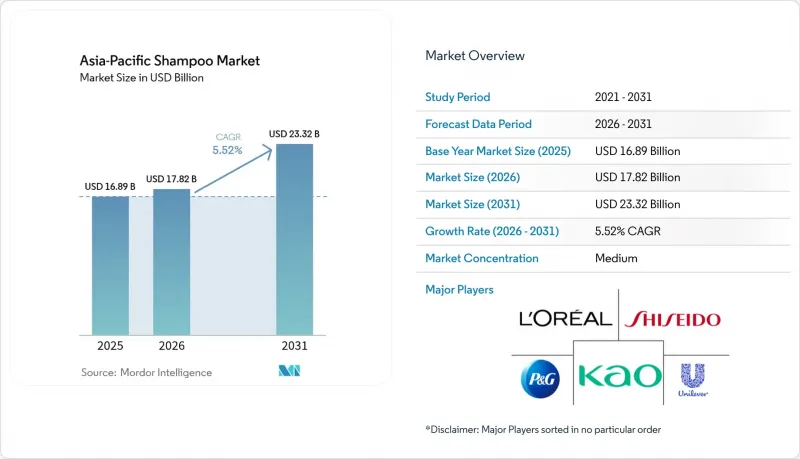
This report is Segmented by Product Type (Standard Shampoo and Natural/Organic/Medicated Shampoo), Hair Concern (General/Multi-purpose, and Specific Purpose ), Category (Mass, Luxury/Premium), Distribution Channel (Supermarkets/Hypermarkets, Convenience/Grocery Stores, and Others), and Geography (China, India, Japan, Australia, and More). The Market Forecasts are Provided in Terms of Value (USD).
Asia-Pacific Shampoo Market Trends and Insights
Rising demand for organic and natural shampoos due to awareness of chemical harms
The Asia-Pacific shampoo market is witnessing a strong rise in demand for organic and natural shampoos fueled by growing consumer awareness of the potential harms associated with chemical ingredients. Consumers in the region, especially in countries like India, China, and Japan, are increasingly favoring products with herbal and plant-based ingredients known for their safety and efficacy. According to NSF International, 74% of consumers considered organic ingredients important in personal care products in 2024 , highlighting the significant weight buyers place on clean, toxin-free formulations. This trend aligns with a broader preference for wellness-oriented, sustainable, and eco-friendly products, supported by the rise of e-commerce and social media influence. The emphasis on transparency, ingredient authenticity, and certification adds to consumer confidence in organic shampoos. With sustainability and health driving purchase decisions, the organic and natural shampoo segment is poised for robust growth in the Asia-Pacific market.
Increasing preference for ayurvedic and herbal ingredients
The Asia-Pacific shampoo market is experiencing robust growth fueled by the increasing consumer preference for ayurvedic and herbal ingredients. In countries like India, China, and Japan, traditional formulations with botanicals such as neem, amla, aloe vera, and shikakai are surging in popularity as safer alternatives to synthetic shampoos. Rising awareness of chemical-related scalp irritation and hair damage has shifted demand toward plant-based products offering nourishment and vitality. For instance, brands offering herbal shampoos with traditional ingredients like onion peel oil and Japanese matcha boast an impressive 80% user satisfaction rate after just 5-6 washes . This aligns with cultural affinity for natural remedies and regulatory support for transparency. Brands are innovating with these extracts, driving premiumization and market expansion.
Proliferation of counterfeit products damaging brand reputation
Counterfeit shampoo products are causing significant challenges in the Asia-Pacific market, severely impacting brand reputations and eroding consumer trust. This issue is particularly prevalent in countries like India and China, where counterfeit shampoos often replicate premium brands. These fake products are manufactured using substandard or harmful ingredients, which can lead to scalp irritation, hair damage, and other serious health risks. The problem is exacerbated by the widespread availability of these counterfeits on e-commerce platforms and informal distribution channels. These channels often target price-sensitive consumers, especially during festive seasons and periods of high demand, when purchasing activity surges. The presence of counterfeit products undermines the efforts of genuine brands that invest heavily in research, development, and quality control to ensure product safety and efficacy. When consumers unknowingly purchase and use counterfeit shampoos, their negative experiences, such as adverse reactions or poor performance, are often mistakenly attributed to the original brands. This misattribution further damages the reputation of legitimate companies, creating a ripple effect that impacts their market share and long-term growth prospects.
Other drivers and restraints analyzed in the detailed report include:
- Demand for targeted solutions like anti-dandruff, hair loss, and scalp health products
- High millennial and Gen Z population driving grooming trends
- High pricing of premium shampoos limiting penetration
For complete list of drivers and restraints, kindly check the Table Of Contents.
Segment Analysis
The standard shampoo segment dominated the Asia-Pacific shampoo market in 2025, capturing 85.12% of the market share. This dominance is largely due to entrenched consumer habits, where consumers prefer familiar, widely available products. Multinational brands benefit from extensive distribution networks spanning supermarkets, hypermarkets, and convenience stores, ensuring easy accessibility for a broad demographic. These channels also offer competitive pricing and frequent promotions that reinforce consumer loyalty. The combination of brand strength, price-point accessibility, and traditional retail presence solidifies standard shampoos as the volume leaders in this region. Despite growing interest in alternatives, these products remain staples for everyday hair care needs across diverse markets in the region.
In contrast, natural, organic, and medicated shampoos represent the fastest-growing segment, expected to expand at a CAGR of 5.99% through 2031. This growth is propelled by increasing regulatory support favoring ingredient transparency and consumer demand for clean, safer cosmetic products. Rising awareness about chemical sensitivities and environmental sustainability encourages consumers to shift towards herbal and medicated formulations. These shampoos appeal especially to health-conscious urban consumers who prioritize product efficacy alongside safety and sustainability credentials. Brands investing in innovation around certification, organic sourcing, and eco-friendly packaging gain traction in this expanding niche. The segment's growth reflects a broader trend toward premiumization and natural beauty in the Asia-Pacific market.
Specific-purpose shampoos, including those formulated for anti-dandruff, volumizing, strengthening, and regrowth benefits, held a significant 52.01% share of the Asia-Pacific shampoo market in 2025. This segment is expanding rapidly, with a CAGR of 5.78% projected through 2031, outpacing the growth of general or multi-purpose variants. The rising demand for these specialized shampoos is driven by consumers' increasing focus on addressing particular hair and scalp issues with effective, targeted solutions. Brands are capitalizing on this trend by investing in clinically backed formulas and marketing campaigns that highlight specific benefits, such as dandruff control and hair thickening. This segment attracts health-conscious consumers who seek personalized hair care tailored to their unique needs.
The general or multi-purpose shampoo segment continues to serve the bulk of everyday hair cleansing needs across diverse consumer groups in the Asia-Pacific region. These shampoos are favored for their versatility and cost-effectiveness, making them accessible across various market tiers and retail channels. With entrenched consumer habits endorsing their use for routine hair care, these products maintain substantial market presence. However, this segment faces competition from more innovative, problem-focused products growing in popularity. Despite this, general shampoos play a crucial role by offering simple, reliable cleansing solutions and often serve as a gateway for consumers to try specialized variants.
Complete Report Scope:
- By Product Type
- Standard Shampoo
- Natural/Organic/Medicated Shampoo
- By Hair Concern
- General/Multi-purpose
- Specific Purpose
- Anti-Dandruff and Scalp Health
- Volumizing and Thickening
- Strengthening and Repair
- Hair Regrowth and Hair Repair
- By Category
- Mass
- Luxury/Premium
- By Distribution Channel
- Supermarkets / Hypermarkets
- Convenience/Grocery Stores
- Online Retail Stores
- Other Distribution Channels
- By Country
- China
- India
- Japan
- Australia
- Indonesia
- Philippines
- South Korea
- Thailand
- Singapore
- Rest of Asia-Pacific
List of Companies Covered in this Report:
- The Procter & Gamble Company
- Unilever PLC
- Kao Corporation
- L'Oreal S.A.
- Shiseido Company, Limited
- Henkel AG & Co. KGaA
- Kenvue, Inc.
- Amorepacific Corp.
- LG Household & Health Care
- Beiersdorf AG
- Church & Dwight Co.
- Dabur India Ltd.
- Marico Ltd.
- The Himalaya Drug Co.
- PZ Cussons PLC
- The Estee Lauder Companies
- China Resources Sanjiu (Selsun)
- BBLUNT (Godrej CP)
- Masan Consumer
- Netco JSC
Additional Benefits:
- The market estimate (ME) sheet in Excel format
- 3 months of analyst support
TABLE OF CONTENTS
1 INTRODUCTION
- 1.1 Study Assumptions and Market Definition
- 1.2 Scope of the Study
2 RESEARCH METHODOLOGY
3 EXECUTIVE SUMMARY
4 MARKET LANDSCAPE
- 4.1 Market Overview
- 4.2 Market Drivers
- 4.2.1 Rising demand for organic and natural shampoos due to awareness of chemical harms
- 4.2.2 Increasing preference for ayurvedic and herbal ingredients
- 4.2.3 Demand for targeted solutions like anti-dandruff, hair loss, and scalp health products
- 4.2.4 High millennial and Gen Z population driving grooming trends
- 4.2.5 Growing popularity of hair coloring boosting specialized shampoo needs
- 4.2.6 Innovation in premium, sustainable, and eco-friendly formulations
- 4.3 Market Restraints
- 4.3.1 Proliferation of counterfeit products damaging brand reputation
- 4.3.2 High pricing of premium shampoos limiting penetration
- 4.3.3 Consumer skepticism toward synthetic formulations
- 4.3.4 Regulatory challenges on chemical ingredients and claims
- 4.4 Consumer Behavior Analysis
- 4.5 Regulatory Landscape
- 4.6 Technological Outlook
- 4.7 Porter's Five Forces
- 4.7.1 Bargaining Power of Suppliers
- 4.7.2 Bargaining Power of Buyers
- 4.7.3 Threat of New Entrants
- 4.7.4 Threat of Substitutes
- 4.7.5 Intensity of Competitive Rivalry
5 MARKET SIZE AND GROWTH FORECASTS (VALUE)
- 5.1 By Product Type
- 5.1.1 Standard Shampoo
- 5.1.2 Natural/Organic/Medicated Shampoo
- 5.2 By Hair Concern
- 5.2.1 General/Multi-purpose
- 5.2.2 Specific Purpose
- 5.2.2.1 Anti-Dandruff and Scalp Health
- 5.2.2.2 Volumizing and Thickening
- 5.2.2.3 Strengthening and Repair
- 5.2.2.4 Hair Regrowth and Hair Repair
- 5.3 By Category
- 5.3.1 Mass
- 5.3.2 Luxury/Premium
- 5.4 By Distribution Channel
- 5.4.1 Supermarkets / Hypermarkets
- 5.4.2 Convenience/Grocery Stores
- 5.4.3 Online Retail Stores
- 5.4.4 Other Distribution Channels
- 5.5 By Country
- 5.5.1 China
- 5.5.2 India
- 5.5.3 Japan
- 5.5.4 Australia
- 5.5.5 Indonesia
- 5.5.6 Philippines
- 5.5.7 South Korea
- 5.5.8 Thailand
- 5.5.9 Singapore
- 5.5.10 Rest of Asia-Pacific
6 COMPETITIVE LANDSCAPE
- 6.1 Market Concentration
- 6.2 Strategic Moves
- 6.3 Market Share Analysis
- 6.4 Company Profiles (includes Global Overview, Market-level Overview, Core Segments, Financials, Strategic Information, Market Rank/Share, Products & Services, Recent Developments)
- 6.4.1 The Procter & Gamble Company
- 6.4.2 Unilever PLC
- 6.4.3 Kao Corporation
- 6.4.4 L'Oreal S.A.
- 6.4.5 Shiseido Company, Limited
- 6.4.6 Henkel AG & Co. KGaA
- 6.4.7 Kenvue, Inc.
- 6.4.8 Amorepacific Corp.
- 6.4.9 LG Household & Health Care
- 6.4.10 Beiersdorf AG
- 6.4.11 Church & Dwight Co.
- 6.4.12 Dabur India Ltd.
- 6.4.13 Marico Ltd.
- 6.4.14 The Himalaya Drug Co.
- 6.4.15 PZ Cussons PLC
- 6.4.16 The Estee Lauder Companies
- 6.4.17 China Resources Sanjiu (Selsun)
- 6.4.18 BBLUNT (Godrej CP)
- 6.4.19 Masan Consumer
- 6.4.20 Netco JSC
7 MARKET OPPORTUNITIES AND FUTURE OUTLOOK

