PUBLISHER: Mordor Intelligence | PRODUCT CODE: 2114156

PUBLISHER: Mordor Intelligence | PRODUCT CODE: 2114156
Europe Shampoo - Market Share Analysis, Industry Trends & Statistics, Growth Forecasts (2026 - 2031)
According to Mordor Intelligence, Europe shampoo market size in 2026 is estimated at USD 8.24 billion, growing from 2025 value of USD 7.89 billion with 2031 projections showing USD 10.27 billion, growing at 4.49% CAGR over 2026-2031.
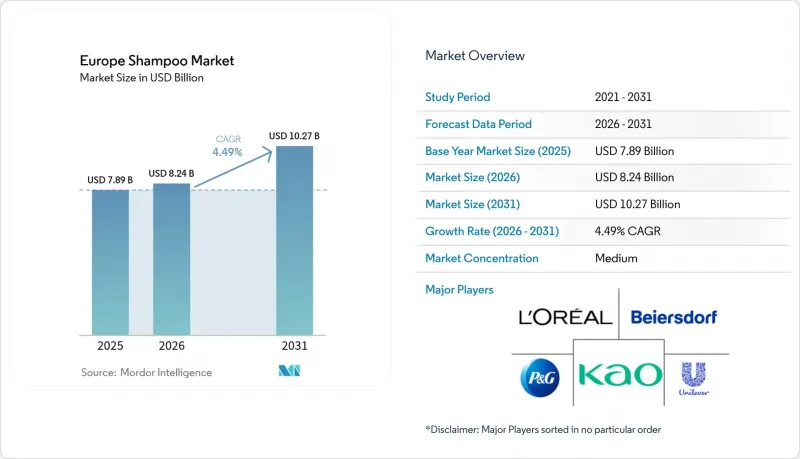
This report is Segmented by Product Type (Standard Shampoo, Natural/Organic/Medicated Shampoo), Hair Concern (General/Multi-purpose, Specific Purpose), Category (Mass, Luxury/Premium), Distribution Channel (Supermarkets/Hypermarkets, Convenience/Grocery Stores, and Others), and Geography (Germany, UK, France, Italy, Spain, and More). The Market Forecasts are Provided in Terms of Value (USD).
Europe Shampoo Market Trends and Insights
Rising focus on scalp and hair health, boosting demand for specialized and medicated shampoos
Growing consumer awareness of scalp and hair health is increasingly driving the demand for specialized and medicated shampoos in Europe. Consumers are shifting from basic cleansing products toward formulations that address specific concerns such as dandruff, hair loss, oily scalp, and sensitivity. According to a 2023 report by the National Institute of Health, hair loss in European men can begin as early as puberty, with a lifetime prevalence estimated to be approximately 80% .Rising pollution levels, stress, and frequent styling habits have intensified scalp-related problems, further strengthening demand for functional solutions. Dermatologist-recommended and clinically tested shampoos are gaining traction due to their perceived efficacy. Brands are investing in research to incorporate active ingredients like biotin, zinc pyrithione, salicylic acid, and natural botanicals for targeted benefits. The trend aligns with holistic beauty and wellness movements emphasizing long-term scalp care. Men's grooming and aging hair segments are contributing new growth opportunities. Overall, scalp and hair health focus is reshaping the Europe shampoo market landscape toward therapeutic and problem-solving innovations.
Strong consumer shift toward natural, organic, sulfate-free and "clean" formulations
In Europe, there is a strong and growing consumer shift toward natural, organic, sulfate-free, and "clean" shampoo formulations driven by increasing awareness of product safety, ingredient transparency, and sustainability. Consumers increasingly prefer shampoos made with gentle, plant-based ingredients like aloe vera, coconut oil, and tea tree, which nourish hair and scalp without harsh chemicals. Vegan and cruelty-free certifications add further appeal, especially among ethical and environmentally conscious buyers. Retailers are expanding their offerings online and offline, supported by influencer marketing and consumer education on clean beauty. According to research by the CBI ministry of foreign affairs, clean-label products are expected to make up over 70% of product portfolios in 2025 and 2026, rising from 52% in 2021 , underscoring the increasing prioritization of clean, natural product ranges. This consumer preference is reshaping the shampoo market toward more sustainable, health-conscious, and transparent brand innovations. Ultimately, the focus on clean, natural formulations continues to drive new product development and market expansion across Europe's personal care sector.
Stringent EU cosmetic and chemical regulations raising formulation and compliance costs
Stringent EU cosmetic and chemical regulations are raising formulation and compliance costs for shampoo manufacturers, acting as a market restraint in Europe. The EU Cosmetics Regulation (EC No 1223/2009) and its recent updates, including the Omnibus VII Regulation (EU 2025/877), introduce new prohibitions and restrictions on substances considered carcinogenic, mutagenic, or toxic for reproduction (CMR), expanding the banned ingredients list as of September 2025. These regulatory changes require urgent reformulation, updated toxicological assessments, and rigorous supplier management to ensure ingredient purity and compliance. Manufacturers must also revise labeling to reflect allergen and safety information accurately. The increasing demand for transparency and adherence to sustainability and safety standards further complicates product development and supply chain management. Consequently, these strict regulations elevate production costs, limit ingredient options, and may delay new product launches, collectively restraining market growth and innovation in the Europe shampoo sector.
Other drivers and restraints analyzed in the detailed report include:
- Premiumization and salon-inspired products increasing average spend per consumer
- Aging population and rising incidence of hair fall and scalp issues driving medicated ranges
- Market saturation and intense competition among global, local and private-label brands
For complete list of drivers and restraints, kindly check the Table Of Contents.
Segment Analysis
The standard shampoo segment dominated the Europe shampoo market in 2025, holding an impressive 82.20% market share. This strong market position can be attributed to entrenched consumer habits favoring familiar, accessible products available at competitive price points. Standard shampoos benefit from their wide availability, especially through supermarkets and hypermarkets, which are the principal distribution channels. Their affordability and proven efficacy make them a staple in most households across the region. Furthermore, the consistent presence of these shampoos on store shelves reinforces consumer trust and brand loyalty. Despite the rising interest in alternatives, conventional shampoos remain the backbone of the product portfolio for many leading brands.
On the other hand, the natural, organic, and medicated shampoo segment is recognized as the fastest-growing category within the Europe market, expanding at a CAGR of 6.26% through 2031. Growth is primarily driven by increasing consumer awareness of the benefits tied to 'clean beauty' products and the endorsement of these formulations by dermatologists. This segment appeals to health-conscious consumers who prioritize ingredient transparency and seek shampoos free from harsh chemicals. Moreover, trends in premiumization and sustainability, including eco-friendly packaging and ethically sourced ingredients, are propelling demand in this space. Brands investing in innovation within this segment see strong consumer engagement and loyalty, particularly among younger demographics.
The general or multi-purpose shampoo segment held the largest share of the Europe shampoo market in 2025, capturing 62.65% of the market. This segment serves the everyday cleansing needs of a broad demographic, making it a staple product in many households. Consumers rely on these shampoos for their versatility and effectiveness in routine hair care. The widespread availability of these products across multiple retail channels enhances their accessibility and appeal. Additionally, familiarity and trust in general shampoos contribute to their dominant market position. Their competitive pricing further entrenches them as the go-to choice for the majority of consumers across the region.
Conversely, the specific-purpose shampoo segment, which includes anti-dandruff, volumizing, strengthening, and hair-regrowth formulas, is the fastest growing, expanding at a compound annual growth rate of 5.78% through 2031. This growth is spurred by increasing consumer demand for targeted hair care solutions backed by clinical evidence. Influencer-led awareness campaigns also play a significant role in educating consumers about the benefits of these specialized shampoos. As consumers become more discerning about their hair needs, products addressing specific concerns gain traction. The combination of scientific validation and strong marketing efforts supports sustained growth in this segment. Consequently, specific-purpose shampoos are carving a growing niche in the Europe shampoo market landscape.
Complete Report Scope:
- By Product Type
- Standard Shampoo
- Natural/Organic/Medicated Shampoo
- By Hair Concern
- General/Multi-purpose
- Specific Purpose
- Anti-Dandruff and Scalp Health
- Volumizing and Thickening
- Strengthening and Repair
- Hair Regrowth and Hair Repair
- By Category
- Mass
- Luxury/Premium
- By Distribution Channel
- Supermarkets / Hypermarkets
- Convenience/Grocery Stores
- Online Retail Stores
- Other Distribution Channels
- By Country
- Germany
- United Kingdom
- France
- Italy
- Spain
- Belgium
- Poland
- Sweden
- Netherlands
- Rest of Europe
List of Companies Covered in this Report:
- L'Oreal S.A.
- Unilever PLC
- The Procter & Gamble Company
- Beiersdorf AG
- Kao Corporation
- Henkel AG & Co. KGaA
- Kenvue, Inc.
- Coty Inc.
- The Estee Lauder Companies
- LVMH
- Pierre Fabre Group
- Church & Dwight Co.
- Revlon Inc.
- Shiseido Company
- Natura & Co.
- Davines S.p.A.
- Lush Retail Ltd.
- Klorane
- Weleda AG
- Faith in Nature Ltd.
Additional Benefits:
- The market estimate (ME) sheet in Excel format
- 3 months of analyst support
TABLE OF CONTENTS
1 INTRODUCTION
- 1.1 Study Assumptions and Market Definition
- 1.2 Scope of the Study
2 RESEARCH METHODOLOGY
3 EXECUTIVE SUMMARY
4 MARKET LANDSCAPE
- 4.1 Market Overview
- 4.2 Market Drivers
- 4.2.1 Rising focus on scalp and hair health, boosting demand for specialized and medicated shampoos
- 4.2.2 Strong consumer shift toward natural, organic, sulfate-free and "clean" formulations
- 4.2.3 Premiumization and salon-inspired products increasing average spend per consumer
- 4.2.4 Aging population and rising incidence of hair fall and scalp issues driving medicated ranges
- 4.2.5 Increasing number of salons and barbershops supporting professional and retail shampoo sales
- 4.2.6 Preference for sustainable, low-waste and recyclable or refillable packaging
- 4.3 Market Restraints
- 4.3.1 Stringent EU cosmetic and chemical regulations raising formulation and compliance costs
- 4.3.2 Market saturation and intense competition among global, local and private?label brands
- 4.3.3 Volatile raw material and packaging costs pressuring manufacturer margins
- 4.3.4 Price?sensitive consumers in some markets limiting premium segment growth
- 4.4 Consumer Behavior Analysis
- 4.5 Regulatory Landscape
- 4.6 Technological Outlook
- 4.7 Porter's Five Forces
- 4.7.1 Bargaining Power of Suppliers
- 4.7.2 Bargaining Power of Buyers
- 4.7.3 Threat of New Entrants
- 4.7.4 Threat of Substitutes
- 4.7.5 Intensity of Competitive Rivalry
5 MARKET SIZE AND GROWTH FORECASTS (VALUE)
- 5.1 By Product Type
- 5.1.1 Standard Shampoo
- 5.1.2 Natural/Organic/Medicated Shampoo
- 5.2 By Hair Concern
- 5.2.1 General/Multi-purpose
- 5.2.2 Specific Purpose
- 5.2.2.1 Anti-Dandruff and Scalp Health
- 5.2.2.2 Volumizing and Thickening
- 5.2.2.3 Strengthening and Repair
- 5.2.2.4 Hair Regrowth and Hair Repair
- 5.3 By Category
- 5.3.1 Mass
- 5.3.2 Luxury/Premium
- 5.4 By Distribution Channel
- 5.4.1 Supermarkets / Hypermarkets
- 5.4.2 Convenience/Grocery Stores
- 5.4.3 Online Retail Stores
- 5.4.4 Other Distribution Channels
- 5.5 By Country
- 5.5.1 Germany
- 5.5.2 United Kingdom
- 5.5.3 France
- 5.5.4 Italy
- 5.5.5 Spain
- 5.5.6 Belgium
- 5.5.7 Poland
- 5.5.8 Sweden
- 5.5.9 Netherlands
- 5.5.10 Rest of Europe
6 COMPETITIVE LANDSCAPE
- 6.1 Market Concentration
- 6.2 Strategic Moves
- 6.3 Market Share Analysis
- 6.4 Company Profiles (includes Global Overview, Market-level Overview, Core Segments, Financials, Strategic Information, Market Rank/Share, Products & Services, Recent Developments)
- 6.4.1 L'Oreal S.A.
- 6.4.2 Unilever PLC
- 6.4.3 The Procter & Gamble Company
- 6.4.4 Beiersdorf AG
- 6.4.5 Kao Corporation
- 6.4.6 Henkel AG & Co. KGaA
- 6.4.7 Kenvue, Inc.
- 6.4.8 Coty Inc.
- 6.4.9 The Estee Lauder Companies
- 6.4.10 LVMH
- 6.4.11 Pierre Fabre Group
- 6.4.12 Church & Dwight Co.
- 6.4.13 Revlon Inc.
- 6.4.14 Shiseido Company
- 6.4.15 Natura & Co.
- 6.4.16 Davines S.p.A.
- 6.4.17 Lush Retail Ltd.
- 6.4.18 Klorane
- 6.4.19 Weleda AG
- 6.4.20 Faith in Nature Ltd.
7 MARKET OPPORTUNITIES AND FUTURE OUTLOOK

