PUBLISHER: Mordor Intelligence | PRODUCT CODE: 2114308

PUBLISHER: Mordor Intelligence | PRODUCT CODE: 2114308
Asia-Pacific Functional Beverages - Market Share Analysis, Industry Trends & Statistics, Growth Forecasts (2026 - 2031)
According to Mordor Intelligence, the Asia-Pacific functional beverages market size was valued at USD 107.37 billion in 2025 and estimated to grow from USD 116.19 billion in 2026 to reach USD 172.49 billion by 2031, at a CAGR of 8.22% during the forecast period (2026-2031).
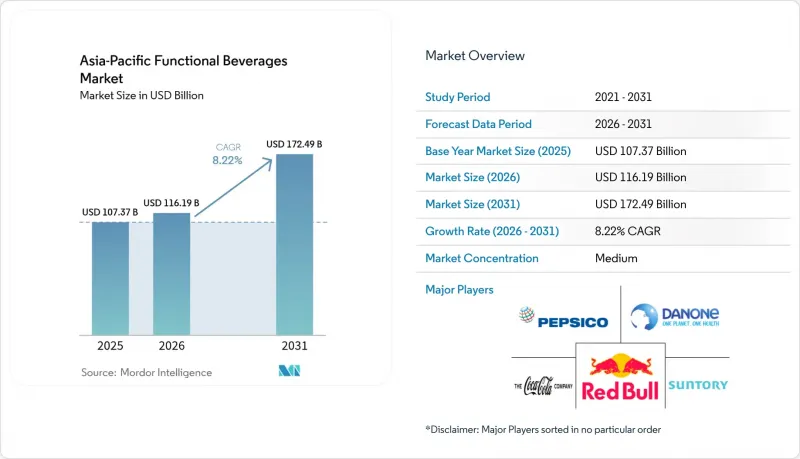
This report is Segmented by Product Type (Sports Drinks, Energy Drinks, Fortified Juice, Dairy and Dairy Alternative Beverage, and More), Packaging Type (PET/Glass Bottles, Cans, Tetra Pak, Others), Distribution Channel (On-Trade, Off-Trade), and Geography (China, Japan, India, Australia, Thailand, Singapore, and More). The Market Forecasts are Provided in Terms of Value (USD).
Asia-Pacific Functional Beverages Market Trends and Insights
Rising health and wellness awareness
Consumer health and wellness awareness is transforming functional beverage consumption into a daily wellness practice. Consumers increasingly seek beverages that provide health benefits beyond basic nutrition, including mental wellness. This trend is evident in products like JIDAI's ASAP SYNERGY, a cognitive enhancement drink designed for Japan's workforce. Regulatory initiatives, such as Singapore's Nutri-Grade labeling system introduced in late 2024, support this shift by providing transparent nutritional information for informed consumer decisions. Moreover, product development incorporating traditional Asian herbs and natural ingredients meets the growing demand for clean-label solutions. The combination of urbanization and busy lifestyles increases the need for convenient, health-supporting beverages. Manufacturers are developing products that address both mental and physical wellness, appealing to various demographic groups from young professionals to older consumers. Companies that combine clear health benefits with transparent labeling and convenience are strengthening their market position. The focus on health and wellness continues to drive innovation and market expansion in the functional beverages industry, supporting sustained market growth.
Growing fitness culture drives consumption of functional drink
The functional beverage market is experiencing increased demand driven by fitness culture growth, particularly in urban areas where gym memberships and fitness app usage continue to increase. Australia recorded 7,313 health and fitness centers in 2024, according to the Australian Bureau of Statistics, indicating a growing consumer base engaged in structured fitness activities . This trend supports premiumization in the functional beverage segment, as consumers demonstrate willingness to spend more on products that offer performance enhancement, sustained energy, and faster recovery benefits aligned with their active lifestyles. The growth of digital fitness platforms and boutique studios strengthens this culture, creating an informed consumer base seeking scientifically formulated beverages to complement their fitness routines. This fitness landscape, characterized by technological integration and comprehensive health approaches, is developing across both developed markets like Australia and Japan, as well as emerging Asia-Pacific economies. Functional beverages formulated for endurance, energy replenishment, and muscle repair have become essential products for fitness enthusiasts. Manufacturers are responding by developing targeted formulations with proteins, electrolytes, and natural stimulants that appeal to performance-focused consumers. The relationship between fitness culture growth and functional beverage development is creating sustained market growth in the Asia-Pacific, establishing this segment as a key component of the wellness beverage category.
Caffeine and sugar health concerns
Rising health consciousness, coupled with ongoing medical research highlighting the risks of excessive caffeine and sugar consumption, is driving consumer skepticism toward high-caffeine and high-sugar functional beverages. Singapore's Nutri-Grade labeling system, set to launch in December 2024, exemplifies regulatory measures aimed at mandating clear nutritional disclosures on beverages. This initiative enables consumers to make informed decisions regarding their sugar and caffeine intake. Developed markets in the Asia-Pacific region are at the forefront of this trend, where higher levels of consumer education and health awareness are pressuring manufacturers to reformulate products with reduced caffeine and sugar content. In response, companies are innovating with natural energy sources and alternative sweetening systems to meet health-conscious demands while maintaining product appeal. However, this shift is reducing the attractiveness of traditional high-stimulant functional beverages that previously drove category growth. Rapid changes in consumer behavior, fueled by health information dissemination, are compelling the industry to adapt formulations quickly to sustain market momentum. This regulatory and consumer-driven dynamic is fostering a healthier product landscape, aligning with broader wellness trends. The Nutri-Grade system's transparent labeling serves as both a guide for consumers and a catalyst for industry evolution, ensuring that health concerns surrounding caffeine and sugar remain central to product development strategies.
Other drivers and restraints analyzed in the detailed report include:
- Sugar-tax-driven reformulation toward low/no-sugar fortification
- Nootropic/probiotic functional shots for focus-seeking workforce
- High cost of ingredients and innovation
For complete list of drivers and restraints, kindly check the Table Of Contents.
Segment Analysis
In 2025, energy drinks hold a dominant 40.05% market share. However, functional/fortified waters are emerging as the fastest-growing segment, with a robust 6.92% CAGR projected through 2031. This growth reflects a market shift toward wellness-oriented products. Consumer preferences are becoming more segmented: high-stimulant energy drinks address performance-driven needs, while functional waters cater to daily hydration, enhanced with vitamins, minerals, and nootropic ingredients. Sports drinks maintain a stable position, benefiting from the expanding fitness culture but facing competition from specialized performance beverages offering targeted benefits. Fortified juices are experiencing moderate growth as consumers seek familiar formats enriched with functional ingredients. Additionally, dairy and dairy alternative beverages are gaining momentum, driven by protein fortification and probiotic enhancements.
These evolving segment dynamics present strategic opportunities for hybrid formulations that combine energy delivery with wellness attributes. For instance, JIDAI's ASAP SYNERGY cognitive drink, launched in Japan in July 2025, exemplifies this trend. Other emerging categories, such as functional teas and plant-based protein drinks, are contributing to market diversification and creating premium positioning opportunities. The regulatory environment varies across product types: energy drinks face stringent caffeine content regulations, while functional waters benefit from more flexible guidelines, fostering innovation in ingredient combinations and health claims.
Complete Report Scope:
- By Product Type
- Sports Drinks
- Energy Drinks
- Fortified Juice
- Dairy and Dairy Alternative Beverage
- Functional/Fortified Water
- Other Product Types
- By Packaging Type
- PET/Glass Bottles
- Cans
- Tetra Pak
- Others
- By Distribution Channel
- On-Trade
- Off-Trade
- Supermarkets/Hypermarkets
- Pharmacies and Health Stores
- Convenience/Grocery Stores
- Online Retail Stores
- Other Distribution Channels
- By Country
- China
- Japan
- India
- Australia
- Thailand
- Singapore
- Indonesia
- South Korea
- Rest of Asia-Pacific
List of Companies Covered in this Report:
- Red Bull GmbH
- The Coca-Cola Company
- Danone S.A.
- Nestle S.A.
- Keurig Dr Pepper Inc.
- PepsiCo, Inc.
- Suntory Holdings Ltd
- Otsuka Holdings Co. Ltd
- Vitasoy International Holdings Ltd
- Monster Beverage Corp.
- Yakult Honsha Co. Ltd
- Wahaha Group Co. Ltd
- Kirin Holdings Co. Ltd
- Meiji Co. Ltd
- Asahi Group Holdings Ltd
- Ocean Drinks Private Limited
- Glanbia plc
- Vitasoy International Holdings Ltd
- Eastroc Beverage (Group) Co., Ltd.
- Ghodawat Consumer Limited
Additional Benefits:
- The market estimate (ME) sheet in Excel format
- 3 months of analyst support
TABLE OF CONTENTS
1 INTRODUCTION
- 1.1 Study Assumptions and Market Definition
- 1.2 Scope of the Study
2 RESEARCH METHODOLOGY
3 EXECUTIVE SUMMARY
4 MARKET DYNAMICS
- 4.1 Market Overview
- 4.2 Market Drivers
- 4.2.1 Rising health and wellness awareness
- 4.2.2 Growing fitness culture drives consumption of functional drink
- 4.2.3 Sugar-tax-driven reformulation toward low/no-sugar fortification
- 4.2.4 Aggressive brand sponsorships in sports and e-sports
- 4.2.5 Nootropic/probiotic functional shots for focus-seeking workforce
- 4.2.6 Rising popularity of natural and clean-label ingredients
- 4.3 Market Restraints
- 4.3.1 Caffeine and sugar health concerns
- 4.3.2 High cost of ingredients and innovation
- 4.3.3 Stringent government regulations
- 4.3.4 Counterfeit/grey-market imports eroding brand equity
- 4.4 Consumer Behavior Analysis
- 4.5 Regulatory Landscape
- 4.6 Technological Outlook
- 4.7 Porter's Five Forces Analysis
- 4.7.1 Threat of New Entrants
- 4.7.2 Bargaining Power of Suppliers
- 4.7.3 Bargaining Power of Buyers
- 4.7.4 Threat of Substitutes
- 4.7.5 Competitive Rivalry
5 MARKET SIZE AND GROWTH FORECASTS (VALUE)
- 5.1 By Product Type
- 5.1.1 Sports Drinks
- 5.1.2 Energy Drinks
- 5.1.3 Fortified Juice
- 5.1.4 Dairy and Dairy Alternative Beverage
- 5.1.5 Functional/Fortified Water
- 5.1.6 Other Product Types
- 5.2 By Packaging Type
- 5.2.1 PET/Glass Bottles
- 5.2.2 Cans
- 5.2.3 Tetra Pak
- 5.2.4 Others
- 5.3 By Distribution Channel
- 5.3.1 On-Trade
- 5.3.2 Off-Trade
- 5.3.2.1 Supermarkets/Hypermarkets
- 5.3.2.2 Pharmacies and Health Stores
- 5.3.2.3 Convenience/Grocery Stores
- 5.3.2.4 Online Retail Stores
- 5.3.2.5 Other Distribution Channels
- 5.4 By Country
- 5.4.1 China
- 5.4.2 Japan
- 5.4.3 India
- 5.4.4 Australia
- 5.4.5 Thailand
- 5.4.6 Singapore
- 5.4.7 Indonesia
- 5.4.8 South Korea
- 5.4.9 Rest of Asia-Pacific
6 COMPETITIVE LANDSCAPE
- 6.1 Market Concentration
- 6.2 Strategic Moves
- 6.3 Market Share Analysis
- 6.4 Company Profiles (includes Global level Overview, Market level overview, Core Segments, Financials as available, Strategic Information, Market Rank/Share for key companies, Products & Services, and Recent Developments)
- 6.4.1 Red Bull GmbH
- 6.4.2 The Coca-Cola Company
- 6.4.3 Danone S.A.
- 6.4.4 Nestle S.A.
- 6.4.5 Keurig Dr Pepper Inc.
- 6.4.6 PepsiCo, Inc.
- 6.4.7 Suntory Holdings Ltd
- 6.4.8 Otsuka Holdings Co. Ltd
- 6.4.9 Vitasoy International Holdings Ltd
- 6.4.10 Monster Beverage Corp.
- 6.4.11 Yakult Honsha Co. Ltd
- 6.4.12 Wahaha Group Co. Ltd
- 6.4.13 Kirin Holdings Co. Ltd
- 6.4.14 Meiji Co. Ltd
- 6.4.15 Asahi Group Holdings Ltd
- 6.4.16 Ocean Drinks Private Limited
- 6.4.17 Glanbia plc
- 6.4.18 Vitasoy International Holdings Ltd
- 6.4.19 Eastroc Beverage (Group) Co., Ltd.
- 6.4.20 Ghodawat Consumer Limited
7 MARKET OPPORTUNITIES AND FUTURE OUTLOOK

