PUBLISHER: Mordor Intelligence | PRODUCT CODE: 2114395

PUBLISHER: Mordor Intelligence | PRODUCT CODE: 2114395
DIY Home Improvement - Market Share Analysis, Industry Trends & Statistics, Growth Forecasts (2026 - 2031)
According to Mordor Intelligence, the DIY home improvement market size was valued at USD 0.87 trillion in 2025 and is estimated to grow from USD 0.93 trillion in 2026 to reach USD 1.29 trillion by 2031, at a CAGR of 6.87% during the forecast period (2026-2031).
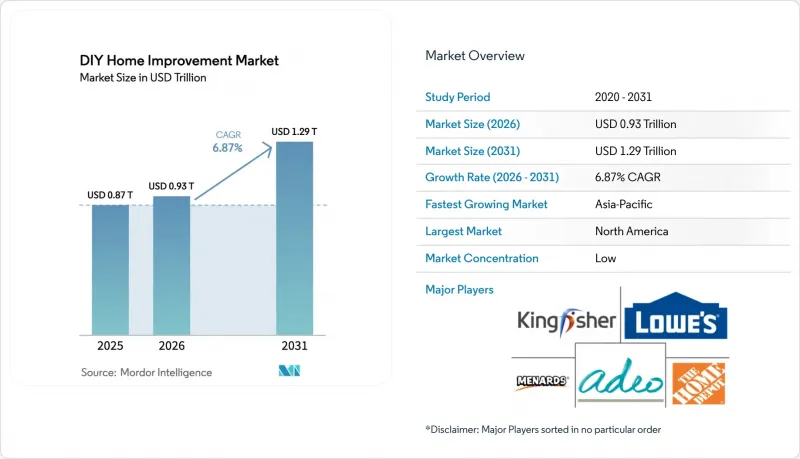
This report is Segmented by Product Type (Building Materials, Paints & Coatings, and More), Distribution Channel (DIY Home Improvement Stores, Specialty Stores, and More), Project Type (Renovation, Remodeling, and New Construction), and Geography (North America, South America, Asia-Pacific, Europe, and Middle East & Africa). The Market Forecasts are Provided in Terms of Value (USD).
Global DIY Home Improvement Market Trends and Insights
Digital retail transformation in home improvement
Digital convenience now shapes how households and trade professionals plan and execute projects, which supports steady gains for the DIY home improvement market as online and offline channels converge. The Home Depot reported that digital transactions accounted for 15.1% of fiscal 2024 net sales, and about half of U.S. online orders were fulfilled through stores, which helps the retailer deliver on delivery speed while controlling last-mile costs for bulky, low-margin products. Store-based fulfillment is also a demand signal engine because high-volume items cycle through local inventory faster, improving planogram accuracy for DIY and Pro baskets alike in the DIY home improvement market. Kingfisher's marketplace model scaled quickly, with GMV rising strongly and incremental retail profits from third-party sellers, which extend the assortment without inventory risk and enhance conversion from long-tail searches. This commerce architecture now anchors competitive strategy because it blends speed, breadth, and cost efficiency that pure plays struggle to match on bulky SKUs in the DIY home improvement market. As privacy rules such as GDPR shape how retailers use customer data, scalable personalization and attribution become key to boosting conversion while maintaining compliance, especially across borders with varying enforcement cadences.
Younger demographic entry into homeownership and renovation
Younger owners are making frequent, style-forward updates, bringing fresh volume to the DIY home improvement market, even when budgets are tighter. Generational behavior continues to shift toward value, digital discovery, and quicker projects that improve livability without long disruptions, which aligns with product categories that are easy to install and replace. Retailers are responding by strengthening digital engagement and content to guide first-time renovators from research to purchase and fulfillment, often combining project calculators, inspiration, and checklists that increase basket attach rates. Omnichannel programs and loyalty ecosystems emphasize education and convenience for these cohorts, reducing friction from idea to execution and strengthening repeat-purchase behavior in the DIY home improvement market. As digital acquisition costs rise, retailers with helpful content and clear fulfillment paths are more likely to retain younger shoppers through subsequent project cycles, which sustains category health. The result is a generational handoff in which online research, in-app planning, and rapid store pickup work together to sustain steady project throughput in the DIY home improvement market.
Labor scarcity driving professional service substitution
Ongoing shortages of skilled trade labor continue to limit project execution capacity, steering a growing share of complex home improvement work toward credentialed professionals and narrowing the scope of purely DIY projects. Major retailers are responding by investing in workforce development, including training programs and scholarships, to strengthen the skilled trades pipeline and improve job-site reliability. At the same time, retailers are expanding Pro-focused capabilities, including jobsite delivery, project-based pricing, and dedicated sales support, to better serve higher-value projects with strict scheduling and specification requirements. These investments are increasing the share of spending captured through professional channels, even when projects originate from DIY-led research and planning. As housing demographics age and building codes become more complex, the DIFM segment is expected to retain a structurally larger role in total market spending, reinforcing a bifurcated landscape in which mass retail supports smaller tasks while professional ecosystems capture larger project budgets.
Other drivers and restraints analyzed in the detailed report include:
- Legacy housing stock maintenance and modernization needs
- Digital content creator impact on home improvement trends
- Commodity price fluctuations deterring project initiation
For complete list of drivers and restraints, kindly check the Table Of Contents.
Segment Analysis
Building materials accounted for 48.33% of the 2025 market size, reflecting the essential nature of lumber, drywall, insulation, cement, and related inputs across repair, replacement, and structural work in the DIY home improvement market. The category's weight is underpinned by aging stock and code cycles that require ongoing updates to roofs, cladding, windows, and foundation perimeter defenses in mature markets. Against this backdrop, flooring and tiles are forecast to expand at a 7.76% CAGR through 2031, as modular surfaces, click-in systems, and lower-VOC materials unlock faster installations and a wider array of styles in the DIY home improvement market. Luxury vinyl tile and large-format porcelain have become favored options for kitchens and baths because they balance cost, durability, and ease of installation for experienced DIYers. The same trends are lifting demand for certified adhesives, underlayments, and trims that improve finish quality and address moisture and acoustics in multi-family dwellings.
Paints and coatings sustain strong brand loyalty and steady turnover due to a wide range of color refresh, stain blocking, and exterior protection tasks that are viable even in tighter budgets. Tools and Equipment remain resilient because homeowners break down projects into smaller scopes, which drives sales of cordless drills, sanders, multi tools, oscillating kits, and rental attachments that enhance capability without major capital outlays. Decor and Lighting, along with Plumbing and Electrical, sit in the middle of essential and deferrable spend, yet streamline upgrades are compelling when paired with energy savings or accessibility needs. Accessibility-led retrofits, such as lever handle faucets and grab bars, benefit from demographic trends and renewed attention to safety and usability in older homes. Together, product categories that save time, reduce mess, and deliver immediate functional improvements will continue to compound their contributions to the DIY home improvement market.
Complete Report Scope:
- By Product Type
- Building Materials
- Paints & Coatings
- Tools & Equipment
- Decor & Lighting
- Flooring & Tiles
- Plumbing & Electrical
- Others
- By Distribution Channel
- DIY Home Improvement Stores
- Specialty Stores
- Online
- Hypermarkets and Supermarkets
- By Project Type
- Renovation
- Remodeling
- New Construction
- By Region
- North America
- Canada
- United States
- Mexico
- South America
- Brazil
- Peru
- Chile
- Argentina
- Rest of South America
- Asia-Pacific
- India
- China
- Japan
- Australia
- South Korea
- South East Asia (Singapore, Malaysia, Thailand, Indonesia, Vietnam, and Philippines)
- Rest of Asia-Pacific
- Europe
- United Kingdom
- Germany
- France
- Spain
- Italy
- BENELUX (Belgium, Netherlands, and Luxembourg)
- NORDICS (Denmark, Finland, Iceland, Norway, and Sweden)
- Rest of Europe
- Middle East & Africa
- United Arab Emirates
- Saudi Arabia
- South Africa
- Nigeria
- Rest of Middle East & Africa
- North America
Geography Analysis
North America retained a 39.35% market share in 2025, reflecting an older housing stock, strong home equity cushions, and a culture of ongoing repair and replacement that supports the DIY home improvement market. More than 80% of homes in the United States are more than 20 years old, which increases the frequency of roof work, mechanical replacements, and envelope improvements that underpin recurring demand throughout the cycle. Within the region, the United States represents the largest home improvement market, reflecting the scale of consumer and professional spending across retail and related services and underscoring the importance of operational excellence for retailers seeking to capture and defend market share. Format diversity is visible across suburban and exurban catchments, where big boxes compete with local specialists and co-op models that tailor assortments to neighborhood needs. As mortgage rates stabilize and employment remains steady, the region continues to support a balanced mix of renovation and remodeling activity in the DIY home improvement market.
Asia-Pacific is the fastest-growing region, with a 7.87% CAGR through 2031, driven by urbanization, rising disposable incomes, and first-time home ownership, which trigger fit-outs and ongoing upgrades in the DIY home improvement market. China and India anchor the momentum, with expanding middle-class segments and active small-project categories that improve livability in compact spaces. Southeast Asian markets add to growth with public housing programs and private renovations that prioritize functional gains and durability within constrained footprints. Japan and Australia exhibit more mature profiles, where aging demographics and stringent codes drive targeted upgrades with emphasis on safety, efficiency, and resilience for climate and seismic conditions. As supply chains mature locally, category adoption continues to rise due to better availability, fair pricing, and shorter lead times in the DIY home improvement market.
Europe presents a mixed picture across the largest retail banners and country markets, reflecting differences in consumer sentiment and policy support in 2025 and 2026. Kingfisher reported that the United Kingdom and Ireland like-for-like sales rose in its fiscal first half, while France fell, illustrating divergent consumer confidence and category traction across the continent. Iberia posted strong like-for-like growth during the same period within Kingfisher's footprint, showcasing the benefit of format segmentation and inventory optimization in markets where demand rotated to value and speed. Central and Eastern Europe present a range of outcomes, with some markets showing flat trends as inflation and financing costs weighed on discretionary purchases in 2025. Renovation mandates aligned with energy transition goals provide a structural foundation in several EU countries, helping stabilize demand for insulation, windows, and heating upgrades in the DIY home improvement market. As retailers streamline markdowns and boost personalization with AI, they are improving throughput, protecting gross margin, and aligning inventory with real-time demand.
- The Home Depot Inc.
- Lowe's Companies Inc.
- ADEO Group (Leroy Merlin)
- Kingfisher plc (B&Q, Screwfix)
- Menards Inc.
- Ace Hardware Corp.
- OBI GmbH
- Travis Perkins plc
- Amazon Services LLC (DIY)
- Walmart Inc. (DIY)
- Bunnings Group
- Wickes Group plc
- Hornbach Holding AG
- Canadian Tire Corp.
- Bauhaus AG
- Wilko Ltd.
- True Value Company
- Mr DIY Group
- Sodimac S.A.
- OBI-Koctas
Additional Benefits:
- The market estimate (ME) sheet in Excel format
- 3 months of analyst support
TABLE OF CONTENTS
1 Introduction
- 1.1 Study Assumptions & Market Definition
- 1.2 Scope of the Study
2 Research Methodology
3 Executive Summary
4 Market Landscape
- 4.1 Market Overview
- 4.2 Market Drivers
- 4.2.1 Digital retail transformation in home improvement
- 4.2.2 Younger demographic entry into homeownership and renovation
- 4.2.3 Legacy housing stock maintenance and modernization needs
- 4.2.4 Digital content creator impact on home improvement trends
- 4.2.5 Collaborative workshop ecosystem growth
- 4.2.6 Augmented reality-enabled DIY adoption
- 4.3 Market Restraints
- 4.3.1 Labor scarcity driving professional service substitution
- 4.3.2 Commodity price fluctuations deterring project initiation
- 4.3.3 Municipal approval complexity limiting DIY scope
- 4.3.4 Liability and warranty gaps in owner-executed projects
- 4.4 Industry Value Chain Analysis
- 4.5 Porter's Five Forces
- 4.5.1 Threat of New Entrants
- 4.5.2 Bargaining Power of Suppliers
- 4.5.3 Bargaining Power of Buyers
- 4.5.4 Threat of Substitutes
- 4.5.5 Competitive Rivalry
- 4.6 Insights into the Latest Trends and Innovations in the Market
- 4.7 Insights on Recent Developments (New Product Launches, Strategic Initiatives, Investments, Partnerships, JVs, Expansion, M&As, etc.) in the Market
5 Market Size & Growth Forecasts (Value)
- 5.1 By Product Type
- 5.1.1 Building Materials
- 5.1.2 Paints & Coatings
- 5.1.3 Tools & Equipment
- 5.1.4 Decor & Lighting
- 5.1.5 Flooring & Tiles
- 5.1.6 Plumbing & Electrical
- 5.1.7 Others
- 5.2 By Distribution Channel
- 5.2.1 DIY Home Improvement Stores
- 5.2.2 Specialty Stores
- 5.2.3 Online
- 5.2.4 Hypermarkets and Supermarkets
- 5.3 By Project Type
- 5.3.1 Renovation
- 5.3.2 Remodeling
- 5.3.3 New Construction
- 5.4 By Region
- 5.4.1 North America
- 5.4.1.1 Canada
- 5.4.1.2 United States
- 5.4.1.3 Mexico
- 5.4.2 South America
- 5.4.2.1 Brazil
- 5.4.2.2 Peru
- 5.4.2.3 Chile
- 5.4.2.4 Argentina
- 5.4.2.5 Rest of South America
- 5.4.3 Asia-Pacific
- 5.4.3.1 India
- 5.4.3.2 China
- 5.4.3.3 Japan
- 5.4.3.4 Australia
- 5.4.3.5 South Korea
- 5.4.3.6 South East Asia (Singapore, Malaysia, Thailand, Indonesia, Vietnam, and Philippines)
- 5.4.3.7 Rest of Asia-Pacific
- 5.4.4 Europe
- 5.4.4.1 United Kingdom
- 5.4.4.2 Germany
- 5.4.4.3 France
- 5.4.4.4 Spain
- 5.4.4.5 Italy
- 5.4.4.6 BENELUX (Belgium, Netherlands, and Luxembourg)
- 5.4.4.7 NORDICS (Denmark, Finland, Iceland, Norway, and Sweden)
- 5.4.4.8 Rest of Europe
- 5.4.5 Middle East & Africa
- 5.4.5.1 United Arab Emirates
- 5.4.5.2 Saudi Arabia
- 5.4.5.3 South Africa
- 5.4.5.4 Nigeria
- 5.4.5.5 Rest of Middle East & Africa
- 5.4.1 North America
6 Competitive Landscape
- 6.1 Market Concentration
- 6.2 Strategic Moves
- 6.3 Market Share Analysis
- 6.4 Company Profiles (includes Global level Overview, Market level overview, Core Segments, Financials as available, Strategic Information, Market Rank/Share for key companies, Products & Services, and Recent Developments)
- 6.4.1 The Home Depot Inc.
- 6.4.2 Lowe's Companies Inc.
- 6.4.3 ADEO Group (Leroy Merlin)
- 6.4.4 Kingfisher plc (B&Q, Screwfix)
- 6.4.5 Menards Inc.
- 6.4.6 Ace Hardware Corp.
- 6.4.7 OBI GmbH
- 6.4.8 Travis Perkins plc
- 6.4.9 Amazon Services LLC (DIY)
- 6.4.10 Walmart Inc. (DIY)
- 6.4.11 Bunnings Group
- 6.4.12 Wickes Group plc
- 6.4.13 Hornbach Holding AG
- 6.4.14 Canadian Tire Corp.
- 6.4.15 Bauhaus AG
- 6.4.16 Wilko Ltd.
- 6.4.17 True Value Company
- 6.4.18 Mr DIY Group
- 6.4.19 Sodimac S.A.
- 6.4.20 OBI-Koctas
7 Market Opportunities & Future Outlook
- 7.1 White-space & Unmet-Need Assessment

