PUBLISHER: Mordor Intelligence | PRODUCT CODE: 2124775

PUBLISHER: Mordor Intelligence | PRODUCT CODE: 2124775
Asia-Pacific DIY Home Improvement - Market Share Analysis, Industry Trends & Statistics, Growth Forecasts (2026 - 2031)
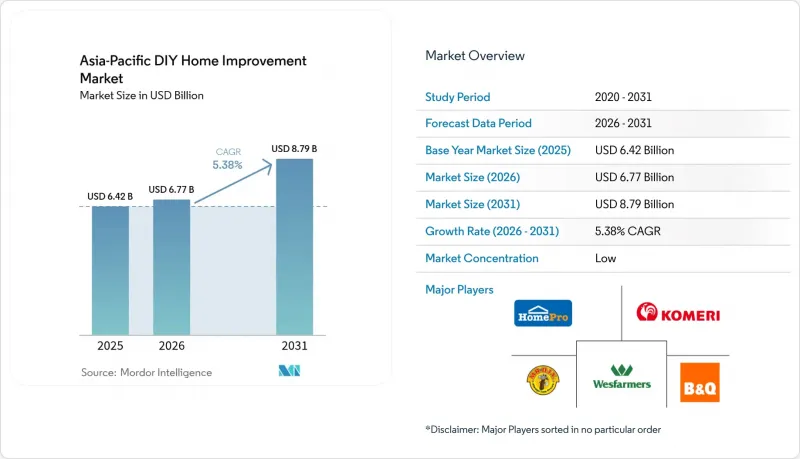
According to Mordor Intelligence, the Asia-Pacific DIY home improvement market size is expected to grow from USD 6.42 billion in 2025 to USD 6.77 billion in 2026 and is forecast to reach USD 8.79 billion by 2031 at 5.38% CAGR over 2026-2031.
This report Segments the Industry Into Product Type (Lumber and Landscape Management, Decor and Indoor Garden, Kitchen, and Other), Distribution Channel (DIY Home Improvement Stores, and Other), by Project Complexity (Minor Cosmetic Upgrades, and Other), and Geography (India, China, Japan, and Other). The Market Forecasts are Provided in Terms of Value (USD).
Asia-Pacific DIY Home Improvement Market Trends and Insights
Rapid urbanization and rising disposable incomes
Urban migration in India is driving increased housing turnover and reducing renovation cycle durations. The preference for DIY solutions over contractor services in smaller urban apartments is driving a notable shift in consumer behavior, effectively expanding the addressable market beyond traditional metropolitan areas. Parallel demographic trends in countries such as Indonesia and Vietnam are contributing to the emergence of new households characterized by increased purchasing power and a growing inclination toward self-managed home improvement projects. These combined factors are expected to underpin long-term growth in the Asia-Pacific DIY home improvement market, presenting significant opportunities for businesses operating in this space.
Omnichannel expansion of big-box DIY retailers
Regional chains are digitizing inventory and fulfilment to match e-commerce standards while leveraging store networks for click-and-collect convenience. Bunnings recorded 5.1% digital sales growth in the first half of fiscal 2024, supported by two-hour collection windows for loyalty members. Big-box retailers enhance their in-store value proposition by offering integrated tutorials, tool rental services, and project consultations, which cater to customer needs and foster engagement. Additionally, the strategic implementation of micro-fulfillment within existing outlets optimizes last-mile logistics by reducing associated costs and improving delivery efficiency for bulky goods. This approach strengthens the competitive positioning of big-box formats in the market.
Skilled-labour shortages and material cost inflation
Since 2020, Japan has experienced a significant decline in its construction workforce, resulting in extended contractor wait times of up to six months. This labour shortage has compelled homeowners to explore alternative self-help solutions to address their construction and renovation needs. In 2024, Queensland experienced a significant increase in installer wages, reflecting heightened demand for skilled labour. The state faces a critical shortage, requiring an additional 18,000 tradespeople to meet market needs and sustain ongoing projects. Tool makers that simplify installation steps gain share as consumers replace labour costs with equipment purchases. Complex electrical or plumbing work remains out of scope for most DIY enthusiasts, limiting uptake in higher-value renovation categories.
Other drivers and restraints analyzed in the detailed report include:
- E-commerce tutorials and influencer-led DIY culture
- Embedded finance and BNPL integrations
- Low DIY skill levels are driving professional outsourcing
For complete list of drivers and restraints, kindly check the Table Of Contents.
Segment Analysis
Painting and wallpaper retained 22.91% of the Asia-Pacific DIY home improvement market share in 2025, highlighting consumer interest in visually impactful yet straightforward projects. Smart-home add-ons are set to register a 13.10% CAGR through 2031, fueled by falling IoT hardware prices and the adoption of the Matter 1.4 interoperability standard MATTER.ORG. Demand for smart lighting, automated blinds, and voice-controlled devices lifts accessory tool sales, benefiting hardware suppliers. Kitchen renovation products sustain momentum as cooking-at-home habits persist, while modular cabinet kits attract renters seeking reversible upgrades. Regulatory requirements limit consumer forays into high-voltage electrical work, but low-voltage LED and switch replacements remain accessible. Lumber and landscape management growth trails other categories due to climate-related supply disruptions, although stabilized softwood imports support volume recovery. Across categories, manufacturers embed guided instructions and QR-linked videos, further lowering entry barriers.
Smart-home penetration reshapes competitive dynamics by encouraging partnerships between device makers and traditional DIY retailers. Tools bundled with calibration apps shorten installation time, and cross-selling opportunities emerge as homeowners integrate sensors with existing renovation plans. Premium paints formulated for low-VOC compliance command margins despite broader price sensitivity. Flooring and building materials benefit from urban apartment refurbishments, especially in China, where renovation cycles shorten and regulatory standards raise material specifications. Integrated product-service bundles, such as paint plus virtual colour simulation, help retailers differentiate and increase basket size.
Complete Report Scope:
- By Product Type
- Lumber and Landscape Management
- Decor and Indoor Garden
- Kitchen
- Painting and Wallpaper
- Tools and Hardware
- Building Materials
- Lighting
- Plumbing and Equipment
- Flooring
- Repair and Replacement
- Electrical Work
- By Distribution Channel
- DIY Home Improvement Stores
- Specialty Stores
- Online
- Other Channels
- By Geography - Country Level
- China
- India
- Japan
- South Korea
- Australia & New Zealand
- Indonesia
- Thailand
- Vietnam
- Malaysia
- Rest of Asia-Pacific
- By Project Complexity
- Minor Cosmetic Upgrades
- Structural Renovations
- Outdoor Landscaping Projects
- Smart-Home Installations
List of Companies Covered in this Report:
- Wesfarmers Ltd (Bunnings)
- Mr DIY Group (Berhad)
- HomePro Public Co.
- Komeri Co. Ltd.
- Kingfisher plc (B&Q China)
- Ace Hardware Indonesia
- IKEA (Southeast Asia & India)
- Amazon APAC
- Flipkart
- LIXIL Group
- Makita Corp.
- Bosch Power Tools APAC
- TOTO Ltd.
- Ozito Industries
- Hafele (Asia)
- Asian Paints
- Nippon Paint Holdings
- DuluxGroup
- Greenply Industries
- Siam Global House
Additional Benefits:
- The market estimate (ME) sheet in Excel format
- 3 months of analyst support
TABLE OF CONTENTS
1 Introduction
- 1.1 Study Assumptions & Market Definition
- 1.2 Scope of the Study
2 Research Methodology
3 Executive Summary
4 Market Landscape
- 4.1 Market Overview
- 4.2 Market Drivers
- 4.2.1 Rapid urbanization & rising disposable incomes
- 4.2.2 Omnichannel expansion of big-box DIY retailers
- 4.2.3 E-commerce tutorials & influencer-led DIY culture
- 4.2.4 Embedded finance & BNPL integrations (under-radar)
- 4.2.5 Regulatory push for low-VOC, fire-safe materials (under-radar)
- 4.2.6 European softwood import diversification stabilising prices (under-radar)
- 4.3 Market Restraints
- 4.3.1 Skilled-labor shortages & material cost inflation
- 4.3.2 Commodity & freight volatility causing stockouts
- 4.3.3 Low DIY skill levels driving professional outsourcing
- 4.3.4 Stringent insurance/permit rules in hazard zones (under-radar)
- 4.4 Value / Supply-Chain Analysis
- 4.5 Regulatory Landscape
- 4.6 Technological Outlook
- 4.7 Porter's Five Forces
- 4.7.1 Threat of New Entrants
- 4.7.2 Bargaining Power of Suppliers
- 4.7.3 Bargaining Power of Buyers
- 4.7.4 Threat of Substitutes
- 4.7.5 Competitive Rivalry
5 Market Size & Growth Forecasts
- 5.1 By Product Type
- 5.1.1 Lumber and Landscape Management
- 5.1.2 Decor and Indoor Garden
- 5.1.3 Kitchen
- 5.1.4 Painting and Wallpaper
- 5.1.5 Tools and Hardware
- 5.1.6 Building Materials
- 5.1.7 Lighting
- 5.1.8 Plumbing and Equipment
- 5.1.9 Flooring
- 5.1.10 Repair and Replacement
- 5.1.11 Electrical Work
- 5.2 By Distribution Channel
- 5.2.1 DIY Home Improvement Stores
- 5.2.2 Specialty Stores
- 5.2.3 Online
- 5.2.4 Other Channels
- 5.3 By Geography - Country Level
- 5.3.1 China
- 5.3.2 India
- 5.3.3 Japan
- 5.3.4 South Korea
- 5.3.5 Australia & New Zealand
- 5.3.6 Indonesia
- 5.3.7 Thailand
- 5.3.8 Vietnam
- 5.3.9 Malaysia
- 5.3.10 Rest of Asia-Pacific
- 5.4 By Project Complexity
- 5.4.1 Minor Cosmetic Upgrades
- 5.4.2 Structural Renovations
- 5.4.3 Outdoor Landscaping Projects
- 5.4.4 Smart-Home Installations
6 Competitive Landscape
- 6.1 Market Concentration
- 6.2 Strategic Moves
- 6.3 Market Share Analysis
- 6.4 Company Profiles (includes Global level Overview, Market level overview, Core Segments, Financials as available, Strategic Information, Market Rank/Share for key companies, Products & Services, and Recent Developments)
- 6.4.1 Wesfarmers Ltd (Bunnings)
- 6.4.2 Mr DIY Group (Berhad)
- 6.4.3 HomePro Public Co.
- 6.4.4 Komeri Co. Ltd.
- 6.4.5 Kingfisher plc (B&Q China)
- 6.4.6 Ace Hardware Indonesia
- 6.4.7 IKEA (Southeast Asia & India)
- 6.4.8 Amazon APAC
- 6.4.9 Flipkart
- 6.4.10 LIXIL Group
- 6.4.11 Makita Corp.
- 6.4.12 Bosch Power Tools APAC
- 6.4.13 TOTO Ltd.
- 6.4.14 Ozito Industries
- 6.4.15 Hafele (Asia)
- 6.4.16 Asian Paints
- 6.4.17 Nippon Paint Holdings
- 6.4.18 DuluxGroup
- 6.4.19 Greenply Industries
- 6.4.20 Siam Global House
7 Market Opportunities & Future Outlook
- 7.1 Smart-home retrofit kits for compact urban apartments
- 7.2 Circular resale platforms for tools & leftover materials

