PUBLISHER: Mordor Intelligence | PRODUCT CODE: 2116428

PUBLISHER: Mordor Intelligence | PRODUCT CODE: 2116428
Germany DIY Home Improvement - Market Share Analysis, Industry Trends & Statistics, Growth Forecasts (2026 - 2031)
According to Mordor Intelligence, the Germany DIY home improvement market size was valued at USD 53.75 billion in 2025 and estimated to grow from USD 57.01 billion in 2026 to reach USD 76.52 billion by 2031, at a CAGR of 6.06% during the forecast period (2026-2031).
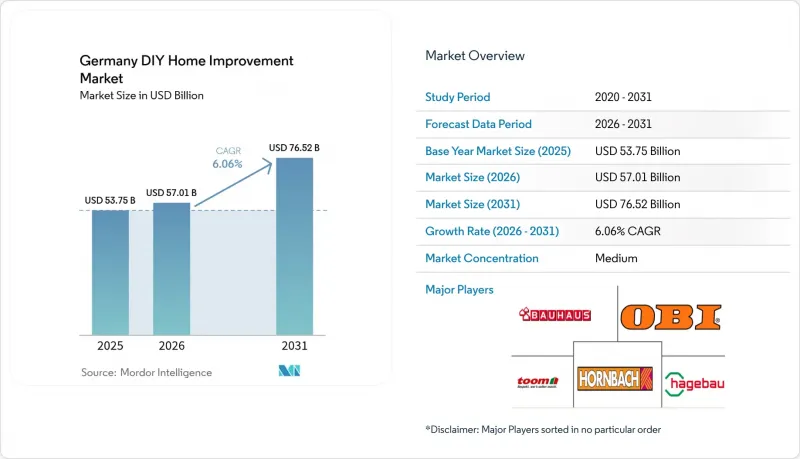
This report is Segmented by Product Category (Building Materials, Tools and Equipment, and More), by Project Type (Renovation, Remodeling, New Construction), by Distribution Channel (DIY Superstores, Specialty Hardware Stores, and More), by Region (Bavaria, Baden-Wurttemberg, North Rhine-Westphalia, Lower Saxony, and More). The Market Forecasts are Provided in Terms of Value (USD).
Germany DIY Home Improvement Market Trends and Insights
Aging Housing Stock Requiring Renovation
About 30% of the country's 21 million buildings carry poor G or H energy ratings, producing a large backlog of mandatory upgrades that expands the Germany DIY home improvement market. Annual refurbishment targets remain unmet, and cost-constrained owners increasingly opt for self-installation kits to comply with the Gebaudeenergiegesetz. Housing transactions trigger compulsory energy improvements, further lifting demand for insulation boards, roofing membranes, and heat-pump accessories. Rising construction costs of roughly 30% during 2021-2024 amplify the substitution of professional contractors with homeowner efforts. Low home-ownership rates mean landlords, too, are turning to budget DIY approaches to keep dwellings rentable under tighter efficiency rules.
Rising DIY Culture Among Cost-conscious Consumers
A broad shift toward frugal home projects is evident as household budgets tighten yet leisure time preferences favor practical creativity. Tool ownership is rising evenly across genders, and battery-powered devices simplify tasks that once demanded professional skill. Stable inflation forecasts around 2.2% for 2025 give planners confidence to allocate funds to weekend projects rather than postpone maintenance. The household tools segment benefits because cordless innovation makes drilling, sanding and sawing easier within apartments that restrict power outlets. Retailers respond with modular workshops and curated starter bundles, anchoring customer loyalty through instructional content and rental add-ons.
Skilled-labour Shortages Inflating Input Prices
One-quarter of construction firms report that limited worker availability constrains order intake, pushing up wages and delaying projects. Scarcity spills into retail channels because manufacturers ration supply to higher-margin professional outlets, sending price lists upward for items like specialty insulation foams. Prefabricated panels and plug-and-play retrofit kits appear as partial solutions because they shorten installation time and reduce skill needs. Municipal pilot programs test maker-spaces where citizens can borrow tools and attend workshops, easing reliance on trade professionals and sustaining the Germany DIY home improvement market despite capacity bottlenecks.
Other drivers and restraints analyzed in the detailed report include:
- Accelerating E-commerce and Omnichannel Penetration
- Sustainability Rules Driving Energy-efficient Retrofits
- High Interest Rates Suppressing Big-ticket Remodels
For complete list of drivers and restraints, kindly check the Table Of Contents.
Segment Analysis
Building Materials captured 23.65% of the Germany DIY home improvement market in 2025, reflecting the dominance of insulation boards, roofing membranes and structural lumber in energy-driven retrofits. Garden and Outdoor ranges post the quickest climb at 6.82% CAGR through 2031 as households seek self-sufficiency and curb-appeal upgrades. The tools segment continues to benefit from cordless innovation, while decorative paints hold resilient because cosmetic refreshes remain affordable entry points for novice do-it-yourselfers.
Many Building Material purchases connect directly to subsidy-qualified projects, lifting average basket values and reinforcing loyalty to full-line superstores offering certified product assortments. Garden demand thrives on a cultural turn toward balcony vegetable patches and pollinator-friendly landscaping kits. Tools enjoy cross-category pull-through because consumers value versatilities such as drilling anchor holes for photovoltaic brackets. Decor and Furniture feel budget pressure, yet specialty lighting tied to smart-home integration partially offsets softness in impulse furnishings.
Complete Report Scope:
- By Product Category
- Building Materials
- Tools and Equipment
- Paints, Coatings and Adhesives
- Lighting and Electrical
- Decor and Furniture
- Garden and Outdoor
- Plumbing Materials
- Flooring
- By Project Type
- Renovation
- Remodeling
- New Construction
- By Distribution Channel
- DIY Superstores
- Specialty Hardware Stores
- Online Pure-Play
- Retailer Click-and-Collect
- By Region - Germany
- Bavaria
- Baden-Wurttemberg
- North Rhine-Westphalia
- Lower Saxony
- Hesse
- Remaining Bundeslander
List of Companies Covered in this Report:
- Bauhaus
- OBI
- Hornbach
- Toom Baumarkt
- Hagebau
- Globus Baumarkt
- Hellweg
- BauSpezi
- BayWa Bau & Garten
- Amazon.de (DIY category)
- eBay Kleinanzeigen DIY
- Wurth
- Bosch Power Tools
- Einhell Germany
- Stanley Black & Decker (DE)
- Hilti Deutschland
- Screwfix Germany
- BauMaxx
- Kingfisher (Screwfix/Brico Depot)
- Adeo Group (Leroy Merlin DE online)
- Manomano
- Hagebaumarkt*
Additional Benefits:
- The market estimate (ME) sheet in Excel format
- 3 months of analyst support
TABLE OF CONTENTS
1 Introduction
- 1.1 Study Assumptions and Market Definition
- 1.2 Scope of the Study
2 Research Methodology
3 Executive Summary
4 Market Landscape
- 4.1 Market Overview
- 4.2 Market Drivers
- 4.2.1 Aging housing stock requiring renovation
- 4.2.2 Rising DIY culture among cost-conscious consumers
- 4.2.3 Accelerating e-commerce and omnichannel penetration
- 4.2.4 Sustainability rules driving energy-efficient retrofits
- 4.2.5 Rental-deposit insurance freeing cash for tenant upgrades
- 4.2.6 Maker-space partnerships with municipalities
- 4.3 Market Restraints
- 4.3.1 Skilled-labour shortages inflating input prices
- 4.3.2 High interest rates suppressing big-ticket remodels
- 4.3.3 Inflation in building-material costs
- 4.3.4 EU product-safety revisions raising sourcing overheads
- 4.4 Value / Supply-Chain Analysis
- 4.5 Regulatory Landscape
- 4.6 Technological Outlook
- 4.7 Porter's Five Forces
- 4.7.1 Competitive Rivalry
- 4.7.2 Bargaining Power of Suppliers
- 4.7.3 Bargaining Power of Buyers
- 4.7.4 Threat of New Entrants
- 4.7.5 Threat of Substitutes
5 Market Size and Growth Forecasts
- 5.1 By Product Category
- 5.1.1 Building Materials
- 5.1.2 Tools and Equipment
- 5.1.3 Paints, Coatings and Adhesives
- 5.1.4 Lighting and Electrical
- 5.1.5 Decor and Furniture
- 5.1.6 Garden and Outdoor
- 5.1.7 Plumbing Materials
- 5.1.8 Flooring
- 5.2 By Project Type
- 5.2.1 Renovation
- 5.2.2 Remodeling
- 5.2.3 New Construction
- 5.3 By Distribution Channel
- 5.3.1 DIY Superstores
- 5.3.2 Specialty Hardware Stores
- 5.3.3 Online Pure-Play
- 5.3.4 Retailer Click-and-Collect
- 5.4 By Region - Germany
- 5.4.1 Bavaria
- 5.4.2 Baden-Wurttemberg
- 5.4.3 North Rhine-Westphalia
- 5.4.4 Lower Saxony
- 5.4.5 Hesse
- 5.4.6 Remaining Bundeslander
6 Competitive Landscape
- 6.1 Market Concentration
- 6.2 Strategic Moves
- 6.3 Market Share Analysis
- 6.4 Company Profiles (includes Global level Overview, Market level overview, Core Segments, Financials as available, Strategic Information, Market Rank/Share for key companies, Products and Services, and Recent Developments)
- 6.4.1 Bauhaus
- 6.4.2 OBI
- 6.4.3 Hornbach
- 6.4.4 Toom Baumarkt
- 6.4.5 Hagebau
- 6.4.6 Globus Baumarkt
- 6.4.7 Hellweg
- 6.4.8 BauSpezi
- 6.4.9 BayWa Bau & Garten
- 6.4.10 Amazon.de (DIY category)
- 6.4.11 eBay Kleinanzeigen DIY
- 6.4.12 Wurth
- 6.4.13 Bosch Power Tools
- 6.4.14 Einhell Germany
- 6.4.15 Stanley Black & Decker (DE)
- 6.4.16 Hilti Deutschland
- 6.4.17 Screwfix Germany
- 6.4.18 BauMaxx
- 6.4.19 Kingfisher (Screwfix/Brico Depot)
- 6.4.20 Adeo Group (Leroy Merlin DE online)
- 6.4.21 Manomano
- 6.4.22 Hagebaumarkt*
7 Market Opportunities & Future Outlook
- 7.1 White-space & Unmet-Need Assessment

