PUBLISHER: Mordor Intelligence | PRODUCT CODE: 2114408

PUBLISHER: Mordor Intelligence | PRODUCT CODE: 2114408
ASEAN Freight Forwarding - Market Share Analysis, Industry Trends & Statistics, Growth Forecasts (2026 - 2031)
According to Mordor Intelligence, the ASEAN freight forwarding market size is expected to grow from USD 31.62 billion in 2025 to USD 33.13 billion in 2026 and is forecast to reach USD 41.86 billion by 2031 at 4.78% CAGR over 2026-2031.
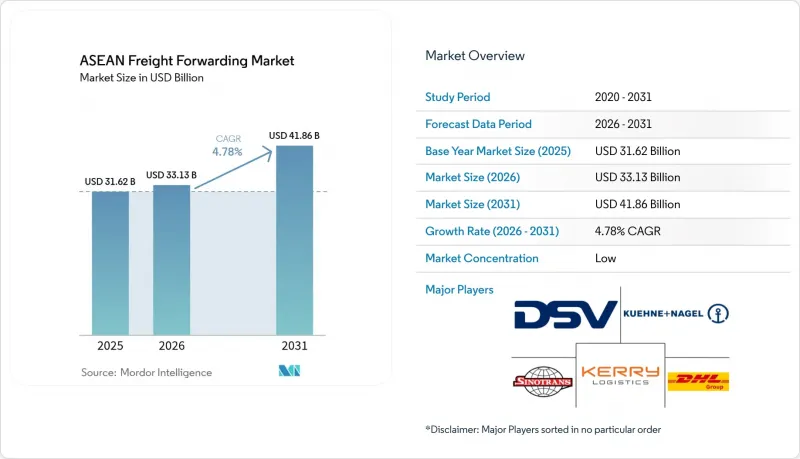
This report is Segmented by Mode of Transport (Air Freight Forwarding, Sea Freight Forwarding, and Others), End User (Manufacturing & Automotive, Oil & Gas, Mining & Quarrying, Agriculture, Fishing & Forestry, Construction, and More), Country (Singapore, Thailand, Malaysia, Indonesia, Vietnam, Philippines, and Rest of ASEAN). The Market Forecasts are Provided in Terms of Value (USD).
ASEAN Freight Forwarding Market Trends and Insights
Rapid Intra-ASEAN Manufacturing Re-shoring Accelerates Regional Trade Flows
Production networks for electronics, automotive, and consumer durables are steadily migrating from coastal China into Vietnam, Thailand, and Malaysia. Contract manufacturers that once operated single-country plants now run multi-site footprints across ASEAN to hedge geopolitical exposure and tap 15% lower wage structures. The dispersion of tier-1 and tier-2 component suppliers multiplies intra-regional cargo legs, requiring freight forwarders to synchronize plant-to-plant movements under tight just-in-time parameters. Dedicated corridors linking Thailand's Eastern Economic Corridor to Vietnamese assembly clusters are already handling higher-frequency, less-than-container-load shipments, while Indonesia's Batam and Java industrial parks are feeding supplemental feeder volumes into Singapore's transshipment streams. Customs transit guarantees under the ASEAN Customs Transit System allow sealed trucks to move across borders without repeated inspections, trimming border dwell times to under four hours.
E-commerce Mini-hubs Transform Cross-border Parcel Logistics Architecture
Online marketplaces across Southeast Asia now push order cut-off times deeper into the evening and promise next-day delivery even for cross-border purchases. To honor those service levels, freight forwarders and platform operators have rolled out micro-fulfillment nodes in Johor, Batam, and Songkhla, keeping inventory within a four-hour line-haul of major metro areas. Small parcels clear customs in bulk at bonded consolidation centers before being injected into last-mile networks, reducing per-item brokerage costs and smoothing daily volume spikes. Blockchain-enabled track-and-trace services give sellers and buyers near-real-time status updates, while automated duty assessment engines pre-calculate landed costs at checkout to improve cart-conversion rates. The mini-hub model increases shipment frequency, compresses average consignment size, and lifts demand for time-definite air cargo uplift on high-density lanes such as Kuala Lumpur-Ho Chi Minh City.
Fragmented Truck Ownership Structure Constrains Last-mile Efficiency
Owner-drivers operate over 70% of commercial vehicles in Indonesia and the Philippines, limiting telematics penetration and consistent service quality. Freight forwarders juggling hundreds of micro-carriers face elevated administrative overhead, while inconsistent maintenance standards inflate roadside-breakdown risks. Consolidation remains slow because small fleets rely on informal lending circles, making capital-intensive upgrades to Euro VI or electric trucks financially out of reach. As e-commerce pushes delivery frequency higher, the shortage of scalable line-haul partners forces forwarders to pay rate premiums during peak seasons, eroding margins.
Other drivers and restraints analyzed in the detailed report include:
- Free-trade Corridor Build-outs Unlock Multimodal Connectivity Gains
- Near-real-time Port Community Systems Enhance Operational Transparency
- Chronic Container Equipment Imbalance Disrupts Service Reliability
For complete list of drivers and restraints, kindly check the Table Of Contents.
Segment Analysis
Sea freight's 54.60% share underscores its role as the backbone of the ASEAN freight forwarding market, funneling containerized exports of electronics, apparel, and automotive parts through the Straits of Malacca and the South China Sea. Within the broader ASEAN freight forwarding market size, full-container-load movements benefited most from manufacturing reshoring, while less-than-container-load volumes captured rising intra-bloc trade. Air freight, though smaller in tonnage, is scaling at a 5.12% CAGR (2026-2031) as e-retailers route high-value smartphones, pharmaceuticals, and fashion items via Bangkok, Kuala Lumpur, and Singapore. Service innovations such as time-definite cross-border parcel flights and temperature-controlled ULDs reduce spoilage risks on life-science cargo and underpin premium yields.
Hybrid routing strategies are spreading as shippers blend ocean for base-load replenishment with scheduled charters for inventory top-ups. The International Maritime Organization's decarbonization rules push carriers toward LNG and methanol-ready newbuilds, prompting freight forwarders to market low-emission lanes at modest rate premiums. Road-rail combinations in the Greater Mekong Subregion extend sea-rail intermodal options, letting cargo skip coastal detours and shave 400 kilometers off certain Hanoi-to-Bangkok routings. These offerings increase operational resilience amid climate-linked weather disruptions and periodic berth congestion.
Complete Report Scope:
- By Mode of Transport
- Air Freight Forwarding
- Sea Freight Forwarding
- Full-Container-Load (FCL)
- Less-than-Container-Load (LCL)
- Others
- By End User
- Manufacturing & Automotive
- Oil & Gas, Mining & Quarrying
- Agriculture, Fishing & Forestry
- Construction
- Distributive Trade (Wholesale/Retail, FMCG)
- Other End Users (Telecom, Pharmaceutical, etc.)
- By Country
- Singapore
- Thailand
- Malaysia
- Indonesia
- Vietnam
- Philippines
- Rest of ASEAN (Myanmar, Laos, Cambodia, Brunei)
List of Companies Covered in this Report:
- Deutsche Post DHL Group (DHL Global Forwarding)
- Kuehne + Nagel International AG
- DSV A/S
- Sinotrans Ltd
- Kerry Logistics Network Ltd
- Nippon Express Co. Ltd
- CEVA Logistics
- Kintetsu World Express Inc.
- Yusen Logistics Co. Ltd
- PT Samudera Indonesia Tbk
- C.H. Robinson Worldwide Inc.
- Expeditors International
- GEODIS
- YCH Group Pte Ltd
- GKE Corp Ltd
- AIT Worldwide Logistics
- LOGISTEED
- Gemadept Logistics
- Freight Management Holdings Bhd
- PT Cahaya Pundimas Indonusa
Additional Benefits:
- The market estimate (ME) sheet in Excel format
- 3 months of analyst support
TABLE OF CONTENTS
1 Introduction
- 1.1 Study Assumptions & Market Definition
- 1.2 Scope of the Study
2 Research Methodology
3 Executive Summary
4 Market Landscape
- 4.1 Market Overview
- 4.2 Market Drivers
- 4.2.1 Rapid intra-ASEAN manufacturing re-shoring
- 4.2.2 E-commerce mini-hubs powering cross-border parcel volumes
- 4.2.3 Free-trade corridor build-outs (e.g., GMS, IMT-GT)
- 4.2.4 Near-real-time port community systems deployment
- 4.2.5 Widespread third-party carbon-offset programs by shippers
- 4.2.6 ASEAN digital customs single-window rollout
- 4.3 Market Restraints
- 4.3.1 Fragmented truck ownership raising last-mile costs
- 4.3.2 Chronic container equipment imbalance
- 4.3.3 Non-harmonised dangerous-goods codes among members
- 4.3.4 Shortage of FIATA-certified freight professionals
- 4.4 Value / Supply-Chain Analysis
- 4.5 Regulatory Landscape
- 4.6 Technological Outlook
- 4.7 Porter's Five Forces
- 4.7.1 Bargaining Power of Buyers
- 4.7.2 Bargaining Power of Suppliers
- 4.7.3 Threat of New Entrants
- 4.7.4 Threat of Substitutes
- 4.7.5 Degree of Rivalry
- 4.8 Freight Transport Corridors
- 4.9 Government Regulations & Initiatives
- 4.10 Insights on E-commerce (Domestic & Cross-border)
- 4.11 Special Economic Zones & Manufacturing Hubs
- 4.12 CPTPP Impact on Freight Forwarding
5 Market Size & Growth Forecasts
- 5.1 By Mode of Transport
- 5.1.1 Air Freight Forwarding
- 5.1.2 Sea Freight Forwarding
- 5.1.2.1 Full-Container-Load (FCL)
- 5.1.2.2 Less-than-Container-Load (LCL)
- 5.1.3 Others
- 5.2 By End User
- 5.2.1 Manufacturing & Automotive
- 5.2.2 Oil & Gas, Mining & Quarrying
- 5.2.3 Agriculture, Fishing & Forestry
- 5.2.4 Construction
- 5.2.5 Distributive Trade (Wholesale/Retail, FMCG)
- 5.2.6 Other End Users (Telecom, Pharmaceutical, etc.)
- 5.3 By Country
- 5.3.1 Singapore
- 5.3.2 Thailand
- 5.3.3 Malaysia
- 5.3.4 Indonesia
- 5.3.5 Vietnam
- 5.3.6 Philippines
- 5.3.7 Rest of ASEAN (Myanmar, Laos, Cambodia, Brunei)
6 Competitive Landscape
- 6.1 Market Concentration & Strategic Moves
- 6.2 Market Share Analysis
- 6.3 Company Profiles {(includes Global level Overview, Market level overview, Core Segments, Financials as available, Strategic Information, Market Rank/Share for key companies, Products & Services, and Recent Developments)}
- 6.3.1 Deutsche Post DHL Group (DHL Global Forwarding)
- 6.3.2 Kuehne + Nagel International AG
- 6.3.3 DSV A/S
- 6.3.4 Sinotrans Ltd
- 6.3.5 Kerry Logistics Network Ltd
- 6.3.6 Nippon Express Co. Ltd
- 6.3.7 CEVA Logistics
- 6.3.8 Kintetsu World Express Inc.
- 6.3.9 Yusen Logistics Co. Ltd
- 6.3.10 PT Samudera Indonesia Tbk
- 6.3.11 C.H. Robinson Worldwide Inc.
- 6.3.12 Expeditors International
- 6.3.13 GEODIS
- 6.3.14 YCH Group Pte Ltd
- 6.3.15 GKE Corp Ltd
- 6.3.16 AIT Worldwide Logistics
- 6.3.17 LOGISTEED
- 6.3.18 Gemadept Logistics
- 6.3.19 Freight Management Holdings Bhd
- 6.3.20 PT Cahaya Pundimas Indonusa
7 Market Opportunities & Future Outlook
- 7.1 White-space & Unmet-need Assessment

