PUBLISHER: Mordor Intelligence | PRODUCT CODE: 2114455

PUBLISHER: Mordor Intelligence | PRODUCT CODE: 2114455
Power Bank - Market Share Analysis, Industry Trends & Statistics, Growth Forecasts (2026 - 2031)
According to Mordor Intelligence, the power bank market size stood at USD 21.72 billion in 2026 and is projected to reach USD 31.97 billion by 2031, advancing at an 8.04% CAGR over the period.
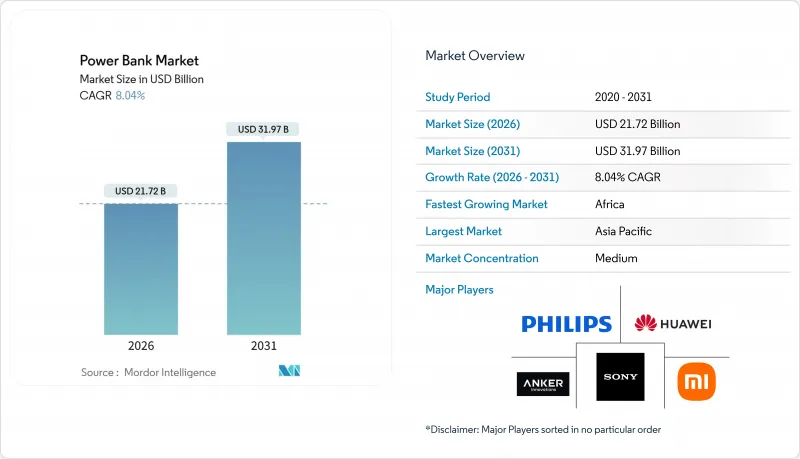
This report is Segmented by Capacity Range (Up To 3, 000 MAh, 3, 001-8, 000 MAh, 8, 001 - 20, 000 MAh, and More), Charging Technology (Wired, and Wireless), Application (Smartphones and Tablets, Laptops and Gaming Consoles, Wearables and IoT Devices, Cameras and Drones, Other Applications), Distribution Channel (Online, and Offline), and Geography. The Market Forecasts are Provided in Terms of Value (USD).
Global Power Bank Market Trends and Insights
Surging Penetration of 5G-Enabled Smartphones
Fifth-generation networks consume 20% to 30% more energy than 4G because beamforming and continuous network scanning shorten daily battery life from 18 hours to 12 hours for heavy users. Vivo's X200 Pro with a 6,000 mAh cell still drained in 9.5 hours under sustained 5G video streaming, confirming that even larger batteries fail to cover an entire day for power users. Flagship silicon-carbon anodes remain limited to devices above USD 800, keeping mid-tier attachment rates for external batteries near 60%. Xiaomi shipped 21.6 million IoT peripherals in Q3-2025, each demanding routine charging and compounding portable-power needs. With Qi2 magnetic charging confined mainly to iPhones, most Android owners still rely on wired packs, reinforcing market breadth even as handset capacity inches upward.
Expanding E-Commerce for Consumer Electronics
China's online retail sales rose 9.8% year on year in the first nine months of 2025, and digital products advanced 8.3%, propelled by algorithmic recommendations that surface power bank listings to recent smartphone or laptop buyers. Alibaba's Portable Power category booked USD 230.4 billion GMV in 2025, up 15.7%, with Anker's 737 model capturing 31% of the 10,000-20,000 mAh tier. Flipkart ranked power banks among its five best-selling accessories during India's 2025 festive season by bundling cashback and no-cost EMI offers. Amazon's Prime Day 2025 discounted 10,000 mAh units to an average of USD 28, compressing margins but driving volume. Direct-to-consumer sites let brands bypass 25%-35% distributor markups, allowing 20,000 mAh, 65 W USB-C models at USD 50-60, a price once reserved for 10,000 mAh packs, broadening mass-market access.
Inflated Counterfeit and Sub-Standard Products Eroding Trust
Samsung recalled 10,000 units in South Korea after 18 overheating incidents, slashing online sales for unbranded power banks under USD 10 by 15%. Indonesian customs seized 50,000 fake Anker packs labeled 20,000 mAh that tested at half capacity and lacked thermal cutoffs. India's revised IS 302 standard will bar uncertified imports after February 2026, potentially eliminating one-third of gray-market shipments. UL 2056 certification costs up to USD 15,000 per SKU, discouraging small makers and concentrating share among brands that amortize compliance across large portfolios. As marketplaces tighten audits, consumer confidence shifts toward traceable, certified models.
Other drivers and restraints analyzed in the detailed report include:
- Higher Penetration in Developing Economies With Unreliable Power Grids
- Integration of GaN Fast-Charging Chipsets in Premium Models
- Incremental Gains in Native Smartphone Battery Life
For complete list of drivers and restraints, kindly check the Table Of Contents.
Segment Analysis
The 8,001-20,000 mAh tranche captured 47.89% of 2025 revenue, underscoring its sweet-spot appeal for two to three full smartphone charges without bulk. Economies of scale in lithium-polymer procurement let brands price 10,000 mAh dual-port units between USD 25 and USD 35 while still protecting margins. Consumers gravitate toward this tier because it slides into backpacks and jackets yet offers a safety net for multiday trips. The segment anchors discount promotions on Tmall, JD, and Amazon, keeping the phrase 'power bank market' in frequent consumer searches. Above 30,000 mAh models are scaling at a 9.21% CAGR as photographers, drone pilots, and field engineers value capacities nearing the 100 Wh airline limit. AUKEY's 27,600 mAh Spark Mega can refill a MacBook Pro twice, reducing downtime for creatives on location. Meanwhile, packs under 3,000 mAh service wearables but contribute negligible revenue, demonstrating how tail segments coexist within the broader power bank market.
Demand for 20,001-30,000 mAh products remains steady because they deliver three laptop recharges yet comply with cabin rules, preserving portability for frequent flyers. Zendure's SuperTank Pro at 26,800 mAh integrates a digital readout, which differentiates it in a crowded middle band. Anker's GaN-based 737 delivers 140 W through a single USB-C port, underscoring that wattage, not just capacity, shapes buyer decisions. The up to 3,000 mAh tier survives in convenience stores for emergency top-ups of earbuds and smartwatches. Although volumes are modest, their ubiquity maintains consumer familiarity, creating entry points that later up-sell higher-capacity products, sustaining the power bank market's trajectory.
Wired models held 82.17% of 2025 revenue thanks to near-universal USB-C adoption and 85%-90% energy-conversion efficiency. USB-C PD 3.1 now supports 240 W, letting a single cable power laptops, tablets, and phones, a versatility prized in enterprise IT kits. Low bill-of-materials costs also allow wired units to command aggressive price tiers in the power bank market. Wireless packs, though only 17.83% in 2025, are projected to grow at an 8.47% CAGR on the back of Qi2 certification, which doubles inductive charging to 15 W for iPhone 12 and newer. Mophie's Powerstation Wireless 10K Slim, priced at USD 79.95, targets early adopters who value MagSafe convenience.
Price differentials are narrowing as AUKEY's MagFusion 10K retails at USD 39.99, undercutting peers by 50% while still offering Qi2 speeds. Anker's MagGo 10K incorporates a fold-out stand and a smart display, showcasing how feature layering can justify 30%-40% premiums. Nevertheless, the inherent energy loss of inductive coupling keeps heavy users loyal to wired options, especially in regions where electricity costs discourage inefficiency. Brands therefore market wireless models as lifestyle accessories rather than primary workhorses, positioning them as complements rather than substitutes within the broader power bank market size narrative.
Complete Report Scope:
- By Capacity Range
- Up to 3,000 mAh
- 3,001 - 8,000 mAh
- 8,001 - 20,000 mAh
- 20,001 - 30,000 mAh
- Above 30,000 mAh
- By Charging Technology
- Wired
- Wireless
- By Application
- Smartphones and Tablets
- Laptops and Gaming Consoles
- Wearables and IoT Devices
- Cameras and Drones
- Other Applications
- By Distribution Channel
- Online
- Offline
- By Geography
- North America
- United States
- Canada
- Mexico
- Europe
- Germany
- United Kingdom
- France
- Russia
- Rest of Europe
- Asia-Pacific
- China
- Japan
- India
- South Korea
- Australia
- Rest of Asia-Pacific
- Middle East and Africa
- Middle East
- Saudi Arabia
- United Arab Emirates
- Rest of Middle East
- Africa
- South Africa
- Egypt
- Rest of Africa
- Middle East
- South America
- Brazil
- Argentina
- Rest of South America
- North America
Geography Analysis
Asia-Pacific commanded 56.12% of 2025 sales, anchored by Shenzhen manufacturers that supply 70% of global lithium-polymer cells at cost bases 30% lower than Western peers. China's dominance ensures localized supply chains and rapid SKU refresh cycles. India's BIS hallmark deadline of February 2026 should weed out non-compliant imports, increase the share of certified domestic brands, and stabilize retail ASPs. Japan's speedy adoption of Qi2 led MagSafe-compatible models to retail at JPY 8,000-12,000 (USD 55-82) in 2025, signaling a willingness to pay for convenience. South Korea tightened audits after Samsung's 2024 recall, elevating UL 2056 labels as a prerequisite for big-box listings. Australia enforced UN 38.3 airline limits, capping carry-on capacity at 100 Wh and reshaping SKU launch strategies.
North America and Europe jointly contributed just over 30% of revenue, buoyed by hybrid work patterns and the EU common-charger mandate that nudged consumers toward new USB-C models. Mophie's 140 W Powerstation Ultra 25K launched at USD 99.95 for MacBook users, reflecting high-spend consumer segments. Germany logged 18% year-on-year sales growth in Q1-2025 amid summer travel planning. France's FNAC and Darty expanded power-bank shelf space by 25% and dedicated end-caps to Qi2 units. Russian market contraction following sanctions opened pockets for lower-priced Chinese brands like Xiaomi.
Africa, the fastest-growing region at 9.11% CAGR, depends on portable power to bridge unreliable grids. South Africa's 2024 load shedding lifted sales 35% in major metros. Kenya's rural M-Pesa users adopt USD 15 packs to avoid transaction disruptions. Egypt's smartphone penetration reached 65% in 2025, yet daily summer outages average four hours, driving attachment rates above 70% in Cairo. Middle Eastern demand grows 7%-8% as tourists and expatriates carry multiple high-drain devices in hot climates. Latin America advances 6%-7% annually; despite USD 90 billion network investment plans, last-mile power deficiencies sustain long-run reliance on external batteries. These varied regional narratives together enlarge the global power bank market.
- Anker Innovations Ltd.
- Xiaomi Corporation
- Samsung Electronics Co., Ltd.
- Shenzhen Haopai Electronics (RAVPower)
- Lenovo Group Ltd.
- Sony Group Corporation
- Koninklijke Philips N.V.
- ADATA Technology Co., Ltd.
- Panasonic Energy Co., Ltd.
- Huawei Technologies Co., Ltd.
- ZAGG Inc. (mophie)
- Belkin International
- UGREEN Group Ltd.
- Baseus Technology Co., Ltd.
- Syska Mobile Accessories
- Ambrane India Pvt. Ltd.
- Intex Technologies (India) Ltd.
- Aukey Technology Co., Ltd.
- Zendure USA Inc.
- EcoFlow Inc.
Additional Benefits:
- The market estimate (ME) sheet in Excel format
- 3 months of analyst support
TABLE OF CONTENTS
1 INTRODUCTION
- 1.1 Study Assumptions and Market Definition
- 1.2 Scope of the Study
2 RESEARCH METHODOLOGY
3 EXECUTIVE SUMMARY
4 MARKET LANDSCAPE
- 4.1 Market Overview
- 4.2 Market Drivers
- 4.2.1 Surging Penetration of 5G-Enabled Smartphones
- 4.2.2 Expanding E-Commerce for Consumer Electronics
- 4.2.3 Higher Penetration in Developing Economies With Unreliable Power Grids
- 4.2.4 Rapid Adoption of High-Capacity Laptops and Gaming Consoles
- 4.2.5 Proliferation of Power-Bank Rental Kiosks at Transit Hubs
- 4.2.6 Integration of GaN Fast-Charging Chipsets in Premium Models
- 4.3 Market Restraints
- 4.3.1 Inflated Counterfeit and Sub-Standard Products Eroding Trust
- 4.3.2 Incremental Gains in Native Smartphone Battery Life
- 4.3.3 Stricter UN 38.3 Air-Cargo Limits for Li-Ion Shipments
- 4.3.4 Early Traction of Solid-State Micro-Batteries Reducing Need for External Packs
- 4.4 Industry Value Chain Analysis
- 4.5 Regulatory Landscape
- 4.6 Technological Outlook
- 4.7 Porter's Five Forces Analysis
- 4.7.1 Bargaining Power of Suppliers
- 4.7.2 Bargaining Power of Buyers
- 4.7.3 Threat of New Entrants
- 4.7.4 Threat of Substitutes
- 4.7.5 Intensity of Competitive Rivalry
- 4.8 Impact of Macroeconomic Factors on the Market
5 MARKET SIZE AND GROWTH FORECASTS (VALUE)
- 5.1 By Capacity Range
- 5.1.1 Up to 3,000 mAh
- 5.1.2 3,001 - 8,000 mAh
- 5.1.3 8,001 - 20,000 mAh
- 5.1.4 20,001 - 30,000 mAh
- 5.1.5 Above 30,000 mAh
- 5.2 By Charging Technology
- 5.2.1 Wired
- 5.2.2 Wireless
- 5.3 By Application
- 5.3.1 Smartphones and Tablets
- 5.3.2 Laptops and Gaming Consoles
- 5.3.3 Wearables and IoT Devices
- 5.3.4 Cameras and Drones
- 5.3.5 Other Applications
- 5.4 By Distribution Channel
- 5.4.1 Online
- 5.4.2 Offline
- 5.5 By Geography
- 5.5.1 North America
- 5.5.1.1 United States
- 5.5.1.2 Canada
- 5.5.1.3 Mexico
- 5.5.2 Europe
- 5.5.2.1 Germany
- 5.5.2.2 United Kingdom
- 5.5.2.3 France
- 5.5.2.4 Russia
- 5.5.2.5 Rest of Europe
- 5.5.3 Asia-Pacific
- 5.5.3.1 China
- 5.5.3.2 Japan
- 5.5.3.3 India
- 5.5.3.4 South Korea
- 5.5.3.5 Australia
- 5.5.3.6 Rest of Asia-Pacific
- 5.5.4 Middle East and Africa
- 5.5.4.1 Middle East
- 5.5.4.1.1 Saudi Arabia
- 5.5.4.1.2 United Arab Emirates
- 5.5.4.1.3 Rest of Middle East
- 5.5.4.2 Africa
- 5.5.4.2.1 South Africa
- 5.5.4.2.2 Egypt
- 5.5.4.2.3 Rest of Africa
- 5.5.4.1 Middle East
- 5.5.5 South America
- 5.5.5.1 Brazil
- 5.5.5.2 Argentina
- 5.5.5.3 Rest of South America
- 5.5.1 North America
6 COMPETITIVE LANDSCAPE
- 6.1 Market Concentration
- 6.2 Strategic Moves
- 6.3 Market Share Analysis
- 6.4 Company Profiles (includes Global Level Overview, Market Level Overview, Core Segments, Financials as Available, Strategic Information, Market Rank/Share, Products and Services, Recent Developments)
- 6.4.1 Anker Innovations Ltd.
- 6.4.2 Xiaomi Corporation
- 6.4.3 Samsung Electronics Co., Ltd.
- 6.4.4 Shenzhen Haopai Electronics (RAVPower)
- 6.4.5 Lenovo Group Ltd.
- 6.4.6 Sony Group Corporation
- 6.4.7 Koninklijke Philips N.V.
- 6.4.8 ADATA Technology Co., Ltd.
- 6.4.9 Panasonic Energy Co., Ltd.
- 6.4.10 Huawei Technologies Co., Ltd.
- 6.4.11 ZAGG Inc. (mophie)
- 6.4.12 Belkin International
- 6.4.13 UGREEN Group Ltd.
- 6.4.14 Baseus Technology Co., Ltd.
- 6.4.15 Syska Mobile Accessories
- 6.4.16 Ambrane India Pvt. Ltd.
- 6.4.17 Intex Technologies (India) Ltd.
- 6.4.18 Aukey Technology Co., Ltd.
- 6.4.19 Zendure USA Inc.
- 6.4.20 EcoFlow Inc.
7 MARKET OPPORTUNITIES AND FUTURE OUTLOOK
- 7.1 White-Space and Unmet-Need Assessment

