PUBLISHER: Mordor Intelligence | PRODUCT CODE: 2114562

PUBLISHER: Mordor Intelligence | PRODUCT CODE: 2114562
Vietnam Battery - Market Share Analysis, Industry Trends & Statistics, Growth Forecasts (2026 - 2031)
According to Mordor Intelligence, the Vietnam battery market size is estimated at USD 1.13 billion in 2026, and is expected to reach USD 1.83 billion by 2031, at a CAGR of 10.09% during the forecast period (2026-2031).
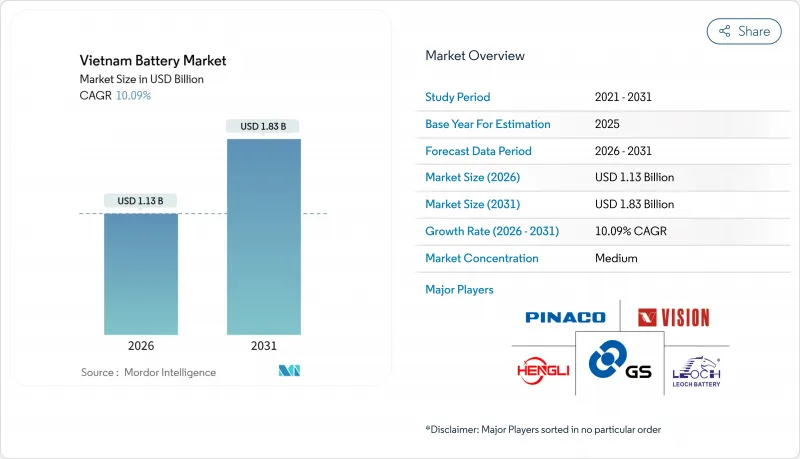
This report is Segmented by Battery Type (Primary Batteries and Secondary Batteries), Technology (Lead-Acid, Li-Ion, Nickel-Metal Hydride, Nickel-Cadmium, Sodium-Sulfur, Solid-State, Flow Battery, and Emerging Chemistries), and Application (Automotive, Industrial, Portable, Power Tools, SLI, and Other Applications). The Market Sizes and Forecasts are Provided in Terms of Value (USD).
Vietnam Battery Market Trends and Insights
Declining Lithium-Ion Cell Prices
Pack costs for lithium-iron-phosphate systems slid under USD 100 per kWh in 2023, and global averages are poised to fall another 40% by 2030. Material expenses dominate cell economics, so cheaper cathodes quickly translate into lower vehicle and storage prices. Vietnam's e-motorcycle segment, already the world's fourth largest, becomes price-competitive with 125 cc gasoline scooters once packs hit USD 80 per kWh, accelerating two-wheeler replacement. Industrial users see payback periods drop below three years when swapping valve-regulated lead-acid for lithium-ion, spurring uninterruptible-power-supply upgrades. Ho Chi Minh City's plan to convert 400,000 motorcycles to electric propulsion starting in 2026 will test whether falling cell prices convert intent into mass adoption.
Surge in EV and E-Bike Adoption
Electric cars captured about 40% of new passenger-car sales in 2025, a level unrivaled in Southeast Asia and driven almost entirely by VinFast's domestic ramp-up. Hanoi's July 2026 ban on fossil-fuel motorcycles inside Ring Road 1 acts as a regulatory catalyst for two-wheeler electrification, while budget constraints postpone similar conversion in public bus fleets. Competition in e-motorcycles remains intense as Chinese brands such as Yadea battle local assemblers across battery-swap and plug-in architectures. Premium models deploy swappable lithium-ion packs, whereas ultra-low-cost options cling to lead-acid, bifurcating supply needs. Decision 876/QD-TTg further mandates 50% electrification of urban transport by 2030, solidifying long-term demand.
Reliance on Pumped-Hydro Over BESS
Vietnam's revised Power Development Plan VIII targets up to 16.3 GW of battery storage by 2030, yet historic preference for pumped-hydro keeps lithium-ion projects sidelined. Pumped-hydro's longer discharge and multi-decade asset life appeal to planners, while lithium-ion's sweet spot lies in short-duration frequency regulation. Electricity of Vietnam launched a 50 MW/50 MWh pilot in 2024 but has yet to publish standardized grid-connection codes for independent operators. Without a wholesale ancillary-services market, developers rely on time-of-use arbitrage alone, which seldom clears investment hurdles at USD 250-350 per kWh installed. Grid-scale deployment thus lags even as solar and wind curtailment rise in high-penetration provinces.
Other drivers and restraints analyzed in the detailed report include:
- Government Incentives for Local Manufacturing
- VinFast/VinES Vertical-Integration Investments
- Limited Domestic Raw-Material Base
For complete list of drivers and restraints, kindly check the Table Of Contents.
Segment Analysis
Secondary rechargeable batteries held 84.9% of the Vietnam battery market share in 2025 and are expanding at an 11.5% CAGR through 2031, outstripping overall growth. The surge reflects VinFast's volume ramp, e-motorcycle proliferation, and 5G tower upgrades shifting from lead-acid to lithium-ion. Industrial power-backup buyers now value 3,000-cycle life and reduced maintenance, nudging valve-regulated lead-acid out of telecom cabinets. T&T Group's planned 2 GWh storage-products facility, scaling to 10 GWh, illustrates rising confidence in rechargeable demand.
Primary cells maintained a 15.1% foothold in 2025, concentrated in remote sensors, medical devices, and low-drain consumer goods, where shelf life trumps cycle costs. Yet the transition to USB-C charging and energy-harvesting IoT nodes caps growth. Rechargeable momentum implies incremental demand of nearly 8 GWh by 2031, pressuring domestic producers to secure cathode supply even as automotive volumes dominate. The Vietnam battery market size for rechargeables could therefore eclipse USD 1.5 billion by 2031 if localization targets hold.
Complete Report Scope:
- By Battery Type
- Primary Batteries
- Secondary Batteries
- By Technology
- Lead-acid
- Li-ion
- Nickel-metal hydride
- Nickel-cadmium
- Sodium-sulfur
- Solid-state
- Flow Battery
- Emerging chemistries
- By Application
- Automotive (HEV, PHEV, and EV)
- Industrial (Motive, Stationary (Telecom, UPS, ESS), etc.)
- Portable (Consumer Electronics, etc.)
- Power Tools
- SLI
- Other Applications
List of Companies Covered in this Report:
- GS Battery Vietnam Co. Ltd
- PINACO
- Vision Group
- Leoch International Technology Ltd
- Saite Power Source (Vietnam) Co. Ltd
- Heng Li (Vietnam) Battery Technology Co. Ltd
- Ritar Power (Vietnam) Co. Ltd
- Tia Sang Battery JSC
- Eni-Florence Vietnam Co. Ltd
- Kung Long Batteries Industrial Co. Ltd
- VinES Energy Solutions JSC
- Panasonic Energy Vietnam
- Samsung SDI
- BYD Co. Ltd
- CATL
- Amara Raja Batteries
- Power Plus Technologies Vietnam
- EnerSys
- Exide Industries
- Furukawa Battery
Additional Benefits:
- The market estimate (ME) sheet in Excel format
- 3 months of analyst support
TABLE OF CONTENTS
1 Introduction
- 1.1 Study Assumptions & Market Definition
- 1.2 Scope of the Study
2 Research Methodology
3 Executive Summary
4 Market Landscape
- 4.1 Market Overview
- 4.2 Market Drivers
- 4.2.1 Declining lithium-ion cell prices
- 4.2.2 Surge in EV & e-bike adoption
- 4.2.3 Government incentives for local manufacturing
- 4.2.4 Expansion of 5G & data-center back-up demand
- 4.2.5 VinFast/VinES vertical-integration investments
- 4.2.6 Supply-chain diversification away from China
- 4.3 Market Restraints
- 4.3.1 Reliance on pumped-hydro over BESS
- 4.3.2 Limited domestic raw-material base
- 4.3.3 Stricter hazardous-waste regulations
- 4.3.4 Grid-connection bottlenecks for large ESS
- 4.4 Supply-Chain Analysis
- 4.5 Regulatory Landscape
- 4.6 Technological Outlook
- 4.7 Porter's Five Forces
- 4.7.1 Threat of New Entrants
- 4.7.2 Bargaining Power of Suppliers
- 4.7.3 Bargaining Power of Buyers
- 4.7.4 Threat of Substitutes
- 4.7.5 Competitive Rivalry
- 4.8 PESTLE Analysis
5 Market Size & Growth Forecasts
- 5.1 By Battery Type
- 5.1.1 Primary Batteries
- 5.1.2 Secondary Batteries
- 5.2 By Technology
- 5.2.1 Lead-acid
- 5.2.2 Li-ion
- 5.2.3 Nickel-metal hydride
- 5.2.4 Nickel-cadmium
- 5.2.5 Sodium-sulfur
- 5.2.6 Solid-state
- 5.2.7 Flow Battery
- 5.2.8 Emerging chemistries
- 5.3 By Application
- 5.3.1 Automotive (HEV, PHEV, and EV)
- 5.3.2 Industrial (Motive, Stationary (Telecom, UPS, ESS), etc.)
- 5.3.3 Portable (Consumer Electronics, etc.)
- 5.3.4 Power Tools
- 5.3.5 SLI
- 5.3.6 Other Applications
6 Competitive Landscape
- 6.1 Market Concentration
- 6.2 Strategic Moves (M&A, Partnerships, PPAs)
- 6.3 Market Share Analysis (Market Rank/Share for key companies)
- 6.4 Company Profiles (includes Global level Overview, Market level overview, Core Segments, Financials as available, Strategic Information, Products & Services, and Recent Developments)
- 6.4.1 GS Battery Vietnam Co. Ltd
- 6.4.2 PINACO
- 6.4.3 Vision Group
- 6.4.4 Leoch International Technology Ltd
- 6.4.5 Saite Power Source (Vietnam) Co. Ltd
- 6.4.6 Heng Li (Vietnam) Battery Technology Co. Ltd
- 6.4.7 Ritar Power (Vietnam) Co. Ltd
- 6.4.8 Tia Sang Battery JSC
- 6.4.9 Eni-Florence Vietnam Co. Ltd
- 6.4.10 Kung Long Batteries Industrial Co. Ltd
- 6.4.11 VinES Energy Solutions JSC
- 6.4.12 Panasonic Energy Vietnam
- 6.4.13 Samsung SDI
- 6.4.14 BYD Co. Ltd
- 6.4.15 CATL
- 6.4.16 Amara Raja Batteries
- 6.4.17 Power Plus Technologies Vietnam
- 6.4.18 EnerSys
- 6.4.19 Exide Industries
- 6.4.20 Furukawa Battery
7 Market Opportunities & Future Outlook
- 7.1 White-space & Unmet-Need Assessment

