PUBLISHER: Mordor Intelligence | PRODUCT CODE: 2114565

PUBLISHER: Mordor Intelligence | PRODUCT CODE: 2114565
Malaysia Battery - Market Share Analysis, Industry Trends & Statistics, Growth Forecasts (2026 - 2031)
According to Mordor Intelligence, the Malaysia battery market size is projected to expand from USD 0.87 billion in 2025 and USD 0.93 billion in 2026 to USD 1.33 billion by 2031, registering a CAGR of 7.48% between 2026 to 2031.
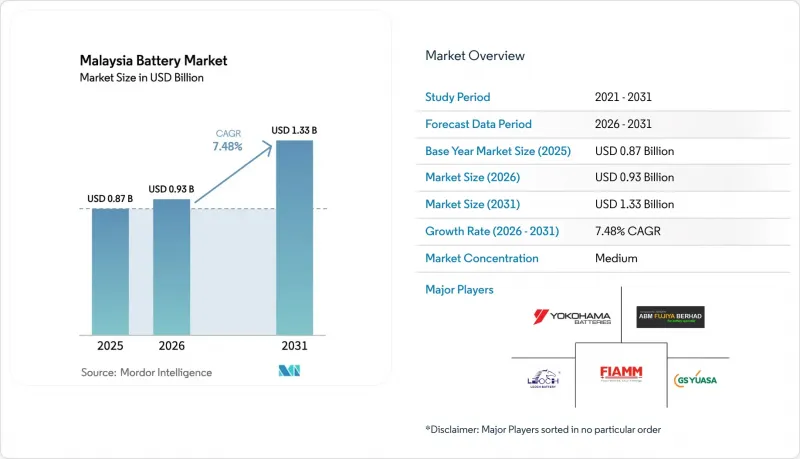
This report is Segmented by Battery Type (Primary Batteries and Secondary Batteries), Technology (Lead-Acid, Li-Ion, Nickel-Metal Hydride, Nickel-Cadmium, Sodium-Sulfur, Solid-State, Flow Battery, and Emerging Chemistries), and Application (Automotive, Industrial, Portable, Power Tools, SLI, and Other Applications). The Market Sizes and Forecasts are Provided in Terms of Value (USD).
Malaysia Battery Market Trends and Insights
Declining Lithium-Ion Battery Prices
Global lithium-ion pack costs averaged USD 108 per kWh in 2025, down 8% year-on-year despite volatile raw-material inputs. Stationary storage packs fell to USD 70 per kWh, slashing levelized costs for solar-plus-storage projects in Malaysia's commercial and industrial (C&I) sector. While falling prices compress margins for domestic cell assemblers, they expand addressable use-cases in off-grid telecom towers, industrial microgrids, and behind-the-meter systems. China's USD 84 per kWh average, 48% lower than Europe's, amplifies competitive pressure on Malaysian producers that lack scale efficiencies. The IEA foresees a further 40% global decline by 2030, implying future Malaysia battery market competitiveness will hinge more on system integration and software than on cell costs.
National Energy Transition Roadmap Incentives for ESS
Malaysia's roadmap targets 70% renewable capacity by 2050 and underwrites a 500 MW BESS roll-out by 2030. The Solar ATAP framework, live since January 2026, mandates storage integration for large-scale solar and community projects, while SELCO guidelines require batteries for rooftop systems above 72 kWp. Tenaga Nasional Berhad's MyBEST tender for 400 MW/1,600 MWh signals a shift from pilots to bankable procurement, yet capacity-payment mechanisms remain undefined, tempering private capital appetite. Early grid projects in Sarawak and Sabah validate technical viability but underscore reliance on multilateral financing.
Limited Domestic Raw-Material Supply Chain
Malaysia lacks lithium, cobalt, and nickel refining at battery-grade purity, forcing manufacturers to import precursor materials primarily from China, Australia, and Indonesia. Secondary lead stocks are plentiful but largely below 99.97% purity, limiting usefulness for valve-regulated lead-acid upgrades. Rising ESG compliance costs and dependence on volatile commodity markets heighten supply-chain risk and reduce cost competitiveness relative to Chinese imports.
Other drivers and restraints analyzed in the detailed report include:
- Expansion of Malaysia's Data-Centre Industry
- Net Energy Metering 4.0 Boosting Residential Storage
- High Upfront Cost of Stationary Storage for Households
For complete list of drivers and restraints, kindly check the Table Of Contents.
Segment Analysis
Secondary batteries held 88.1% of Malaysia's battery market share in 2025 and are forecast to grow at a 7.9% CAGR, buoyed by EV uptake, grid-scale mandates, and industrial motive replacements. Primary batteries retain 11.9% share, confined to remote sensors and medical devices. The National Energy Transition Roadmap and Solar ATAP program anchor demand for rechargeable systems, while EVE Energy's CNY 8.654 billion Phase 2 ESS investment exemplifies the scale economics needed to serve domestic and export customers. Primary battery innovation focuses on shelf-life and eco-chemistry tweaks, underscoring a structural pivot toward rechargeables.
Complete Report Scope:
- By Battery Type
- Primary Batteries
- Secondary Batteries
- By Technology
- Lead-acid
- Li-ion
- Nickel-metal hydride
- Nickel-cadmium
- Sodium-sulfur
- Solid-state
- Flow Battery
- Emerging chemistries
- By Application
- Automotive (HEV, PHEV, and EV)
- Industrial (Motive, Stationary (Telecom, UPS, ESS), etc.)
- Portable (Consumer Electronics, etc.)
- Power Tools
- SLI
- Other Applications
List of Companies Covered in this Report:
- Panasonic Energy Malaysia Sdn Bhd
- Samsung SDI Energy Malaysia Sdn Bhd
- GS Yuasa Corporation
- FIAMM Energy Technology SpA
- Yokohama Batteries Sdn Bhd
- GP Batteries (Malaysia) Sdn Bhd
- Leoch Battery Corporation
- Amaron Quanta Malaysia
- EnerSys
- Camel Group Co. Ltd
- Eclimo Sdn Bhd
- Century Motolite Battery Sdn Bhd
- ABM Fujiya Berhad
- GPA Holdings Berhad
- BYD Co. Ltd (Malaysia)
- CATL (Malaysian distributor network)
- Sunwoda Electronic Co. Ltd
- Lithium Werks Malaysia
- Duracell Malaysia Sdn Bhd
- Toshiba T&D Systems Asia
Additional Benefits:
- The market estimate (ME) sheet in Excel format
- 3 months of analyst support
TABLE OF CONTENTS
1 Introduction
- 1.1 Study Assumptions & Market Definition
- 1.2 Scope of the Study
2 Research Methodology
3 Executive Summary
4 Market Landscape
- 4.1 Market Overview
- 4.2 Market Drivers
- 4.2.1 Declining lithium-ion battery prices
- 4.2.2 National Energy Transition Roadmap incentives for ESS
- 4.2.3 Expansion of Malaysia's data-centre industry
- 4.2.4 Net Energy Metering 4.0 boosting residential storage
- 4.2.5 Rapid growth of e-moped & e-scooter market
- 4.2.6 SEA battery-manufacturing FDI inflows
- 4.3 Market Restraints
- 4.3.1 Limited domestic raw-material supply chain
- 4.3.2 High upfront cost of stationary storage for households
- 4.3.3 Policy-continuity uncertainty in EV incentives
- 4.3.4 Influx of low-cost Chinese battery imports
- 4.4 Supply-Chain Analysis
- 4.5 Regulatory Landscape
- 4.6 Technological Outlook
- 4.7 Porter's Five Forces
- 4.7.1 Threat of New Entrants
- 4.7.2 Bargaining Power of Suppliers
- 4.7.3 Bargaining Power of Buyers
- 4.7.4 Threat of Substitutes
- 4.7.5 Intensity of Competitive Rivalry
- 4.8 PESTLE Analysis
5 Market Size & Growth Forecasts
- 5.1 By Battery Type
- 5.1.1 Primary Batteries
- 5.1.2 Secondary Batteries
- 5.2 By Technology
- 5.2.1 Lead-acid
- 5.2.2 Li-ion
- 5.2.3 Nickel-metal hydride
- 5.2.4 Nickel-cadmium
- 5.2.5 Sodium-sulfur
- 5.2.6 Solid-state
- 5.2.7 Flow Battery
- 5.2.8 Emerging chemistries
- 5.3 By Application
- 5.3.1 Automotive (HEV, PHEV, and EV)
- 5.3.2 Industrial (Motive, Stationary (Telecom, UPS, ESS), etc.)
- 5.3.3 Portable (Consumer Electronics, etc.)
- 5.3.4 Power Tools
- 5.3.5 SLI
- 5.3.6 Other Applications
6 Competitive Landscape
- 6.1 Market Concentration
- 6.2 Strategic Moves (M&A, Partnerships, PPAs)
- 6.3 Market Share Analysis (Market Rank/Share for key companies)
- 6.4 Company Profiles (includes Global level Overview, Market level overview, Core Segments, Financials as available, Strategic Information, Products & Services, and Recent Developments)
- 6.4.1 Panasonic Energy Malaysia Sdn Bhd
- 6.4.2 Samsung SDI Energy Malaysia Sdn Bhd
- 6.4.3 GS Yuasa Corporation
- 6.4.4 FIAMM Energy Technology SpA
- 6.4.5 Yokohama Batteries Sdn Bhd
- 6.4.6 GP Batteries (Malaysia) Sdn Bhd
- 6.4.7 Leoch Battery Corporation
- 6.4.8 Amaron Quanta Malaysia
- 6.4.9 EnerSys
- 6.4.10 Camel Group Co. Ltd
- 6.4.11 Eclimo Sdn Bhd
- 6.4.12 Century Motolite Battery Sdn Bhd
- 6.4.13 ABM Fujiya Berhad
- 6.4.14 GPA Holdings Berhad
- 6.4.15 BYD Co. Ltd (Malaysia)
- 6.4.16 CATL (Malaysian distributor network)
- 6.4.17 Sunwoda Electronic Co. Ltd
- 6.4.18 Lithium Werks Malaysia
- 6.4.19 Duracell Malaysia Sdn Bhd
- 6.4.20 Toshiba T&D Systems Asia
7 Market Opportunities & Future Outlook
- 7.1 White-space & Unmet-Need Assessment

