PUBLISHER: Mordor Intelligence | PRODUCT CODE: 2114588

PUBLISHER: Mordor Intelligence | PRODUCT CODE: 2114588
Endodontics - Market Share Analysis, Industry Trends & Statistics, Growth Forecasts (2026 - 2031)
According to Mordor Intelligence, the endodontics market size is estimated at USD 2.16 billion in 2026, and is expected to reach USD 2.83 billion by 2031, at a CAGR of 5.55% during the forecast period (2026-2031).
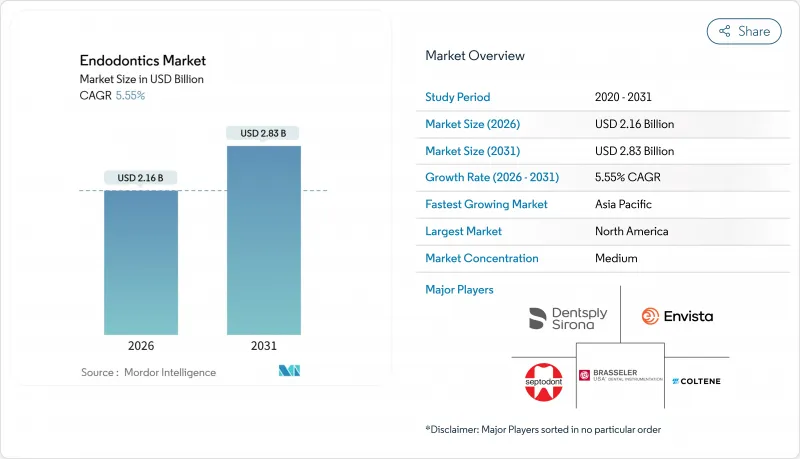
This report is Segmented by Product Type (Consumables [Endodontic Burs, Obturation Materials, and More] and Instruments [Apex Locators, Lasers, and More]), End User (Dental Clinics, Dental Hospitals and More), Technology (Manual Systems, Rotary Systems, and More), and Geography (North America, Europe, and More). The Market Forecasts are Provided in Terms of Value (USD).
Global Endodontics Market Trends and Insights
Rising Incidence of Periodontal and Dental-Caries Cases Among the Aging Population
Adults aged 65 and older will constitute 16% of the global population by 2030, a cohort with 2.8-times higher prevalence of apical periodontitis than younger age groups. Tooth-retention campaigns have lowered edentulism but simultaneously increased the number of teeth susceptible to pulpal necrosis. Japan, the world's most aged society, recorded an 11% jump in root-canal procedures per 1,000 inhabitants between 2020 and 2024, a surge fully covered by national insurance. Chronic systemic diseases such as diabetes compromise healing and raise retreatment volumes, favoring advanced obturation sealers that release calcium and hydroxyl ions. These demographic tailwinds are weaker in Sub-Saharan Africa and South Asia, where younger populations and lower dental-care utilization delay immediate impact, yet the long-term vector remains upward.
Rapid Advances in NiTi Rotary Files and Adaptive-Motion Systems
Heat-treated nickel-titanium alloys-marketed as Gold Wire, Blue Wire, or CM Wire-deliver 40%-60% higher cyclic-fatigue resistance than conventional superelastic NiTi, enabling confident shaping of complex canal curvatures. Dentsply Sirona shipped more than 8 million WaveOne Gold files globally by the end of 2025, while FKG Dentaire's XP-endo Shaper uses shape-memory expansion to minimize pre-flaring. Adaptive-motion algorithms embedded in cordless motors adjust torque and rotation in real time, reducing ledge formation and cutting chair time by 18% according to a 2025 meta-analysis. These advances are particularly impactful in multi-rooted molars where traditional files risk separation, thereby lifting clinical success and patient throughput.
High Cost of Advanced Endodontic Devices and Consumables
Equipping a treatment room with a cordless motor, apex locator, CBCT scanner, and laser platform can exceed USD 80,000. Rotary NiTi systems cost USD 8-15 per canal under single-use or limited-reuse protocols versus USD 2-3 for stainless-steel hand files, a differential hard to recover where average root-canal fees are USD 50-150. Import tariffs of 10% on dental devices in India and fragmented after-sales support in Indonesia or Nigeria further dampen adoption. Leasing and refurbished pathways help, yet warranty gaps and inconsistent service make many clinicians wary. Out-of-pocket dominant markets shift expenses straight to patients, limiting penetration to large urban clinics.
Other drivers and restraints analyzed in the detailed report include:
- Expansion of Dental-Clinic Networks and Dental-Tourism Hubs in Emerging Markets
- AI-Driven 3D Periapical Imaging Boosting Treatment Precision
- Stringent Global Approval Pathways for New Obturation and Laser Systems
For complete list of drivers and restraints, kindly check the Table Of Contents.
Segment Analysis
Consumables commanded 61.55% of Endodontics market share in 2025, driven by constant turnover of files, obturation materials, and irrigation solutions. Heat-treated NiTi files, offering 40%-60% greater fatigue resistance, are displacing conventional alloys and are pivotal to repeat purchases. Bioactive sealers that release calcium ions shorten periapical healing by up to 20% versus epoxy-resin alternatives. Instruments and equipment, although smaller, will grow at a 7.25% CAGR, underpinned by cordless motors with Bluetooth connectivity, laser units for minimally invasive pulpotomy, and AI-integrated apex locators. Machine-assisted obturation guns speed three-dimensional fills, appealing to high-volume practices. As the European Union pushes toward disposable files, unit volumes rise even as per-unit margins compress, benefiting firms with vertically integrated packaging lines.
Complete Report Scope:
- By Product Type
- Consumables
- Endodontic Burs
- Obturation Materials
- Endodontic Files & Shapers
- Irrigation Solutions & Lubricants
- Instruments / Equipment
- Apex Locators
- Lasers
- Machine-Assisted Obturation Systems
- Scalers
- Others
- Consumables
- By End-User
- Dental Clinics
- Dental Hospitals
- Academic & Research Institutes
- By Technology
- Manual Systems
- Rotary Systems
- Laser-Assisted Endodontics
- AI-Guided Navigation Systems
- By Geography
- North America
- United States
- Canada
- Mexico
- Europe
- Germany
- United Kingdom
- France
- Italy
- Spain
- Rest of Europe
- Asia-Pacific
- China
- India
- Japan
- Australia
- South Korea
- Rest of Asia-Pacific
- Middle East and Africa
- GCC
- South Africa
- Rest of Middle East and Africa
- South America
- Brazil
- Argentina
- Rest of South America
- North America
Geography Analysis
North America captured 37.23% of global revenue in 2025. The United States hosts 15 million procedures annually and leads adoption of AI navigation and laser systems, though reimbursement for retreatment and adjunctive CBCT imaging remains inconsistent. Canada's mixed public-private model creates a two-tier market, and Mexico's border cities attract U.S. dental-tourists with FDA-cleared devices at 50% lower fees.
Asia-Pacific will grow at 8.51% CAGR through 2031, powered by rising middle-class incomes and government infrastructure pushes. China subsidizes rotary systems and apex locators for rural townships, narrowing urban-rural quality gaps. India produces over 2,000 new endodontic specialists each year, fueling procedural capacity. Thailand and Malaysia combine ISO-certified supply chains with internationally trained clinicians, underpinning dental-tourism appeal. Australia is evaluating single-use mandates that could speed rotations away from reusable files and lift consumables turnover.
Europe prioritizes infection control, with Germany and France reimbursing 70%-80% of disposable file costs, hastening adoption in both private and hospital settings. The United Kingdom's NHS budget constraints maintain a divide between basic care and private premium offerings. Southern European cities cater to Northern European patients seeking lower prices yet CE-marked devices. The Middle East invests in dental hubs under healthcare diversification plans, and South Africa's private sector adopts rotary and CBCT tech at rates similar to Southern Europe.
South America records pockets of rapid growth, mainly in Brazil and Argentina where urban chains standardize protocols. Currency volatility occasionally disrupts imports but fosters local refurbishment markets for CBCT and laser equipment.
- BIOLASE
- Brasseler USA
- Coltene Holding
- Dentsply Sirona
- DiaDent Group
- EdgeEndo
- Envista (Kerr)
- FKG Dentaire
- Fotona d.o.o.
- Henry Schein Endo
- Hu-Friedy Group (STERIS)
- Ivoclar Vivadent
- J Morita Corp.
- Mani Inc.
- Micro-Mega
- Neolix
- Poldent
- Septodont
- SS White Dental
- Tri Hawk
- Ultradent Products
- VDW GmbH
Additional Benefits:
- The market estimate (ME) sheet in Excel format
- 3 months of analyst support
TABLE OF CONTENTS
1 Introduction
- 1.1 Study Assumptions & Market Definition
- 1.2 Scope of the Study
2 Research Methodology
3 Executive Summary
4 Market Landscape
- 4.1 Market Overview
- 4.2 Market Drivers
- 4.2.1 Rising incidence of periodontal & dental-caries cases among the ageing population
- 4.2.2 Rapid advances in NiTi rotary files and adaptive-motion systems
- 4.2.3 Expansion of dental-clinic networks and dental-tourism hubs in EMs
- 4.2.4 AI-driven 3-D periapical imaging boosting treatment precision
- 4.2.5 EU subsidies for single-use instrumentation to curb cross-infection
- 4.3 Market Restraints
- 4.3.1 High cost of advanced endodontic devices & consumables
- 4.3.2 Stringent global approval pathways for new obturation/laser systems
- 4.3.3 Limited reimbursement for retreatment & CBCT imaging
- 4.3.4 Eco-regulations on single-use plastics inflating consumable costs
- 4.4 Supply-Chain Analysis
- 4.5 Regulatory Landscape
- 4.6 Technological Outlook
- 4.7 Porter's Five Forces
- 4.7.1 Threat of New Entrants
- 4.7.2 Bargaining Power of Suppliers
- 4.7.3 Bargaining Power of Buyers
- 4.7.4 Threat of Substitutes
- 4.7.5 Competitive Rivalry
5 Market Size & Growth Forecasts (Value, USD)
- 5.1 By Product Type
- 5.1.1 Consumables
- 5.1.1.1 Endodontic Burs
- 5.1.1.2 Obturation Materials
- 5.1.1.3 Endodontic Files & Shapers
- 5.1.1.4 Irrigation Solutions & Lubricants
- 5.1.2 Instruments / Equipment
- 5.1.2.1 Apex Locators
- 5.1.2.2 Lasers
- 5.1.2.3 Machine-Assisted Obturation Systems
- 5.1.2.4 Scalers
- 5.1.2.5 Others
- 5.1.1 Consumables
- 5.2 By End-User
- 5.2.1 Dental Clinics
- 5.2.2 Dental Hospitals
- 5.2.3 Academic & Research Institutes
- 5.3 By Technology
- 5.3.1 Manual Systems
- 5.3.2 Rotary Systems
- 5.3.3 Laser-Assisted Endodontics
- 5.3.4 AI-Guided Navigation Systems
- 5.4 By Geography
- 5.4.1 North America
- 5.4.1.1 United States
- 5.4.1.2 Canada
- 5.4.1.3 Mexico
- 5.4.2 Europe
- 5.4.2.1 Germany
- 5.4.2.2 United Kingdom
- 5.4.2.3 France
- 5.4.2.4 Italy
- 5.4.2.5 Spain
- 5.4.2.6 Rest of Europe
- 5.4.3 Asia-Pacific
- 5.4.3.1 China
- 5.4.3.2 India
- 5.4.3.3 Japan
- 5.4.3.4 Australia
- 5.4.3.5 South Korea
- 5.4.3.6 Rest of Asia-Pacific
- 5.4.4 Middle East and Africa
- 5.4.4.1 GCC
- 5.4.4.2 South Africa
- 5.4.4.3 Rest of Middle East and Africa
- 5.4.5 South America
- 5.4.5.1 Brazil
- 5.4.5.2 Argentina
- 5.4.5.3 Rest of South America
- 5.4.1 North America
6 Competitive Landscape
- 6.1 Market Concentration
- 6.2 Market Share Analysis
- 6.3 Company Profiles (includes Global level Overview, Market level overview, Core Segments, Financials as available, Strategic Information, Market Rank/Share for key companies, Products & Services, and Recent Developments)
- 6.3.1 Biolase
- 6.3.2 Brasseler USA
- 6.3.3 Coltene Holding
- 6.3.4 Dentsply Sirona
- 6.3.5 DiaDent Group
- 6.3.6 EdgeEndo
- 6.3.7 Envista (Kerr)
- 6.3.8 FKG Dentaire
- 6.3.9 Fotona d.o.o.
- 6.3.10 Henry Schein Endo
- 6.3.11 Hu-Friedy Group (STERIS)
- 6.3.12 Ivoclar Vivadent
- 6.3.13 J Morita Corp.
- 6.3.14 Mani Inc.
- 6.3.15 Micro-Mega
- 6.3.16 Neolix
- 6.3.17 Poldent
- 6.3.18 Septodont Holding
- 6.3.19 SS White Dental
- 6.3.20 Tri Hawk
- 6.3.21 Ultradent Products
- 6.3.22 VDW GmbH
7 Market Opportunities & Future Outlook
- 7.1 White-space & Unmet-Need Assessment

