PUBLISHER: Mordor Intelligence | PRODUCT CODE: 2114613

PUBLISHER: Mordor Intelligence | PRODUCT CODE: 2114613
United States Pet - Market Share Analysis, Industry Trends & Statistics, Growth Forecasts (2026 - 2031)
According to Mordor Intelligence, the United States pet market was valued at USD 155.4 billion in 2025 and estimated to grow from USD 165.6 billion in 2026 to reach USD 228.0 billion by 2031, at a CAGR of 6.60% during the forecast period (2026-2031).
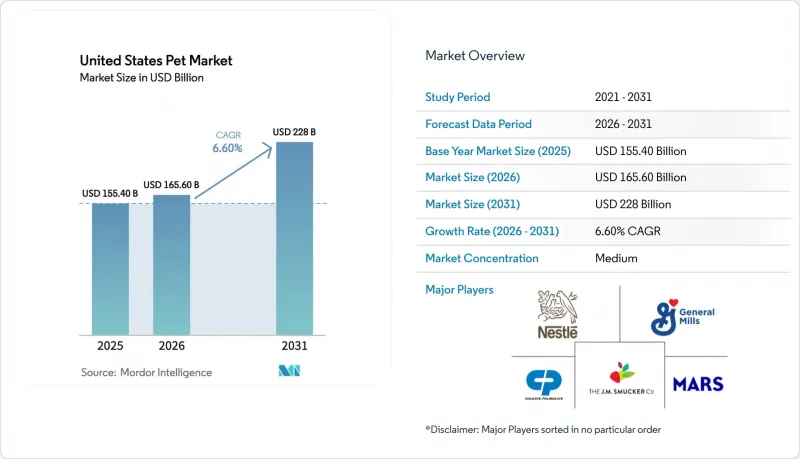
This report is Segmented by Pet Type (Dog, Cat, and Other Pets), by Product Type (Food, Supplies, and Services), and by Distribution Channel (Supermarkets and Hypermarkets, Mass Merchandisers and Club, Pet Specialty Stores, Veterinary Clinics, Online Retailers, and Direct-To-Consumer Brands). The Market Forecasts are Provided in Terms of Value (USD).
United States Pet Market Trends and Insights
Humanization-Driven Premium Spend
Fresh and frozen meals have highlighted consumers' willingness to invest in minimally processed, nutritious options. The emphasis on premium offerings has expanded to include services such as grooming, behavioral training, and spa treatments, creating recurring revenue opportunities for specialty retailers. Transparency in product ingredients, including single-protein formulas and non-GMO (genetically modified organism) labels, strengthens brand loyalty among health-conscious pet owners. Additionally, social media platforms contribute to the normalization of high-end purchases by promoting aspirational pet lifestyles, thereby increasing peer-to-peer influence on purchasing decisions. Companies that integrate personalization and functional health claims continue to experience consistent demand for premium products, even during broader economic uncertainties.
Accelerating E-commerce and Omnichannel Penetration
Online channels captured a significant share of the United States pet market revenue in 2025, a share driven by autoship subscriptions that reduce churn and elevate lifetime value. E-retailer Chewy generated USD 11.86 billion in net sales for fiscal 2024, with the majority share derived from autoship customers. Brick-and-mortar chains responded by launching click-and-collect services, deploying mobile apps, and partnering with last-mile couriers to match the immediacy of pure plays. Direct-to-consumer newcomers leverage higher gross margins to fund agile innovation and rapid brand storytelling. This distribution shift compresses prices in commodity categories while widening the gap in premium, data-driven services.
Inflation-Driven Trade-Down to Value Brands
Consumer budgets tightened in 2025 as food and energy prices rose, shifting demand toward private-label offerings at mass merchants. A leading warehouse club's in-house pet food line gained share, compressing volume for mid-tier brands. Bank transaction data indicated that category spending grew just 3.2% in 2025, below long-term averages . Brands have responded with smaller pack sizes and value-tier extensions to preserve shopper loyalty. While inflation is projected to moderate, price sensitivity could outlast the immediate economic cycle, making portfolio depth essential for manufacturers.
Other drivers and restraints analyzed in the detailed report include:
- Rising Pet-Insurance Adoption
- FDA Fast-Track Pathway for Novel Therapeutics
- Veterinary Workforce Shortage
For complete list of drivers and restraints, kindly check the Table Of Contents.
Segment Analysis
Dogs accounted for 60% of the United States pet market size in 2025, while cats are projected to outpace with a 7.8% CAGR through 2031. The faster feline trajectory stems from apartment-friendly ownership patterns among young professionals and the recent rollout of premium cat-specific nutrition, therapeutic, and insurance products. Other pets, such as birds, freshwater fish, reptiles, and small mammals, combined, represented comparatively less revenue, benefiting from specialized diets and habitat innovations that boost average basket size. Cats' expanding penetration into employer-sponsored insurance programs reinforces the frequency of clinical care, narrowing historical disparities with canine coverage. Regulatory approvals, such as the monoclonal antibody for feline osteoarthritis in 2024, further catalyze veterinary spend and anchor the species' upgrade cycle.
Lower ownership costs and an independent nature make cats attractive for urban dwellers, while social media visibility elevates their cultural status, propelling accessory and furniture purchases. Dogs retain leadership in services such as daycare, training, and outdoor gear, where behavioral complexity supports higher ticket prices. Reptile and exotic avian ownership is limited by interstate transport rules and veterinary accessibility, capping their upside despite niche enthusiasm. Small mammal sales remain stable, buoyed by educational campaigns underscoring responsible care. To succeed across species, manufacturers and retailers must tailor communication and product design to distinct behavioral and health drivers rather than adopting a monolithic strategy.
Complete Report Scope:
- By Pet Type
- Dog
- Cat
- Other Pets
- By Product Type
- Food
- Dry Kibble
- Wet / Canned
- Fresh / Frozen
- Treats and Chews
- Supplements
- Supplies
- Grooming and Hygiene
- Toys and Enrichment
- Bedding and Habitat
- Other Supplies
- Services
- Veterinary Care
- Insurance
- Boarding and Day-care
- Training and Behavior
- Food
- By Distribution Channel
- Supermarkets / Hypermarkets
- Mass Merchandisers / Club
- Pet Specialty Stores
- Veterinary Clinics
- Online Retailers
- Direct-to-Consumer Brands
List of Companies Covered in this Report:
- Mars, Incorporated
- Nestle S.A.(Purina)
- Colgate-Palmolive Company (Hill's Pet Nutrition Inc.)
- The J. M. Smucker Company
- General Mills Inc.
- Spectrum Brands, Inc.
- BC Partners
- Petco Animal Supplies, Inc.
- Elanco Animal Health Inc.
- Freshpet Inc.
- Zoetis Services LLC
- Trupanion
- Central Garden & Pet Company
- Bark, Inc.
- The Farmer's Dog, Inc.
Additional Benefits:
- The market estimate (ME) sheet in Excel format
- 3 months of analyst support
TABLE OF CONTENTS
1 Introduction
- 1.1 Study Assumptions and Market Definition
- 1.2 Scope of the Study
2 Research Methodology
3 Executive Summary
4 Market Landscape
- 4.1 Market Overview
- 4.2 Market Drivers
- 4.2.1 Humanization-Driven Premium Spend
- 4.2.2 Accelerating E-commerce and Omnichannel Penetration
- 4.2.3 Rising Pet-Insurance Adoption
- 4.2.4 Employer-Sponsored Pet-Care Benefits Expansion
- 4.2.5 FDA Fast-Track Pathway for Novel Therapeutics
- 4.2.6 Climate-Resilient Novel Protein Sourcing
- 4.3 Market Restraints
- 4.3.1 Inflation-Driven Trade-Down to Value Brands
- 4.3.2 Veterinary Workforce Shortage
- 4.3.3 Extended Producer-Responsibility Packaging Fees
- 4.3.4 Social-Media Trend Volatility and Inventory Risk
- 4.4 Regulatory Landscape
- 4.5 Technological Outlook
- 4.6 Porter's Five Forces
- 4.6.1 Bargaining Power of Suppliers
- 4.6.2 Bargaining Power of Buyers/Consumers
- 4.6.3 Threat of New Entrants
- 4.6.4 Threat of Substitute Products
- 4.6.5 Intensity of Competitive Rivalry
5 Market Size and Growth Forecasts (Value)
- 5.1 By Pet Type
- 5.1.1 Dog
- 5.1.2 Cat
- 5.1.3 Other Pets
- 5.2 By Product Type
- 5.2.1 Food
- 5.2.1.1 Dry Kibble
- 5.2.1.2 Wet / Canned
- 5.2.1.3 Fresh / Frozen
- 5.2.1.4 Treats and Chews
- 5.2.1.5 Supplements
- 5.2.2 Supplies
- 5.2.2.1 Grooming and Hygiene
- 5.2.2.2 Toys and Enrichment
- 5.2.2.3 Bedding and Habitat
- 5.2.2.4 Other Supplies
- 5.2.3 Services
- 5.2.3.1 Veterinary Care
- 5.2.3.2 Insurance
- 5.2.3.3 Boarding and Day-care
- 5.2.3.4 Training and Behavior
- 5.2.1 Food
- 5.3 By Distribution Channel
- 5.3.1 Supermarkets / Hypermarkets
- 5.3.2 Mass Merchandisers / Club
- 5.3.3 Pet Specialty Stores
- 5.3.4 Veterinary Clinics
- 5.3.5 Online Retailers
- 5.3.6 Direct-to-Consumer Brands
6 Competitive Landscape
- 6.1 Market Concentration
- 6.2 Strategic Moves
- 6.3 Market Share Analysis
- 6.4 Company Profiles (includes Global Level Overview, Market Level Overview, Core Business Segments, Financials, Key Information, Market Rank, Market Share, Products and Services, and Analysis of Recent Developments).
- 6.4.1 Mars, Incorporated
- 6.4.2 Nestle S.A.(Purina)
- 6.4.3 Colgate-Palmolive Company (Hill's Pet Nutrition Inc.)
- 6.4.4 The J. M. Smucker Company
- 6.4.5 General Mills Inc.
- 6.4.6 Spectrum Brands, Inc.
- 6.4.7 BC Partners
- 6.4.8 Petco Animal Supplies, Inc.
- 6.4.9 Elanco Animal Health Inc.
- 6.4.10 Freshpet Inc.
- 6.4.11 Zoetis Services LLC
- 6.4.12 Trupanion
- 6.4.13 Central Garden & Pet Company
- 6.4.14 Bark, Inc.
- 6.4.15 The Farmer's Dog, Inc.
7 Market Opportunities and Future Outlook

