PUBLISHER: Mordor Intelligence | PRODUCT CODE: 2114615

PUBLISHER: Mordor Intelligence | PRODUCT CODE: 2114615
Sealing And Strapping Packaging Tapes - Market Share Analysis, Industry Trends & Statistics, Growth Forecasts (2026 - 2031)
According to Mordor Intelligence, the sealing and strapping packaging tapes market size is expected to grow from USD 21.52 billion in 2025 to USD 22.58 billion in 2026 and is forecast to reach USD 28.71 billion by 2031 at 4.92% CAGR over 2026-2031.
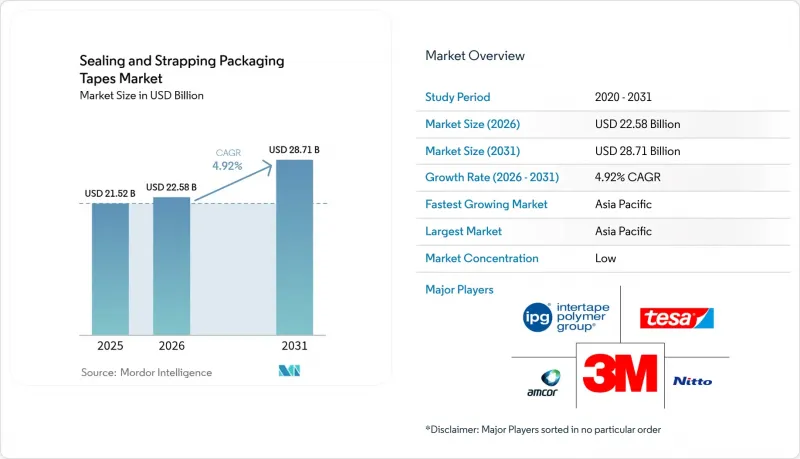
This report is Segmented by Material Type (Plastic, Paper, Foil and Filament, and More), Adhesive Type (Acrylic, Rubber-Based, Hot-Melt, and More), Backing Substrate (BOPP, Kraft Paper, PET, PVC, Glass-Fibre Filament), End-Use Industry (Logistics and Warehousing, E-Commerce and Retail Fulfilment, and More), and by Geography. The Market Forecasts are Provided in Terms of Value (USD).
Global Sealing And Strapping Packaging Tapes Market Trends and Insights
E-commerce boom boosting carton-sealing tape consumption
Digital retail accelerates parcel counts, multiplying tape usage per shipment as each box requires primary sealing, reinforcement, and tamper evidence. High-speed fulfillment centers specify low-noise, high-adhesion tapes capable of withstanding temperature swings from cold-chain nodes to desert delivery routes. Custom-printed tapes double as security devices and brand assets, supporting direct-to-consumer marketing strategies. Cross-border sellers demand multi-certified products that comply with food-contact and pharmaceutical rules, creating premium niches for suppliers able to verify conformity. The sealing and strapping packaging tapes market is therefore tightly coupled to the volume and sophistication of last-mile delivery operations.
Expansion of global logistics and warehousing hubs
Automated warehouses rely on robotic taping systems that require substrates with consistent unwind profiles and controlled adhesion curves. Investments in cold-storage and pharma distribution centers spur demand for low-temperature adhesives that avoid brittleness at sub-zero conditions. Regional hubs in the UAE and Saudi Arabia broaden supply footprints, lifting tape consumption in the Middle East and Africa. Meanwhile, just-in-time inventory models shorten production lots, driving smaller but more frequent tape orders that benefit converters with flexible scheduling capabilities. Through 2030, the sealing and strapping packaging tapes market is expected to shadow global warehouse square-footage growth.
Volatile petroleum-based raw-material prices
Propylene and ethylene cost swings squeeze converters' margins as polypropylene and polyethylene account for a significant slice of input spnd. Cracker shutdowns in Southeast Asia heighten supply risk, forcing producers to hedge inventories or negotiate formula-based contracts. Adhesive ingredients follow similar volatility, particularly natural rubber used in high-tack tapes. Short-term price spikes strain smaller manufacturers with limited purchasing leverage, potentially slowing capacity additions in the sealing and strapping packaging tapes market.
Other drivers and restraints analyzed in the detailed report include:
- Cost-performance shift toward BOPP and PET tapes
- Smart tamper-evident tapes with RFID/QR for traceability
- Strict regulations on single-use plastics
For complete list of drivers and restraints, kindly check the Table Of Contents.
Segment Analysis
Plastic tapes retained 51.78% of revenue in 2025 thanks to durable BOPP and PET films that combine moisture resistance and competitive pricing. The sealing and strapping packaging tapes market size attributed to plastics is set to climb alongside e-commerce corrugated box usage, though its share gradually erodes as regulations favor fiber-based products. Paper tapes, especially water-activated varieties, post a 8.78% CAGR to 2031, buoyed by recyclability mandates and brand owners' zero-plastic pledges. European rules calling for fully recyclable packaging by 2030 catalyze paper adoption, while North American retailers promote fiber-based sealing options to meet corporate ESG targets. Hybrid substrates that apply thin poly coatings onto kraft backings emerge, marrying barrier performance with easy repulpability. Material innovators target carbon-neutral formulations by blending recycled content with bio-resins, positioning paper to capture incremental share across premium consumer segments. Over the forecast horizon, plastic producers focus on downgauging and chemical-recycling alliances to maintain relevance within the sealing and strapping packaging tapes market.
Acrylic chemistries delivered 46.92% of 2025 sales, favored for UV stability and storage durability in hot and cold supply chains. Rubber-based systems, including synthetic variants, grow 7.94% annually as high-speed automated lines demand instant tack for faster case-forming cycles. Hot-melt grades gain traction in refrigerated environments, avoiding condensation-related failures. Silicone adhesives, though niche, serve automotive battery and electronics assemblies that face extremes from -300°F to 1000°F. Water-activated starch glues resurge alongside paper backings, with converters investing in precision dispensers to improve cycle times. Partnerships such as Dow-Henkel pursue bio-based polymer designs to cut cradle-to-gate emissions by 25% Dow. Suppliers therefore segment offerings by application, optimizing resin blends to capture diverse opportunities within the sealing and strapping packaging tapes industry.
Complete Report Scope:
- By Material Type
- Plastic
- BOPP
- PP
- PET
- PVC
- Paper
- Foil and Filament
- Others
- Plastic
- By Adhesive Type
- Acrylic (Water-/Solvent-/UV)
- Rubber-based (Natural and Synthetic)
- Hot-melt
- Silicone
- Water-activated Starch-based
- By Backing Substrate
- Biaxially-oriented Polypropylene (BOPP)
- Kraft Paper
- Polyester (PET)
- PVC
- Glass-fibre Filament
- By End-use Industry
- Logistics and Warehousing
- E-commerce and Retail Fulfilment
- Food and Beverage
- Pharmaceuticals and Medical Devices
- Electronics and Electricals
- Automotive and Industrial
- Others
- By Geography
- North America
- United States
- Canada
- Mexico
- Europe
- Germany
- United Kingdom
- France
- Italy
- Spain
- Russia
- Rest of Europe
- Asia-Pacific
- China
- India
- Japan
- South Korea
- Australia and New Zealand
- Rest of Asia-Pacific
- Middle East and Africa
- Middle East
- United Arab Emirates
- Saudi Arabia
- Turkey
- Rest of Middle East
- Africa
- South Africa
- Nigeria
- Egypt
- Rest of Africa
- Middle East
- South America
- Brazil
- Argentina
- Rest of South America
- North America
Geography Analysis
Asia-Pacific dominated the sealing and strapping packaging tapes market with 38.10% share in 2025 and is projected to advance at 8.55% CAGR to 2031. China sustains volume demand through export-oriented manufacturing, while India's digital commerce boom elevates parcel counts and paper-tape penetration. Regional governments channel infrastructure spending toward smart warehouses and 5G-enabled logistics corridors, stimulating demand for RFID-compatible tapes. Cross-border e-marketplaces intensify service-level competition, prompting carriers to standardize on global adhesives to minimize in-transit failures. Local suppliers benefit from proximate resin and film capacity, yet multinationals scale up regional plants, as evidenced by tesa's new Mumbai and Bengaluru hubs that bolster technical support and cut lead times.
North America, though mature, remains lucrative due to premium adoption of smart and sustainable solutions. Tariff dynamics with Canada and Mexico influence raw-material flows and sourcing strategies, pushing converters to balance domestic and imported substrate. Retail consolidation amplifies vendor qualification hurdles, but it also rewards suppliers capable of nationwide service and data-driven performance reporting. Smart-packaging mandates from big-box chains accelerate RFID tape rollouts, turning warehouses into real-time visibility nodes for omnichannel inventory.
- 3M Company
- Tesa SE (Beiersdorf)
- Nitto Denko Corporation
- Intertape Polymer Group
- Berry Global Inc.
- Avery Dennison Corporation
- Shurtape Technologies
- Scapa Group plc
- Nichiban Co., Ltd.
- CCT Tapes
- Mactac LLC
- Ajit Industries
- Saint-Gobain Performance Plastics
- Henkel AG & Co. KGaA
- Rogers Corporation
- You-San Technology
- Dow Inc. (Hot-melt resins)
- Bostik SA
- UPM Raflatac (Paper-backed tapes)
- Duck Brand (ShurTech)
Additional Benefits:
- The market estimate (ME) sheet in Excel format
- 3 months of analyst support
TABLE OF CONTENTS
1 INTRODUCTION
- 1.1 Study Assumptions and Market Definition
- 1.2 Scope of the Study
2 RESEARCH METHODOLOGY
3 EXECUTIVE SUMMARY
4 MARKET LANDSCAPE
- 4.1 Market Overview
- 4.2 Market Drivers
- 4.2.1 E-commerce boom boosting carton-sealing tape consumption
- 4.2.2 Expansion of global logistics and warehousing hubs
- 4.2.3 Cost-performance shift toward BOPP and PET tapes
- 4.2.4 Smart tamper-evident tapes with RFID/QR for traceability
- 4.2.5 Growth in recyclable water-activated paper tapes
- 4.3 Market Restraints
- 4.3.1 Volatile petroleum-based raw-material prices
- 4.3.2 Strict regulations on single-use plastics
- 4.3.3 Adhesive-VOC emission compliance costs
- 4.3.4 Automation bottlenecks in paper-tape dispensing lines
- 4.4 Supply-Chain Analysis
- 4.5 Regulatory Landscape
- 4.6 Technological Outlook
- 4.7 Porter's Five Forces
- 4.7.1 Threat of New Entrants
- 4.7.2 Bargaining Power of Buyers
- 4.7.3 Bargaining Power of Suppliers
- 4.7.4 Threat of Substitutes
- 4.7.5 Intensity of Competitive Rivalry
5 MARKET SIZE AND GROWTH FORECASTS (VALUE)
- 5.1 By Material Type
- 5.1.1 Plastic
- 5.1.1.1 BOPP
- 5.1.1.2 PP
- 5.1.1.3 PET
- 5.1.1.4 PVC
- 5.1.2 Paper
- 5.1.3 Foil and Filament
- 5.1.4 Others
- 5.1.1 Plastic
- 5.2 By Adhesive Type
- 5.2.1 Acrylic (Water-/Solvent-/UV)
- 5.2.2 Rubber-based (Natural and Synthetic)
- 5.2.3 Hot-melt
- 5.2.4 Silicone
- 5.2.5 Water-activated Starch-based
- 5.3 By Backing Substrate
- 5.3.1 Biaxially-oriented Polypropylene (BOPP)
- 5.3.2 Kraft Paper
- 5.3.3 Polyester (PET)
- 5.3.4 PVC
- 5.3.5 Glass-fibre Filament
- 5.4 By End-use Industry
- 5.4.1 Logistics and Warehousing
- 5.4.2 E-commerce and Retail Fulfilment
- 5.4.3 Food and Beverage
- 5.4.4 Pharmaceuticals and Medical Devices
- 5.4.5 Electronics and Electricals
- 5.4.6 Automotive and Industrial
- 5.4.7 Others
- 5.5 By Geography
- 5.5.1 North America
- 5.5.1.1 United States
- 5.5.1.2 Canada
- 5.5.1.3 Mexico
- 5.5.2 Europe
- 5.5.2.1 Germany
- 5.5.2.2 United Kingdom
- 5.5.2.3 France
- 5.5.2.4 Italy
- 5.5.2.5 Spain
- 5.5.2.6 Russia
- 5.5.2.7 Rest of Europe
- 5.5.3 Asia-Pacific
- 5.5.3.1 China
- 5.5.3.2 India
- 5.5.3.3 Japan
- 5.5.3.4 South Korea
- 5.5.3.5 Australia and New Zealand
- 5.5.3.6 Rest of Asia-Pacific
- 5.5.4 Middle East and Africa
- 5.5.4.1 Middle East
- 5.5.4.1.1 United Arab Emirates
- 5.5.4.1.2 Saudi Arabia
- 5.5.4.1.3 Turkey
- 5.5.4.1.4 Rest of Middle East
- 5.5.4.2 Africa
- 5.5.4.2.1 South Africa
- 5.5.4.2.2 Nigeria
- 5.5.4.2.3 Egypt
- 5.5.4.2.4 Rest of Africa
- 5.5.4.1 Middle East
- 5.5.5 South America
- 5.5.5.1 Brazil
- 5.5.5.2 Argentina
- 5.5.5.3 Rest of South America
- 5.5.1 North America
6 COMPETITIVE LANDSCAPE
- 6.1 Market Concentration
- 6.2 Strategic Moves
- 6.3 Market Share Analysis
- 6.4 Company Profiles (includes Global level Overview, Market level overview, Core Segments, Financials as available, Strategic Information, Market Rank/Share, Products and Services, Recent Developments)
- 6.4.1 3M Company
- 6.4.2 Tesa SE (Beiersdorf)
- 6.4.3 Nitto Denko Corporation
- 6.4.4 Intertape Polymer Group
- 6.4.5 Berry Global Inc.
- 6.4.6 Avery Dennison Corporation
- 6.4.7 Shurtape Technologies
- 6.4.8 Scapa Group plc
- 6.4.9 Nichiban Co., Ltd.
- 6.4.10 CCT Tapes
- 6.4.11 Mactac LLC
- 6.4.12 Ajit Industries
- 6.4.13 Saint-Gobain Performance Plastics
- 6.4.14 Henkel AG & Co. KGaA
- 6.4.15 Rogers Corporation
- 6.4.16 You-San Technology
- 6.4.17 Dow Inc. (Hot-melt resins)
- 6.4.18 Bostik SA
- 6.4.19 UPM Raflatac (Paper-backed tapes)
- 6.4.20 Duck Brand (ShurTech)
7 MARKET OPPORTUNITIES AND FUTURE OUTLOOK
- 7.1 White-space and Unmet-need Assessment

