PUBLISHER: Mordor Intelligence | PRODUCT CODE: 2125597

PUBLISHER: Mordor Intelligence | PRODUCT CODE: 2125597
North America Packaging Tapes - Market Share Analysis, Industry Trends & Statistics, Growth Forecasts (2026 - 2031)
According to Mordor Intelligence, the North America packaging tapes market size is estimated at USD 8.01 billion in 2026, and is expected to reach USD 10.18 billion by 2031, at a CAGR of 4.92% during the forecast period (2026-2031).
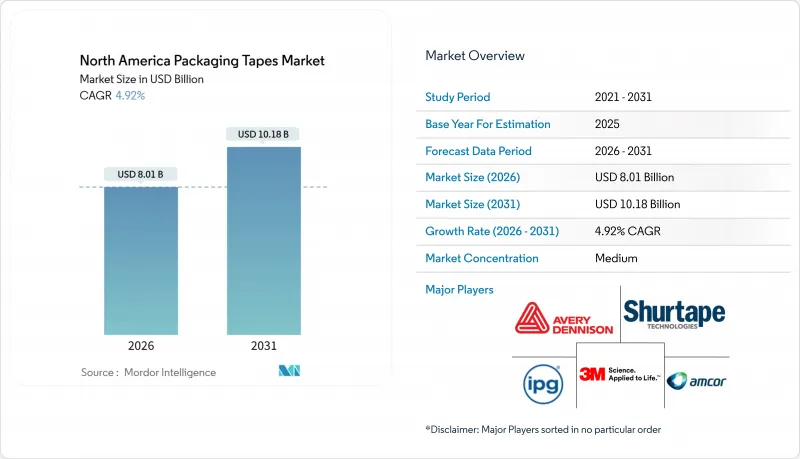
This report is Segmented by Material Type (Plastic and Paper), Adhesive Type (Acrylic, Hot-Melt, Rubber-Based, and Others), End-User Industry (E-Commerce, Food and Beverage Industry, Retail Industry, and Others), and Geography (United States, Canada, and Mexico). The Market Forecasts are Provided in Terms of Value (USD).
North America Packaging Tapes Market Trends and Insights
Resilient E-Commerce And Omni-Channel Logistics Demand
Automation is ratcheting up tape consumption per carton sealed. Amazon's 2024 warehouse expansion added additional capacity equipped with case sealers that process boxes at a steady rate, each requiring hot-melt tapes that deliver instant grab. Fulfillment providers consolidate inventory into fewer, larger hubs, raising average throughput and ensuring the packaging tapes market continues to expand even if e-commerce penetration levels off. Robotics eliminates manual dwell time, favoring adhesives that bond in under one second, while level-wound rolls support uninterrupted runs on high-speed equipment. Because downtime costs can be high, operators willingly pay premiums for splice-free, automation-grade tapes that guarantee process reliability.
Food-Grade Compliance Accelerating Paper And WAT Adoption
In response to FDA 21 CFR 175.105 and Canada's CFIA regulations, there's a heightened demand for proof that adhesives won't leach into food. This push has nudged buyers towards opting for water-based acrylics or water-activated chemistries on kraft backings. Despite these tapes commanding a price premium, food and beverage brands are willing to absorb the extra cost to safeguard their export certifications. Henkel's AQUENCE PS range, boasting food contact certification, is now penetrating beverage and chilled-food sectors, where a low-temperature tack is essential. With PFAS restrictions tightening, 3M is set to completely withdraw from that chemical class by the close of 2025, necessitating a reformulation of its legacy products. Retailers, aligning supplier scorecards with ESG metrics, view paper tapes as an efficient solution to reduce plastic usage and sidestep EPR fees, positioning them as pivotal players in reshaping the packaging tapes landscape.
Volatile Propylene And Rubber Feedstock Prices
In 2024, spot propylene prices fluctuated across Gulf Coast hubs. This volatility led to a reduction of BOPP margins within a single quarter. Similarly, rubber raw materials experienced price swings, largely attributed to weather disruptions in Southeast Asia. While larger manufacturers can hedge against these fluctuations using multi-year contracts, regional converters often lack this advantage. As a result, they are compelled to pass on the volatility to buyers, albeit with a delay. This delay strains their relationships with high-volume retailers, who typically budget for annual tape costs months in advance. Consequently, even as the packaging tapes market sees a rise in volume, spikes in feedstock prices dampen profit expectations.
Other drivers and restraints analyzed in the detailed report include:
- Automation-Ready Hot-Melt PSA Lines At NA Fulfillment Hubs
- Near-Shoring Boosts Tape Demand In Cross-Border Trade Zones
- Rising State Plastic-Waste EPR Fees On BOPP/PVC Tapes
For complete list of drivers and restraints, kindly check the Table Of Contents.
Segment Analysis
Paper tapes are forecast to rise 5.61% CAGR through 2031, eclipsing overall packaging tapes market growth as brands target substrates that move seamlessly through recycling mills. Plastic grades retained 77.11% of 2025 revenue because BOPP resists humidity and maintains tensile strength in export shipments, yet national retailers have committed to eliminating unrecyclable components by 2030. These pledges allow paper variants to cannibalize low-risk SKUs, especially in e-commerce channels where tape visibility also supports branding.
Kraft backings paired with water-activated adhesives seal fiber-based cartons without contaminating paper streams, making them a preferred option in states that impose EPR fees. Reinforced paper tape closes historical strength gaps, enabling paper to secure medium-duty loads previously reserved for plastic. Conversely, frozen food and cross-continent routes still demand plastic grades that withstand extreme temperatures. Adhesive formulators respond by tailoring tack to recycled corrugate, ensuring both substrates retain their share in their respective niches as the packaging tapes market diversifies.
Complete Report Scope:
- By Material Type
- Plastic
- Paper
- By Adhesive Type
- Acrylic
- Hot-Melt
- Rubber-Based
- Others
- By End-User Industry
- E-Commerce
- Food and Beverage Industry
- Retail Industry
- Others
- Geography
- United States
- Canada
- Mexico
List of Companies Covered in this Report:
- 3M
- Amcor plc
- Avery Dennison Corporation
- CCT Tapes
- Henkel AG & Co. KGaA
- Intertape Polymer Group Inc.
- LINTEC Corporation
- Mactac LLC
- Nitto Denko Corporation
- Scapa
- Shurtape Technologies LLC
- Tesa SE
Additional Benefits:
- The market estimate (ME) sheet in Excel format
- 3 months of analyst support
TABLE OF CONTENTS
1 Introduction
- 1.1 Study Assumptions and Market Definition
- 1.2 Scope of the Study
2 Research Methodology
3 Executive Summary
4 Market Landscape
- 4.1 Market Overview
- 4.2 Market Drivers
- 4.2.1 Resilient e-commerce and omni-channel logistics demand
- 4.2.2 Food-grade compliance accelerating paper and WAT adoption
- 4.2.3 Automation-ready hot-melt PSA lines at NA fulfillment hubs
- 4.2.4 Near-shoring boosts tape demand in cross-border trade zones
- 4.2.5 Digitally-printed, brand-protection tapes gain traction
- 4.3 Market Restraints
- 4.3.1 Volatile propylene and rubber feedstock prices
- 4.3.2 Rising state plastic-waste EPR fees on BOPP/PVC tapes
- 4.3.3 Capital cost of converting legacy lines to water-based systems
- 4.4 Value Chain Analysis
- 4.5 Porter's Five Forces
- 4.5.1 Bargaining Power of Suppliers
- 4.5.2 Bargaining Power of Consumers
- 4.5.3 Threat of New Entrants
- 4.5.4 Threat of Substitute Products
- 4.5.5 Degree of Competition
5 Market Size and Growth Forecasts (Value)
- 5.1 By Material Type
- 5.1.1 Plastic
- 5.1.2 Paper
- 5.2 By Adhesive Type
- 5.2.1 Acrylic
- 5.2.2 Hot-Melt
- 5.2.3 Rubber-Based
- 5.2.4 Others
- 5.3 By End-User Industry
- 5.3.1 E-Commerce
- 5.3.2 Food and Beverage Industry
- 5.3.3 Retail Industry
- 5.3.4 Others
- 5.4 Geography
- 5.4.1 United States
- 5.4.2 Canada
- 5.4.3 Mexico
6 Competitive Landscape
- 6.1 Market Concentration
- 6.2 Strategic Moves
- 6.3 Market Share (%)/Ranking Analysis
- 6.4 Company Profiles (includes Global level Overview, Market level overview, Core Segments, Financials as available, Strategic Information, Products and Services, Recent Developments)
- 6.4.1 3M
- 6.4.2 Amcor plc
- 6.4.3 Avery Dennison Corporation
- 6.4.4 CCT Tapes
- 6.4.5 Henkel AG & Co. KGaA
- 6.4.6 Intertape Polymer Group Inc.
- 6.4.7 LINTEC Corporation
- 6.4.8 Mactac LLC
- 6.4.9 Nitto Denko Corporation
- 6.4.10 Scapa
- 6.4.11 Shurtape Technologies LLC
- 6.4.12 Tesa SE
7 Market Opportunities and Future Outlook
- 7.1 White-Space and Unmet-Need Assessment

