PUBLISHER: Mordor Intelligence | PRODUCT CODE: 2116913

PUBLISHER: Mordor Intelligence | PRODUCT CODE: 2116913
Packaging Tapes - Market Share Analysis, Industry Trends & Statistics, Growth Forecasts (2026 - 2031)
According to Mordor Intelligence, packaging tapes market size in 2026 is estimated at USD 34.08 billion, growing from 2025 value of USD 32.14 billion with 2031 projections showing USD 45.72 billion, growing at 6.05% CAGR over 2026-2031.
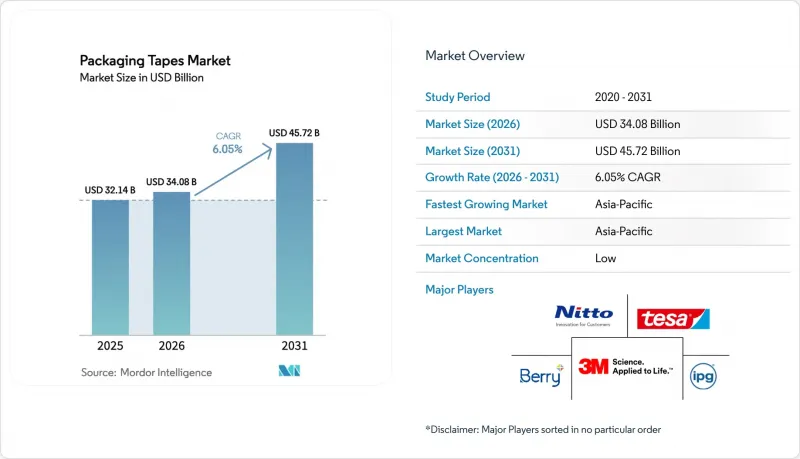
This report is Segmented by Material Type (Plastic, Paper), Adhesive Type (Acrylic, Hot-Melt, Rubber-Based, Other Adhesive Types), Product Form (Carton-Sealing Tapes, Masking and Painter's Tapes, Strapping and Bundling Tapes), End-User Industry (E-Commerce, Food and Beverage, Retail, Other End-User Industries), and Geography (Asia-Pacific, North America, Europe, South America, and Middle-East and Africa).
Global Packaging Tapes Market Trends and Insights
E-commerce Carton-Volume Boom Drives Tier-2 and Tier-3 Penetration
Secondary-city logistics hubs in India, Brazil, and Indonesia are becoming critical nodes in e-commerce networks. India's e-commerce packaging spending is projected to climb from USD 451.4 million in 2019 to USD 975.4 million in 2025, raising localized demand for pressure-sensitive seals. Fulfillment centers are pairing machine-learning box-sizing algorithms with paper-reel dispensers that cut corrugate usage by 35% in North America and Europe. These installations reduce void fill, shorten pick times, and sustain double-digit parcel throughput, spurring procurement managers to lock in long-term tape contracts. Asian suppliers such as tesa have opened Mumbai and Bengaluru service hubs to stay within 24-hour reach of electronics OEMs now shifting to tier-2 industrial corridors.
Demand Spike from Temperature-Controlled Grocery Fulfillment Centers
Supermarket chains are rolling out micro-fulfillment assets that must keep perishables between -25 °C and +8 °C across last-mile routes. UPS added four Temperature True lines in 2024, tailoring Med 100 cartons for ambient medicines and Med 400 for frozen biologics. These box styles need acrylic or rubber adhesives that retain tack below -20 °C, prompting a shift away from hot-melt grades that crack at sub-zero loading docks. The trend penetrates Latin America and Southeast Asia where urban grocery startups sign subscription deals for tapes pre-qualified under ISTA 7D cold-chain protocols.
Carton-Free Shipping Initiatives Challenge Traditional Packaging Models
Amazon's policy to eradicate 95% of plastic air pillows in North America and broaden Ships in Own Container protocols cuts tape consumption on certain SKUs. Its frustration-free program has eliminated 181,000 tons of excess material and avoided 307 million boxes since launch. Marketplace rivals now pilot on-demand paper-bagging machines that seal without adhesive, presenting a long-term volume drag for the packaging tapes market.
Other drivers and restraints analyzed in the detailed report include:
- Shift From Manual to Automated Case-Sealing Lines
- Retailers' Private-Label Expansion in Emerging Markets
- OECD-Level Plastic Packaging Taxes Reshape Material Selection
For complete list of drivers and restraints, kindly check the Table Of Contents.
Segment Analysis
Plastic substrates captured 64.02% of the packaging tapes market share in 2025 because BOPP films deliver high tensile strength, optical clarity, and low cost. BOPP seals overtake PVC in North American parcel centers, while rigid PVC persists in European pharma distribution due to chemical resistance. The packaging tapes market size for plastic grades is projected to reach USD 29.12 billion in 2031, though its share will erode as taxes bite.
Paper-based alternatives are growing 6.79% CAGR. Recyclability, curbside acceptance, and rising Kraft supply in Southeast Asia encourage adoption despite moisture concerns. Producers now add biodegradable barrier coatings that withstand 24-hour 90%-RH testing.
Acrylic chemistries accounted for 44.12% of the packaging tapes market size in 2025, thanks to UV stability and compliance with more than 5 wt% solvent rules under EU BAT directives. Water-based acrylics also bond well to recycled corrugate, a rising substrate in Europe.
Rubber-based systems post the fastest 6.58% CAGR by leveraging styrenic block copolymers that maintain tack down to -25 °C. KRATON's SIBS platform cuts organosolvent use 30%, meeting California's Air Resources Board limits. Tex Year's bio-based compostable rubber adhesive reaches 85% bio-content with 90% degradation in 180 days, suiting circular-economy packaging
Complete Report Scope:
- By Material Type
- Plastic
- Paper
- By Adhesive Type
- Acrylic
- Hot-Melt
- Rubber-Based
- Other Adhesive Types
- By Product Form
- Carton-Sealing Tapes
- Masking and Painter's Tapes
- Strapping and Bundling Tapes
- By End-user Industry
- E-commerce
- Food and Beverage
- Retail
- Other End-user Industries
- By Geography
- Asia-Pacific
- China
- India
- Japan
- South Korea
- Rest of Asia-Pacific
- North America
- United States
- Canada
- Mexico
- Europe
- Germany
- United Kingdom
- France
- Italy
- Rest of Europe
- South America
- Brazil
- Argentina
- Rest of South America
- Middle-East and Africa
- Saudi Arabia
- South Africa
- Rest of Middle-East and Africa
- Asia-Pacific
Geography Analysis
Asia Pacific held 39.10% of the packaging tapes market share in 2025, fueled by mobile-first retail and a sizable contract-manufacturing pipeline. Chinese converters supply antistatic BOPP tapes to smartphone plants in the Greater Bay Area, where 2024 output exceeded 250 million handsets.
North America focuses on case-sealer automation to offset labor scarcity. The region introduces noise-reduced tapes that meet OSHA 75 dB limits, supporting ergonomic mandates. Amazon's 95% plastic-air-pillow removal shifts uptake toward paper-based rolls sourced from U.S. kraft mills, stimulating domestic tape coating lines.
Europe's stringent plastic taxes intensify trials of recycled-content films and solvent-free adhesives. Spain, France, and Italy replicate the UK levy, incentivizing fiber substrates and bumping up kraft-line utilization.
- 3M
- Avery Dennison Corporation
- Berry Global Inc.
- CCT
- Essentra PLC
- Intertape Polymer Group Inc.
- Lohmann GmbH & Co. KG
- Nitto Denko Corporation
- Packman Packaging Pvt. Ltd.
- Pact Group Holdings
- PPM Industries SpA
- Saint-Gobain
- Scapa Group plc
- Shurtape Technologies LLC
- tesa SE
- Vibac Group
- Worthen Industries
Additional Benefits:
- The market estimate (ME) sheet in Excel format
- 3 months of analyst support
TABLE OF CONTENTS
1 Introduction
- 1.1 Study Assumptions and Market Definition
- 1.2 Scope of the Study
2 Research Methodology
3 Executive Summary
4 Market Landscape
- 4.1 Market Overview
- 4.2 Market Drivers
- 4.2.1 E-Commerce Carton?Volume Boom in Tier-2 and Tier-3 Cities
- 4.2.2 Demand Spike from Temperature-Controlled Grocery Fulfilment Centers
- 4.2.3 Shift From Manual to Automated Case-Sealing Lines
- 4.2.4 Retailers' Private-Label Expansion in Emerging Markets
- 4.2.5 OEM Specification of Quiet-Release Tapes for Worker Safety
- 4.3 Market Restraints
- 4.3.1 OECD-Level Plastic-Packaging Taxes
- 4.3.2 VOC-Emission Caps on Solvent-Based Acrylics
- 4.3.3 Supply Crunch of Natural Rubber Due To Disease Outbreaks
- 4.3.4 Carton-Free Shipping Pilots by Leading Marketplaces
- 4.4 Value Chain Analysis
- 4.5 Porter's Five Forces
- 4.5.1 Bargaining Power of Suppliers
- 4.5.2 Bargaining Power of Buyers
- 4.5.3 Threat of New Entrants
- 4.5.4 Threat of Substitute Products and Services
- 4.5.5 Degree of Competition
5 Market Size and Growth Forecasts (Value)
- 5.1 By Material Type
- 5.1.1 Plastic
- 5.1.2 Paper
- 5.2 By Adhesive Type
- 5.2.1 Acrylic
- 5.2.2 Hot-Melt
- 5.2.3 Rubber-Based
- 5.2.4 Other Adhesive Types
- 5.3 By Product Form
- 5.3.1 Carton-Sealing Tapes
- 5.3.2 Masking and Painter's Tapes
- 5.3.3 Strapping and Bundling Tapes
- 5.4 By End-user Industry
- 5.4.1 E-commerce
- 5.4.2 Food and Beverage
- 5.4.3 Retail
- 5.4.4 Other End-user Industries
- 5.5 By Geography
- 5.5.1 Asia-Pacific
- 5.5.1.1 China
- 5.5.1.2 India
- 5.5.1.3 Japan
- 5.5.1.4 South Korea
- 5.5.1.5 Rest of Asia-Pacific
- 5.5.2 North America
- 5.5.2.1 United States
- 5.5.2.2 Canada
- 5.5.2.3 Mexico
- 5.5.3 Europe
- 5.5.3.1 Germany
- 5.5.3.2 United Kingdom
- 5.5.3.3 France
- 5.5.3.4 Italy
- 5.5.3.5 Rest of Europe
- 5.5.4 South America
- 5.5.4.1 Brazil
- 5.5.4.2 Argentina
- 5.5.4.3 Rest of South America
- 5.5.5 Middle-East and Africa
- 5.5.5.1 Saudi Arabia
- 5.5.5.2 South Africa
- 5.5.5.3 Rest of Middle-East and Africa
- 5.5.1 Asia-Pacific
6 Competitive Landscape
- 6.1 Market Concentration
- 6.2 Strategic Moves
- 6.3 Market Share(%) / Ranking Analysis
- 6.4 Company Profiles (includes Global level Overview, Market level overview, Core Segments, Financials as available, Strategic Information, Market Rank/Share for key companies, Products and Services, and Recent Developments)
- 6.4.1 3M
- 6.4.2 Avery Dennison Corporation
- 6.4.3 Berry Global Inc.
- 6.4.4 CCT
- 6.4.5 Essentra PLC
- 6.4.6 Intertape Polymer Group Inc.
- 6.4.7 Lohmann GmbH & Co. KG
- 6.4.8 Nitto Denko Corporation
- 6.4.9 Packman Packaging Pvt. Ltd.
- 6.4.10 Pact Group Holdings
- 6.4.11 PPM Industries SpA
- 6.4.12 Saint-Gobain
- 6.4.13 Scapa Group plc
- 6.4.14 Shurtape Technologies LLC
- 6.4.15 tesa SE
- 6.4.16 Vibac Group
- 6.4.17 Worthen Industries
7 Market Opportunities and Future Outlook
- 7.1 White-space and Unmet-Need Assessment
- 7.2 Research and Development of Sustainable Packaging Tapes

