PUBLISHER: Mordor Intelligence | PRODUCT CODE: 2114675

PUBLISHER: Mordor Intelligence | PRODUCT CODE: 2114675
Europe Watch - Market Share Analysis, Industry Trends & Statistics, Growth Forecasts (2026 - 2031)
According to Mordor Intelligence, the Europe watch market size was USD 26.63 billion in 2025, stands at USD 28.47 billion in 2026, and is projected to reach USD 35.09 billion by 2031, expanding at a 6.86% CAGR over 2026-2031.
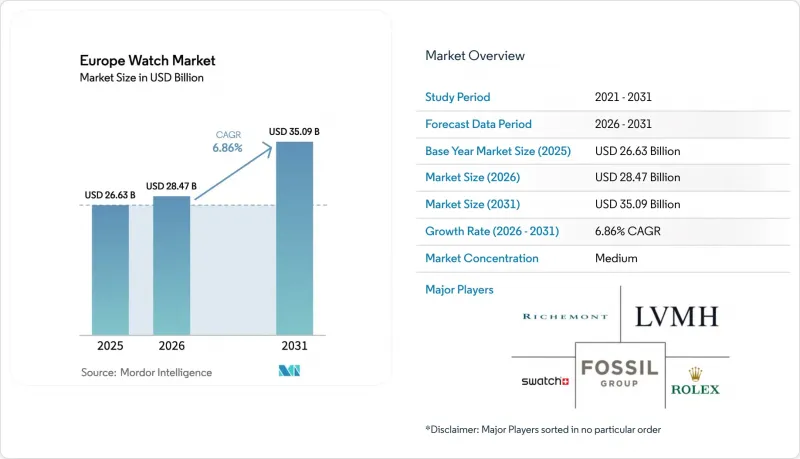
This report is Segmented by Product Type (Quartz/Mechanical, Digital Watch), Category (Mass, Premium), End User (Men, Women, Unisex), Distribution Channel (Online Retail Stores, and More), and Geography (Germany, United Kingdom, France, Italy, Spain, Russia, Netherlands, Poland, Belgium, Sweden, Rest of Europe). The Market Forecasts are Provided in Terms of Value (USD).
Europe Watch Market Trends and Insights
Blending adventure sports with smarter wearables
Rugged smartwatches, equipped with altimeters, GPS, and optical heart-rate monitors, now blur the lines between fitness trackers and traditional sports watches, boasting a commendable 200-meter water resistance. Casio's G-SHOCK GSW-H1000 exemplifies this evolution, featuring Wear OS, a dual-layer display, and premium titanium casebacks, all priced at USD 779. This offering has found favor among outdoor enthusiasts in Germany and Scandinavia, who value both durability and data for their demanding activities, such as hiking, mountaineering, and water sports. While Garmin and Suunto have long held sway in this niche, even storied Swiss brands are introducing hybrid models, underscoring a growing appetite for devices that meld narrative with performance metrics. These hybrid models often combine traditional craftsmanship with advanced technology, appealing to a broader audience. Notably, younger consumers are increasingly shunning the age-old dilemma of choosing between prestige and practicality, leading to a surge in adoption as they seek products that align with their active lifestyles and modern preferences.
Preference for luxury timepiece
In Germany, the UK, France, and Italy, affluent collectors view mechanical watches as a hedge against inflation. This perspective has driven demand, resulting in multi-year waitlists for highly sought-after models from Rolex and Patek Philippe. These timepieces are not only seen as luxury items but also as investment assets that retain or even appreciate in value over time. Even as the broader luxury sales landscape shows signs of softening, the demand for these watches remains robust. Highlighting a shift in demographics, Sotheby's has noted a 70% increase in female bidders since 2015, reflecting growing interest among women in the watch market. Furthermore, premiums in the secondary market underscore the effectiveness of managed scarcity in preserving value and exclusivity. As a result, the European watch market continues to wield significant pricing power, even in the face of challenges posed by rising interest rates.
Increased prevalence of counterfeit products
Every year, EU border agencies confiscate millions of counterfeit watches. However, social media platforms often provide a loophole for sellers to evade customs checks, enabling the distribution of fake products directly to consumers. This trend disproportionately affects mid-tier brands, which lack the resources of luxury brands to combat counterfeiting effectively. The Federation of the Swiss Watch Industry operates anti-counterfeiting initiatives including public guidance pages and a reporting mechanism, but the scale of the problem persists as counterfeiters adopt sophisticated manufacturing techniques: laser-etched serial numbers, near-identical packaging, and functional movements that make detection difficult for casual buyers. The challenge intensifies with the use of laser-etched serials and replicated movements, which closely mimic genuine products, making detection increasingly difficult for authorities. In response, many firms are turning to blockchain passports as a solution to authenticate their products, ensure traceability throughout the supply chain, and build consumer trust. While this technology offers a robust method to combat counterfeiting, it also introduces additional costs, which can be a significant burden for smaller brands.
Other drivers and restraints analyzed in the detailed report include:
- Rising disposable income and fashion consciousness
- Resurgence of mechanical heritage brands via crowdfunding
- Declining footfall in brick-and-mortar watch stores
For complete list of drivers and restraints, kindly check the Table Of Contents.
Segment Analysis
In 2025, quartz and mechanical watches together held a dominant 66.14% share of Europe's watch market. This leadership position is anchored in a deep-rooted consumer trust in the precision, craftsmanship, and heritage these timepieces represent. Prestige mechanical watches, often limited editions, command premium prices bolstered by their brand equity, even as their unit sales stabilize. These high-end watches are often associated with luxury and exclusivity, appealing to collectors and connoisseurs who value intricate designs and traditional watchmaking techniques. On the other hand, brands like Casio, with offerings such as the EUR 307 EDIFICE automatic, are making mechanical watches more accessible. These options cater to enthusiasts who desire authenticity without the hefty Swiss price tag, bridging the gap between luxury and affordability. Collectively, these dynamics not only uphold the value of these watches but also cement their pivotal role in Europe's horological landscape.
Digital watches are on a rapid ascent, with projections indicating a 5.18% CAGR growth rate through 2031. This surge is largely attributed to the seamless blend of technology with modern lifestyle demands. There's a notable uptick in the demand for fitness-centric smartwatches that marry functionality with aesthetics. These devices are increasingly equipped with advanced features such as heart rate monitoring, GPS tracking, and sleep analysis, catering to health-conscious consumers. Industry leaders like Apple and Garmin are setting the gold standard for performance and connectivity, offering products that integrate effortlessly with smartphones and other digital ecosystems. Meanwhile, Casio's G-SHOCK hybrid stands out, showcasing a robust design paired with advanced digital features, appealing to consumers who prioritize durability alongside innovation. The growth trajectory is especially pronounced among urban, active consumers who value wellness monitoring and a smooth connection to their digital lives. This trend firmly establishes digital watches as the most agile and evolving segment in Europe's watch market.
In 2025, mass-market watches secured a commanding 58.57% share of the European watch market, solidifying their status as the dominant segment. Brands such as Casio, Swatch, Fossil, and Timex lead the charge, thanks to their widespread availability, trendy designs, and competitive pricing. These strategies resonate with a diverse consumer base in both urban and suburban locales. The brands' collaborations, like Swatch Group's MoonSwatch priced at USD 385, showcase their ability to blend everyday utility with fashion-forward appeal, leveraging hype tactics often associated with luxury tiers. While direct-to-consumer disruptors have squeezed margins, mass-market brands counter with innovative limited drops and dynamic marketing, ensuring brand loyalty. This segment's resilience underscores a consistent demand for reliable, affordable timepieces, even amidst economic uncertainties. In essence, mass-market watches not only anchor the industry's volume base but also adeptly navigate the shifting retail landscape.
Meanwhile, the premium watch segment is on a rapid ascent, projected to grow at a 7.24% CAGR through 2031. This surge is largely driven by affluent consumers increasingly viewing timepieces as portable stores of value. Strategies emphasizing scarcity and craftsmanship have cultivated an inelastic demand. Limited-edition releases, for instance, command premium prices even in the secondary market, which boasts a global valuation of USD 27 billion and is expanding at double-digit rates. Notably, there's a demographic shift: female collectors are making their mark, increasingly participating in high-profile auctions, such as those at Sotheby's, expanding the segment's appeal beyond its traditional base. Premium watch houses are adeptly navigating challenges, striking a balance between maintaining exclusivity and addressing Gen Z's priorities, such as sustainability and ethical sourcing. The secondary trading market bolsters liquidity, allowing for resale value appreciation, further enhancing the allure of watches as investments. Given these dynamics, premium watches are poised to capture significant value in Europe's evolving luxury landscape.
Complete Report Scope:
- By Product Type
- Quartz/Mechanical
- Digital Watch
- Smart Watches
- Other Digital Types
- Category
- Mass
- Premium
- End User
- Men
- Women
- Unisex
- By Distribution Channel
- Online Retail Stores
- Specialty Stores
- Supermarkets/Hypermarkets
- Other Distribution Channels
- Country
- Germany
- United Kingdom
- France
- Italy
- Spain
- Russia
- Netherlands
- Poland
- Belgium
- Sweden
- Rest of Europe
List of Companies Covered in this Report:
- Apple Inc.
- Bulgari SpA
- Bulova Corp.
- Casio Computer Co., Ltd
- Citizen Watch Co., Ltd
- Daniel Wellington AB
- Fossil Group Inc.
- Garmin Ltd
- Google LLC (Fitbit Inc.)
- Huawei Technologies Co., Ltd
- LVMH SE (TAG Heuer, Zenith, Hublot)
- Mondaine Watch Ltd
- MVMT Watches
- Patek Philippe SA
- Richemont SA
- Rolex SA
- Samsung Electronics Co., Ltd
- Seiko Holdings Corp.
- The Swatch Group Ltd
- Timex Group
- Uhrenfabrik Junghans GmbH & Co. KG
Additional Benefits:
- The market estimate (ME) sheet in Excel format
- 3 months of analyst support
TABLE OF CONTENTS
1 INTRODUCTION
- 1.1 Study Assumptions and Market Definition
- 1.2 Scope of the Study
2 RESEARCH METHODOLOGY
3 EXECUTIVE SUMMARY
4 MARKET LANDSCAPE
- 4.1 Market Overview
- 4.2 Market Drivers
- 4.2.1 Blending adventure sports with smarter wearables
- 4.2.2 Preference for luxury timepiece
- 4.2.3 Rising disposable income and fashion consciousness
- 4.2.4 Resurgence of mechanical heritage brands via crowdfunding
- 4.2.5 EU EPR Rules triggering modular, repairable designs
- 4.2.6 Biometric-enabled luxury hybrid timepieces
- 4.3 Market Restraints
- 4.3.1 Increased prevalence of counterfeit products
- 4.3.2 Declining footfall in brick-and-mortar watch stores
- 4.3.3 Swiss movement export quotas creating supply bottlenecks
- 4.3.4 Gen-Z aversion to exotic-material straps
- 4.4 Consumer Behaviour Analysis
- 4.5 Regulatory Landscape and Technology Outlook
- 4.6 Porter's Five Forces
- 4.6.1 Bargaining Power of Suppliers
- 4.6.2 Bargaining Power of Buyers
- 4.6.3 Threat of New Entrants
- 4.6.4 Threat of Substitutes
- 4.6.5 Competitive Rivalry
5 MARKET SIZE AND GROWTH FORECASTS (VALUE)
- 5.1 By Product Type
- 5.1.1 Quartz/Mechanical
- 5.1.2 Digital Watch
- 5.1.2.1 Smart Watches
- 5.1.2.2 Other Digital Types
- 5.2 Category
- 5.2.1 Mass
- 5.2.2 Premium
- 5.3 End User
- 5.3.1 Men
- 5.3.2 Women
- 5.3.3 Unisex
- 5.4 By Distribution Channel
- 5.4.1 Online Retail Stores
- 5.4.2 Specialty Stores
- 5.4.3 Supermarkets/Hypermarkets
- 5.4.4 Other Distribution Channels
- 5.5 Country
- 5.5.1 Germany
- 5.5.2 United Kingdom
- 5.5.3 France
- 5.5.4 Italy
- 5.5.5 Spain
- 5.5.6 Russia
- 5.5.7 Netherlands
- 5.5.8 Poland
- 5.5.9 Belgium
- 5.5.10 Sweden
- 5.5.11 Rest of Europe
6 COMPETITIVE LANDSCAPE
- 6.1 Market Concentration
- 6.2 Strategic Moves
- 6.3 Market Share Analysis
- 6.4 Company Profiles (includes Global level Overview, Market level overview, Core Segments, Financials as available, Strategic Information, Market Rank/Share for key companies, Products and Services, and Recent Developments)
- 6.4.1 Apple Inc.
- 6.4.2 Bulgari SpA
- 6.4.3 Bulova Corp.
- 6.4.4 Casio Computer Co., Ltd
- 6.4.5 Citizen Watch Co., Ltd
- 6.4.6 Daniel Wellington AB
- 6.4.7 Fossil Group Inc.
- 6.4.8 Garmin Ltd
- 6.4.9 Google LLC (Fitbit Inc.)
- 6.4.10 Huawei Technologies Co., Ltd
- 6.4.11 LVMH SE (TAG Heuer, Zenith, Hublot)
- 6.4.12 Mondaine Watch Ltd
- 6.4.13 MVMT Watches
- 6.4.14 Patek Philippe SA
- 6.4.15 Richemont SA
- 6.4.16 Rolex SA
- 6.4.17 Samsung Electronics Co., Ltd
- 6.4.18 Seiko Holdings Corp.
- 6.4.19 The Swatch Group Ltd
- 6.4.20 Timex Group
- 6.4.21 Uhrenfabrik Junghans GmbH & Co. KG
7 MARKET OPPORTUNITIES AND FUTURE OUTLOOK

