PUBLISHER: Mordor Intelligence | PRODUCT CODE: 2114808

PUBLISHER: Mordor Intelligence | PRODUCT CODE: 2114808
India Watch - Market Share Analysis, Industry Trends & Statistics, Growth Forecasts (2026 - 2031)
According to Mordor Intelligence, the indian watch market size in 2026 is estimated at USD 4.62 billion, growing from 2025 value of USD 4.19 billion with 2031 projections showing USD 7.52 billion, growing at 10.23% CAGR over 2026-2031.
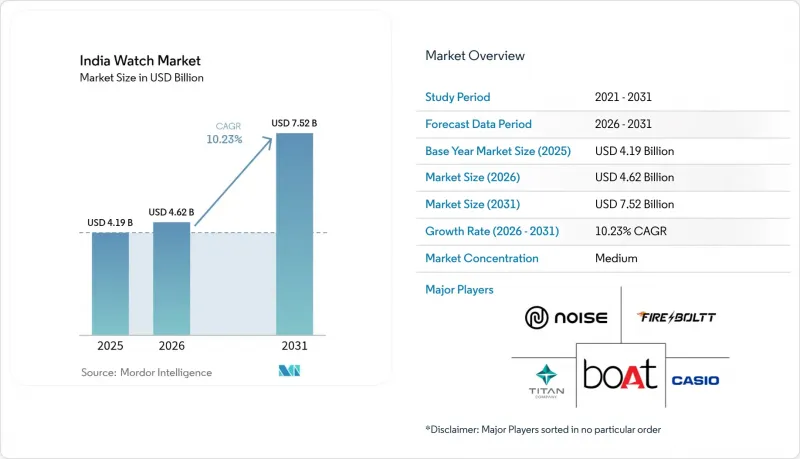
This report is Segmented by Product Type (Quartz/Analog Watches, Digital Watches, Smartwatches), End User (Men, Women, Kids), Category (Premium, Mass), Distribution Channel (Online Retail Stores, Offline Retail Stores). The Market Forecasts are Provided in Terms of Value (USD).
India Watch Market Trends and Insights
Affordable smartwatch boom and domestic production incentives
Production-linked incentives have paved the way for contract manufacturers to penetrate the market, leading to a remarkable rise in domestic smartwatch assembly, jumping from 4% of shipments in Q3 2022 to an impressive 82% in Q3 2023. These incentives have significantly reduced entry barriers, encouraging manufacturers to scale operations locally. Investments in displays, battery packs, and printed circuit boards, bolstered by subsidies, are strengthening the local supply chain. This development is creating a positive feedback loop, enhancing both scale and price competitiveness, while also fostering innovation and cost efficiency within the ecosystem. However, the triumph of ultra-low-price models has led to a more than 60% drop in average selling prices over three years. This trend highlights the urgency for brands to steer consumers towards mid- and premium-tier devices to sustain profitability and market growth. Brands like Fire-Boltt, Noise, and boAt have capitalized on local output agreements, maintaining their volume leadership while also venturing into higher-margin SKUs. These brands are experimenting with product differentiation and premium features to appeal to a broader consumer base. As a result, the cost dynamics of the Indian watch market are becoming increasingly appealing to multinational component vendors eyeing localized operations, further strengthening the market's global competitiveness.
Rising disposable income and premiumization of analog and luxury watches
Affluent shoppers in metro and Tier-I cities are increasingly gravitating towards premium analog and hybrid watches, buoyed by rising household incomes. In 2023, Swiss watch imports surged by 39.5% compared to 2021, underscoring the pent-up demand that emerges when wealthy consumers gain clearer price insights and access to convenient payment methods. This growth highlights the increasing preference for high-quality, luxury timepieces among India's affluent population, driven by their desire for exclusivity and status symbols. Meanwhile, domestic boutique brands are flourishing, skillfully blending traditional Indian craftsmanship with contemporary mechanics, and establishing a niche around the INR 100,000 price point. These brands are leveraging India's rich heritage of artisanal skills to create unique offerings that appeal to both domestic and international buyers. With a phased removal of 20% customs duties on Swiss watches set to unfold over the next seven years, retail prices are poised to drop. This shift is expected to broaden the consumer base at the upper end and further tilt the Indian watch market towards premium offerings, making luxury watches more accessible to a wider audience.
Margin squeeze from falling ASPs in smartwatches
Over the past year, average selling prices for budget wearables dropped from USD 21 to USD 18.8, squeezing gross margins even as input costs for sensors and memory saw only a modest decline. Budget-conscious shoppers now view devices priced under INR 1,000 as disposable novelties rather than essential items. This shift has led to fewer repeat purchases and heightened concerns about stock becoming obsolete, as these low-cost devices often fail to meet long-term consumer expectations in terms of durability and functionality. In response, brands are channeling their marketing efforts towards products priced above INR 20,000, emphasizing clearer value propositions, enhanced battery life, and regulated health metrics. By targeting this premium segment, companies aim to attract a more discerning customer base willing to invest in reliable and feature-rich devices, ultimately rejuvenating profitability in the Indian watch market.
Other drivers and restraints analyzed in the detailed report include:
- Expansion of online retail and omni-channel strategies
- Youth fashion consciousness and brand collaborations
- Market saturation and longer replacement cycles
For complete list of drivers and restraints, kindly check the Table Of Contents.
Segment Analysis
In 2025, quartz and analog watches command a dominant 56.45% share of the Indian timepiece market. This sustained preference underscores a deep-rooted cultural affinity for traditional watches, particularly in formal and professional contexts. Older consumers and professionals in established industries, where classic styles hold sway, continue to favor these timepieces. Valued for their reliability, craftsmanship, and timeless aesthetics, these watches seamlessly complement formal attire. The segment witnesses a surge in premiumization, evident from a 39.5% uptick in Swiss watch imports, signaling a burgeoning consumer appetite for luxury and quality. Furthermore, domestic luxury brands, such as Bangalore Watch Company, are tapping into cultural nuances to craft premium analog offerings that appeal to discerning buyers.
On the other hand, smartwatches are the market's fastest risers, boasting a robust compound annual growth rate (CAGR) of 8.78% projected through 2031. This surge is predominantly fueled by the increasing adoption of health monitoring features and a pronounced inclination towards wearable tech among the youth. A distinct market divide emerges: premium smartwatches, priced above Rs 20,000, are witnessing a staggering 147% year-over-year growth, driven by their advanced health tracking and AI functionalities. The trend is epitomized by Google's Pixel Watch 3, debuting at Rs 39,900 to Rs 43,900, showcasing the shift towards high-end, feature-laden devices. Samsung's Galaxy Watches, bolstered by recent regulatory nods for blood pressure and ECG monitoring, underscore how cutting-edge health features not only validate premium pricing but also spur innovation. Conversely, budget smartwatches face an uphill battle in gaining consumer traction, as their perceived low value curtails their market reach, despite competitive pricing.
In India's watch market, men's watches command a dominant 57.68% share. This stronghold is attributed to the perception of watches as essential accessories and status symbols among Indian men. Urbanization and increasing disposable incomes in major cities have intensified the demand, particularly for brands that seamlessly merge style with technology. While many men gravitate towards traditional analog watches for their classic allure, there's a notable shift towards smartwatches, valued for their fitness tracking and professional utility. The influence of celebrity endorsements, coupled with prominent digital campaigns, has further solidified male engagement. As the trend of premiumization continues, the men's segment is poised to lead, shaped by changing fashion sensibilities and evolving work cultures.
Meanwhile, the women's segment, though smaller, is the fastest-growing, expanding at an impressive rate of 9.16%. This surge is intricately tied to societal shifts, with more women stepping into the workforce and carving out professional careers. In 2024, approximately 41% of women in India are part of the workforce, a significant demographic driving the demand for both elegant and functional watches. In response, brands are curating designs and features that resonate with women's dynamic lifestyles. The rise of digital platforms and e-commerce has revolutionized shopping for women, offering convenience and a personalized touch. As women increasingly influence household purchasing decisions and seek products that mirror their aspirations, this segment's rapid growth underscores its pivotal role in India's watch industry.
Complete Report Scope:
- By Product Type
- Quartz/Analog Watches
- Digital Watches
- Smartwatches
- BY End User
- Men
- Women
- Kids
- By Category
- Premium
- Mass
- By Distribution Channel
- Online Retail Stores
- Offline Retail Stores
List of Companies Covered in this Report:
- The Tata Group (Titan Company)
- Noise
- Apple Inc
- Fire-Boltt
- Fossil Group Inc
- Garmin Ltd
- Boat (Imagine Marketing)
- BBK Electronics Corp Ltd
- Rolex SA
- PVH Corp (Tommy Hilfiger)
- Samsung Corp
- Swatch Group Ltd, The
- Xiaomi Corp
- Casio Computer Co Ltd
- Timex Group BV
- Seiko Group Corp
- GOQii Inc
- LVMH Moet Hennessy Louis Vuitton SA
- Richemont SA, Cie Financiere
- Movado Group Inc
Additional Benefits:
- The market estimate (ME) sheet in Excel format
- 3 months of analyst support
TABLE OF CONTENTS
1 INTRODUCTION
- 1.1 Study Assumptions and Market Definition
- 1.2 Scope of the Study
2 RESEARCH METHODOLOGY
3 EXECUTIVE SUMMARY
4 MARKET LANDSCAPE
- 4.1 Market Overview
- 4.2 Market Drivers
- 4.2.1 Affordable smart-watch boom and domestic production incentives
- 4.2.2 Rising disposable income and premiumisation of analog and luxury watches
- 4.2.3 Expansion of online retail and omni-channel strategies
- 4.2.4 Youth fashion consciousness and brand collaborations
- 4.2.5 PLI scheme-driven localisation of wearable components
- 4.2.6 Health-insurer partnerships leveraging smartwatch data
- 4.3 Market Restraints
- 4.3.1 Margin squeeze from falling ASPs in smartwatches
- 4.3.2 Market saturation and longer replacement cycles
- 4.3.3 Counterfeit / grey-import analog watches
- 4.3.4 Shallow domestic capability in mechanical movements
- 4.4 Consumer Behavior Analysis
- 4.5 Regulatory Landscape
- 4.6 Technological Outlook
- 4.7 Porter's Five Forces
- 4.7.1 Bargaining Power of Suppliers
- 4.7.2 Bargaining Power of Buyers
- 4.7.3 Threat of New Entrants
- 4.7.4 Threat of Substitutes
- 4.7.5 Competitive Rivalry
5 MARKET SIZE AND GROWTH FORECASTS (VALUE)
- 5.1 By Product Type
- 5.1.1 Quartz/Analog Watches
- 5.1.2 Digital Watches
- 5.1.3 Smartwatches
- 5.2 BY End User
- 5.2.1 Men
- 5.2.2 Women
- 5.2.3 Kids
- 5.3 By Category
- 5.3.1 Premium
- 5.3.2 Mass
- 5.4 By Distribution Channel
- 5.4.1 Online Retail Stores
- 5.4.2 Offline Retail Stores
6 COMPETITIVE LANDSCAPE
- 6.1 Market Concentration
- 6.2 Strategic Moves
- 6.3 Market Share Analysis
- 6.4 Company Profiles (includes Global level Overview, Market level overview, Core Segments, Financials as available, Strategic Information, Market Rank/Share for key companies, Products and Services, and Recent Developments)
- 6.4.1 The Tata Group (Titan Company)
- 6.4.2 Noise
- 6.4.3 Apple Inc
- 6.4.4 Fire-Boltt
- 6.4.5 Fossil Group Inc
- 6.4.6 Garmin Ltd
- 6.4.7 Boat (Imagine Marketing)
- 6.4.8 BBK Electronics Corp Ltd
- 6.4.9 Rolex SA
- 6.4.10 PVH Corp (Tommy Hilfiger)
- 6.4.11 Samsung Corp
- 6.4.12 Swatch Group Ltd, The
- 6.4.13 Xiaomi Corp
- 6.4.14 Casio Computer Co Ltd
- 6.4.15 Timex Group BV
- 6.4.16 Seiko Group Corp
- 6.4.17 GOQii Inc
- 6.4.18 LVMH Moet Hennessy Louis Vuitton SA
- 6.4.19 Richemont SA, Cie Financiere
- 6.4.20 Movado Group Inc
7 MARKET OPPORTUNITIES AND FUTURE OUTLOOK

