PUBLISHER: Mordor Intelligence | PRODUCT CODE: 2114687

PUBLISHER: Mordor Intelligence | PRODUCT CODE: 2114687
Flue Gas Desulfurization (FGD) - Market Share Analysis, Industry Trends & Statistics, Growth Forecasts (2026 - 2031)
According to Mordor Intelligence, the flue gas desulfurization market size in 2026 is estimated at USD 27.61 billion, growing from 2025 value of USD 26.03 billion with 2031 projections showing USD 37.03 billion, growing at 6.05% CAGR over 2026-2031.
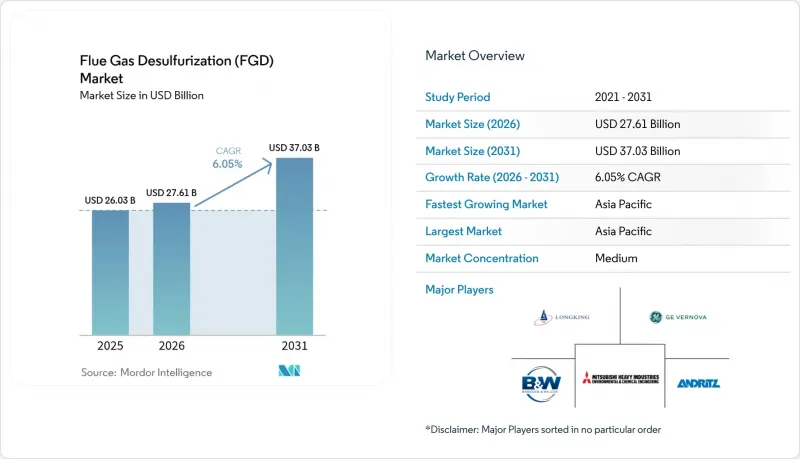
This report is Segmented by Type (Wet FGD, Dry and Semi-Dry FGD, and Hybrid and Advanced Sorbent Injection), Reagent/Sorbent (Limestone, Lime, Seawater, and Sodium-Based and Other Alkalis), End-User Industry (Power Generation, Cement, Iron and Steel, Chemical and Petrochemical, Non-Ferrous Metals, and More), and Geography (North America, Europe, Asia-Pacific, South America, and More).
Global Flue Gas Desulfurization (FGD) Market Trends and Insights
Stringent SO2-Emission Caps in Coal-Fired Power Plants
Global alignment on sulfur-oxide limits is reshaping procurement calendars. China's ultra-low emission code caps SO2 at 35 mg/Nm3 and achieves 99% capture through limestone-gypsum loops. The EU's revised Industrial Emissions Directive imposes tighter benchmarks for large combustion plants, compelling upgrades across legacy fleets. The US Environmental Protection Agency finalized a 2024 rule obligating residual coal units to meet stringent hourly sulfur ceilings, catalyzing retrofits in Midwest and Appalachian stations. In Poland, mandated installations lifted limestone use from negligible in 1994 to 3.4 million t/y by 2019 as capture efficiencies passed the 90% mark. Compliance accelerators such as automatic reagent optimization, modular absorber sections, and dual-alkali loops reduce downtime, reinforcing a replacement cycle that lengthens the economic life of installed reactors even as coal dispatch inches downward.
Mandatory Retrofits of Aging Industrial Boilers & Kilns
Industrial point sources below 50 MW thermal capacity now fall under the EU Medium Combustion Plant Directive, multiplying the addressable base by thousands of lignite dryers, kilns, and refinery heaters. Cement plants reveal favorable economics because flue moisture can be reused for raw-meal conditioning, offsetting utility costs. Heidelberg Materials' USD 500 million Mitchell upgrade in Indiana targets a 2 million t/y CO2 capture plateau, pairing amine absorption with a new FGD pretreatment train. Similar archetypes materialize in non-ferrous smelters, where elemental-sulfur recovery couples revenue streams with compliance credit sales. Retrofits therefore gravitate toward multi-contaminant kits delivering incremental mercury and NOx abatement, making the flue gas desulfurization market a cross-sector platform for integrated pollution control.
High CAPEX & Disposal Costs of Wet FGD Sludge
Installation expenses near INR 12 million/MW hinder India's rollout, prompting advisory panels to question blanket mandates. Disposal charges escalate where sludge requires thermal drying or leachate sealing, lifting the levelized cost of electricity by up to USD 3/MWh in emerging grids. Zero-liquid-discharge prescriptions magnify water treatment capital; Pennsylvania's Homer City power station invested USD 750 million in a compliant evaporator crystallizer train before closing in 2024. As a result, dry sorbent injection garners interest despite lower capture efficiency, creating a price ceiling for the flue gas desulfurization market in capital-constrained regions.
Other drivers and restraints analyzed in the detailed report include:
- Rising Demand for FGD-Derived Synthetic Gypsum
- Integration of FGD with Carbon-Capture Retrofits
- Coal-to-Renewables Shift Curbing New Installations
For complete list of drivers and restraints, kindly check the Table Of Contents.
Segment Analysis
Wet limestone-gypsum reactors represented 86.92% of the flue gas desulfurization market share in 2025, cemented by>95% SO2 capture efficiencies under ultra-low emission codes in China. At a flue gas desulfurization market size of USD 22.63 billion, the type thrives on established vendor ecosystems and stable sorbent supply chains. Hybrid and sorbent-injection variants, while accounting for a modest revenue slice, clocked a 9.65% CAGR and attracted industrial retrofits where space or water scarcity constrains wet designs.
Operators favor proven wet loops for high-sulfur, high-volume stacks, yet innovation accelerates around circulating fluidized bed scrubbers that fold in particulate removal, cutting electrostatic precipitator capital outlay. Tri-Mer's SorbSaver system, for example, integrates dry sorbent dispersion with low-energy baghouses and lowers reagent overdosing by up to 40%, aligning with budgets in sub-25 MW industrial boilers. The coexistence of established and novel designs expands supplier addressable revenue as users layer hybrid kits onto legacy absorbers, sustaining healthy competition within the flue gas desulfurization market.
Complete Report Scope:
- By Type
- Wet FGD
- Limestone/Gypsum Wet Scrubbers
- Seawater Scrubbers
- Dry and Semi-Dry FGD
- Spray-Dry Absorbers
- Circulating Fluidized-Bed Dry Scrubbers
- Hybrid and Advanced Sorbent Injection
- Wet FGD
- By Reagent/Sorbent
- Limestone
- Lime
- Seawater
- Sodium-based and Other Alkalis
- By End-User Industry
- Power Generation
- Cement
- Iron and Steel
- Chemical and Petrochemical
- Non-Ferrous Metals
- Waste-to-Energy and Others
- By Geography
- North America
- United States
- Canada
- Mexico
- Europe
- Germany
- United Kingdom
- France
- Italy
- Spain
- Russia
- Rest of Europe
- Asia Pacific
- China
- India
- Japan
- South Korea
- ASEAN Countries
- Rest of Asia Pacific
- South America
- Brazil
- Argentina
- Rest of South America
- Middle East and Africa
- Saudi Arabia
- United Arab Emirates
- South Africa
- Egypt
- Rest of Middle East and Africa
- North America
Geography Analysis
Asia-Pacific commands 61.70% of 2025 revenue and will tack on a 6.98% CAGR through 2031, anchored by China's>95% wet-system penetration and India's multi-gigawatt pipeline despite intermittent policy debate. Vietnam, Indonesia, and the Philippines incentivize SO2 control upgrades via concessional lending, adding density to regional vendor service networks. Japan and South Korea specialize in marine scrubber supply, leveraging shipyard ecosystems to export turnkey kits across global fleets.
Europe enforces the world's strictest emission ceilings, spurring retrofits in small-to-medium industrial plants. Germany, Belgium, and Poland invest heavily in absorber upgrades linked to carbon-capture pilots under the EU Innovation Fund, positioning the region as a technology incubator. Nordic maritime regulations accelerate the adoption of closed-loop scrubbers, export regulatory templates worldwide, and sustain European equipment backlogs.
North America experiences structural attrition in utility coal capacity, yet industrial adopters buoy order intake. Cement plants in the United States advance with USD 500 million-plus CCUS retrofits that assume FGD bleeds for solvent protection. Canada tightens sulfur limits in oil-sands boilers, stimulating fresh package-plant bids, while Mexican utilities outline modernization roadmaps aligning with updated NOM-085-SEMARNAT limits. South America and the Middle East & Africa contribute single-digit revenue shares but deliver sporadic large orders tied to refinery expansions, fertiliser complexes, and copper smelters, offering long-cycle prospects for globally active OEMs.
- Alstom SA
- Andritz AG
- Babcock & Wilcox Enterprises Inc.
- Ducon Technologies Inc.
- Fujian Longking Co. Ltd
- GE Vernova
- Hamon Corporation
- John Wood Group PLC
- Mitsubishi Heavy Industries Environmental & Chemical Engg. Co.
- Thermax Ltd
- Chiyoda Corp.
- Doosan Lentjes GmbH
- Marsulex Environmental Technologies
- Valmet Oyj
- Siemens Energy AG
- FLSmidth A/S
- Carmeuse Group
- Larsen & Toubro-MHI Power Boilers Pvt Ltd
- Clyde Bergemann Power Group
- John Cockerill Environment
Additional Benefits:
- The market estimate (ME) sheet in Excel format
- 3 months of analyst support
TABLE OF CONTENTS
1 Introduction
- 1.1 Study Assumptions & Market Definition
- 1.2 Scope of the Study
2 Research Methodology
3 Executive Summary
4 Market Landscape
- 4.1 Market Overview
- 4.2 Market Drivers
- 4.2.1 Stringent SO2-emission caps in coal-fired power plants
- 4.2.2 Mandatory retrofits of aging industrial boilers & kilns
- 4.2.3 Rising demand for FGD-derived synthetic gypsum
- 4.2.4 Integration of FGD with carbon-capture retrofits
- 4.2.5 IMO rules driving high-sulfur marine fuel scrubbers
- 4.2.6 Predictive-maintenance analytics lowering OPEX
- 4.3 Market Restraints
- 4.3.1 High CAPEX & disposal costs of wet FGD sludge
- 4.3.2 Coal-to-renewables shift curbing new installations
- 4.3.3 Limestone supply chain bottlenecks & price volatility
- 4.3.4 Zero-liquid-discharge (ZLD) rules inflating water-use costs
- 4.4 Supply-Chain Analysis
- 4.5 Regulatory Landscape
- 4.6 Technological Outlook
- 4.7 Porter's Five Forces
- 4.7.1 Bargaining Power of Suppliers
- 4.7.2 Bargaining Power of Buyers
- 4.7.3 Threat of New Entrants
- 4.7.4 Threat of Substitutes
- 4.7.5 Intensity of Competitive Rivalry
5 Market Size & Growth Forecasts
- 5.1 By Type
- 5.1.1 Wet FGD
- 5.1.1.1 Limestone/Gypsum Wet Scrubbers
- 5.1.1.2 Seawater Scrubbers
- 5.1.2 Dry and Semi-Dry FGD
- 5.1.2.1 Spray-Dry Absorbers
- 5.1.2.2 Circulating Fluidized-Bed Dry Scrubbers
- 5.1.3 Hybrid and Advanced Sorbent Injection
- 5.1.1 Wet FGD
- 5.2 By Reagent/Sorbent
- 5.2.1 Limestone
- 5.2.2 Lime
- 5.2.3 Seawater
- 5.2.4 Sodium-based and Other Alkalis
- 5.3 By End-User Industry
- 5.3.1 Power Generation
- 5.3.2 Cement
- 5.3.3 Iron and Steel
- 5.3.4 Chemical and Petrochemical
- 5.3.5 Non-Ferrous Metals
- 5.3.6 Waste-to-Energy and Others
- 5.4 By Geography
- 5.4.1 North America
- 5.4.1.1 United States
- 5.4.1.2 Canada
- 5.4.1.3 Mexico
- 5.4.2 Europe
- 5.4.2.1 Germany
- 5.4.2.2 United Kingdom
- 5.4.2.3 France
- 5.4.2.4 Italy
- 5.4.2.5 Spain
- 5.4.2.6 Russia
- 5.4.2.7 Rest of Europe
- 5.4.3 Asia Pacific
- 5.4.3.1 China
- 5.4.3.2 India
- 5.4.3.3 Japan
- 5.4.3.4 South Korea
- 5.4.3.5 ASEAN Countries
- 5.4.3.6 Rest of Asia Pacific
- 5.4.4 South America
- 5.4.4.1 Brazil
- 5.4.4.2 Argentina
- 5.4.4.3 Rest of South America
- 5.4.5 Middle East and Africa
- 5.4.5.1 Saudi Arabia
- 5.4.5.2 United Arab Emirates
- 5.4.5.3 South Africa
- 5.4.5.4 Egypt
- 5.4.5.5 Rest of Middle East and Africa
- 5.4.1 North America
6 Competitive Landscape
- 6.1 Market Concentration
- 6.2 Strategic Moves (M&A, Partnerships, PPAs)
- 6.3 Market Share Analysis (Market Rank/Share for key companies)
- 6.4 Company Profiles (includes Global level Overview, Market level overview, Core Segments, Financials as available, Strategic Information, Products & Services, and Recent Developments)
- 6.4.1 Alstom SA
- 6.4.2 Andritz AG
- 6.4.3 Babcock & Wilcox Enterprises Inc.
- 6.4.4 Ducon Technologies Inc.
- 6.4.5 Fujian Longking Co. Ltd
- 6.4.6 GE Vernova
- 6.4.7 Hamon Corporation
- 6.4.8 John Wood Group PLC
- 6.4.9 Mitsubishi Heavy Industries Environmental & Chemical Engg. Co.
- 6.4.10 Thermax Ltd
- 6.4.11 Chiyoda Corp.
- 6.4.12 Doosan Lentjes GmbH
- 6.4.13 Marsulex Environmental Technologies
- 6.4.14 Valmet Oyj
- 6.4.15 Siemens Energy AG
- 6.4.16 FLSmidth A/S
- 6.4.17 Carmeuse Group
- 6.4.18 Larsen & Toubro-MHI Power Boilers Pvt Ltd
- 6.4.19 Clyde Bergemann Power Group
- 6.4.20 John Cockerill Environment
7 Market Opportunities & Future Outlook
- 7.1 White-space & Unmet-Need Assessment

