PUBLISHER: Mordor Intelligence | PRODUCT CODE: 2114708

PUBLISHER: Mordor Intelligence | PRODUCT CODE: 2114708
Immune Checkpoint Inhibitors - Market Share Analysis, Industry Trends & Statistics, Growth Forecasts (2026 - 2031)
According to Mordor Intelligence, the immune checkpoint inhibitors market size is expected to grow from USD 50.29 billion in 2025 to USD 58.43 billion in 2026 and is forecast to reach USD 123.57 billion by 2031 at 16.18% CAGR over 2026-2031.
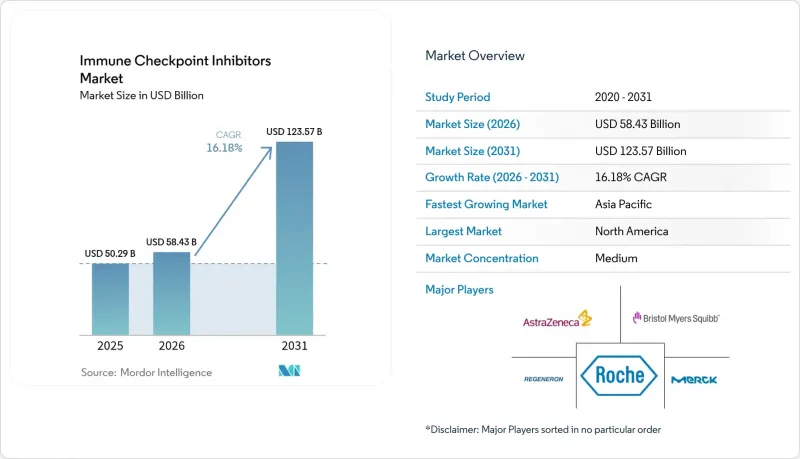
This report is Segmented by Inhibitor Type (CTLA-4 Inhibitors, PD-1 Inhibitors, and More), Indication (Non-Small Cell Lung Cancer, and More), Route of Administration (Intravenous and Sub-Cutaneous), Distribution Channel (Hospital Pharmacies, and More), and Geography (North America, Europe, Asia-Pacific, Middle East and Africa, South America). The Market Forecasts are Provided in Terms of Value (USD).
Global Immune Checkpoint Inhibitors Market Trends and Insights
Rising Investments in R&D and Clinical Trials
Pharmaceutical companies increase capital commitments to immune checkpoint inhibitor pipelines, with Bristol Myers Squibb reporting a 21% rise in growth-portfolio revenues from immuno-oncology programs in 2025. Novartis directed over USD 5.5 billion to licensing and acquisitions in 2024, reflecting an urgent pivot ahead of looming patent expiries. India's post-2019 regulatory overhaul positions the country as a cost-efficient site for global oncology trials, drawing sponsors seeking large treatment-naive populations. The pipeline inflation accelerates first-in-class experimentation around LAG-3, TIGIT, and bispecific constructs that may redefine standard-of-care combinations.
Increased Product Approvals & Special Designations
Regulators expedite filings under breakthrough, priority review, and orphan frameworks. The FDA cleared retifanlimab-dlwr for anal canal carcinoma in 2025, and cosibelimab-ipdl became the first PD-L1 therapy for cutaneous squamous cell carcinoma in 2024. EMA approvals for tislelizumab extensions and nivolumab-ipilimumab in hepatocellular carcinoma mirror this momentum. Tissue-agnostic endorsements, typified by pembrolizumab for dMMR tumors, reward firms with robust biomarker data sets. Faster pathways shorten revenue ramp-up times and intensify competition for first-mover advantage.
High Treatment Cost & Reimbursement Hurdles
Monthly U.S. therapy costs span USD 11,961-15,043 despite a crowded class, straining payer budgets and limiting uptake in low-income settings. Medicare reference products saw 32.7% rate cuts five years after biosimilar entry, and biosimilars fell 50.3%, challenging sustainable margins. The Inflation Reduction Act further compresses specialty pharmacy reimbursement, threatening medically-integrated dispensing models.
Other drivers and restraints analyzed in the detailed report include:
- Expansion of ICIs into Earlier-Line & Adjuvant Settings
- AI-Powered Biomarker Discovery Raising Response Rates
- Adaptive Resistance in "Cold" Tumours Limiting Durability
For complete list of drivers and restraints, kindly check the Table Of Contents.
Segment Analysis
PD-1 agents delivered 60.92% of immune checkpoint inhibitors market revenue in 2025, underpinned by Keytruda and Opdivo franchises. LAG-3 molecules such as relatlimab exhibit a 17.49% CAGR, supported by melanoma uptake. PD-L1 products gain from tissue-agnostic labels, while CTLA-4 checkpoints shift to combination partner roles. TIGIT and TIM-3 pipelines progress unevenly, reflecting nuanced biology and mixed readouts. Bispecific antibodies that bridge PD-1 with LAG-3 or VEGF targets may offset monotherapy plateaus and refresh intellectual-property clocks.
A widening array of oral LAG-3 small molecules under investigation underscores demand for cost-efficient oral immunomodulation. This diversification of modalities broadens prescriber choice and mitigates resistance patterns inherent in single-checkpoint blockade.
Non-small cell lung cancer controlled 26.34% of immune checkpoint inhibitors market revenue in 2025, retaining front-line dominance. Small cell lung cancer delivers the fastest expansion at 22.55% CAGR, buoyed by limited historical options and durable benefits from anti-PD-L1 plus chemotherapy combinations. Melanoma sustains steady uptake through LAG-3 combination approvals. Renal cell carcinoma and hepatocellular carcinoma respond well to IO-VEGF pairings. Urothelial cancer leverages antibody-drug conjugate synergies, with enfortumab vedotin plus pembrolizumab doubling overall survival versus chemotherapy.
Precision medicine drives differentiation as microsatellite instability status, tumor mutational burden, and PD-L1 expression refine therapeutic choices. Earlier-stage interventions shift volume from metastatic to adjuvant settings, altering oncology workflow and resource allocation.
Complete Report Scope:
- By Inhibitor Type
- CTLA-4 Inhibitors
- PD-1 Inhibitors
- PD-L1 Inhibitors
- LAG-3 Inhibitors
- TIGIT Inhibitors
- TIM-3 & Other Next-Gen Checkpoints
- By Indication
- Non-Small Cell Lung Cancer (NSCLC)
- Small Cell Lung Cancer (SCLC)
- Melanoma
- Renal Cell Carcinoma
- Head & Neck Cancers
- Urothelial & Bladder Cancer
- Hepatocellular Carcinoma
- Hodgkin Lymphoma
- Other Cancers
- By Route of Administration
- Intravenous
- Sub-cutaneous
- By Distribution Channel
- Hospital Pharmacies
- Retail Pharmacies
- Online Pharmacies
- By Geography
- North America
- United States
- Canada
- Mexico
- Europe
- Germany
- United Kingdom
- France
- Italy
- Spain
- Rest of Europe
- Asia-Pacific
- China
- Japan
- India
- Australia
- South Korea
- Rest of Asia-Pacific
- Middle East & Africa
- GCC
- South Africa
- Rest of Middle East & Africa
- South America
- Brazil
- Argentina
- Rest of South America
- North America
Geography Analysis
North America held 36.74% of immune checkpoint inhibitors market revenue in 2025, supported by favorable reimbursement and trial density. Asia-Pacific rises at 19.56% CAGR on the back of regulatory convergence and local manufacturing incentives. China's National Medical Products Administration authorized Keytruda for neoadjuvant NSCLC, highlighting regional agility. Japan benefits from domestic innovators like Ono Pharmaceutical in immuno-oncology.
Europe demonstrates steady growth through harmonized regulatory pathways and value-based healthcare adoption, with the European Medicines Agency's multiple 2024-2025 approvals for checkpoint inhibitor combinations indicating continued market expansion. The region's emphasis on health technology assessment and cost-effectiveness analysis shapes market access strategies and pricing negotiations. Middle East and Africa represent emerging opportunities with significant unmet medical needs, yet face affordability challenges that limit widespread adoption of premium-priced immunotherapies. South America's growth potential centers on Brazil and Argentina, where regulatory improvements and healthcare infrastructure investments create opportunities for market expansion. The geographic landscape's evolution reflects broader economic development patterns and healthcare system maturation, with emerging markets increasingly demanding local manufacturing capabilities and technology transfer agreements to ensure sustainable access to innovative cancer therapies.
- Bristol-Myers Squibb
- Merck
- Roche
- Regeneron Pharmaceuticals
- AstraZeneca
- Eli Lilly and Company
- Sanofi
- BeiGene
- Junshi Biosciences
- GlaxoSmithKline
- Innovent Biologics
- Novartis
- Incyte
- Exelixis
- Gilead Sciences
- Ono Pharmaceutical
- Zai Lab
- Shanghai Henlius
- Iovance Biotherapeutics
- MacroGenics
Additional Benefits:
- The market estimate (ME) sheet in Excel format
- 3 months of analyst support
TABLE OF CONTENTS
1 Introduction
- 1.1 Study Assumptions & Market Definition
- 1.2 Scope of the Study
2 Research Methodology
3 Executive Summary
4 Market Landscape
- 4.1 Market Overview
- 4.2 Market Drivers
- 4.2.1 Rising Investments In R&D and Clinical Trials
- 4.2.2 Increased Product Approvals & Special Designations
- 4.2.3 Expansion of ICIs into Earlier-Line & Adjuvant Settings
- 4.2.4 AI-Powered Biomarker Discovery Raising Response Rates
- 4.2.5 Growth of Sub-Cutaneous ICI Formulations Easing Infusion Capacity
- 4.2.6 Local-Manufactured Biosimilars Driving Affordability
- 4.3 Market Restraints
- 4.3.1 High Treatment Cost & Reimbursement Hurdles
- 4.3.2 Immune-Related Adverse Events and Safety Concerns
- 4.3.3 Adaptive Resistance in "Cold" Tumours Limiting Durability
- 4.3.4 Price Erosion from Incoming ICI Biosimilars Reducing ROI
- 4.4 Porter's Five Forces Analysis
- 4.4.1 Threat of New Entrants
- 4.4.2 Bargaining Power of Buyers/Consumers
- 4.4.3 Bargaining Power of Suppliers
- 4.4.4 Threat of Substitute Products
- 4.4.5 Intensity of Competitive Rivalry
5 Market Size & Growth Forecasts (Value in USD)
- 5.1 By Inhibitor Type
- 5.1.1 CTLA-4 Inhibitors
- 5.1.2 PD-1 Inhibitors
- 5.1.3 PD-L1 Inhibitors
- 5.1.4 LAG-3 Inhibitors
- 5.1.5 TIGIT Inhibitors
- 5.1.6 TIM-3 & Other Next-Gen Checkpoints
- 5.2 By Indication
- 5.2.1 Non-Small Cell Lung Cancer (NSCLC)
- 5.2.2 Small Cell Lung Cancer (SCLC)
- 5.2.3 Melanoma
- 5.2.4 Renal Cell Carcinoma
- 5.2.5 Head & Neck Cancers
- 5.2.6 Urothelial & Bladder Cancer
- 5.2.7 Hepatocellular Carcinoma
- 5.2.8 Hodgkin Lymphoma
- 5.2.9 Other Cancers
- 5.3 By Route of Administration
- 5.3.1 Intravenous
- 5.3.2 Sub-cutaneous
- 5.4 By Distribution Channel
- 5.4.1 Hospital Pharmacies
- 5.4.2 Retail Pharmacies
- 5.4.3 Online Pharmacies
- 5.5 By Geography
- 5.5.1 North America
- 5.5.1.1 United States
- 5.5.1.2 Canada
- 5.5.1.3 Mexico
- 5.5.2 Europe
- 5.5.2.1 Germany
- 5.5.2.2 United Kingdom
- 5.5.2.3 France
- 5.5.2.4 Italy
- 5.5.2.5 Spain
- 5.5.2.6 Rest of Europe
- 5.5.3 Asia-Pacific
- 5.5.3.1 China
- 5.5.3.2 Japan
- 5.5.3.3 India
- 5.5.3.4 Australia
- 5.5.3.5 South Korea
- 5.5.3.6 Rest of Asia-Pacific
- 5.5.4 Middle East & Africa
- 5.5.4.1 GCC
- 5.5.4.2 South Africa
- 5.5.4.3 Rest of Middle East & Africa
- 5.5.5 South America
- 5.5.5.1 Brazil
- 5.5.5.2 Argentina
- 5.5.5.3 Rest of South America
- 5.5.1 North America
6 Competitive Landscape
- 6.1 Market Concentration
- 6.2 Market Share Analysis
- 6.3 Company Profiles (includes Global level Overview, Market level overview, Core Segments, Financials as available, Strategic Information, Market Rank/Share for key companies, Products & Services, and Recent Developments)
- 6.3.1 Bristol-Myers Squibb
- 6.3.2 Merck & Co.
- 6.3.3 F. Hoffmann-La Roche
- 6.3.4 Regeneron Pharmaceuticals
- 6.3.5 AstraZeneca
- 6.3.6 Eli Lilly
- 6.3.7 Sanofi
- 6.3.8 BeiGene
- 6.3.9 Junshi Biosciences
- 6.3.10 GlaxoSmithKline
- 6.3.11 Innovent Biologics
- 6.3.12 Novartis
- 6.3.13 Incyte
- 6.3.14 Exelixis
- 6.3.15 Gilead Sciences
- 6.3.16 Ono Pharmaceutical
- 6.3.17 Zai Lab
- 6.3.18 Shanghai Henlius
- 6.3.19 Iovance Biotherapeutics
- 6.3.20 MacroGenics
7 Market Opportunities & Future Outlook
- 7.1 White-space & Unmet-need Assessment

