PUBLISHER: Mordor Intelligence | PRODUCT CODE: 2114846

PUBLISHER: Mordor Intelligence | PRODUCT CODE: 2114846
Electric Kettle - Market Share Analysis, Industry Trends & Statistics, Growth Forecasts (2026 - 2031)
According to Mordor Intelligence, the electric kettle market size in 2026 is estimated at USD 1.99 billion, growing from 2025 value of USD 1.89 billion with 2031 projections showing USD 2.59 billion, growing at 5.39% CAGR over 2026-2031.
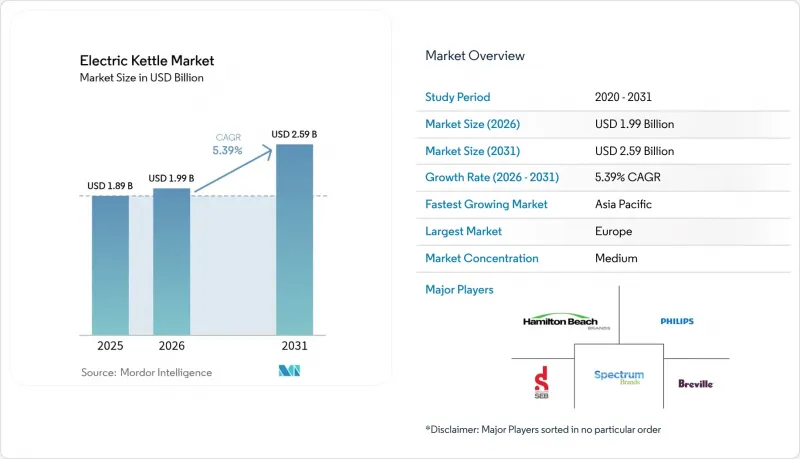
This report is Segmented by Product Type (Standard Electric Kettles, Variable-Temperature Kettles, and More), Material (Stainless Steel, Plastic, and More), Capacity (Less Than 1. 0 L, 1. 0 - 1. 5 L, and More), End-User (Residential, and Commercial/HoReCa), Distribution Channel (Supermarkets & Hypermarkets, and More), and Geography (North America, and More). The Market Forecasts are Provided in Terms of Value (USD).
Global Electric Kettle Market Trends and Insights
Growing Demand for Energy-Efficient Home Appliances
Energy efficiency has moved from a purchase preference to a market admission ticket. Europe's Regulation 2023/826 enforces a 0.5-watt standby-power ceiling, a benchmark many brands now treat as a floor to showcase superior engineering. The rule is reinforced by the Eco-design for Sustainable Products Regulation, which codifies recyclability and durability metrics that influence every phase of a kettle's lifecycle . Chinese manufacturers have responded by launching greener lines that align with domestic energy-saving incentives while keeping export doors open. The convergence of policy pressure and operating-cost awareness ensures that energy labeling and actual consumption figures remain front-of-pack communication rather than footnotes. Early movers who meet or surpass the EU threshold already enjoy simplified market entry in regions preparing similar statutes.
Proliferation of Specialty Tea & Coffee Chains
Specialty cafes require water-heating equipment capable of tight temperature tolerances and repeated duty cycles, a demand profile materially different from household use. Their willingness to pay for reliability and flavour accuracy raises the performance bar and inadvertently educates consumers on the benefits of precision brewing. As more chains franchise into secondary cities, suppliers gain scale economies, which then spill over into premium consumer models. Manufacturers that validate designs in commercial settings transfer credibility to retail buyers, strengthening brand equity without heavy consumer advertising.
Microwave Ovens & Instant Boilers as Substitutes
High microwave penetration in the United States favors reheating water in multifunction devices, challenging dedicated kettles in convenience. Meanwhile, plumbed-in instant boilers in modern kitchens deliver water at drinkable temperatures without waiting. Kettle makers respond with rapid-boil elements that take 60-90 seconds for a mug and highlight flavor retention and lower standby power to reclaim the convenience narrative. Regional marketing stresses cultural rituals-such as tea brewing in the United Kingdom-to counter purely functional comparisons.
Other drivers and restraints analyzed in the detailed report include:
- Adoption of Smart/IoT-Enabled Kettles
- Expansion of Single-Person Households Driving Compact Models
- Volatile Stainless-Steel Prices
For complete list of drivers and restraints, kindly check the Table Of Contents.
Segment Analysis
In 2025, Standard Electric Kettles contributed 48.12% of the total revenue, maintaining their dominance in the market. However, Smart kettles achieved a 9.86% CAGR outlook to 2031, even though standard units still own nearly half of the revenue. Their acceleration signals an inflection where embedded connectivity migrates from early adopters into the mass mid-tier. Variable-temperature models act as transitional products for customers focused on specialty beverages but not yet convinced by full IoT control. Rapid adoption of firmware-updatable bases and companion apps illustrates how software is displacing pure hardware as the seat of value. Premium positioning also shields brands from price wars that often characterize the legacy portion of the electric kettle market.
Consumer data underscore a bifurcation: one cohort seeks minimalistic boil-only units for price attractiveness, while another cohort embraces multi-sensor platforms that integrate scheduling, alt-mode energy savings, and child-lock features. As production costs fall, connected features will cascade downward, eventually becoming standard across nearly the entire electric kettle market.
Stainless steel retained a 57.92% share in 2025 and is forecast to expand at 5.53% CAGR through 2031, underpinning the premium segment's solidity. Recyclability and flavour neutrality reinforce its leadership despite higher material outlays. Glass occupies a visible but fragile niche, marketed for aesthetic transparency and chemical inertness, particularly among health-conscious buyers. Plastic is losing ground under micro-plastic scrutiny; however, it retains relevance in budget ranges where cost sensitivity exceeds environmental concern.
The Ecodesign for Sustainable Products Regulation spotlights end-of-life impacts, incentivizing manufacturers to switch to mono-material designs or easily separable assemblies. Groupe SEB's commitment to 60% recycled content exemplifies how ESG metrics turn into procurement mandates . Brands experimenting with biopolymer handles and bamboo accents illustrate a search for lower-footprint alternatives without undermining thermal safety.
Complete Report Scope:
- By Product Type
- Standard Electric Kettles
- Variable-Temperature Kettles
- Travel / Compact Kettles
- Smart / Connected Kettles
- By Material
- Stainless Steel
- Plastic
- Glass
- Mixed / Others
- By Capacity
- Less than 1.0 L
- 1.0 - 1.5 L
- 1.6 - 2.0 L
- Greater than 2.0 L
- By End-User
- Residential
- Commercial/HoReCa
- By Distribution Channel
- Supermarkets & Hypermarkets
- Specialty Electronic Retailers
- Online
- Other Distribution Channels
- By Geography
- North America
- United States
- Canada
- Mexico
- South America
- Brazil
- Peru
- Chile
- Argentina
- Rest of South America
- Europe
- United Kingdom
- Germany
- France
- Spain
- Italy
- BENELUX
- NORDICS
- Rest of Europe
- Asia-Pacific
- India
- China
- Japan
- Australia
- South Korea
- South-East Asia
- Rest of Asia-Pacific
- Middle East & Africa
- United Arab Emirates
- Saudi Arabia
- South Africa
- Nigeria
- Rest of Middle East & Africa
- North America
Geography Analysis
Europe contributes 33.84% of 2025 sales and combines high disposable incomes with regulatory pull. The region's standby-power ceiling has raised the minimum engineering bar, creating exportable design templates for multinational brands. Premiumization accompanies growing attention to recyclability; many EU consumers now filter purchase choices through an environmental lens. Additionally, historically strong tea cultures across the United Kingdom, Ireland, and Germany buoy baseline kettle volumes even as alternative hot-water systems penetrate kitchens.
Asia-Pacific is projected to log a 9.12% CAGR by 2031, becoming the principal volume driver for the electric kettle market. China's status as the world's top appliance exporter, shipping 4.48 billion units in 2024, has created scale advantages across the supply chain . The region's burgeoning middle class values both design and safety upgrades, catalyzing a shift from entry-level plastic units to stainless or glass mid-tier models. Manufacturing clusters in Guangdong and Zhejiang provinces shorten iteration cycles, enabling rapid accommodation of EU compliance tweaks.
North America records mature penetration but faces substitution pressure from microwave usage and integrated instant boilers. Nevertheless, the market remains attractive for premium brands that emphasize design language and IoT capabilities. Hamilton Beach's USD 156.7 million Q3 2024 revenue showed category resilience when paired with margin-expanding product mixes . South America, the Middle East, and Africa trail in adoption but deliver pockets of high growth whenever GDP per-capita thresholds intersect with retail infrastructure expansion. Localization of color palettes and plug standards is central to winning early share in these emerging territories.
List of Companies Covered in this Report:
- Hamilton Beach Brands Holding Co.
- Koninklijke Philips N.V.
- Breville Pty Limited
- Groupe SEB (Tefal & Krups)
- Spectrum Brands Holdings (Russell Hobbs)
- De'Longhi Appliances S.r.l.
- Midea Group Co., Ltd.
- Xiaomi Corp.
- Bosch Hausgerate GmbH
- Kenwood Limited
- Cuisinart (Conair Corp.)
- Sunbeam Products, Inc.
- SMEG S.p.A.
- Havells India Ltd.
- Bajaj Electricals Ltd.
- Morphy Richards
- Tatung Co.
- Tiger Corporation
- Zojirushi Corporation
- Aroma Housewares Co.
Additional Benefits:
- The market estimate (ME) sheet in Excel format
- 3 months of analyst support
TABLE OF CONTENTS
1 Introduction
- 1.1 Study Assumptions & Market Definition
- 1.2 Scope of the Study
2 Research Methodology
3 Executive Summary
4 Market Landscape
- 4.1 Market Overview
- 4.2 Market Drivers
- 4.2.1 Growing demand for energy-efficient home appliances
- 4.2.2 Proliferation of specialty tea & coffee chains
- 4.2.3 Adoption of smart/IoT-enabled kettles
- 4.2.4 Expansion of single-person households driving compact models
- 4.2.5 Corporate pantry & co-working space installations
- 4.2.6 E-commerce flash-sales accelerating replacement cycles
- 4.3 Market Restraints
- 4.3.1 Microwave ovens & instant boilers as substitutes
- 4.3.2 Volatile stainless-steel prices
- 4.3.3 EU scrutiny on standby-power consumption
- 4.3.4 Micro-plastic leaching concerns in plastic kettles
- 4.4 Industry Value Chain Analysis
- 4.5 Porter's Five Forces Analysis
- 4.5.1 Threat Of New Entrants
- 4.5.2 Bargaining Power Of Suppliers
- 4.5.3 Bargaining Power Of Buyers
- 4.5.4 Threat Of Substitutes
- 4.5.5 Competitive Rivalry
- 4.6 Insights into the Latest Trends and Innovations in the Market
- 4.7 Insights on Recent Developments (New Product Launches, Strategic Initiatives, Investments, Partnerships, JVs, Expansion, M&As, Etc.) in the Market
5 Market Size & Growth Forecasts (Value)
- 5.1 By Product Type
- 5.1.1 Standard Electric Kettles
- 5.1.2 Variable-Temperature Kettles
- 5.1.3 Travel / Compact Kettles
- 5.1.4 Smart / Connected Kettles
- 5.2 By Material
- 5.2.1 Stainless Steel
- 5.2.2 Plastic
- 5.2.3 Glass
- 5.2.4 Mixed / Others
- 5.3 By Capacity
- 5.3.1 Less than 1.0 L
- 5.3.2 1.0 - 1.5 L
- 5.3.3 1.6 - 2.0 L
- 5.3.4 Greater than 2.0 L
- 5.4 By End-User
- 5.4.1 Residential
- 5.4.2 Commercial/HoReCa
- 5.5 By Distribution Channel
- 5.5.1 Supermarkets & Hypermarkets
- 5.5.2 Specialty Electronic Retailers
- 5.5.3 Online
- 5.5.4 Other Distribution Channels
- 5.6 By Geography
- 5.6.1 North America
- 5.6.1.1 United States
- 5.6.1.2 Canada
- 5.6.1.3 Mexico
- 5.6.2 South America
- 5.6.2.1 Brazil
- 5.6.2.2 Peru
- 5.6.2.3 Chile
- 5.6.2.4 Argentina
- 5.6.2.5 Rest of South America
- 5.6.3 Europe
- 5.6.3.1 United Kingdom
- 5.6.3.2 Germany
- 5.6.3.3 France
- 5.6.3.4 Spain
- 5.6.3.5 Italy
- 5.6.3.6 BENELUX
- 5.6.3.7 NORDICS
- 5.6.3.8 Rest of Europe
- 5.6.4 Asia-Pacific
- 5.6.4.1 India
- 5.6.4.2 China
- 5.6.4.3 Japan
- 5.6.4.4 Australia
- 5.6.4.5 South Korea
- 5.6.4.6 South-East Asia
- 5.6.4.7 Rest of Asia-Pacific
- 5.6.5 Middle East & Africa
- 5.6.5.1 United Arab Emirates
- 5.6.5.2 Saudi Arabia
- 5.6.5.3 South Africa
- 5.6.5.4 Nigeria
- 5.6.5.5 Rest of Middle East & Africa
- 5.6.1 North America
6 Competitive Landscape
- 6.1 Market Concentration
- 6.2 Strategic Moves
- 6.3 Market Share Analysis
- 6.4 Company Profiles (includes Global level Overview, Market level overview, Core Segments, Financials as available, Strategic Information, Market Rank/Share for key companies, Products & Services, and Recent Developments)
- 6.4.1 Hamilton Beach Brands Holding Co.
- 6.4.2 Koninklijke Philips N.V.
- 6.4.3 Breville Pty Limited
- 6.4.4 Groupe SEB (Tefal & Krups)
- 6.4.5 Spectrum Brands Holdings (Russell Hobbs)
- 6.4.6 De'Longhi Appliances S.r.l.
- 6.4.7 Midea Group Co., Ltd.
- 6.4.8 Xiaomi Corp.
- 6.4.9 Bosch Hausgerate GmbH
- 6.4.10 Kenwood Limited
- 6.4.11 Cuisinart (Conair Corp.)
- 6.4.12 Sunbeam Products, Inc.
- 6.4.13 SMEG S.p.A.
- 6.4.14 Havells India Ltd.
- 6.4.15 Bajaj Electricals Ltd.
- 6.4.16 Morphy Richards
- 6.4.17 Tatung Co.
- 6.4.18 Tiger Corporation
- 6.4.19 Zojirushi Corporation
- 6.4.20 Aroma Housewares Co.
7 Market Opportunities & Future Outlook
- 7.1 White-Space & Unmet-Need Assessment

