PUBLISHER: Mordor Intelligence | PRODUCT CODE: 2114848

PUBLISHER: Mordor Intelligence | PRODUCT CODE: 2114848
Germany Third-Party Logistics (3PL) - Market Share Analysis, Industry Trends & Statistics, Growth Forecasts (2026 - 2031)
According to Mordor Intelligence, the Germany third-Party logistics market size was valued at USD 40.68 billion in 2025 and estimated to grow from USD 42.29 billion in 2026 to reach USD 51.37 billion by 2031, at a CAGR of 3.97% during the forecast period (2026-2031).
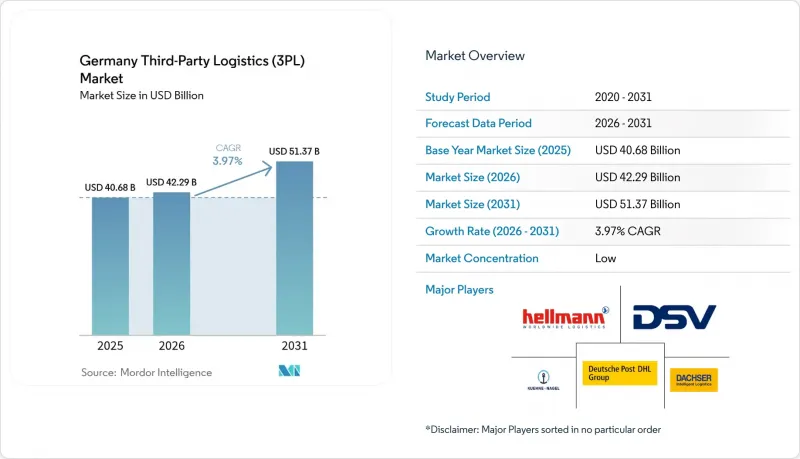
This report is Segmented by Service (Domestic Transportation Management, International Transportation Management, and More), by End User (Automotive, Energy & Utilities, Manufacturing, and More), by Logistics Model (Asset-Light, Asset-Heavy, Hybrid), and by States (North Rhine-Westphalia, Bavaria, and More). The Market Forecasts are Provided in Terms of Value (USD).
Germany Third-Party Logistics (3PL) Market Trends and Insights
E-commerce Parcel Volumes Surge Beyond Pre-Pandemic Baseline
Parcel demand continues to outpace 2019 benchmarks as consumers shift more discretionary purchases online. Smartphones drive 57% of checkouts, forcing fulfillment networks to accommodate smaller, faster deliveries. Germany's average 1.44-day transit time and 94.39% first-attempt delivery success entrench the country as a preferred distribution base. DHL processes 6.7 million domestic parcels daily and targets over 5% annual e-commerce revenue growth, illustrating how incumbent operators redirect resources from declining mail toward parcel logistics. Scalability in last-mile capacity remains a decisive competitive lever as parcel density spreads across suburban and rural zones.
Omnichannel Retail Drives Inventory Decentralization
Retailers now split stock across multiple micro-fulfillment locations to meet next-day commitments. REWE's USD 275 million Magdeburg center embodies this pivot, operating 49,500 m2 with 50% automation and throughput of 286,000 daily packages. Distributed nodes shorten lead times but multiply planning complexity, pushing merchants to outsource visibility and allocation tasks. Asset-Light 3PLs gain traction by layering advanced WMS and analytics over shared facilities, enabling retailers to flex capacity without owning warehouses.
Structural Truck-Driver Shortage (More than 80,000 Vacancies)
With fewer than 3% of drivers under 25, retirements outpace recruits, leaving fleets short of capacity. Annual economic drag hits USD 11 billion as routes are deferred or priced higher. Regulatory hurdles for non-EU drivers and lifestyle concerns depress new entries, forcing 3PLs to increase wages and invest in retention amenities. Larger operators buffer the impact with autonomous yard tractors and optimized routing, whereas small firms face margin compression and the risk of exit.
Other drivers and restraints analyzed in the detailed report include:
- Rising Cross-Border B2C Flows Post-Brexit Rerouting
- Automation ROI Improves with USD 13.2 Minimum Wage
- High Electricity Tariffs Limit Cold-Chain Capacity Expansion
For complete list of drivers and restraints, kindly check the Table Of Contents.
Segment Analysis
Domestic Transportation Management contributed 38.45% to 2025 revenue, underlining the Germany third-party logistics market size derived from the country's 13,000-km Autobahn grid and dense industrial clusters. Regular groupage and full-truckload moves support export production and intra-EU supply chains. Meanwhile, Value-Added Warehousing & Distribution is projected to grow 6.55% annually through 2031 as retailers decentralize inventory and manufacturers demand postponement services. This shift raises the Germany third-party logistics market share of facility-based offerings, encouraging providers to retrofit space with shuttle systems, voice-directed picking, and temperature-controlled zones.
Automation and real-time visibility reshape service boundaries. Carriers such as Rhenus trimmed network transit times by 34% after redesigning hub flows, proving that IT-enabled routing can unlock capacity without expanding fleets. Clients increasingly request transport-related warehousing, expecting single-invoice, end-to-end solutions. Consequently, 3PLs bundle consolidation, cross-dock, and final-mile under unified contracts, blurring the lines between legacy transport and storage segments.
Complete Report Scope:
- By Service
- Domestic Transportation Management (DTM)
- Roadways
- Railways
- Airways
- Waterways
- International Transportation Management (ITM)
- Roadways
- Railways
- Airways
- Waterways
- Value-Added Warehousing & Distribution (VAWD)
- Domestic Transportation Management (DTM)
- By End User
- Automotive
- Energy & Utilities
- Manufacturing
- Life Sciences & Healthcare
- Technology & Electronics
- E-commerce
- Consumer Goods & FMCG
- Food & Beverages
- Others
- By Logistics Model
- Asset-Light (Management-Based)
- Asset-Heavy (Own Fleet & Warehouses)
- Hybrid
- By States - Germany (Value)
- North Rhine-Westphalia
- Bavaria (Bayern)
- Baden-Wurttemberg
- Rest of States
List of Companies Covered in this Report:
- DHL Group
- Dachser
- Kuehne + Nagel
- DSV
- Hellmann Worldwide Logistics
- FIEGE Logistics
- Rhenus Logistics
- UPS Supply Chain Solutions Inc.
- FedEx
- HAVI Logistics
- Honold Logistik
- APL Logistics
- Geodis
- Arvato
- BLG Logistics Group
- Rohlig Logistics
- Seifert Logistics Group
- Bollore Logistics
- ID Logistics Group
- Scan Global Logistics
Additional Benefits:
- The market estimate (ME) sheet in Excel format
- 3 months of analyst support
TABLE OF CONTENTS
1 Introduction
- 1.1 Study Assumptions & Market Definition
- 1.2 Scope of the Study
2 Research Methodology
3 Executive Summary
4 Market Landscape
- 4.1 Market Overview
- 4.2 Market Drivers
- 4.2.1 E-commerce parcel volumes surge beyond pre-pandemic baseline
- 4.2.2 Omnichannel retail drives inventory decentralisation
- 4.2.3 Rising cross-border B2C flows post-Brexit rerouting
- 4.2.4 Automation ROI improves with Germany's EUR 12 minimum wage hikes
- 4.2.5 ESG-linked loans incentivise green warehousing retrofits
- 4.2.6 Bundeswehr re-armament programme lifts defence-logistics spend
- 4.3 Market Restraints
- 4.3.1 Structural truck-driver shortage (>80 000 vacancies)
- 4.3.2 High electricity tariffs limit cold-chain capacity expansion
- 4.3.3 Strict Sunday truck-ban complicates network planning
- 4.3.4 Near-shoring to CEE shifts volumes out of domestic 3PL hubs
- 4.4 Value / Supply-Chain Analysis
- 4.5 Regulatory Landscape
- 4.6 Technological Outlook
- 4.7 Porter's Five Forces
- 4.7.1 Threat of New Entrants
- 4.7.2 Bargaining Power of Suppliers
- 4.7.3 Bargaining Power of Buyers
- 4.7.4 Threat of Substitutes
- 4.7.5 Industry Rivalry
- 4.8 Impact of Geopolitics & Pandemic
5 Market Size & Growth Forecasts (Value)
- 5.1 By Service
- 5.1.1 Domestic Transportation Management (DTM)
- 5.1.1.1 Roadways
- 5.1.1.2 Railways
- 5.1.1.3 Airways
- 5.1.1.4 Waterways
- 5.1.2 International Transportation Management (ITM)
- 5.1.2.1 Roadways
- 5.1.2.2 Railways
- 5.1.2.3 Airways
- 5.1.2.4 Waterways
- 5.1.3 Value-Added Warehousing & Distribution (VAWD)
- 5.1.1 Domestic Transportation Management (DTM)
- 5.2 By End User
- 5.2.1 Automotive
- 5.2.2 Energy & Utilities
- 5.2.3 Manufacturing
- 5.2.4 Life Sciences & Healthcare
- 5.2.5 Technology & Electronics
- 5.2.6 E-commerce
- 5.2.7 Consumer Goods & FMCG
- 5.2.8 Food & Beverages
- 5.2.9 Others
- 5.3 By Logistics Model
- 5.3.1 Asset-Light (Management-Based)
- 5.3.2 Asset-Heavy (Own Fleet & Warehouses)
- 5.3.3 Hybrid
- 5.4 By States - Germany (Value)
- 5.4.1 North Rhine-Westphalia
- 5.4.2 Bavaria (Bayern)
- 5.4.3 Baden-Wurttemberg
- 5.4.4 Rest of States
6 Competitive Landscape
- 6.1 Market Concentration
- 6.2 Strategic Moves
- 6.3 Market Share Analysis
- 6.4 Company Profiles (includes Global level Overview, Market level overview, Core Segments, Financials as available, Strategic Information, Market Rank/Share for key companies, Products & Services, and Recent Developments)
- 6.4.1 DHL Group
- 6.4.2 Dachser
- 6.4.3 Kuehne + Nagel
- 6.4.4 DSV
- 6.4.5 Hellmann Worldwide Logistics
- 6.4.6 FIEGE Logistics
- 6.4.7 Rhenus Logistics
- 6.4.8 UPS Supply Chain Solutions Inc.
- 6.4.9 FedEx
- 6.4.10 HAVI Logistics
- 6.4.11 Honold Logistik
- 6.4.12 APL Logistics
- 6.4.13 Geodis
- 6.4.14 Arvato
- 6.4.15 BLG Logistics Group
- 6.4.16 Rohlig Logistics
- 6.4.17 Seifert Logistics Group
- 6.4.18 Bollore Logistics
- 6.4.19 ID Logistics Group
- 6.4.20 Scan Global Logistics
7 Market Opportunities & Future Outlook

