PUBLISHER: Mordor Intelligence | PRODUCT CODE: 2114948

PUBLISHER: Mordor Intelligence | PRODUCT CODE: 2114948
France Third-Party Logistics (3PL) - Market Share Analysis, Industry Trends & Statistics, Growth Forecasts (2026 - 2031)
According to Mordor Intelligence, the France third-Party logistics market size is expected to grow from USD 29.57 billion in 2025 to USD 30.82 billion in 2026 and is forecast to reach USD 37.91 billion by 2031 at 4.23% CAGR over 2026-2031.
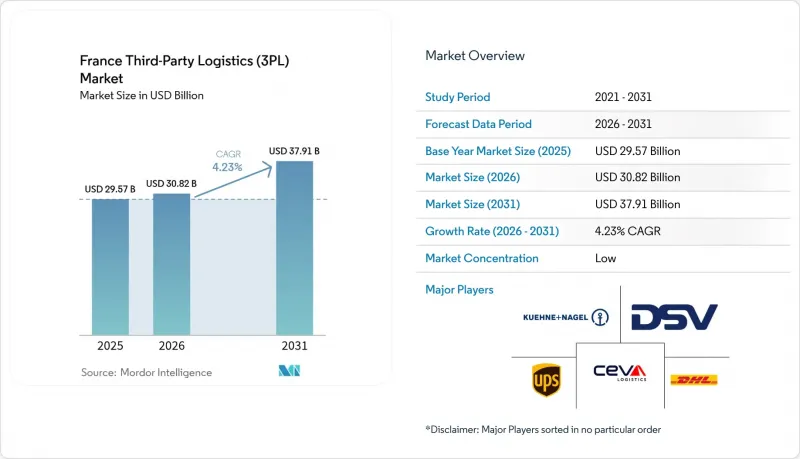
This report is Segmented by Service (Domestic Transportation Management (Roadways, Railways, Airways, Waterways), and More), End User (Automotive, Energy & Utilities, Manufacturing, Life Sciences & Healthcare, Technology & Electronics, and More), Logistics Model (Asset-Light, Asset-Heavy, Hybrid). The Market Forecasts are Provided in Terms of Value (USD).
France Third-Party Logistics (3PL) Market Trends and Insights
Surge in E-commerce Fulfillment Demand
France's rapid online retail migration is stretching last-mile capacity, prompting 3PLs to redesign city-center networks around electric vans, micro-hubs, and parcel lockers rather than pure speed. Seventy percent of French online shoppers now prefer low-emission delivery options, pushing providers to balance sustainability and service costs. The resale economy's climb toward a €14 billion valuation by 2030 intensifies reverse logistics and inspection needs, steering retailers toward value-added warehouse solutions instead of basic transport. Fashion continues to post the deepest online penetration, yet grocery and homeware categories are closing the gap, further lifting demand for temperature-controlled urban facilities. Together, these shifts explain why warehousing and distribution services outpace core trucking within the France third-party logistics market.
Growing Intra-EU Cross-Border Trade
Post-Brexit rerouting places France at the center of mainland trade flows, supported by multimodal investments that connect Northern manufacturing belts to Mediterranean ports. The mandatory ELO digital envelope, effective September 2025, automates customs paperwork for roll-on/roll-off freight, trimming wait times and encouraging smaller 3PLs to add international lanes. New corridors stemming from the India-Middle East-Europe initiative will designate French ports as the first continental landing points, raising long-haul forwarding and customs brokerage demand. Government strategy papers for 2025-2026 earmark funding for smart-border technology and low-carbon truck parking along the A1 and A16 highways. As near-shoring expands, shippers increasingly request integrated warehousing in Calais and Lille that can service both domestic and Benelux markets within 24 hours.
Driver Shortage & Mounting Labor Costs
Unfilled truck positions surpass 50,000 nationwide, constraining capacity even as demand rebounds. Warehouses feel parallel stress, with 72% of operators citing recruitment difficulties and 85% flagging retention challenges. The financial strain shows in insolvency filings-486 logistics firms entered administration during Q1 2024 alone, a level unseen since the 2008-2009 crisis. Fuel volatility and limited pricing power compress already thin margins, especially for smaller operators that lack automation capital. These pressures invite accelerated robotics adoption, but payback periods remain lengthy for asset-heavy fleets unless complemented by densification and route-optimization software.
Other drivers and restraints analyzed in the detailed report include:
- Outsourcing Focus of French Manufacturers
- Expansion of Cold-Chain in Pharma & Food
- Stringent Carbon-Emissions Compliance Costs
For complete list of drivers and restraints, kindly check the Table Of Contents.
Segment Analysis
Domestic Transportation Management contributed 42.65% of France third-party logistics market share in 2025, buoyed by dense motorway coverage and sustained road-freight preference. Yet the segment's mid-single-digit growth is eclipsed by Value-Added Warehousing & Distribution, whose 6.85% CAGR echoes rising SKU counts, omnichannel order profiles, and shrinking delivery windows. International Transportation Management remains vulnerable to geopolitical uncertainty, though the ELO customs envelope and fresh rail links to Spain and Italy are expected to lift volumes from 2026 onward.
The France third-party logistics industry is shifting from transactional trucking to integrated lifecycle stewardship. Retailers request kitting, personalization, and returns grading inside warehouses, embedding 3PLs deeper into the downstream customer experience. This service layering underpins incremental fees and fortifies long-term contracts, offsetting margin squeezes in pure line-haul. Meanwhile, intermodal volumes benefit as government subsidies rekindle rail; MEDLOG's Paris hub plans to process one million TEUs per year by 2027, supporting emission-cutting objectives and enhancing regional capacity balance.
Complete Report Scope:
- By Service
- Domestic Transportation Management (DTM)
- Roadways
- Railways
- Airways
- Waterways
- International Transportation Management (ITM)
- Roadways
- Railways
- Airways
- Waterways
- Value-Added Warehousing & Distribution (VAWD)
- Domestic Transportation Management (DTM)
- By End User
- Automotive
- Energy & Utilities
- Manufacturing
- Life Sciences & Healthcare
- Technology & Electronics
- E-commerce
- Consumer Goods & FMCG
- Food & Beverages
- Others
- By Logistics Model
- Asset-Light (Management-Based)
- Asset-Heavy (Own Fleet & Warehouses)
- Hybrid
List of Companies Covered in this Report:
- Bansard International
- SEKO Logistics
- DSV
- DHL Group
- GEFCO
- GEODIS
- ID Logistics
- Dimotrans Group
- Schneider
- XPO Logistics
- Kuehne + Nagel
- CEVA Logistics
- FM Logistic
- DACHSER France
- Rhenus Logistics
- United Parcel Service, Inc.
- Nippon Express
- Groupe CAT
- Dimotrans Group
- STEF
Additional Benefits:
- The market estimate (ME) sheet in Excel format
- 3 months of analyst support
TABLE OF CONTENTS
1 Introduction
- 1.1 Study Assumptions & Market Definition
- 1.2 Scope of the Study
2 Research Methodology
3 Executive Summary
4 Market Landscape
- 4.1 Market Overview
- 4.2 Market Drivers
- 4.2.1 Surge in e-commerce fulfilment demand
- 4.2.2 Growing intra-EU cross-border trade
- 4.2.3 Outsourcing focus of French manufacturers
- 4.2.4 Expansion of cold-chain in pharma & food
- 4.2.5 5G-enabled warehouse automation pilots
- 4.2.6 Rail-freight revitalisation boosting intermodal 3PL
- 4.3 Market Restraints
- 4.3.1 Driver shortage & mounting labour costs
- 4.3.2 Stringent carbon-emissions compliance costs
- 4.3.3 Urban consolidation-zone truck restrictions
- 4.3.4 Post-Brexit volatility at Calais & Channel ports
- 4.4 Value/Supply-Chain Analysis
- 4.5 Regulatory Landscape
- 4.6 Technological Outlook
- 4.7 Porter's Five Forces
- 4.7.1 Bargaining Power of Suppliers
- 4.7.2 Bargaining Power of Buyers
- 4.7.3 Threat of New Entrants
- 4.7.4 Threat of Substitutes
- 4.7.5 Competitive Rivalry
- 4.8 General Trends in Warehousing
- 4.9 Demand from CEP, Last-mile, Cold-chain
- 4.10 Insights on e-Commerce Business
5 Market Size & Growth Forecasts (Value)
- 5.1 By Service
- 5.1.1 Domestic Transportation Management (DTM)
- 5.1.1.1 Roadways
- 5.1.1.2 Railways
- 5.1.1.3 Airways
- 5.1.1.4 Waterways
- 5.1.2 International Transportation Management (ITM)
- 5.1.2.1 Roadways
- 5.1.2.2 Railways
- 5.1.2.3 Airways
- 5.1.2.4 Waterways
- 5.1.3 Value-Added Warehousing & Distribution (VAWD)
- 5.1.1 Domestic Transportation Management (DTM)
- 5.2 By End User
- 5.2.1 Automotive
- 5.2.2 Energy & Utilities
- 5.2.3 Manufacturing
- 5.2.4 Life Sciences & Healthcare
- 5.2.5 Technology & Electronics
- 5.2.6 E-commerce
- 5.2.7 Consumer Goods & FMCG
- 5.2.8 Food & Beverages
- 5.2.9 Others
- 5.3 By Logistics Model
- 5.3.1 Asset-Light (Management-Based)
- 5.3.2 Asset-Heavy (Own Fleet & Warehouses)
- 5.3.3 Hybrid
6 Competitive Landscape
- 6.1 Market Concentration
- 6.2 Strategic Moves
- 6.3 Market Share Analysis
- 6.4 Company Profiles (includes Global level Overview, Market level overview, Core Segments, Financials as available, Strategic Information, Market Rank/Share for key companies, Products & Services, and Recent Developments)
- 6.4.1 Bansard International
- 6.4.2 SEKO Logistics
- 6.4.3 DSV
- 6.4.4 DHL Group
- 6.4.5 GEFCO
- 6.4.6 GEODIS
- 6.4.7 ID Logistics
- 6.4.8 Dimotrans Group
- 6.4.9 Schneider
- 6.4.10 XPO Logistics
- 6.4.11 Kuehne + Nagel
- 6.4.12 CEVA Logistics
- 6.4.13 FM Logistic
- 6.4.14 DACHSER France
- 6.4.15 Rhenus Logistics
- 6.4.16 United Parcel Service, Inc.
- 6.4.17 Nippon Express
- 6.4.18 Groupe CAT
- 6.4.19 Dimotrans Group
- 6.4.20 STEF
7 Market Opportunities & Future Outlook
- 7.1 White-space & Unmet-Need Assessment

