PUBLISHER: Mordor Intelligence | PRODUCT CODE: 2114857

PUBLISHER: Mordor Intelligence | PRODUCT CODE: 2114857
Southeast Asia Savory Snacks - Market Share Analysis, Industry Trends & Statistics, Growth Forecasts (2026 - 2031)
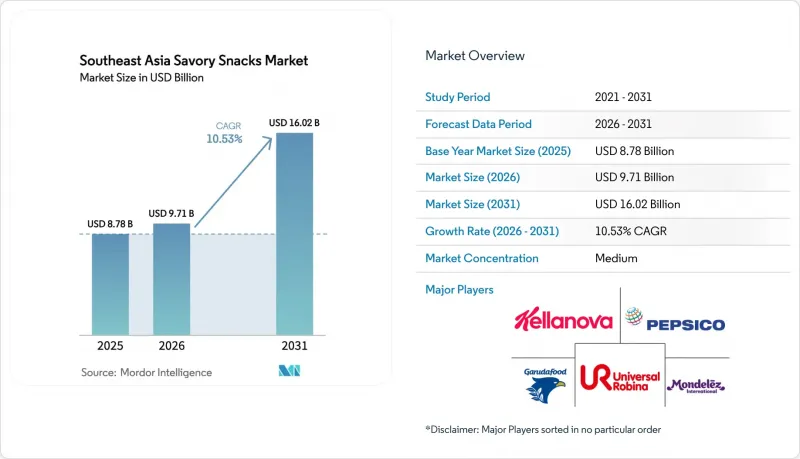
According to Mordor Intelligence, the Southeast Asia savory snacks market size is projected to increase from USD 8.78 billion in 2025 to USD 9.71 billion in 2026 and reach USD 16.02 billion by 2031, growing at a CAGR of 10.53% from 2026 to 2031.
This report is Segmented by Product Type (Chips and Crisp Based Snacks, Meat Snacks, Popcorn, Fruit and Vegetable Snacks, and More), Flavor Profile (Classic Salted and Flavored), Distribution Channel (Supermarkets/Hypermarkets, Convenience Stores, and More) and Country (Indonesia, Malaysia, Vietnam, Thailand, Singapore, and More). The Market Forecasts are Provided in Terms of Value (USD).
Southeast Asia Savory Snacks Market Trends and Insights
Rapid urbanisation and growth of modern retail in Indonesia, Vietnam and Philippines
The rapid urbanization in Southeast Asia, particularly in Indonesia, Vietnam, and the Philippines, is significantly driving the growth of the savory snacks market in the region. Urbanization rates reported by the World Bank stand at 58.57% for Indonesia, 39.48% for Vietnam, and 48.28% for the Philippines. This demographic shift toward urban living has led to a growing preference for convenient, ready-to-eat snack options among consumers. Additionally, modern retail formats like supermarkets and hypermarkets have made products more accessible, catering to the changing preferences of urban consumers. Additionally, the rapid growth of retail infrastructure in the region, including a steady increase in convenience stores, is driving market growth. For instance, in Indonesia, the number of convenience stores grew from 39,714 in 2021 to 46,118 in 2023. These developments are fueling the expansion of the savory snacks market in Southeast Asia, as urban consumers increasingly prefer a wider variety of snacks that are easy to find.
Health-oriented reformulation (reduced sodium/oil) led by Thailand and Singapore
Thailand and Singapore are taking the lead in making savory snacks healthier in the Southeast Asia market by lowering sodium and oil levels. These efforts support government health initiatives like Thailand's "Healthier Choice" logo program and Singapore's "Healthier Choice Symbol" campaign, which motivate manufacturers to offer healthier snack options. The Health Promotion Board (HPB) in Singapore reports that snacks with the "Healthier Choice Symbol" are gaining popularity among consumers, driving market growth. Similarly, Thailand's Ministry of Public Health has actively promoted sodium reduction strategies, aiming to reduce sodium consumption by 30% by 2025. These government-backed efforts are significantly influencing product innovation and reformulation trends in the region.
Volatile palm-oil and potato prices from climate shocks across SEA
Climate changes in Southeast Asia have caused unstable prices for palm oil and potatoes, which are essential raw materials for making savory snacks. These price changes are a major challenge for the Southeast Asia Savory Snacks Market because they directly increase production costs and reduce profit margins for manufacturers. Extreme weather events like floods, droughts, and high temperatures make raw material prices unpredictable, making it harder to keep pricing and supply chains steady. Higher costs for these key ingredients may force manufacturers to either bear the extra expenses or raise prices for consumers, which could lower demand. This instability not only disrupts production but also makes long-term planning and investments difficult, slowing down the market's growth in the region.
Other drivers and restraints analyzed in the detailed report include:
- Local-cuisine flavor innovation (sambal, tom-yum, durian) engaging Gen-Z
- Tourism rebound lifting on-the-go sales in Thailand and Malaysia
- Halal-certification lead-times slowing launches in Indonesia and Malaysia
For complete list of drivers and restraints, kindly check the Table Of Contents.
Segment Analysis
In 2025, chips and crisp-based snacks held a significant 38.13% share of the market. This strong position is due to consumers' long-standing preference for these snacks and the wide distribution networks that make them easily available. These snacks are a popular choice because they are convenient and familiar. Additionally, companies regularly launch new flavors and innovative products, which keep chips and crisp-based snacks appealing and help them maintain their leading position in the competitive snack market.
Meanwhile, fruit and vegetable snacks are becoming a fast-growing segment in the Southeast Asian savory snacks market. These snacks are expected to grow at a high CAGR of 12.50% during the forecast period, surpassing the overall market growth. This growth shows that consumers are shifting toward healthier and more nutritious snack options. The change is driven by increasing health awareness and a preference for natural ingredients. The popularity of plant-based diets and the availability of premium, organic snacks are also boosting this segment. The rapid growth of fruit and vegetable snacks highlights their potential to change market trends and create opportunities for new products and expansion in the future.
Complete Report Scope:
- By Product Type
- Chips & Crisp- Based Snacks
- Potato Chips
- Tortilla & Corn Chips
- Rice & Pulse-Based Chips
- Multigrain Chips
- Seaweed & Marine-Based Crisps
- Nuts, Seeds & Trail Mixes
- Fruit and Vegetable Snacks
- Popcorn Snacks
- Meat & Jerky Snacks
- Extruded & Puffed Snacks
- Others Products
- Chips & Crisp- Based Snacks
- By Distribution Channel
- Supermarkets/Hypermarkets
- Convenience Stores
- Online Retailers
- Others Distribution Channels
- By Flavor Profile
- Classic Salted/ Plain
- Flavored
- By Country
- Indonesia
- Malaysia
- Vietnam
- Thailand
- Philippines
- Myanmar
- Singapore
- Rest of Southeast Asia
List of Companies Covered in this Report:
- PepsiCo Inc.
- Mondelez International
- Teck Huat & Co. Pte Ltd
- Universal Robina Corporation
- Kellanova
- Calbee Inc.
- GarudaFood Putra Putri Jaya Tbk
- Tao Kae Noi Food & Marketing PCL
- Monde Nissin Corp.
- Want Want Holdings Ltd.
- VinaMit JSC
- J&D Food Industries Sdn Bhd
- Thai Snack Foods Co., Ltd
- Srisan Food Co., Ltd.
- Orang Tua Group
- Kameda Seika Co.
- PT Sekar Laut Tbk
- Liwayway Holdings (Oishi)
- Mamee-Double Decker (M) Sdn Bhd
- PT Mayora Indah Tbk
Additional Benefits:
- The market estimate (ME) sheet in Excel format
- 3 months of analyst support
TABLE OF CONTENTS
1 INTRODUCTION
- 1.1 Study Assumptions and Market Definition
- 1.2 Scope of the Study
2 RESEARCH METHODOLOGY
3 EXECUTIVE SUMMARY
4 MARKET LANDSCAPE
- 4.1 Market Overview
- 4.2 Market Drivers
- 4.2.1 Rapid urbanisation and growth of modern retail in Indonesia, Vietnam and Philippines
- 4.2.2 Health-oriented reformulation (reduced sodium/oil) led by Thailand and Singapore
- 4.2.3 Local-cuisine flavour innovation (sambal, tom-yum, durian) engaging Gen-Z
- 4.2.4 Domestic extruder capacity expansions lowering price points in Indonesia & Vietnam
- 4.2.5 E-commerce and quick-commerce fulfilment boosting urban snack demand
- 4.2.6 Tourism rebound lifting on-the-go sales in Thailand and Malaysia
- 4.3 Market Restraints
- 4.3.1 Volatile palm-oil and potato prices from climate shocks across SEA
- 4.3.2 Halal-certification lead-times slowing launches in Indonesia and Malaysia
- 4.3.3 Salt-/sugar-tax proposals in Singapore and Philippines pressuring margins
- 4.3.4 Fragmented rural distribution networks limiting reach beyond Tier-2 towns
- 4.4 Value/Supply-Chain Analysis
- 4.5 Regulatory Outlook
- 4.6 Technological Outlook (high-pressure & twin-screw extrusion, clean-label processing)
- 4.7 Porter's Five Forces
- 4.7.1 Threat of New Entrants
- 4.7.2 Bargaining Power of Buyers
- 4.7.3 Bargaining Power of Suppliers
- 4.7.4 Threat of Substitutes
- 4.7.5 Intensity of Rivalry
5 MARKET SIZE AND GROWTH FORECASTS (VALUE)
- 5.1 By Product Type
- 5.1.1 Chips & Crisp- Based Snacks
- 5.1.1.1 Potato Chips
- 5.1.1.2 Tortilla & Corn Chips
- 5.1.1.3 Rice & Pulse-Based Chips
- 5.1.1.4 Multigrain Chips
- 5.1.1.5 Seaweed & Marine-Based Crisps
- 5.1.2 Nuts, Seeds & Trail Mixes
- 5.1.3 Fruit and Vegetable Snacks
- 5.1.4 Popcorn Snacks
- 5.1.5 Meat & Jerky Snacks
- 5.1.6 Extruded & Puffed Snacks
- 5.1.7 Others Products
- 5.1.1 Chips & Crisp- Based Snacks
- 5.2 By Distribution Channel
- 5.2.1 Supermarkets/Hypermarkets
- 5.2.2 Convenience Stores
- 5.2.3 Online Retailers
- 5.2.4 Others Distribution Channels
- 5.3 By Flavor Profile
- 5.3.1 Classic Salted/ Plain
- 5.3.2 Flavored
- 5.4 By Country
- 5.4.1 Indonesia
- 5.4.2 Malaysia
- 5.4.3 Vietnam
- 5.4.4 Thailand
- 5.4.5 Philippines
- 5.4.6 Myanmar
- 5.4.7 Singapore
- 5.4.8 Rest of Southeast Asia
6 COMPETITIVE LANDSCAPE
- 6.1 Market Concentration
- 6.2 Strategic Moves
- 6.3 Market Share Analysis
- 6.4 Company Profiles (includes Global-level Overview, Market-level Overview, Core Segments, Financials, Strategic Info, Market Rank/Share, Products and Services, Recent Developments)
- 6.4.1 PepsiCo Inc.
- 6.4.2 Mondelez International
- 6.4.3 Teck Huat & Co. Pte Ltd
- 6.4.4 Universal Robina Corporation
- 6.4.5 Kellanova
- 6.4.6 Calbee Inc.
- 6.4.7 GarudaFood Putra Putri Jaya Tbk
- 6.4.8 Tao Kae Noi Food & Marketing PCL
- 6.4.9 Monde Nissin Corp.
- 6.4.10 Want Want Holdings Ltd.
- 6.4.11 VinaMit JSC
- 6.4.12 J&D Food Industries Sdn Bhd
- 6.4.13 Thai Snack Foods Co., Ltd
- 6.4.14 Srisan Food Co., Ltd.
- 6.4.15 Orang Tua Group
- 6.4.16 Kameda Seika Co.
- 6.4.17 PT Sekar Laut Tbk
- 6.4.18 Liwayway Holdings (Oishi)
- 6.4.19 Mamee-Double Decker (M) Sdn Bhd
- 6.4.20 PT Mayora Indah Tbk
7 MARKET OPPORTUNITES AND FUTURE OUTLOOK

