PUBLISHER: Mordor Intelligence | PRODUCT CODE: 2114890

PUBLISHER: Mordor Intelligence | PRODUCT CODE: 2114890
America AI Retail - Market Share Analysis, Industry Trends & Statistics, Growth Forecasts (2026 - 2031)
According to Mordor Intelligence, the America AI retail market reached USD 6.43 billion in 2026 and is projected to grow to USD 12.66 billion by 2031, registering a 14.51% CAGR.
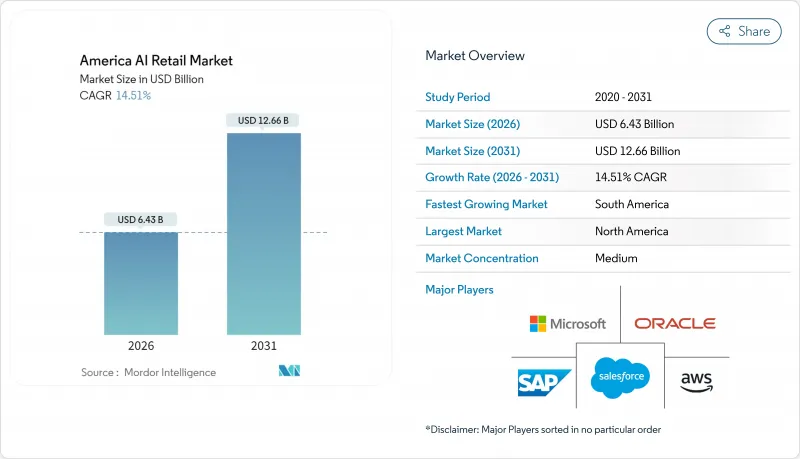
This report is Segmented by Channel (Omnichannel, Brick and Mortar, and Pure-Play Online Retailers), Solution (Software, and Service), Application (Apparel and Footwear, Food and Grocery, Home Improvement, and More), Technology (Machine Learning, Natural Language Processing, Chatbots, Image and Video Analytics, and Swarm Intelligence), and Geography. The Market Forecasts are Provided in Terms of Value (USD).
America AI Retail Market Trends and Insights
Accelerated GPU And Edge-AI Hardware Innovation
NVIDIA's retail blueprints released in January 2025 trimmed model latency to sub-50 milliseconds, enabling real-time personalization at the point of sale without round-tripping data to cloud centers. More than 12,000 EGX edge nodes processed 4.2 billion daily inference calls by December 2025, validating at-scale performance. Intel's Gaudi 3 accelerators, launched in April 2025, delivered 70% of comparable throughput at 55% of the capital outlay, carving space for cost-sensitive regional chains. As hardware footprints proliferate, demand is rising for model-compression and federated-learning tools that protect data-residency requirements while keeping training local. Hardware vendors have responded by packaging silicon, software, and deployment expertise, lowering entry barriers for mid-market adopters and adding momentum to the America AI Retail Market.
Omnichannel Personalization Imperative
Retailers integrating browsing, in-store, and mobile data into unified profiles saw double-digit increases in conversion rates in 2025. Adobe's real-time CDP processed 18 billion customer events per day, demonstrating that data-rich profiles unlock 2.7-times higher conversion rates when individualized messaging is delivered within 24 hours. Microsoft deepened this trend in June 2025 by embedding Azure OpenAI Service into Dynamics 365 Customer Insights, generating natural-language content tuned to each shopper's context, a move that trimmed bounce rates by nearly one-third. As retailers merge e-commerce, store operations, and marketing into unified data teams, omnichannel personalization has become a board-level mandate, driving incremental spending that supports the America AI Retail Market.
Shortage Of Retail-Specific Data-Science Talent
Retailers face a structural talent gap as hybrid expertise in machine learning and merchandising remains scarce. Median salaries for North American AI engineers climbed to USD 185,000 in 2025, yet turnover topped 30% as hyperscalers lured specialists with equity packages. Talent scarcity inflates project budgets, extends timelines, and forces many chains to embrace low-code platforms or managed services. Although retailers sponsor university programs and acquire analytics boutiques, these measures take years to bear fruit, sustaining drag on near-term adoption.
Other drivers and restraints analyzed in the detailed report include:
- AI-First Operating Models Among Tier-1 Retailers
- Supply-Chain Optimization For Last-Mile Efficiency
- Legacy IT Integration Complexity And Costs
For complete list of drivers and restraints, kindly check the Table Of Contents.
Segment Analysis
Pure-play online operators are forecast to grow at 15.19% through 2031, surpassing the overall America AI retail market CAGR as they exploit flexible infrastructure and rapid experiment cycles to roll out recommendation engines, dynamic pricing, and conversational commerce. Omnichannel retailers accounted for 43.67% of 2025 revenue by leveraging store footprints for click-and-collect services, yet they shoulder heavier integration burdens that slow the rollout of new use cases. The AI retail market size for brick-and-mortar chains continues to expand, but competitive intensity is rising as Amazon's Just Walk Out setup has been extended to more than 140 North American sites, setting new expectations for frictionless checkout.
Shopify democratized advanced tooling in May 2025 when it launched Magic AI for 2.1 million merchants, compressing the capability gap between small sellers and large e-commerce leaders. Physical retailers are fighting back with edge-AI kiosks that deliver personalized offers in-store; Lowe's Mylow Companion reduced average visit times by 28% while increasing basket sizes by 17%. As experiential differentiation eclipses pure assortment breadth, data density will determine winners, reinforcing investment in unified-commerce AI stacks and sustaining expansion of the America AI retail market.
Software held 52.89% of 2025 revenue, but services are rallying with a 14.92% CAGR through 2031 as retailers outsource architecture design, model tuning, and change management. Enterprises adopting on-premise modules do so to preserve data residency, while mid-market retailers typically favor multitenant clouds. The America AI retail market for managed services is growing as integration complexity and talent shortages are tilting the total cost of ownership toward external providers.
Infosys and Cognizant each report multiyear agreements that bundle platform selection, data migration, and operational analytics. SAP's Joule assistant automates low-value queries, yet the vendor's own services arm spends up to 9 months tailoring workflows to each client's unique schema. Salesforce's 2025 debut of Agentforce follows the same pattern: license revenue is paired with professional services that shoulder configuration tasks. As buyers mature, procurement teams specify time-to-value metrics, turning implementation prowess into a primary differentiator and driving sustained expansion of the service slice of the America AI retail market.
Complete Report Scope:
- By Channel
- Omnichannel
- Brick and Mortar
- Pure-Play Online Retailers
- By Solution
- Software
- On Premise
- Cloud
- Service
- Software
- By Application
- Apparel and Footwear
- Food and Grocery
- Electronics and Home Appliances
- Home Improvement
- Other Applications
- By Technology
- Machine Learning
- Natural Language Processing
- Chatbots
- Image and Video Analytics
- Swarm Intelligence
- By Geography
- North America
- United States
- Canada
- Mexico
- South America
- Brazil
- Argentina
- Rest of South America
- North America
List of Companies Covered in this Report:
- Amazon Web Services Inc.
- Microsoft Corporation
- Google LLC
- IBM Corporation
- SAP SE
- Salesforce Inc.
- Oracle Corporation
- NVIDIA Corporation
- Intel Corporation
- ViSenze Pte Ltd.
- Sentient Technologies Holdings Ltd.
- Sophos Inc.
- Cognizant Technology Solutions
- Infosys Limited
- Walmart Global Tech
- Shopify Inc.
- Blue Yonder Group Inc.
- Symbotic Inc.
- Kroger Technology
- Ocado Group plc
Additional Benefits:
- The market estimate (ME) sheet in Excel format
- 3 months of analyst support
TABLE OF CONTENTS
1 INTRODUCTION
- 1.1 Study Assumptions and Market Definition
- 1.2 Scope of the Study
2 RESEARCH METHODOLOGY
3 EXECUTIVE SUMMARY
4 MARKET LANDSCAPE
- 4.1 Market Overview
- 4.2 Market Drivers
- 4.2.1 Accelerated GPU and Edge-AI Hardware Innovation
- 4.2.2 Omnichannel Personalization Imperative
- 4.2.3 AI-First Operating Models Among Tier-1 Retailers
- 4.2.4 Supply-Chain Optimization for Last-Mile Efficiency
- 4.2.5 Real-time Computer-Vision Loss-Prevention Systems
- 4.2.6 Quantum-Inspired Inventory Optimization Pilots
- 4.3 Market Restraints
- 4.3.1 Shortage of Retail-Specific Data-Science Talent
- 4.3.2 Legacy IT Integration Complexity and Costs
- 4.3.3 Increasing Data-Privacy and AI-Audit Regulations
- 4.3.4 Sustainability Concerns over AI Energy Footprint
- 4.4 Impact of Macroeconomic Factors on the Market
- 4.5 Industry Value Chain Analysis
- 4.6 Regulatory Landscape
- 4.7 Technological Outlook
- 4.8 Porter's Five Forces Analysis
- 4.8.1 Threat of New Entrants
- 4.8.2 Bargaining Power of Buyers
- 4.8.3 Bargaining Power of Suppliers
- 4.8.4 Threat of Substitutes
- 4.8.5 Intensity of Competitive Rivalry
5 MARKET SIZE AND GROWTH FORECASTS (VALUE)
- 5.1 By Channel
- 5.1.1 Omnichannel
- 5.1.2 Brick and Mortar
- 5.1.3 Pure-Play Online Retailers
- 5.2 By Solution
- 5.2.1 Software
- 5.2.1.1 On Premise
- 5.2.1.2 Cloud
- 5.2.2 Service
- 5.2.1 Software
- 5.3 By Application
- 5.3.1 Apparel and Footwear
- 5.3.2 Food and Grocery
- 5.3.3 Electronics and Home Appliances
- 5.3.4 Home Improvement
- 5.3.5 Other Applications
- 5.4 By Technology
- 5.4.1 Machine Learning
- 5.4.2 Natural Language Processing
- 5.4.3 Chatbots
- 5.4.4 Image and Video Analytics
- 5.4.5 Swarm Intelligence
- 5.5 By Geography
- 5.5.1 North America
- 5.5.1.1 United States
- 5.5.1.2 Canada
- 5.5.1.3 Mexico
- 5.5.2 South America
- 5.5.2.1 Brazil
- 5.5.2.2 Argentina
- 5.5.2.3 Rest of South America
- 5.5.1 North America
6 COMPETITIVE LANDSCAPE
- 6.1 Market Concentration
- 6.2 Strategic Moves
- 6.3 Market Share Analysis
- 6.4 Company Profiles {(includes Global Level Overview, Market Level Overview, Core Segments, Financials as available, Strategic Information, Market Rank/Share for key companies, Products and Services, and Recent Developments)}
- 6.4.1 Amazon Web Services Inc.
- 6.4.2 Microsoft Corporation
- 6.4.3 Google LLC
- 6.4.4 IBM Corporation
- 6.4.5 SAP SE
- 6.4.6 Salesforce Inc.
- 6.4.7 Oracle Corporation
- 6.4.8 NVIDIA Corporation
- 6.4.9 Intel Corporation
- 6.4.10 ViSenze Pte Ltd.
- 6.4.11 Sentient Technologies Holdings Ltd.
- 6.4.12 Sophos Inc.
- 6.4.13 Cognizant Technology Solutions
- 6.4.14 Infosys Limited
- 6.4.15 Walmart Global Tech
- 6.4.16 Shopify Inc.
- 6.4.17 Blue Yonder Group Inc.
- 6.4.18 Symbotic Inc.
- 6.4.19 Kroger Technology
- 6.4.20 Ocado Group plc
7 MARKET OPPORTUNITIES AND FUTURE OUTLOOK
- 7.1 White-Space and Unmet-Need Assessment

