PUBLISHER: Mordor Intelligence | PRODUCT CODE: 2114954

PUBLISHER: Mordor Intelligence | PRODUCT CODE: 2114954
Eastern Europe Construction - Market Share Analysis, Industry Trends & Statistics, Growth Forecasts (2026 - 2031)
According to Mordor Intelligence, the Eastern Europe construction market size is expected to grow from USD 482.05 billion in 2025 to USD 507.02 billion in 2026 and is forecast to reach USD 652.68 billion by 2031 at 5.18% CAGR over 2026-2031.
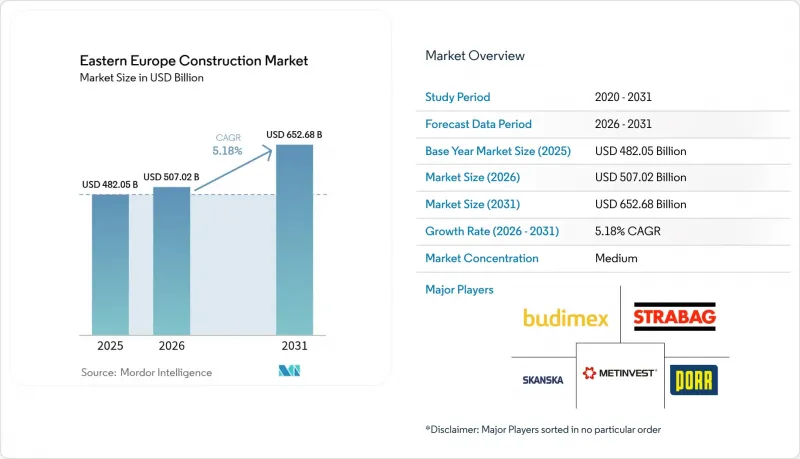
This report is Segmented by Sector (Residential, Commercial, Infrastructure), by Construction Type (New Construction, Renovation), by Construction Method (Conventional On-Site, Modern Methods of Construction), by Investment Source (Public, Private), and by Geography (Romania, Hungary, Croatia, Ukraine, Bulgaria, Rest of Eastern Europe). The Market Forecasts are Provided in Terms of Value (USD).
Eastern Europe Construction Market Trends and Insights
Surge in EU-Funded Infrastructure Programs
EU cohesion countries have been awarded EUR 25.8 billion (USD 28.1 billion) for 2021-2027 under the Connecting Europe Facility, unleashing large packages for rail, road, energy, and digital corridors. Hungary's MAV rail upgrade alone combines EUR 1.0 billion (USD 1.1 billion) of European Investment Bank funding with national co-financing, underscoring the catalytic role of blended public capital. The 2024 CEF Transport call introduced an extra EUR 2.5 billion (USD 2.7 billion) and opened eligibility to Ukraine and Moldova, broadening the addressable project pipeline. Compliance with EU procurement law and environmental standards is incentivizing contractors to upgrade digital processes. Taken together, these measures anchor a multi-year backlog that is expected to keep civil-engineering order books full through the medium term.
Rapid Build-Out of Renewable-Energy Assets
Eastern Europe's energy transition is catalyzing construction demand across generation, transmission, and storage. The Green Energy Corridor that links Azerbaijan, Georgia, Hungary, and Romania represents a EUR 10 billion (USD 10.9 billion) opportunity to build 1,100 km of high-capacity lines capable of carrying 4 GW of clean power. Hungary has earmarked EUR 52.5 million (USD 57.2 million) to upgrade its network so it can triple solar capacity by 2030, requiring new substations and automation. In Romania, a 400 MW wind farm at Pestera II attracted EUR 30 million (USD 32.7 million) of EIB money, while the USD 93 million Pecineaga project is under construction. Ukrainian-owned DTEK is rolling out a 5 GW portfolio across four EU markets, channeling nearly USD 163 million into early-stage wind and solar parks. These investments are fast-tracking grid reinforcement, foundation works, and component installation across the region.
High Interest-Rate Environment Squeezing Developer Liquidity
Policy rates have toggled between 4.5% and 8.1% since 2023, eroding debt-coverage ratios and scuttling some speculative schemes. The European Central Bank has since started trimming key rates, narrowing commercial-property yield spreads, and partially reviving deal flow. Private lenders have returned selectively to Central and Eastern Europe after a decade-long lull, but underwriting remains conservative. Developers, therefore, face a period of tight capital, likely to temper growth over the next two years.
Other drivers and restraints analyzed in the detailed report include:
- Return of Foreign Direct Investment into Post-War Ukraine Reconstruction
- Demand Spike for Affordable Multifamily Housing in Urban Corridors
- Acute Skilled-Labor Shortages Driving Wage Inflation
For complete list of drivers and restraints, kindly check the Table Of Contents.
Segment Analysis
Infrastructure contributed 38.49% to 2025 revenue and is projected to rise at a 7.28% CAGR, the fastest among all sectors, thereby defining the growth vector of the Eastern Europe construction market size. Mega-rail projects such as Hungary's EUR 2.162 billion (USD 2.4 billion) modernization and Romania's cross-country motorway extensions are moving in lockstep with power-grid upgrades like the USD 10.9 billion Green Energy Corridor. Energy-infrastructure work is further supported by Hungary's USD 57.2 million network upgrades aimed at tripling solar capacity by 2030.
Residential activity is mixed: urban apartment demand remains strong, as highlighted by Bucharest's USD 54.5 million Corallis project, yet high rates and elevated land prices constrain mortgage affordability. Commercial work is pivoting toward low-carbon office retrofits, exemplified by Skanska's timber-frame tower in Prague, while industrial and logistics builds benefit from near-shoring and e-commerce growth despite site-permitting frictions.
New builds maintained 60.85% of 2025 revenue, cementing their role as the largest slice of the Eastern Europe construction market share. However, renovation works are gathering pace at a 6.15% CAGR as Soviet-era assets undergo energy-efficiency retrofits to meet European performance standards. Ukraine offers a unique blend, where demining and partial rebuilding of utilities are prerequisites for full-scale new construction.
EU funding increasingly rewards deep-renovation projects, easing the financing of facade insulation, HVAC upgrades, and smart-meter installation. Space scarcity in city cores and permitting complexities further tilt economics toward adaptive reuse, particularly among commercial landlords needing to hit carbon-budget checkpoints.
Complete Report Scope:
- By Sector
- Residential
- Apartments/Condominiums
- Villas/Landed Houses
- Commercial
- Office
- Retail
- Industrial and Logistics
- Others
- Infrastructure
- Transportation Infrastructure (Roadways, Railways, Airways, others)
- Energy & Utilities
- Others
- Residential
- By Construction Type
- New Construction
- Renovation
- By Construction Method
- Conventional On-Site
- Modern Methods of Construction (Prefabricated, Modular, etc)
- By Investment Source
- Public
- Private
- By Geography
- Romania
- Hungary
- Croatia
- Ukraine
- Bulgaria
- Rest of Eastern Europe
List of Companies Covered in this Report:
- Strabag
- Skanska
- PORR
- Budimex
- Metinvest
- Vinci
- Eurovia
- BESIX
- Bouygues
- Eiffage
- ACCIONA
- FCC Construccion
- Royal BAM Group
- Hochtief
- Astaldi
- Ferrovial
- Gulermak
- China Communications Construction Co. (CCCC)
- Impresa Pizzarotti
- Unibep
Additional Benefits:
- The market estimate (ME) sheet in Excel format
- 3 months of analyst support
TABLE OF CONTENTS
1 Introduction
- 1.1 Study Assumptions & Market Definition
- 1.2 Scope of the Study
2 Research Methodology
3 Executive Summary
4 Market Landscape
- 4.1 Market Overview
- 4.2 Market Drivers
- 4.2.1 Surge in EU-funded infrastructure programmes
- 4.2.2 Return of foreign direct investment (FDI) into post-war Ukraine reconstruction
- 4.2.3 Rapid build-out of renewable-energy assets (on- and off-shore wind, utility-scale PV)
- 4.2.4 Demand spike for affordable multifamily housing in urban corridors
- 4.2.5 Digital twin & BIM mandates in public procurement (under-reported)
- 4.2.6 Pre-fabricated timber modules to meet green-build quotas (under-reported)
- 4.3 Market Restraints
- 4.3.1 High interest-rate environment squeezing developer liquidity
- 4.3.2 Acute skilled-labour shortages driving wage inflation
- 4.3.3 Chronic permitting delays tied to anti-corruption reforms (under-reported)
- 4.3.4 Cross-border supply-chain chokepoints for cement & rebar (under-reported)
- 4.4 Value / Supply-Chain Analysis
- 4.4.1 Overview
- 4.4.2 Real Estate Developers and Contractors - Key Quantitative and Qualitative Insights
- 4.4.3 Architectural and Engineering Companies - Key Quantitative and Qualitative Insights
- 4.4.4 Building Material and Equipment Companies - Key Quantitative and Qualitative Insights
- 4.5 Government Initiatives & Vision
- 4.6 Regulatory Landscape
- 4.7 Technological Outlook
- 4.8 Industry Attractiveness - Porter's Five Force Analysis
- 4.8.1 Bargaining Power of Suppliers
- 4.8.2 Bargaining Power of Consumers
- 4.8.3 Threat of New Entrants
- 4.8.4 Threat of Substitutes
- 4.8.5 Intensity of Competitive Rivalry
- 4.9 Pricing (Construction Materials) and Construction Cost (Materials, Labour, Equipment) Analysis
- 4.10 Comparison of Key Industry Metrics of the Eastern European Region with Other Major Countries
- 4.11 Key Upcoming/Ongoing Projects (with a focus on Mega Projects)
5 Market Size & Growth Forecasts (Value, USD)
- 5.1 By Sector
- 5.1.1 Residential
- 5.1.1.1 Apartments/Condominiums
- 5.1.1.2 Villas/Landed Houses
- 5.1.2 Commercial
- 5.1.2.1 Office
- 5.1.2.2 Retail
- 5.1.2.3 Industrial and Logistics
- 5.1.2.4 Others
- 5.1.3 Infrastructure
- 5.1.3.1 Transportation Infrastructure (Roadways, Railways, Airways, others)
- 5.1.3.2 Energy & Utilities
- 5.1.3.3 Others
- 5.1.1 Residential
- 5.2 By Construction Type
- 5.2.1 New Construction
- 5.2.2 Renovation
- 5.3 By Construction Method
- 5.3.1 Conventional On-Site
- 5.3.2 Modern Methods of Construction (Prefabricated, Modular, etc)
- 5.4 By Investment Source
- 5.4.1 Public
- 5.4.2 Private
- 5.5 By Geography
- 5.5.1 Romania
- 5.5.2 Hungary
- 5.5.3 Croatia
- 5.5.4 Ukraine
- 5.5.5 Bulgaria
- 5.5.6 Rest of Eastern Europe
6 Competitive Landscape
- 6.1 Market Concentration
- 6.2 Strategic Moves
- 6.3 Market Share Analysis
- 6.4 Company Profiles (includes Global level Overview, Market level overview, Core Segments, Financials as available, Strategic Information, Products & Services, and Recent Developments)
- 6.4.1 Strabag
- 6.4.2 Skanska
- 6.4.3 PORR
- 6.4.4 Budimex
- 6.4.5 Metinvest
- 6.4.6 Vinci
- 6.4.7 Eurovia
- 6.4.8 BESIX
- 6.4.9 Bouygues
- 6.4.10 Eiffage
- 6.4.11 ACCIONA
- 6.4.12 FCC Construccion
- 6.4.13 Royal BAM Group
- 6.4.14 Hochtief
- 6.4.15 Astaldi
- 6.4.16 Ferrovial
- 6.4.17 Gulermak
- 6.4.18 China Communications Construction Co. (CCCC)
- 6.4.19 Impresa Pizzarotti
- 6.4.20 Unibep
7 Market Opportunities & Future Outlook
- 7.1 White-space & Unmet-Need Assessment

