PUBLISHER: Mordor Intelligence | PRODUCT CODE: 2115853

PUBLISHER: Mordor Intelligence | PRODUCT CODE: 2115853
Italy Construction - Market Share Analysis, Industry Trends & Statistics, Growth Forecasts (2026 - 2031)
According to Mordor Intelligence, the Italy construction market size is expected to grow from USD 228.70 billion in 2025 to USD 236.32 billion in 2026 and is forecast to reach USD 278.29 billion by 2031 at 3.33% CAGR over 2026-2031.
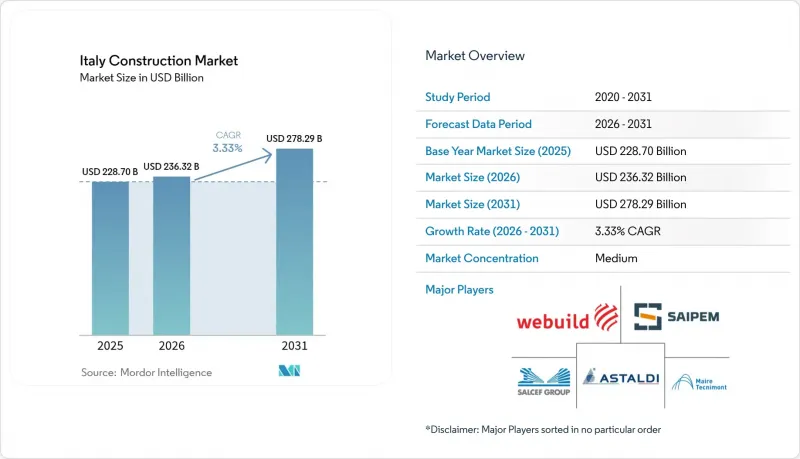
This report is Segmented by Sector (Residential, Commercial, and Infrastructure), by Construction Type (New Construction and Renovation), by Construction Method (Conventional On-Site and Modern Methods of Construction), by Investment Source (Public and Private), and by Geography (Milan, Rome, and More). The Report Offers Market Size and Forecasts in Value (USD) for all the Above Segments.
Italy Construction Market Trends and Insights
Large-scale Public Infrastructure Modernization Under National and EU Stimulus Plans
Massive funding under the NRRP allocates USD 217 billion for 2021-2026, channeling USD 78 billion toward ecological transition and infrastructure upgrades. Public works spending rose 13.7% in 2024 as transport, water and digital projects broke ground, cushioning weakness in residential starts. Southern provinces, long constrained by connectivity gaps, posted construction growth of 0.9% in 2024 versus 0.7% in the North, illustrating how targeted outlays are recalibrating the Italy construction market. These projects, including the Brenner Base Tunnel and the Tyrrhenian Link, embed resilience standards that require advanced digital design and low-carbon materials. Contractors with integrated engineering, procurement and environmental compliance capabilities are winning multi-year frameworks that provide predictable backlog and technology transfer opportunities.
Structural Shift Toward Residential Energy Efficiency and Deep-Retrofit Renovations
The EPBD mandates every residential building reach energy class D by 2033, a target that affects nearly 60% of Italy's housing stock currently labeled G or F. Lombardy and Piedmont alone would need USD 135 billion in upgrades, equal to 20.2% of regional GDP. Although the "Superbonus" scheme is being phased out, heightened consumer awareness and stricter resale requirements are propelling demand for heat-pump installations, triple glazing and smart metering. Specialized design-build firms that bundle energy modelling, subsidy advisory and performance guarantees are scaling rapidly, often in partnership with utilities and fintech platforms that tailor mortgage-linked retrofit loans.
Elevated Construction Input Costs Due to Global Supply Chain Disruptions and Energy Prices
The Construction Cost Index hit multiyear peaks as steel, cement and bitumen prices surged, squeezing contractor margins. Northern regions, home to steel-intensive industrial builds, face steeper cost spikes. Firms are responding by stockpiling bulk materials, forging long-term supplier alliances and broadening recycled-content procurement to hedge volatility. Digital marketplaces offering live price feeds and AI-powered forecasting are gaining traction, allowing mid-tier builders to negotiate index-linked contracts and mitigate risk.
Other drivers and restraints analyzed in the detailed report include:
- Expansion of High-Speed Rail and Urban Mobility Networks for Sustainable Transport
- Accelerated Growth in Utility-Scale Renewable Energy Construction Projects
- High Interest Rate Environment Reducing Mortgage Access and Private Residential Investment
For complete list of drivers and restraints, kindly check the Table Of Contents.
Segment Analysis
Infrastructure work generated the fastest growth, advancing at a 3.94% CAGR from 2026 to 2031 as rail corridors, grid links and water projects dominate procurement schedules. Terna's USD 26 billion programme and Webuild's high-speed rail packages illustrate how long-cycle assets are anchoring order books. The Italy construction market size for transportation alone is projected to climb steadily as EU corridors intersect domestic freight upgrades. Conversely, the residential segment-despite holding 41.02% of 2025 revenue-faces mixed signals; energy-efficient demand gains are countered by tapering tax credits. Commercial builds are bifurcated, with data centres and logistics sheds filling pipelines while traditional offices retrench.
Infrastructure contracts are structured around multi-stakeholder frameworks that require granular ESG reporting and digital twin integration, altering bid-evaluation priorities. Residential players emphasize net-zero ready designs, stimulating uptake of prefabricated facades and heat-pump systems. Commercial asset classes see investor scrutiny around embodied carbon, pushing contractors to validate material sourcing and lifecycle emissions. Collectively, these shifts ensure the Italy construction market remains sensitive to policy and capital-market requirements, steering growth toward sectors that marry resilience and digital performance.
New builds retained 54.62% of Italy construction market share in 2025 and are forecast to rise at 3.74% CAGR as high-profile schemes such as the Strait of Messina bridge (USD 15.3 billion) progress toward procurement. Visibility on long-duration public projects gives tier-one contractors revenue certainty, while private industrial and logistics builds secure pre-lease agreements that underpin financing.
Renovation commands 45.38% of spending and is evolving from reactive maintenance to strategic retrofits driven by EPBD deadlines. Deep-retrofit packages that achieve class D or better are gaining traction, supported by building-integrated photovoltaics and phase-change insulation panels. Energy-performance contracting models shift upfront capital risks onto ESCOs, widening market access for asset owners. This regulatory momentum places renovation at the heart of decarbonisation, reinforcing its value proposition within the Italy construction market.
Complete Report Scope:
- By Sector
- Residential
- Apartments/Condominiums
- Villas/Landed Houses
- Commercial
- Office
- Retail
- Industrial and Logistics
- Others
- Infrastructure
- Transportation Infrastructure (Roadways, Railways, Airways, others)
- Energy & Utilities
- Others
- Residential
- By Construction Type
- New Construction
- Renovation
- By Construction Method
- Conventional On-Site
- Modern Methods of Construction (Prefabricated, Modular, etc)
- By Investment Source
- Public
- Private
- By Region
- Milan
- Rome
- Turin
- Rest of Italy
List of Companies Covered in this Report:
- Webuild SpA
- Saipem SpA
- Astaldi SpA
- Salcef Group SpA
- Maire Tecnimont SpA
- Cimolai SpA
- GLF SpA
- Rizzani de Eccher SpA
- Impresa Pizzarotti & C. SpA
- Bonatti SpA
- Itinera SpA
- Cooperativa Muratori Cementisti Ravenna
- Bentini Costruzioni SpA
- Trevi Finanziaria SpA
- Fincantieri Infrastructure SpA
- Ghella SpA
- Condotte d'Acqua SpA
- Caltagirone Group
- Todini Costruzioni SpA
- De Eccher Italia Srl
Additional Benefits:
- The market estimate (ME) sheet in Excel format
- 3 months of analyst support
TABLE OF CONTENTS
1 Introduction
- 1.1 Study Assumptions & Market Definition
- 1.2 Scope of the Study
2 Research Methodology
3 Executive Summary
4 Market Insights and Dynamics
- 4.1 Market Overview (incl. Current Economic & Construction Scenario)
- 4.2 Market Drivers
- 4.2.1 Large-Scale Public Infrastructure Modernization Under National and EU Stimulus Plans
- 4.2.2 Structural Shift Toward Residential Energy Efficiency and Deep-Retrofit Renovations
- 4.2.3 Expansion of High-Speed Rail and Urban Mobility Networks for Sustainable Transport
- 4.2.4 Accelerated Growth in Utility-Scale Renewable Energy Construction Projects
- 4.3 Market Restraints
- 4.3.1 Elevated Construction Input Costs Due to Global Supply Chain Disruptions and Energy Prices
- 4.3.2 High Interest Rate Environment Reducing Mortgage Access and Private Residential Investment
- 4.4 Value / Supply-Chain Analysis
- 4.4.1 Overview
- 4.4.2 Real Estate Developers and Contractors - Key Quantitative and Qualitative Insights
- 4.4.3 Architectural and Engineering Companies - Key Quantitative and Qualitative Insights
- 4.4.4 Building Material and Equipment Companies - Key Quantitative and Qualitative Insights
- 4.5 Government Initiatives & Vision
- 4.6 Regulatory Outlook
- 4.7 Technological Outlook
- 4.8 Porter's Five Forces
- 4.8.1 Bargaining Power of Suppliers
- 4.8.2 Bargaining Power of Buyers
- 4.8.3 Threat of New Entrants
- 4.8.4 Threat of Substitutes
- 4.8.5 Intensity of Competitive Rivalry
- 4.9 Pricing (Construction Materials) and Construction Cost (Materials, Labour, Equipment) Analysis
- 4.10 Comparison of Key Industry Metrics of Italy with Other Countries
- 4.11 Key Upcoming/Ongoing Projects (with a focus on Mega Projects)
5 Market Size & Growth Forecasts (Value, USD Billion)
- 5.1 By Sector
- 5.1.1 Residential
- 5.1.1.1 Apartments/Condominiums
- 5.1.1.2 Villas/Landed Houses
- 5.1.2 Commercial
- 5.1.2.1 Office
- 5.1.2.2 Retail
- 5.1.2.3 Industrial and Logistics
- 5.1.2.4 Others
- 5.1.3 Infrastructure
- 5.1.3.1 Transportation Infrastructure (Roadways, Railways, Airways, others)
- 5.1.3.2 Energy & Utilities
- 5.1.3.3 Others
- 5.1.1 Residential
- 5.2 By Construction Type
- 5.2.1 New Construction
- 5.2.2 Renovation
- 5.3 By Construction Method
- 5.3.1 Conventional On-Site
- 5.3.2 Modern Methods of Construction (Prefabricated, Modular, etc)
- 5.4 By Investment Source
- 5.4.1 Public
- 5.4.2 Private
- 5.5 By Region
- 5.5.1 Milan
- 5.5.2 Rome
- 5.5.3 Turin
- 5.5.4 Rest of Italy
6 Competitive Landscape
- 6.1 Market Concentration
- 6.2 Strategic Moves (M&A, PPPs, Digitalisation)
- 6.3 Market Share Analysis
- 6.4 Company Profiles {(includes Global level Overview, Market level overview, Core Segments, Financials as available, Strategic Information, Market Rank/Share for key companies, Products & Services, and Recent Developments)}
- 6.4.1 Webuild SpA
- 6.4.2 Saipem SpA
- 6.4.3 Astaldi SpA
- 6.4.4 Salcef Group SpA
- 6.4.5 Maire Tecnimont SpA
- 6.4.6 Cimolai SpA
- 6.4.7 GLF SpA
- 6.4.8 Rizzani de Eccher SpA
- 6.4.9 Impresa Pizzarotti & C. SpA
- 6.4.10 Bonatti SpA
- 6.4.11 Itinera SpA
- 6.4.12 Cooperativa Muratori Cementisti Ravenna
- 6.4.13 Bentini Costruzioni SpA
- 6.4.14 Trevi Finanziaria SpA
- 6.4.15 Fincantieri Infrastructure SpA
- 6.4.16 Ghella SpA
- 6.4.17 Condotte d'Acqua SpA
- 6.4.18 Caltagirone Group
- 6.4.19 Todini Costruzioni SpA
- 6.4.20 De Eccher Italia Srl
7 Market Opportunities & Future Outlook

