PUBLISHER: Mordor Intelligence | PRODUCT CODE: 2114981

PUBLISHER: Mordor Intelligence | PRODUCT CODE: 2114981
North America Airport Baggage Handling Systems - Market Share Analysis, Industry Trends & Statistics, Growth Forecasts (2026 - 2031)
According to Mordor Intelligence, the North America airport baggage handling systems market size was valued at USD 0.55 billion in 2025 and is estimated to grow from USD 0.59 billion in 2026 to USD 0.89 billion by 2031, at an 8.57% CAGR during the forecast period.
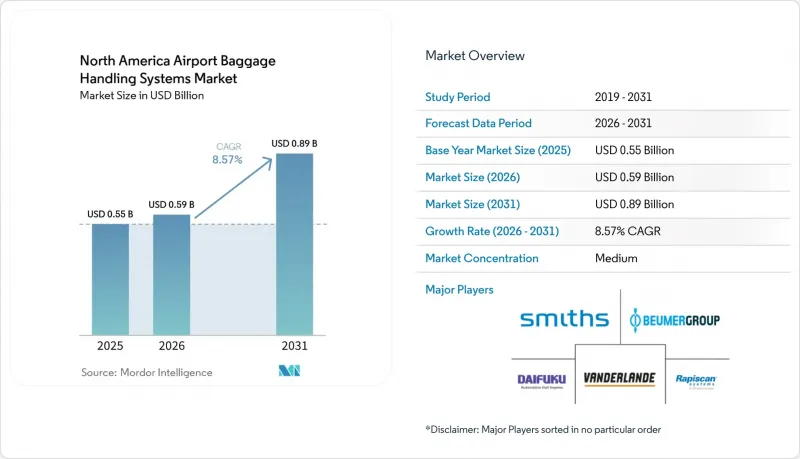
This report is Segmented by Airport Capacity (Up To 15 Million, 15 To Less Than 25 Million, 25 To Less Than 40 Million, and More), Solution (Check-In and Ticketing Systems, and More), Technology (Barcode, RFID, and More), System Type (Conveyor Belt Systems, and More), and Geography (United States, Canada, and Mexico). The Market Forecasts are Provided in Terms of Value (USD).
North America Airport Baggage Handling Systems Market Trends and Insights
Acceleration of Airport Modernization and Capacity Expansion Programs
The North America airport baggage handling systems market benefits from major terminal programs that combine capacity additions with the replacement of aging baggage equipment. The FAA states that Airport Infrastructure Grant funding under the Infrastructure Investment and Jobs Act totals USD 14.5 billion from FY2022 through FY2026, including a final USD 2.9 billion installment in FY2026. The Airport Terminal Program provided USD 5 billion for terminal development during the same period. ACI-NA estimated that US airports required USD 173.9 billion in infrastructure investment over 5 years, which highlights the funding gap facing many operators. Large projects can support multi-year procurement plans for conveyance, sortation, screening interfaces, controls, and maintenance services. The uneven availability of grants also separates better-funded primary airports from smaller facilities that must sequence their projects. Procurement at larger airports can combine baggage work with terminal, gate, and security changes. This gives integrators scope to coordinate interfaces across several operating areas. Smaller operators are more likely to separate upgrades into limited phases. The North America airport baggage handling systems market consequently includes both large replacement programs and smaller modernization packages. Each type requires planning that protects daily airport operations.
Regulatory Compliance with IATA Resolution 753 Driving RFID-Based Tracking Adoption
IATA Resolution 753 requires baggage monitoring at a minimum of 4 custody-transfer points, placing tracking performance at the center of airport and airline requirements. IATA reported that 60% of airlines in the region had implemented the resolution in 2024, while 75% of airports worldwide had the required capability. These results make a case for retrofits where airports need better custody data but cannot replace an entire sorting system. The North America airport baggage handling systems market, therefore, includes a growing software and sensor layer alongside physical equipment. Compliance targets through 2027 give airports a defined period for implementation and testing. Airlines also need dependable data at handoff points, so airport equipment must work with carrier processes. This makes system compatibility relevant when selecting a vendor. A tracking deployment can include readers, software, message links, and procedures for exception handling. The market benefits from this layered investment model. It permits upgrades at airports that do not have immediate plans to change core conveyors.
High Capital Investment Requirements for Large-Scale Baggage System Retrofits
Brownfield baggage projects require work around live flight operations, phased cutovers, structural changes, and interfaces with security systems. These conditions increase both project duration and project cost when compared with a greenfield installation. ACI-NA reported that the Airport Terminal Program was oversubscribed by a factor of 10 and ended in FY2026. Smaller airports may therefore face TSA and IATA compliance obligations without a comparable grant source. The North America airport baggage handling systems market has responded through modular systems that can be installed in stages. This approach can defer a full replacement, but it can also lengthen the period between early planning and a final system contract. Legacy layouts add another constraint because new equipment must operate with existing conveyors, controls, and terminal space. A live airport cannot simply stop baggage processing while a replacement is installed. Operators must arrange testing, cutovers, and fallback procedures around airline schedules. This raises the importance of detailed engineering and experienced installation teams. The North America airport baggage handling systems market continues to require retrofit-specific services as well as new equipment. Phased projects can manage risk, but they can require several procurement decisions over time.
Other drivers and restraints analyzed in the detailed report include:
- TSA Mandates for CT-EDS Integration Driving Baggage System Upgrades
- Increasing Use of Automation and AI to Reduce Mishandled Baggage Rates
- Cybersecurity Risks Associated with Connected and IoT-Enabled Baggage Systems
For complete list of drivers and restraints, kindly check the Table Of Contents.
Segment Analysis
The 25 to less than 40 million-passenger tier accounted for 35.65% of the North American airport baggage handling systems market in 2025. These airports are large enough to justify in-line screening and automated sortation, yet they often face the limits of existing terminal footprints. TSA-checked baggage inspection system requirements and IATA tracking rules shape their investment decisions. Toronto Pearson and Montreal-Trudeau fall within or near this capacity range and have active programs that include baggage infrastructure. The above-40-million-passenger tier produces the highest single-contract values because major hubs require large, complex system designs. These facilities have many airline connections and a large number of transfer bags. Their equipment must support simultaneous throughput, screening, storage, and operational continuity. Many of these airports have already upgraded core equipment over the past decade and now add layers of technology to their established equipment.
The up to 15 million and 15 to less than 25 million passenger tiers offer distinct routes to growth for the North America airport baggage handling systems market. Smaller airports are reviewing modular, individual-carrier systems as an alternative to conventional conveyor systems. This supports phased investment when a full terminal reconstruction is not affordable. The input draft identified Grand Rapids Gerald R. Ford International Airport as an early adopter that integrated individual carrier totes with self-bag drop using common-use kiosk infrastructure. Smaller Canadian airports also installed equipment in 2025, including new baggage systems at Charlottetown and Saint John. These examples show that modernization extends beyond the largest hubs, although the project scale is lower and funding decisions are more constrained. The market includes work that improves reliability and passenger processing at these airports. Projects may focus on a single baggage belt, a small sorting area, or a self-service connection. The commercial value is lower than at a major hub, but the number of facilities broadens the addressable base.
Tracking and tracing is the fastest-growing solution category, with a projected 12.72% CAGR through 2031. Resolution 753, carrier pressure to reduce mishandling costs, and the wider availability of RFID and analytics platforms support this demand. Tracking is increasingly purchased as a data layer that can work with an existing conveyor or sorter. This lets an airport improve compliance without replacing the underlying system. It also supports a more measured investment decision when space or funding is limited. Airports can prioritize visibility at critical transfer points before considering mechanical changes. The North America airport baggage handling systems market, therefore, serves airports that need compliance improvements as well as airports undertaking complete modernization. IATA's 2025 roadmap treats electronic bag tags, GPS tracking, and API-based messaging as a separate development path from physical sorting technology.
Conveying and sorting systems remain the operational backbone of the North America airport baggage handling systems market, with a 38.91% market share. Their replacement is tied to screening equipment life cycles, terminal capacity additions, and the condition of current equipment. Security screening systems benefit from continued integration of CT-EDS, while early baggage storage becomes increasingly important as self-service bag drop changes the timing of bag arrivals. Reclaim and unloading equipment is also receiving attention for robotic assistance, particularly in labor-intensive and peak-period operations. Check-in and ticketing systems are increasingly linked with self-service and biometric processes. SITA reported that 66% of airlines offered automated bag drop, while 16% planned to do so by 2027.
Complete Report Scope:
- By Airport Capacity
- Up to 15 million
- 15 to Less than 25 million
- 25 to Less than 40 million
- Above 40 million
- By Solution
- Check-In and Ticketing Systems
- Security Screening Systems
- Conveying and Sorting Systems
- Early Baggage Storage (EBS)
- Baggage Reclaim/Unloading
- Tracking and Tracing
- By Technology
- Barcode
- RFID
- IoT Sensors and Edge Devices
- Robotics and Autonomous Vehicles (AVs)
- AI/ML Software
- By System Type
- Conveyor Belt Systems
- Tilt-Tray and Cross-Belt Sorters
- Destination-Coded Vehicle (DCV)
- Tote-based/Individual Carrier Systems (ICS)
- Hybrid and Other Emerging Systems
- By Geography
- United States
- Canada
- Mexico
List of Companies Covered in this Report:
- Vanderlande Industries B.V.
- Daifuku Co., Ltd.
- BEUMER Group GmbH & Co. KG
- Alstef Group SAS
- Fives SAS
- G&S Airport Conveyor
- Pteris Global Limited
- Logplan LLC
- Ansir Systems
- SITA N.V.
- Smiths Group plc
- Leonardo S.p.A.
- Rapiscan Systems, Inc.
- ADB SAFEGATE
Additional Benefits:
- The market estimate (ME) sheet in Excel format
- 3 months of analyst support
TABLE OF CONTENTS
1 INTRODUCTION
- 1.1 Study Assumptions and Market Definition
- 1.2 Scope of the Study
2 RESEARCH METHODOLOGY
3 EXECUTIVE SUMMARY
4 MARKET LANDSCAPE
- 4.1 Market Overview
- 4.2 Market Drivers
- 4.2.1 Acceleration of airport modernization and capacity expansion programs
- 4.2.2 Regulatory compliance with IATA Resolution driving RFID-based tracking adoption
- 4.2.3 Recovery in air passenger traffic driving higher baggage throughput demand
- 4.2.4 Increasing use of automation and AI to reduce mishandled baggage rates
- 4.2.5 TSA mandates for CT-EDS integration driving baggage system upgrades
- 4.2.6 Rising emphasis on climate-resilient baggage handling system design
- 4.3 Market Restraints
- 4.3.1 High capital investment requirements for large-scale baggage system retrofits
- 4.3.2 Integration complexity with legacy baggage handling infrastructure
- 4.3.3 Component cost volatility linked to tariffs and import dependencies
- 4.3.4 Cybersecurity risks associated with connected and IoT-enabled baggage systems
- 4.4 Value Chain Analysis
- 4.5 Regulatory Landscape
- 4.6 Technological Outlook
- 4.7 Porter's Five Forces Analysis
- 4.7.1 Bargaining Power of Suppliers
- 4.7.2 Bargaining Power of Buyers
- 4.7.3 Threat of New Entrants
- 4.7.4 Threat of Substitutes
- 4.7.5 Intensity of Competitive Rivalry
5 MARKET SIZE AND GROWTH FORECASTS (VALUE)
- 5.1 By Airport Capacity
- 5.1.1 Up to 15 million
- 5.1.2 15 to Less than 25 million
- 5.1.3 25 to Less than 40 million
- 5.1.4 Above 40 million
- 5.2 By Solution
- 5.2.1 Check-In and Ticketing Systems
- 5.2.2 Security Screening Systems
- 5.2.3 Conveying and Sorting Systems
- 5.2.4 Early Baggage Storage (EBS)
- 5.2.5 Baggage Reclaim/Unloading
- 5.2.6 Tracking and Tracing
- 5.3 By Technology
- 5.3.1 Barcode
- 5.3.2 RFID
- 5.3.3 IoT Sensors and Edge Devices
- 5.3.4 Robotics and Autonomous Vehicles (AVs)
- 5.3.5 AI/ML Software
- 5.4 By System Type
- 5.4.1 Conveyor Belt Systems
- 5.4.2 Tilt-Tray and Cross-Belt Sorters
- 5.4.3 Destination-Coded Vehicle (DCV)
- 5.4.4 Tote-based/Individual Carrier Systems (ICS)
- 5.4.5 Hybrid and Other Emerging Systems
- 5.5 By Geography
- 5.5.1 United States
- 5.5.2 Canada
- 5.5.3 Mexico
6 COMPETITIVE LANDSCAPE
- 6.1 Market Concentration
- 6.2 Strategic Moves
- 6.3 Market Share Analysis
- 6.4 Company Profiles (includes Global level Overview, Market level overview, Core Segments, Financials as available, Strategic Information, Market Rank/Share for key companies, Products and Services, and Recent Developments)
- 6.4.1 Vanderlande Industries B.V.
- 6.4.2 Daifuku Co., Ltd.
- 6.4.3 BEUMER Group GmbH & Co. KG
- 6.4.4 Alstef Group SAS
- 6.4.5 Fives SAS
- 6.4.6 G&S Airport Conveyor
- 6.4.7 Pteris Global Limited
- 6.4.8 Logplan LLC
- 6.4.9 Ansir Systems
- 6.4.10 SITA N.V.
- 6.4.11 Smiths Group plc
- 6.4.12 Leonardo S.p.A.
- 6.4.13 Rapiscan Systems, Inc.
- 6.4.14 ADB SAFEGATE
7 MARKET OPPORTUNITIES AND FUTURE OUTLOOK
- 7.1 White-space and Unmet-Need Assessment

