PUBLISHER: Mordor Intelligence | PRODUCT CODE: 2115118

PUBLISHER: Mordor Intelligence | PRODUCT CODE: 2115118
Middle East and Africa Airport Baggage Handling Systems - Market Share Analysis, Industry Trends & Statistics, Growth Forecasts (2026 - 2031)
According to Mordor Intelligence, the Middle East and Africa airport baggage handling systems market size was valued at USD 182.40 million in 2025, and is projected to grow from USD 203.76 million in 2026 to USD 360.59 million by 2031 at a 12.09% CAGR between 2026 and 2031.
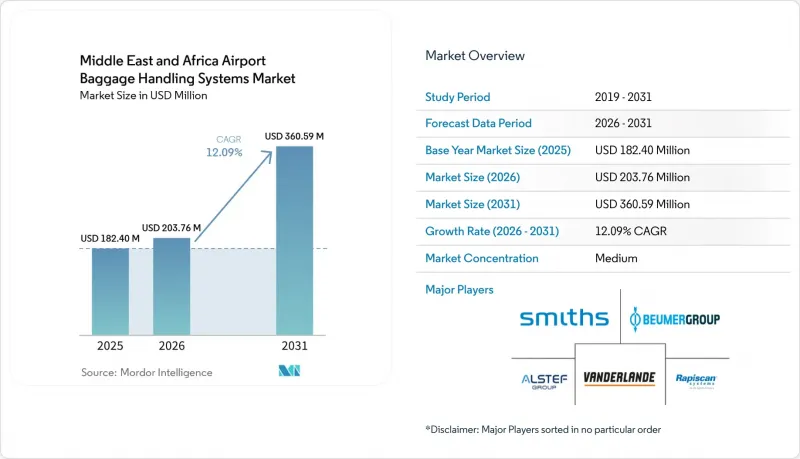
This report is Segmented by Airport Capacity (Up To 15 Million, 15 To Less Than 25 Million, 25 To Less Than 40 Million, and More), Solution (Check-In and Ticketing Systems, and More), Technology (Barcode, RFID, and More ), System Type (Conveyor Belt Systems, and More), and Geography (Saudi Arabia, and More). The Market Forecasts are Provided in Terms of Value (USD).
Middle East and Africa Airport Baggage Handling Systems Market Trends and Insights
Rapid Airport Capacity Expansions Across the GCC
Dubai Aviation Engineering Projects confirmed in 2025 that contracts exceeding AED 55 billion (USD 14.97 billion) for Al Maktoum International Airport were scheduled to be awarded in 2026. Dedicated baggage-handling packages are among the earliest to be procured for the project. Al Maktoum and King Salman International Airport together target a capacity of over 445 million passengers annually. Such throughput requires sorters capable of handling 15,000 to 20,000 bags per hour. The market, therefore, favors automated sorting designs rather than conventional conveyor-only systems. Bechtel's May 2025 agreement to manage 3 terminal packages at King Salman International Airport indicates that delivery is moving into active procurement. Parsons also received delivery-partner contracts for the airport's airfield and landside infrastructure in May 2025. Matarat Holding manages 22 regional airports and is also advancing capacity projects in Hail, Abha, Taif, and Qassim. This broadens demand beyond the flagship hubs. Commissioning-related awards for King Salman's first terminal and Al Maktoum's first phase support a sustained pipeline for the market.
Government-Backed Tourism Diversification Programs
Saudi Arabia recorded 123 million tourists and USD 81 billion in tourism revenue during 2025, according to the official Vision 2030 annual report. The country revised its 2030 visitor target to 150 million after reaching the earlier 100 million target ahead of schedule. Passenger facilities must expand alongside this tourism program. Automated baggage handling supports the passenger experience required at transfer airports and visitor gateways. Consequently, tourism policy has become an upstream driver of market demand. It also shortens the interval between announced capacity plans and system tenders. Egypt is advancing Terminal 4 at Cairo International Airport, which is designed to handle at least 30 million passengers annually and incorporate AI, digital technologies, and smart airport operating systems. Separately, in March 2025, the International Finance Corporation is expected to advise Egypt on private sector participation across 11 airports, with Hurghada International Airport serving as the pilot PPP transaction. The program could create a pathway for private capital and operating expertise to support airport infrastructure, improve operational efficiency, and upgrade passenger services across the participating airports. SITA has also discussed a national airport digital transformation program with Egypt. These programs connect tourism expansion with operational modernization. They create demand for flexible suppliers in the market.
Sub-Saharan Capex Constraints Post-COVID-19
The African Union stated in October 2025 that Africa requires USD 25-30 billion over the next decade to close aviation infrastructure gaps. It identified USD 10 billion for airport and aerodrome infrastructure. Many airport upgrades, therefore, depend on multilateral or concessional financing. This can delay contract conversion after tenders are issued. Kenya's planned greenfield terminal remains tied to the confirmation of financing. The market has a distinct funding divide between Gulf mega-projects and sub-Saharan airport programs. South African airport tenders show that operational needs remain strong despite funding pressures. ACSA issued maintenance solicitations for baggage handling at Bram Fischer, King Shaka, and Cape Town International airports during 2025 and 2026. These procurements can maintain existing systems, but they do not always fund complete replacements. Suppliers need to assess financing certainty alongside the technical scope. Tender pipelines may be broader than the awarded-contract pipeline. This slows deployment schedules in parts of Africa. It also makes modular projects more relevant to the Middle East and Africa airport baggage handling systems market.
Other drivers and restraints analyzed in the detailed report include:
- Mandatory ICAO Annex 17 Security Compliance Upgrades
- Shift Toward End-to-End Self-Service Passenger Journeys
- High Integration Complexity with Legacy IT and OT
For complete list of drivers and restraints, kindly check the Table Of Contents.
Segment Analysis
Airports handling more than 40 million passengers accounted for 45.20% of the market share in 2025. Dubai, Doha, Riyadh, Istanbul, and Jeddah are key demand centers for high-capacity baggage handling infrastructure, as major hub airports expand passenger capacity and terminal operations. At Al Maktoum International Airport, the planned development includes an automated underground baggage handling system designed to support large-scale passenger expansion. In February 2025, Hamad International Airport is scheduled to open Concourse E, adding 51,000 square meters and eight contact gates. The subsequent completion of Concourses D and E is expected to increase the airport's overall capacity to more than 65 million passengers annually. These large hubs require extensive conveying, sortation, storage, screening interfaces, controls, and baggage tracking infrastructure.
Airports handling more than 40 million passengers are also the fastest-growing capacity segment, with a forecast CAGR of 12.57% through 2031. Software, monitoring, predictive maintenance, and high-level controls are also becoming increasingly important as operators aim to improve the performance of installed baggage infrastructure. Istanbul Airport demonstrates this requirement through its large-scale baggage system, which combines individual carrier technology, early baggage storage, integrated software, and continuous tracking. Smaller and mid-sized airports generally prefer scalable modernization approaches. However, technology selection depends on baggage volumes, transfer intensity, terminal configuration, screening requirements, and available investment, rather than passenger capacity alone.
Conveying and sorting systems accounted for 31.93% of the market in 2025. The share reflects the trunk infrastructure needed in major terminal projects. High-capacity tilt-tray and cross-belt sorters can achieve up to 2,400 discharges each hour. These systems move bags between check-in, screening, storage, transfer, and reclaim areas. Their importance is greatest where large airports require continuous high-volume baggage flow. The segment remains the physical base for integrated baggage operations.
Tracking and tracing is the fastest-growing solution segment, with a forecast CAGR of 13.03% through 2031. Tracking and tracing are gaining importance as airports seek to improve baggage visibility and provide passengers with timely updates. In May 2025, IATA reported that 81% of travelers wanted better baggage tracking, while 74% expected real-time mobile updates. SITA also reported a 23% decline in mishandled baggage rates in 2025. At Hamad International Airport, BEUMER's CrisBag system offers more than 10,000 storage positions and enables continuous baggage tracking across key handling stages.
Complete Report Scope:
- By Airport Capacity
- Up to 15 million
- 15 to Less than 25 million
- 25 to Less than 40 million
- Above 40 million
- By Solution
- Check-In and Ticketing Systems
- Security Screening Systems
- Conveying and Sorting Systems
- Early Baggage Storage (EBS)
- Baggage Reclaim/Unloading
- Tracking and Tracing
- By Technology
- Barcode
- RFID
- IoT Sensors and Edge Devices
- Robotics and Autonomous Vehicles (AVs)
- AI/ML Software
- By System Type
- Conveyor Belt Systems
- Tilt-Tray and Cross-Belt Sorters
- Destination-Coded Vehicle (DCV)
- Tote-based/Individual Carrier Systems (ICS)
- Hybrid and Other Emerging Systems
- By Geography
- Saudi Arabia
- United Arab Emirates
- Kuwait
- Egypt
- Oman
- Qatar
- Turkey
- Bahrain
- South Africa
- Rest of Middle East and Africa
List of Companies Covered in this Report:
- BEUMER Group GmbH & Co. KG
- Vanderlande Industries B.V.
- Daifuku Co., Ltd.
- SITA N.V.
- Alstef Group SAS
- Smiths Group plc
- Pteris Global Limited
- ADB SAFEGATE
- Fives SAS
- Logplan LLC
- ULMA Manutencion S.Coop
- Rapiscan Systems, Inc.
- Leonardo S.p.A.
- TAV Technologies (TAV Airports Holding)
- Middle East Tasks Co. Ltd.
Additional Benefits:
- The market estimate (ME) sheet in Excel format
- 3 months of analyst support
TABLE OF CONTENTS
1 INTRODUCTION
- 1.1 Study Assumptions and Market Definition
- 1.2 Scope of the Study
2 RESEARCH METHODOLOGY
3 EXECUTIVE SUMMARY
4 MARKET LANDSCAPE
- 4.1 Market Overview
- 4.2 Market Drivers
- 4.2.1 Rapid airport capacity expansions across the Gulf Cooperation Council (GCC)
- 4.2.2 Government-backed tourism diversification programs
- 4.2.3 Mandatory ICAO Annex 17 security compliance upgrades
- 4.2.4 Shift toward end-to-end self-service passenger journeys
- 4.2.5 AI-powered predictive maintenance to cut downtime
- 4.2.6 Green-airport mandates favoring low-energy conveyors
- 4.3 Market Restraints
- 4.3.1 Sub-saharan capex constraints post-COVID-19
- 4.3.2 High integration complexity with legacy information technology (IT) and operational technology (OT)
- 4.3.3 Volatile regional supply chain for electromechanical parts
- 4.3.4 Heightened cybersecurity and data-sovereignty legislation
- 4.4 Value Chain Analysis
- 4.5 Regulatory Landscape
- 4.6 Technological Outlook
- 4.7 Porter's Five Forces Analysis
- 4.7.1 Bargaining Power of Suppliers
- 4.7.2 Bargaining Power of Buyers
- 4.7.3 Threat of New Entrants
- 4.7.4 Threat of Substitutes
- 4.7.5 Intensity of Competitive Rivalry
5 MARKET SIZE AND GROWTH FORECASTS (VALUE)
- 5.1 By Airport Capacity
- 5.1.1 Up to 15 million
- 5.1.2 15 to Less than 25 million
- 5.1.3 25 to Less than 40 million
- 5.1.4 Above 40 million
- 5.2 By Solution
- 5.2.1 Check-In and Ticketing Systems
- 5.2.2 Security Screening Systems
- 5.2.3 Conveying and Sorting Systems
- 5.2.4 Early Baggage Storage (EBS)
- 5.2.5 Baggage Reclaim/Unloading
- 5.2.6 Tracking and Tracing
- 5.3 By Technology
- 5.3.1 Barcode
- 5.3.2 RFID
- 5.3.3 IoT Sensors and Edge Devices
- 5.3.4 Robotics and Autonomous Vehicles (AVs)
- 5.3.5 AI/ML Software
- 5.4 By System Type
- 5.4.1 Conveyor Belt Systems
- 5.4.2 Tilt-Tray and Cross-Belt Sorters
- 5.4.3 Destination-Coded Vehicle (DCV)
- 5.4.4 Tote-based/Individual Carrier Systems (ICS)
- 5.4.5 Hybrid and Other Emerging Systems
- 5.5 By Geography
- 5.5.1 Saudi Arabia
- 5.5.2 United Arab Emirates
- 5.5.3 Kuwait
- 5.5.4 Egypt
- 5.5.5 Oman
- 5.5.6 Qatar
- 5.5.7 Turkey
- 5.5.8 Bahrain
- 5.5.9 South Africa
- 5.5.10 Rest of Middle East and Africa
6 COMPETITIVE LANDSCAPE
- 6.1 Market Concentration
- 6.2 Strategic Moves
- 6.3 Market Share Analysis
- 6.4 Company Profiles (includes Global level Overview, Market level overview, Core Segments, Financials as available, Strategic Information, Market Rank/Share for key companies, Products and Services, and Recent Developments)
- 6.4.1 BEUMER Group GmbH & Co. KG
- 6.4.2 Vanderlande Industries B.V.
- 6.4.3 Daifuku Co., Ltd.
- 6.4.4 SITA N.V.
- 6.4.5 Alstef Group SAS
- 6.4.6 Smiths Group plc
- 6.4.7 Pteris Global Limited
- 6.4.8 ADB SAFEGATE
- 6.4.9 Fives SAS
- 6.4.10 Logplan LLC
- 6.4.11 ULMA Manutencion S.Coop
- 6.4.12 Rapiscan Systems, Inc.
- 6.4.13 Leonardo S.p.A.
- 6.4.14 TAV Technologies (TAV Airports Holding)
- 6.4.15 Middle East Tasks Co. Ltd.
7 MARKET OPPORTUNITIES AND FUTURE OUTLOOK
- 7.1 White-space and Unmet-Need Assessment

