PUBLISHER: Mordor Intelligence | PRODUCT CODE: 2115061

PUBLISHER: Mordor Intelligence | PRODUCT CODE: 2115061
Connected Motorcycle - Market Share Analysis, Industry Trends & Statistics, Growth Forecasts (2026 - 2031)
According to Mordor Intelligence, the connected motorcycle market size is expected to grow from USD 0.43 billion in 2025 to USD 0.57 billion in 2026 and is forecasted to reach USD 2.28 billion by 2031 at a 32.01% CAGR over 2026-2031.
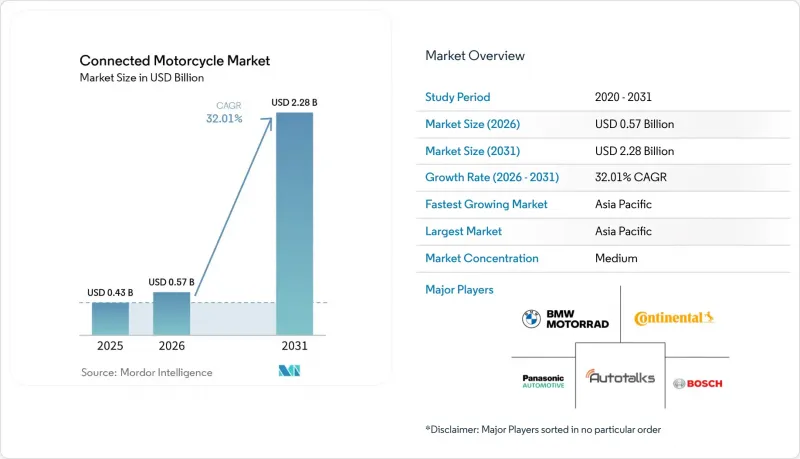
This report is Segmented by Service (Driver Assistance, Infotainment, Safety and Emergency Call, and More), Hardware Type (Embedded ECU, Tethered Smartphone, and Integrated Cockpit), End User (Private and Commercial), Network Type (Cellular, DSRC, and Satellite-IoT), and Geography (North America, South America, and More). Market Forecasts are Provided in Terms of Value (USD) and Volume (Units).
Global Connected Motorcycle Market Trends and Insights
5G Roll-Outs Enabling Ultra-Low-Latency V2X
With stand-alone 5G networks achieving radio latency in the millisecond range, features like collision warnings and cooperative adaptive cruise control are becoming a reality for riders. Autotalks and Rolling Wireless have unveiled a 5G-V2X chipset family set for series production, compatible with both cellular V2X and older DSRC modes. Japan has allocated a dedicated frequency band for V2X, laying the groundwork for nationwide V2X pilot corridors. Meanwhile, in the United States, efforts are underway to expand V2X coverage on highways. Such initiatives firmly establish 5G as the cornerstone of the connected motorcycle market, enabling advanced safety features and seamless communication for riders over the coming decade.
Government Cyber-Security Mandates (UNECE R155/156)
UNECE Regulation 155 obliges every new motorcycle type-approval from July 2029 to include a full Cyber Security Management System, while Regulation 156 codifies software-update logging and validation. These rules apply to category L vehicles and push security hardware costs into even entry-level models. Tier-one suppliers respond with bundled telematics and ABS units that amortize certification expense. Smaller manufacturers must weigh white-label platforms against in-house solutions, a strategic fork that can alter brand differentiation. Early adoption helps firms avoid future production bottlenecks as the deadline approaches.
High Incremental BOM Cost for Mass-Market Bikes
Entry-level motorcycle manufacturers are experiencing a squeeze on margins as the addition of telematics, displays, and secure gateways significantly increases component costs. Renesas is addressing this challenge with its single-chip telematics controllers, which reduce both PCB area and firmware overhead. However, costs are further increased by UNECE R155 compliance, which requires comprehensive cybersecurity audits. To maintain their edge, manufacturers such as Hero MotoCorp are turning to smartphone-based dashboards. These dashboards shift much of the processing burden to the rider's device. Yet, this integration complexity can detract from the overall user experience. Such challenges are curbing the rapid adoption of connected motorcycles, especially in price-sensitive segments.
Other drivers and restraints analyzed in the detailed report include:
- Surging Integration of eSIM-Based Telematics
- OEM Push Toward ADAS-Ready Two-Wheelers
- Li-Ion Thermal-Runaway Recalls Dampen OEM Appetite
For complete list of drivers and restraints, kindly check the Table Of Contents.
Segment Analysis
Infotainment accounted for 34.31% of 2025 revenue, indicating the current center of gravity in the connected motorcycle market. Driver assistance services are projected to grow at 44.21% between 2026 and 2031, the fastest among all service categories. Mandatory eCall functions, as outlined by the European Commission, transform safety services into non-optional add-ons. Meanwhile, remote diagnostics and firmware updates satisfy UNECE security rules, and usage-based insurance gains favor with risk-averse insurers in high-traffic regions. The combined pull of regulation and insurer incentives positions driver assistance as the lead growth engine over the forecast horizon.
Regulation influences adoption priorities, encouraging OEMs to invest in over-the-air capabilities while leaving infotainment dependent on discretionary spending. Driver assistance sits between crowd-pleasing features and mandatory functions, giving it a balanced mix of regulatory and market support. Commercial fleets tend to prioritize vehicle management for cost control, whereas private riders prefer a balance of entertainment and safety. As a result, service portfolios diverge by customer group, and suppliers craft tiered offerings that align with each segment's willingness to pay. This dynamic ensures the connected motorcycle market continues to diversify its revenue streams.
Embedded control units commanded 54.82% of 2025 deployments, reflecting their ability to provide always-on connectivity and seamless over-the-air updates. Premium brands embed these units under the seat or fairing to deliver integrated navigation, diagnostics, and rider-assistance alerts. Rising production volumes gradually trim bill-of-materials costs, but budget-conscious OEMs still seek lower-priced alternatives to address price-sensitive buyers. Tethered smartphone solutions, forecast to grow at a 37.51% CAGR through 2031, answer that need by using the rider's handset for data processing and network access. Although tethering lacks automatic crash notification if the phone is absent, it offers a compelling entry point for first-time connected motorcycle customers.
Hybrid architectures sit between both extremes, combining a small embedded module for mandatory safety functions with a phone-based app for infotainment and ride analytics. This split hardware model helps OEMs comply with regulations while avoiding the full cost of a high-spec ECU. Integrated cockpit clusters, which incorporate a color display and telematics modem into the instrument panel, appeal to touring riders who spend long hours on the road and expect rich mapping capabilities on demand. Suppliers continue to shrink display bezels and improve sunlight readability, enhancing perceived value. As these advances roll into mid-range models, hardware diversity broadens the connected motorcycle market size and keeps competition active across price tiers.
Complete Report Scope:
- By Service
- Driver Assistance
- Infotainment
- Safety and Emergency Call
- Vehicle Management / OTA Updates
- Insurance and UBI
- By Hardware Type
- Embedded Control Unit
- Tethered Smartphone-based
- Integrated Cockpit Cluster
- By End User
- Private Consumers
- Commercial / Fleet
- By Network Type
- Cellular (4G/5G)
- Dedicated Short-Range Comms (C-V2X/802.11p)
- Satellite-IoT and LPWAN
- Geography
- North America
- United States
- Canada
- Rest of North America
- South America
- Brazil
- Argentina
- Rest of South America
- Europe
- Germany
- United Kingdom
- France
- Russia
- Rest of Europe
- Asia-Pacific
- China
- India
- Japan
- South Korea
- Rest of Asia-Pacific
- Middle East and Africa
- Egypt
- Turkey
- South Africa
- Saudi Arabia
- United Arab Emirates
- Rest of Middle East and Africa
- North America
Geography Analysis
The Asia-Pacific region accounted for 41.73% of 2025 revenue and is projected to grow at 35.81% through 2031, giving the region the steepest slope on the connected motorcycle market growth curve. China's mandate for V2X-ready smart roads accelerates adoption in every major city. Japan and South Korea favor tethered architectures because high smartphone penetration lowers incremental hardware cost. At the same time, Southeast Asian fleets deploy telematics across food-delivery and ride-hailing bikes to control operating expenses and raise safety. Together, these demand vectors strengthen supply-chain resilience and encourage component vendors to localize production lines, shortening lead times. Government initiatives that pair smart infrastructure funding with tax incentives further boost momentum.
North America follows with a forecasted CAGR of 24.92%, as state-level insurance discounts prompt riders to accept telemetry in exchange for lower premiums. Federal agencies have not yet mandated eCall; however, proposed safety rules continue to pressure OEMs to embed crash notification capability before regulations are finalized. Europe advances at 23.99% despite strict GDPR compliance burdens that elevate development costs. Germany, France, and the United Kingdom dominate regional spending due to their high per-capita incomes and established touring cultures. Eastern Europe lags as patchy cellular coverage limits the utility of telematics beyond urban zones.
South America, the Middle East and Africa grow from smaller bases yet show pockets of rapid uptake. Brazilian riders in congested cities value theft-recovery services, but exchange-rate fluctuations constrain upgrade cycles. Gulf states are investing in smart-city corridors that require V2X compliance for all new vehicles, thereby driving demand for premium connected models. Africa's vast rural expanses favor hybrid cellular-satellite modules that ensure emergency connectivity where cellular towers are scarce. As terrestrial networks spread, suppliers position low-cost retrofit kits to tap the vast installed base of unconnected motorcycles.
- BMW Motorrad
- Continental AG
- Robert Bosch GmbH
- Panasonic Corporation
- TE Connectivity
- Autotalks
- Aeris Communications
- Vodafone Group PLC
- Starcom Systems
- KPIT Technologies
- Honda Motor Co.
- Yamaha Motor Co.
- Hero MotoCorp
- NXP Semiconductors
- Qualcomm Technologies
- Harman International
- Telit Cinterion
- Alpinestars
- Dainese SpA
- Sena Technologies
Additional Benefits:
- The market estimate (ME) sheet in Excel format
- 3 months of analyst support
TABLE OF CONTENTS
1 Introduction
- 1.1 Study Assumptions & Market Definition
- 1.2 Scope of the Study
2 Research Methodology
3 Executive Summary
4 Market Landscape
- 4.1 Market Overview
- 4.2 Market Drivers
- 4.2.1 5G Roll-Outs Enabling Ultra-Low-Latency V2X
- 4.2.2 Government Cyber-Security Mandates (UNECE R155/156)
- 4.2.3 Surging Integration of eSIM-Based Telematics
- 4.2.4 OEM Push Toward ADAS-Ready Two-Wheelers
- 4.2.5 Premium Bike Sales Boom in Emerging Asia-Pacific
- 4.2.6 Edge-AI Chips Slashing On-Board Power Draw
- 4.3 Market Restraints
- 4.3.1 High Incremental BOM Cost for Mass-Market Bikes
- 4.3.2 Li-Ion Thermal-Runaway Recalls Dampen OEM Appetite
- 4.3.3 Rider Privacy Concerns Over Continuous Data Upload
- 4.3.4 Limited DSRC/5.9 GHz Spectrum in EU-27
- 4.4 Value / Supply-Chain Analysis
- 4.5 Regulatory Landscape
- 4.6 Technological Outlook
- 4.7 Porter's Five Forces
- 4.7.1 Bargaining Power of Buyers
- 4.7.2 Bargaining Power of Suppliers
- 4.7.3 Threat of New Entrants
- 4.7.4 Threat of Substitute Products
- 4.7.5 Intensity of Competitive Rivalry
5 Market Size & Growth Forecasts (Value (USD) and Volume (Units))
- 5.1 By Service
- 5.1.1 Driver Assistance
- 5.1.2 Infotainment
- 5.1.3 Safety and Emergency Call
- 5.1.4 Vehicle Management / OTA Updates
- 5.1.5 Insurance and UBI
- 5.2 By Hardware Type
- 5.2.1 Embedded Control Unit
- 5.2.2 Tethered Smartphone-based
- 5.2.3 Integrated Cockpit Cluster
- 5.3 By End User
- 5.3.1 Private Consumers
- 5.3.2 Commercial / Fleet
- 5.4 By Network Type
- 5.4.1 Cellular (4G/5G)
- 5.4.2 Dedicated Short-Range Comms (C-V2X/802.11p)
- 5.4.3 Satellite-IoT and LPWAN
- 5.5 Geography
- 5.5.1 North America
- 5.5.1.1 United States
- 5.5.1.2 Canada
- 5.5.1.3 Rest of North America
- 5.5.2 South America
- 5.5.2.1 Brazil
- 5.5.2.2 Argentina
- 5.5.2.3 Rest of South America
- 5.5.3 Europe
- 5.5.3.1 Germany
- 5.5.3.2 United Kingdom
- 5.5.3.3 France
- 5.5.3.4 Russia
- 5.5.3.5 Rest of Europe
- 5.5.4 Asia-Pacific
- 5.5.4.1 China
- 5.5.4.2 India
- 5.5.4.3 Japan
- 5.5.4.4 South Korea
- 5.5.4.5 Rest of Asia-Pacific
- 5.5.5 Middle East and Africa
- 5.5.5.1 Egypt
- 5.5.5.2 Turkey
- 5.5.5.3 South Africa
- 5.5.5.4 Saudi Arabia
- 5.5.5.5 United Arab Emirates
- 5.5.5.6 Rest of Middle East and Africa
- 5.5.1 North America
6 Competitive Landscape
- 6.1 Market Concentration
- 6.2 Strategic Moves
- 6.3 Market Share Analysis
- 6.4 Company Profiles (includes Global Level Overview, Market Level Overview, Core Segments, Financials as Available, Strategic Information, Market Rank/Share for Key Companies, Products and Services, SWOT Analysis, and Recent Developments)
- 6.4.1 BMW Motorrad
- 6.4.2 Continental AG
- 6.4.3 Robert Bosch GmbH
- 6.4.4 Panasonic Corporation
- 6.4.5 TE Connectivity
- 6.4.6 Autotalks
- 6.4.7 Aeris Communications
- 6.4.8 Vodafone Group PLC
- 6.4.9 Starcom Systems
- 6.4.10 KPIT Technologies
- 6.4.11 Honda Motor Co.
- 6.4.12 Yamaha Motor Co.
- 6.4.13 Hero MotoCorp
- 6.4.14 NXP Semiconductors
- 6.4.15 Qualcomm Technologies
- 6.4.16 Harman International
- 6.4.17 Telit Cinterion
- 6.4.18 Alpinestars
- 6.4.19 Dainese SpA
- 6.4.20 Sena Technologies
7 Market Opportunities & Future Outlook
- 7.1 White-space & Unmet-Need Assessment

