PUBLISHER: Mordor Intelligence | PRODUCT CODE: 2115062

PUBLISHER: Mordor Intelligence | PRODUCT CODE: 2115062
Asia Pacific Automotive Infotainment Systems - Market Share Analysis, Industry Trends & Statistics, Growth Forecasts (2026 - 2031)
According to Mordor Intelligence, the Asia-Pacific automotive infotainment system market size was valued at USD 8.31 billion in 2025 and estimated to grow from USD 9.2 billion in 2026 to reach USD 15.26 billion by 2031, at a CAGR of 10.66% during the forecast period (2026-2031).
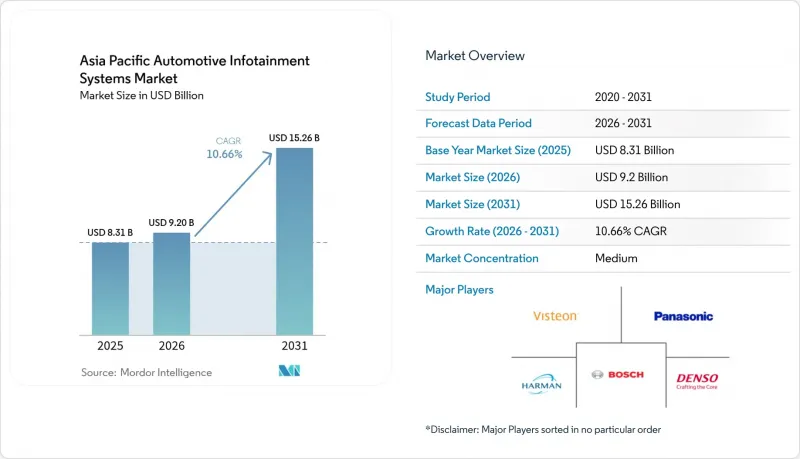
This report is Segmented by Installation Type (In-Dash Infotainment, and More), Vehicle Type (Passenger Cars, and More), Component (Display, Head Unit, and More), Propulsion (Internal Combustion Engine, and More), Connectivity (4G, 5G, and 2G/3G), Operating System (Linux, and Others), Sales Channel (OEM and Aftermarket), and Country. The Market Forecasts in Value (USD).
Asia Pacific Automotive Infotainment Systems Market Trends and Insights
Growing Demand for Connected-Car Services
Fleet operators and ride-hailing aggregators now view infotainment as a critical tool for enhancing operational efficiency rather than a mere cabin luxury. The integration of telematics enables more efficient routing, provides insights into driver behavior, and supports predictive maintenance, all of which contribute to noticeable reductions in fuel consumption. In markets such as India and South Korea, usage-based insurance pilots are encouraging the adoption of connectivity-enabled head units by offering tailored incentives. Furthermore, the use of cloud-based traffic prediction has streamlined operations by eliminating the need for embedded maps, thereby reducing the overall Bill of Materials (BOM) and improving cost efficiency.
Shift to OTA-Upgradeable, Software-Defined Vehicles
In 2024, Volkswagen Group China introduced over-the-air (OTA) updates for a significant number of vehicles . At the same time, Hyundai and Kia plan to extend OTA updates to the majority of their upcoming models for the following year. Furthermore, BMW's iDrive 9.0 incorporates hypervisors to enable independent updates for cockpit systems. These advancements in faster iteration cycles are driving growth in subscription-based revenue streams while simultaneously reducing costs associated with vehicle recalls.
High BOM Cost in Price-Sensitive Markets
Display modules, connectivity ICs, and SoCs account for a major portion of the infotainment bill of materials. Due to cost constraints in India's mass-market cars, original equipment manufacturers are compelled to ship head units with simplified features to maintain affordability. Furthermore, import tariffs imposed by ASEAN countries significantly increase the overall cost of semiconductors. Meanwhile, local manufacturing capabilities in India remain limited, focusing primarily on the production of wiring harnesses and performing basic assembly tasks.
Other drivers and restraints analyzed in the detailed report include:
- OEM-Tech Giant Platform Partnerships
- Low-Cost SoC Penetration in Entry-Level Cars
- Patchy 5G Coverage Outside Metro Areas
For complete list of drivers and restraints, kindly check the Table Of Contents.
Segment Analysis
Rear-seat entertainment revenue is climbing at 12.04% CAGR, even as in-dash units dominated 77.65% of 2025 sales. Curved multi-zone displays from Continental reduce wiring weight and enable independent streaming for passengers. Chauffeur-driven cultures in China and South Korea accelerate demand, whereas cost-sensitive India and ASEAN remain in-dash centric. Premium EV brands, such as NIO, now bundle rear-seat screens as a baseline, moving a former luxury feature into mid-segment expectations.
Greater cabin screen real estate supports targeted advertising, unlocking fresh revenue for OEM app stores. The Asia-Pacific Automotive Infotainment System market, therefore, sees rear-seat uptake influencing supplier roadmaps toward modular domain controllers that independently power multiple displays-a critical differentiation frontier heading to 2031.
Passenger cars account for 71.78% of revenue, yet they are pivoting to subscription models for navigation and ADAS upgrades. Light commercial vehicles deliver 11.55% CAGR, leveraging telematics-enabled infotainment for route optimization and driver analytics. Mahindra's Treo Zor embeds fleet APIs accessible via cabin touchscreens, illustrating how logistics operators convert infotainment into a mission-critical dashboard.
Fleet buyers prioritize uptime and TCO, so ruggedized screens, remote diagnostics, and FOTA are vital. OEMs offer tiered SaaS plans that are packaged at the time of purchase, locking in multi-year data contracts. The Asia-Pacific Automotive Infotainment System market accrues incremental recurring revenue beyond the showroom, underpinning strategic focus on LCVs for suppliers.
Displays secured a 43.28% value share in 2025, as OLEDs replace LCDs in premium tiers. Samsung Display's 100,000:1-contrast automotive OLED enables augmented-reality overlays and microsecond response times. Yet, operating-system software and apps lead growth at a 13.18% CAGR, signaling a margin migration.
Domain controllers now integrate cockpit, cluster, and rear-seat logic into a single SoC, significantly reducing the bill of materials. With the shift to subscription-based economics, original equipment manufacturers retain a larger share of app-store revenues compared to traditional phone platforms. Consequently, the Asia-Pacific Automotive Infotainment System market increasingly benefits suppliers that adapt from focusing solely on hardware delivery to offering end-to-end software lifecycle services.
Complete Report Scope:
- By Installation Type
- In-dash Infotainment
- Rear-seat Infotainment
- By Vehicle Type
- Passenger Cars
- Light Commercial Vehicles
- Medium and Heavy Commercial Vehicles
- By Component
- Display / Touch-screen Module
- Head Unit / Domain Controller
- Operating-System Software and Apps
- Connectivity ICs and Antenna Modules
- By Propulsion Type
- Internal-Combustion Engine Vehicles
- Hybrid Electric Vehicles
- Battery Electric Vehicles
- By Connectivity Generation
- 4G LTE
- 5G
- Legacy 2G/3G
- By Operating System
- Linux-Based (AAOS, AGL, etc.)
- QNX
- Android Automotive OS
- Others (Proprietary, RTOS)
- By Sales Channel
- OEM-Installed
- Aftermarket
- By Country
- China
- Japan
- India
- South Korea
- Australia
- Rest of Asia-Pacific
List of Companies Covered in this Report:
- Panasonic Corporation
- Harman International Inc. (Samsung)
- Denso Corporation
- Robert Bosch GmbH
- Visteon Corporation
- Continental AG
- Alpine Electronics Inc.
- JVCKenwood Corporation
- Mitsubishi Electric Corporation
- Aptiv PLC
- Hyundai Mobis
- Garmin Ltd.
- Sony Group Corporation
- BlackBerry QNX
Additional Benefits:
- The market estimate (ME) sheet in Excel format
- 3 months of analyst support
TABLE OF CONTENTS
1 Introduction
- 1.1 Study Assumptions and Market Definition
- 1.2 Scope of the Study
2 Research Methodology
3 Executive Summary
4 Market Landscape
- 4.1 Market Overview
- 4.2 Market Drivers
- 4.2.1 Growing Demand for Connected-Car Services
- 4.2.2 OEM-Tech Giant Platform Partnerships
- 4.2.3 Regulatory Mandates (ecall, Telematics)
- 4.2.4 Localized OTT and Navigation Ecosystems (ASEAN)
- 4.2.5 Low-Cost Soc Penetration in Entry-Level Cars
- 4.2.6 Shift to OTA-Upgradeable, Software-Defined Vehicles
- 4.3 Market Restraints
- 4.3.1 High BOM Cost in Price-Sensitive Markets
- 4.3.2 Software Fragmentation and Cybersecurity Risks
- 4.3.3 Head-Unit Shortages from Chip Supply Shocks
- 4.3.4 Patchy 5G Coverage Outside Metro Areas
- 4.4 Value / Supply-Chain Analysis
- 4.5 Regulatory Landscape
- 4.6 Technological Outlook
- 4.7 Porter's Five Forces
- 4.7.1 Threat of New Entrants
- 4.7.2 Bargaining Power of Suppliers
- 4.7.3 Bargaining Power of Buyers
- 4.7.4 Threat of Substitutes
- 4.7.5 Competitive Rivalry
5 Market Size and Growth Forecasts
- 5.1 By Installation Type
- 5.1.1 In-dash Infotainment
- 5.1.2 Rear-seat Infotainment
- 5.2 By Vehicle Type
- 5.2.1 Passenger Cars
- 5.2.2 Light Commercial Vehicles
- 5.2.3 Medium and Heavy Commercial Vehicles
- 5.3 By Component
- 5.3.1 Display / Touch-screen Module
- 5.3.2 Head Unit / Domain Controller
- 5.3.3 Operating-System Software and Apps
- 5.3.4 Connectivity ICs and Antenna Modules
- 5.4 By Propulsion Type
- 5.4.1 Internal-Combustion Engine Vehicles
- 5.4.2 Hybrid Electric Vehicles
- 5.4.3 Battery Electric Vehicles
- 5.5 By Connectivity Generation
- 5.5.1 4G LTE
- 5.5.2 5G
- 5.5.3 Legacy 2G/3G
- 5.6 By Operating System
- 5.6.1 Linux-Based (AAOS, AGL, etc.)
- 5.6.2 QNX
- 5.6.3 Android Automotive OS
- 5.6.4 Others (Proprietary, RTOS)
- 5.7 By Sales Channel
- 5.7.1 OEM-Installed
- 5.7.2 Aftermarket
- 5.8 By Country
- 5.8.1 China
- 5.8.2 Japan
- 5.8.3 India
- 5.8.4 South Korea
- 5.8.5 Australia
- 5.8.6 Rest of Asia-Pacific
6 Competitive Landscape
- 6.1 Market Concentration
- 6.2 Strategic Moves
- 6.3 Market Share Analysis
- 6.4 Company Profiles {(Includes Global level Overview, Market level overview, Core Segments, Financials as available, Strategic Information, Market Rank/Share for key companies, Products and Services, and Recent Developments)}
- 6.4.1 Panasonic Corporation
- 6.4.2 Harman International Inc. (Samsung)
- 6.4.3 Denso Corporation
- 6.4.4 Robert Bosch GmbH
- 6.4.5 Visteon Corporation
- 6.4.6 Continental AG
- 6.4.7 Alpine Electronics Inc.
- 6.4.8 JVCKenwood Corporation
- 6.4.9 Mitsubishi Electric Corporation
- 6.4.10 Aptiv PLC
- 6.4.11 Hyundai Mobis
- 6.4.12 Garmin Ltd.
- 6.4.13 Sony Group Corporation
- 6.4.14 BlackBerry QNX
7 Market Opportunities and Future Outlook

