PUBLISHER: Mordor Intelligence | PRODUCT CODE: 2115832

PUBLISHER: Mordor Intelligence | PRODUCT CODE: 2115832
Europe Automotive Infotainment Systems - Market Share Analysis, Industry Trends & Statistics, Growth Forecasts (2026 - 2031)
According to Mordor Intelligence, the european automotive infotainment systems market size was valued at USD 17.97 billion in 2025 and estimated to grow from USD 18.95 billion in 2026 to reach USD 25.45 billion by 2031, at a CAGR of 6.08% during the forecast period (2026-2031).
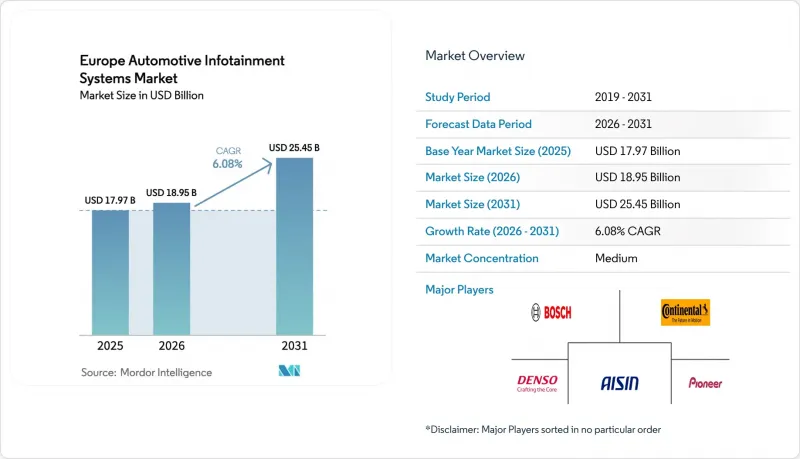
This report is Segmented by Installation Type (In-Dash Infotainment and More), Vehicle Type (Passenger Cars and More), Component (Display/Touch-Screen Module and More), Propulsion (Internal Combustion Engine Vehicles and More), Connectivity (Legacy 2G/3G and More), Operating System, Sales Channel, and Geography (Germany, and More). Market Forecasts are Provided in Value (USD).
Europe Automotive Infotainment Systems Market Trends and Insights
EU eCall and Safety Telematics Mandate (Reg. 2018/858)
Regulation 2018/858 compels every new passenger car and light commercial vehicle sold in the EU to embed an automatic emergency-call module, anchoring baseline infotainment specifications to include 4G modems and GNSS receivers. Enforcement concluded in 2024, but original equipment manufacturers quickly expanded the mandated module into a revenue hub that layers predictive maintenance alerts, insurance telematics, and stolen-vehicle tracking onto the same hardware. Continental and Bosch now market white-label telematics-as-a-service packages that original equipment manufacturers rebrand inside their own mobility apps. A 2025 Commission assessment showed emergency-response times in rural areas fell 40%, reinforcing consumer acceptance of always-connected cockpits across the European automotive infotainment systems market.
Surge in EV Adoption Driving Energy-Aware Infotainment
Battery electric vehicles captured a significant share of EU passenger registrations in 2025, shifting cockpit priorities from entertainment to energy stewardship. Infotainment systems now integrate battery-thermal modeling, charging-station availability, and range-optimized routing. Volkswagen's ID.Software 4.0 reserves 5G bandwidth via network slicing to keep charger data current, an upgrade that cut charging-related complaints 28% in Q4 2025. BMW's 2026 Dutch pilot offers off-peak charging discounts when drivers let infotainment schedule battery sessions, recasting the cockpit as an energy-management console and strengthening stickiness inside the European automotive infotainment systems market.
High Cost of Large OLED/Mini-LED Displays and HPC SoCs
LG Display has been supplying advanced flexible P-OLED panels for Mercedes-Benz's MBUX Hyperscreen infotainment system used in EQS and other electric vehicles, supporting curved panoramic display designs across the dashboard. NVIDIA's DRIVE Orin SoC adds USD 500 per unit, limiting adoption to luxury trims. Mainstream brands such as Volkswagen capped display upgrades at 10 inches in 2025 to preserve margins, restraining premium-screen rollouts in the European automotive infotainment systems market.
Other drivers and restraints analyzed in the detailed report include:
- 5G Stand-Alone Roll-Out and Network Slicing for In-Car Data
- Rising Consumer Demand for Smartphone-Like Digital Cockpits
- Compliance Burden From UNECE R155/R156 Cyber Rules
For complete list of drivers and restraints, kindly check the Table Of Contents.
Segment Analysis
In-dash units still held 72.13% revenue share in 2025, upheld by mandatory eCall connectivity, but single-digit growth underscores commoditization. Suppliers compete on integration cost, not screen size, as hardware converges on shared domain controllers. Rear-seat systems instead differentiate through content deals with Disney+ or Xbox Cloud Gaming, accelerating software subscriptions inside the European automotive infotainment systems market.
The rear-seat infotainment segment will climb at a 14.27% CAGR through 2031. Luxury original equipment manufacturers exploit long battery electric vehicle wheelbases to mount dual 11-inch touchscreens, wireless headsets, and gaming modes, delivering a lounge atmosphere. Chauffeur-driven executives in Germany, China, and the Middle East sustain this premium, while family-oriented MPVs in Spain and France expand addressable volumes.
Passenger cars retained 86.42% share in 2025, anchored by 10.9 million EU registrations, yet battery electric vehicle variants of these cars will grow 38.56% a year. Energy-aware interfaces now display battery thermal state, regenerative-brake scores, and intelligent charging tips, features that elevate cockpit centrality within the European automotive infotainment systems market.
Commercial vans lag volumes but fast-track telematics for fleet optimization. The European Commission's proposal to extend eCall to more than 3.5-ton trucks enlarges future demand. Medium-duty drivers require digital tachograph integration and real-time load analytics, nudging infotainment suppliers to tailor rugged HMI variants. Passenger-car dominance persists through 2031, yet light commercial vehicle digitization diversifies revenue streams across the European automotive infotainment systems industry.
Display modules represented 48.29% of 2025 revenue, but their CAGR trails 16.84% growth in operating-system software and apps. Original equipment manufacturers now embed app stores, cloud gaming, and feature-on-demand unlocks, turning the cockpit into a persistent revenue engine across the European automotive infotainment systems market.
Domain controller commoditization compresses hardware margins. Qualcomm and NXP ship turnkey reference boards that slash BOM by 18% for Visteon SmartCore customers. Subscription bundles, premium navigation, or in-car karaoke, generate >70% gross margin, shifting profitability toward software even while screens remain the largest absolute pool.
Complete Report Scope:
- By Installation Type
- In-dash Infotainment
- Rear-seat Infotainment
- By Vehicle Type
- Passenger Cars
- Light Commercial Vehicles
- Medium and Heavy Commercial Vehicles
- By Component
- Display/Touch-Screen Module
- Head Unit/Domain Controller
- Operating-System Software and Apps
- Connectivity ICs and Antenna Modules
- By Propulsion Type
- Internal Combustion Engine Vehicles
- Hybrid Electric Vehicles
- Battery Electric Vehicles
- By Connectivity Generation
- Legacy 2G/3G
- 4G LTE
- 5G
- By Operating System
- Linux-Based (AAOS, AGL, etc.)
- QNX
- Android Automotive OS
- Others (Proprietary, RTOS)
- By Sales Channel
- Original Equipment Manufacturer (OEM) Installed
- Aftermarket
- By Country
- Germany
- United Kingdom
- France
- Italy
- Spain
- Russia
- Rest of Europe
List of Companies Covered in this Report:
- Continental AG
- Robert Bosch GmbH
- Harman International (Samsung)
- AISIN CORPORATION
- Visteon Corporation
- Panasonic Automotive Systems
- Alpine Electronics
- Denso Corporation
- Aptiv PLC
- LG Electronics
- Valeo SA
- Faurecia Clarion Electronics
- Pioneer Corporation
- Samsung Electronics (Exynos Auto)
- Qualcomm Technologies Inc.
- NVIDIA Corporation (Automotive)
- STMicroelectronics
- NXP Semiconductors
- Renesas Electronics Corp.
- TomTom N V
- Garmin Ltd.
Additional Benefits:
- The market estimate (ME) sheet in Excel format
- 3 months of analyst support
TABLE OF CONTENTS
1 Introduction
- 1.1 Study Assumptions and Market Definition
- 1.2 Scope of the Study
2 Research Methodology
3 Executive Summary
4 Market Landscape
- 4.1 Market Overview
- 4.2 Market Drivers
- 4.2.1 EU eCall and Safety Telematics Mandate (Reg. 2018/858)
- 4.2.2 Surge in Electric Vehicle Adoption Driving Energy-Aware Infotainment
- 4.2.3 5G Stand-Alone Roll-out and Network Slicing for In-Car Data
- 4.2.4 Rising Consumer Demand for Smartphone-Like Digital Cockpits
- 4.2.5 Open Gateway APIs Unlocking Cross-Operator QoS Contracts
- 4.2.6 Chinese Entry-Level Battery Electric Vehicles Forcing Feature-Rich Low-Cost IVI
- 4.3 Market Restraints
- 4.3.1 High Cost of Large OLED/Mini-LED Displays and HPC SoCs
- 4.3.2 Compliance Burden from UNECE R155/R156 Cyber Rules
- 4.3.3 North-South Electric Vehicle and Connectivity Adoption Divide Across Europe
- 4.3.4 Asian Semiconductor Supply Dependency Exposes Lead-Time Risk
- 4.4 Value/Supply-Chain Analysis
- 4.5 Regulatory Landscape
- 4.6 Technological Outlook
- 4.7 Porter's Five Forces
- 4.7.1 Threat of New Entrants
- 4.7.2 Bargaining Power of Suppliers
- 4.7.3 Bargaining Power of Buyers
- 4.7.4 Threat of Substitutes
- 4.7.5 Competitive Rivalry
5 Market Size and Growth Forecasts (Value in USD)
- 5.1 By Installation Type
- 5.1.1 In-dash Infotainment
- 5.1.2 Rear-seat Infotainment
- 5.2 By Vehicle Type
- 5.2.1 Passenger Cars
- 5.2.2 Light Commercial Vehicles
- 5.2.3 Medium and Heavy Commercial Vehicles
- 5.3 By Component
- 5.3.1 Display/Touch-Screen Module
- 5.3.2 Head Unit/Domain Controller
- 5.3.3 Operating-System Software and Apps
- 5.3.4 Connectivity ICs and Antenna Modules
- 5.4 By Propulsion Type
- 5.4.1 Internal Combustion Engine Vehicles
- 5.4.2 Hybrid Electric Vehicles
- 5.4.3 Battery Electric Vehicles
- 5.5 By Connectivity Generation
- 5.5.1 Legacy 2G/3G
- 5.5.2 4G LTE
- 5.5.3 5G
- 5.6 By Operating System
- 5.6.1 Linux-Based (AAOS, AGL, etc.)
- 5.6.2 QNX
- 5.6.3 Android Automotive OS
- 5.6.4 Others (Proprietary, RTOS)
- 5.7 By Sales Channel
- 5.7.1 Original Equipment Manufacturer (OEM) Installed
- 5.7.2 Aftermarket
- 5.8 By Country
- 5.8.1 Germany
- 5.8.2 United Kingdom
- 5.8.3 France
- 5.8.4 Italy
- 5.8.5 Spain
- 5.8.6 Russia
- 5.8.7 Rest of Europe
6 Competitive Landscape
- 6.1 Market Concentration
- 6.2 Strategic Moves
- 6.3 Market Share Analysis
- 6.4 Company Profiles (Includes Global Level Overview, Market Level Overview, Core Segments, Financials as Available, Strategic Information, Market Rank/Share for Key Companies, Products and Services, SWOT Analysis, and Recent Developments)
- 6.4.1 Continental AG
- 6.4.2 Robert Bosch GmbH
- 6.4.3 Harman International (Samsung)
- 6.4.4 AISIN CORPORATION
- 6.4.5 Visteon Corporation
- 6.4.6 Panasonic Automotive Systems
- 6.4.7 Alpine Electronics
- 6.4.8 Denso Corporation
- 6.4.9 Aptiv PLC
- 6.4.10 LG Electronics
- 6.4.11 Valeo SA
- 6.4.12 Faurecia Clarion Electronics
- 6.4.13 Pioneer Corporation
- 6.4.14 Samsung Electronics (Exynos Auto)
- 6.4.15 Qualcomm Technologies Inc.
- 6.4.16 NVIDIA Corporation (Automotive)
- 6.4.17 STMicroelectronics
- 6.4.18 NXP Semiconductors
- 6.4.19 Renesas Electronics Corp.
- 6.4.20 TomTom N V
- 6.4.21 Garmin Ltd.
7 Market Opportunities and Future Outlook
- 7.1 White-Space and Unmet-Need Assessment

