PUBLISHER: Mordor Intelligence | PRODUCT CODE: 2115071

PUBLISHER: Mordor Intelligence | PRODUCT CODE: 2115071
Automotive Voice Recognition System - Market Share Analysis, Industry Trends & Statistics, Growth Forecasts (2026 - 2031)
According to Mordor Intelligence, the automotive voice recognition system market size was valued at USD 4.45 billion in 2025 and estimated to grow from USD 5.08 billion in 2026 to reach USD 9.86 billion by 2031, at a CAGR of 14.17% during the forecast period (2026-2031).
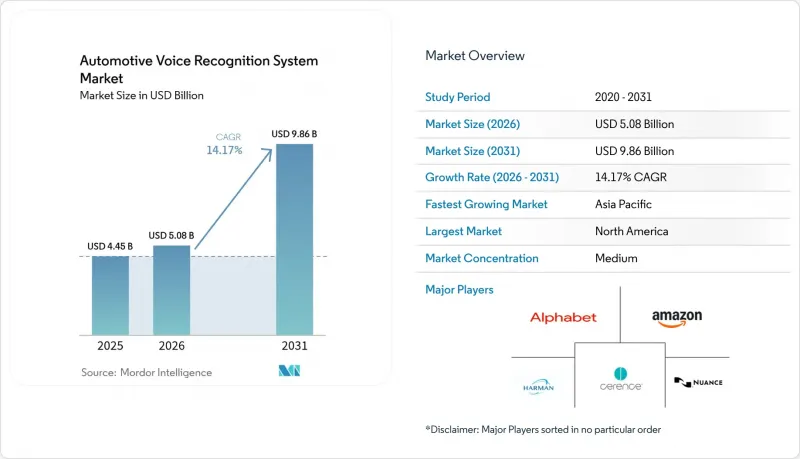
This report is Segmented by Vehicle Type (Passenger Cars, Light Commercial Vehicles, and More), Technology (Embedded, Cloud-Based, and More), Vehicle Class (Economy, Mid-Priced, and More), Microphone Array Design (Single-Mic, Dual-Mic, and More), and Geography (North America, and More). The Report Offers the Market Size and Forecasts for all the Above Segments in Value (USD).
Global Automotive Voice Recognition System Market Trends and Insights
Rising Adoption of Connected-Car Ecosystems
Connected-car platforms now link vehicle functions, smart-home devices, and third-party apps through a unified voice layer. Volkswagen's rollout of Cerence Chat Pro enables conversational control over navigation, weather, and commerce from a single interface. Over-the-air updates continually sharpen recognition accuracy and add new skills, helping brands keep pace with user expectations. Partnerships such as SoundHound AI with Tencent extend these benefits into mobility super-apps that bridge in-car and mobile experiences. As ecosystems mature, authenticated voice commerce unlocks new revenue streams for automakers, further reinforcing voice as the default human-machine channel.
Surge in Luxury & Premium Vehicle Penetration
Premium marques deploy voice as a signature experience to justify higher sticker prices. The 2025 Mercedes-Benz S-Class introduced AI-powered assistants able to recognise individual occupants and anticipate preferences. Jaguar Land Rover's collaboration with Cerence adds emotion detection and multilingual support to bolster brand differentiation. Such luxury rollouts absorb early cost premiums, allow software refinement in low-volume settings and pave the way for cost-down migration to mid-segment vehicles. Subscription add-ons in premium segments also validate monetisation models that mainstream brands later replicate.
Up-Front Hardware Retrofit Costs
Substantial upfront investments required for voice recognition hardware integration create significant barriers for automakers operating in price-sensitive markets and existing vehicle retrofitting scenarios. These costs are compounded by the need for electromagnetic compatibility solutions to address RF interference, requiring additional shielding and filtering components that further increase implementation expenses. Cerence Link's OBD-port solution represents one approach to retrofit challenges, but such aftermarket solutions typically offer limited functionality compared to integrated systems. The cost burden is particularly acute for commercial vehicle operators who must balance voice system benefits against fleet acquisition costs, though emerging evidence suggests voice technology's operational efficiency gains can justify the investment over time.
Other drivers and restraints analyzed in the detailed report include:
- Tighter In-Cabin Distraction Regulations
- Edge-AI Chip Cost Declines
- Accent and Dialect Accuracy Gaps in Emerging Markets
For complete list of drivers and restraints, kindly check the Table Of Contents.
Segment Analysis
Passenger Cars still command 72.60% of 2025 shipments, yet their growth curve will plateau relative to fleet-driven demand. Learnings from round-the-clock commercial duty cycles feed refinements back into consumer interfaces, raising reliability expectations. As regulatory thresholds tighten for distraction metrics, passenger models increasingly inherit fleet-proven microphone arrays and edge-processing chips, ensuring consistency across brand portfolios.
Commercial Vehicles, although contributing a smaller base, will outpace the broader Automotive Voice Recognition System market at a 14.62% CAGR through 2031. Fleet operators quantify return on investment via reduced distraction-related incidents and faster dispatch communications. Light commercial vans increasingly ship with voice-activated work-order logging, while heavy trucks pair assistants with telematics to vocalise predictive-maintenance alerts. These tangible savings persuade fleet owners to specify voice as standard spec, reinforcing unit volumes that, in turn, dilute per-vehicle costs for passenger cars.
Embedded processing remains the workhorse, anchoring 53.80% of 2025 revenue because it satisfies GDPR-centred privacy norms and guarantees service in low-coverage zones. However, cloud-centric architectures are scaling fastest at 14.65% CAGR, propelled by generative-AI services impossible to host on 16-bit microcontrollers. Volkswagen's ChatGPT integration shows how on-demand cloud reasoning augments local command sets while retaining sub-second response times.
Hybrid topologies now blend the two, running wake-word and HVAC commands on the device while routing knowledge queries to remote GPUs. This split satisfies data-protection regulators yet unleashes richer experiences, making hybrid likely to dominate the Automotive Voice Recognition System market share beyond 2028. Suppliers that orchestrate seamless hand-offs between edge and cloud thus occupy pivotal positions in OEM roadmaps.
Complete Report Scope:
- By Vehicle Type
- Passenger Cars
- Light Commercial Vehicles
- Heavy Commercial Vehicles
- By Technology
- Embedded
- Cloud-based
- Hybrid
- By Vehicle Class
- Economy
- Mid-priced
- Luxury
- By Microphone Array Design
- Single-mic
- Dual-mic
- Beam-forming mic
- By Geography
- North America
- United States
- Canada
- Rest of North America
- South America
- Brazil
- Argentina
- Rest of South America
- Europe
- Germany
- United Kingdom
- France
- Italy
- Spain
- Russia
- Rest of Europe
- Asia Pacific
- China
- Japan
- India
- South Korea
- Australia
- Rest of Asia Pacific
- Middle East and Africa
- Turkey
- Saudi Arabia
- United Arab Emirates
- South Africa
- Rest of Middle East and Africa
- North America
Geography Analysis
North America accounted for 37.10% of 2025 revenue, underpinned by ubiquitous smartphone assistant usage and early embrace of in-car voice commerce. US OEMs bundle food-ordering, fuel-payment, and subscription media inside voice dashboards that expand recurring revenue streams beyond the original sale. Canada accentuates bilingual English-French processing, compelling suppliers to optimise language-switching algorithms. While regional growth cools from earlier highs, upcoming NHTSA driver-impairment mandates create a fresh floor for demand by 2026.
Asia Pacific is the fastest climber, with a 14.78% CAGR that will lift its Automotive Voice Recognition System market share materially by 2031. China's domestic automakers embed Baidu and Tencent assistants as default user interfaces, leaning on 5G networks to serve generative AI queries. Great Wall Motor's global expansion program relies on Cerence for multilingual rollout across right-hand and left-hand drive markets. India's push for regional-language recognition fuels model training runs that raise system robustness worldwide. Japan emphasises elder-friendly features such as medication reminders, shaping inclusive design frameworks exported globally.
Europe maintains steady adoption, driven less by gadget enthusiasm than by safety and privacy regulation. GDPR steers OEMs toward on-device processing or consent-controlled cloud hand-offs, while Euro NCAP's 2026 rating updates make hands-free control indispensable for touchscreen-heavy interiors. Volkswagen Group's pan-brand ChatGPT upgrade demonstrates how European players reconcile privacy with AI capability through anonymised, opt-in data flows. Growing demand for multi-language support across 24 official EU tongues also pushes suppliers to invest in accent coverage.
- Apple Inc.
- Alphabet Inc. (Google)
- Harman International Industries
- Nuance Communications Inc.
- Cerence Inc.
- Continental AG
- Amazon.com Inc.
- Bosch GmbH
- SoundHound AI Inc.
- IBM Corporation
- Sensory Inc.
- Baidu Inc.
- LG Electronics
- Valeo SA
- BlackBerry QNX
- iNAGO Corporation
- Yandex LLC
- Kardome Technology Ltd
- Voicebox Technologies
Additional Benefits:
- The market estimate (ME) sheet in Excel format
- 3 months of analyst support
TABLE OF CONTENTS
1 Introduction
- 1.1 Study Assumptions and Market Definition
- 1.2 Scope of the Study
2 Research Methodology
3 Executive Summary
4 Market Landscape
- 4.1 Market Overview
- 4.2 Market Drivers
- 4.2.1 Rising adoption of connected-car ecosystems
- 4.2.2 Surge in luxury and premium vehicle penetration
- 4.2.3 Tighter in-cabin distraction regulations
- 4.2.4 Edge-AI chip cost declines
- 4.2.5 OEM monetisation via voice commerce
- 4.2.6 Push for driver-health monitoring integration
- 4.3 Market Restraints
- 4.3.1 Up-front hardware retrofit costs
- 4.3.2 Accent and dialect accuracy gaps in emerging markets
- 4.3.3 Data-privacy compliance burden (GDPR, China PIPL)
- 4.3.4 RF interference from multi-sensor cockpits
- 4.4 Value / Supply-Chain Analysis
- 4.5 Regulatory Landscape
- 4.6 Technological Outlook
- 4.7 Porter's Five Forces Analysis
- 4.7.1 Threat of New Entrants
- 4.7.2 Bargaining Power of Buyers/Consumers
- 4.7.3 Bargaining Power of Suppliers
- 4.7.4 Threat of Substitute Products
- 4.7.5 Intensity of Competitive Rivalry
5 Market Size and Growth Forecasts (Value (USD))
- 5.1 By Vehicle Type
- 5.1.1 Passenger Cars
- 5.1.2 Light Commercial Vehicles
- 5.1.3 Heavy Commercial Vehicles
- 5.2 By Technology
- 5.2.1 Embedded
- 5.2.2 Cloud-based
- 5.2.3 Hybrid
- 5.3 By Vehicle Class
- 5.3.1 Economy
- 5.3.2 Mid-priced
- 5.3.3 Luxury
- 5.4 By Microphone Array Design
- 5.4.1 Single-mic
- 5.4.2 Dual-mic
- 5.4.3 Beam-forming mic
- 5.5 By Geography
- 5.5.1 North America
- 5.5.1.1 United States
- 5.5.1.2 Canada
- 5.5.1.3 Rest of North America
- 5.5.2 South America
- 5.5.2.1 Brazil
- 5.5.2.2 Argentina
- 5.5.2.3 Rest of South America
- 5.5.3 Europe
- 5.5.3.1 Germany
- 5.5.3.2 United Kingdom
- 5.5.3.3 France
- 5.5.3.4 Italy
- 5.5.3.5 Spain
- 5.5.3.6 Russia
- 5.5.3.7 Rest of Europe
- 5.5.4 Asia Pacific
- 5.5.4.1 China
- 5.5.4.2 Japan
- 5.5.4.3 India
- 5.5.4.4 South Korea
- 5.5.4.5 Australia
- 5.5.4.6 Rest of Asia Pacific
- 5.5.5 Middle East and Africa
- 5.5.5.1 Turkey
- 5.5.5.2 Saudi Arabia
- 5.5.5.3 United Arab Emirates
- 5.5.5.4 South Africa
- 5.5.5.5 Rest of Middle East and Africa
- 5.5.1 North America
6 Competitive Landscape
- 6.1 Market Concentration
- 6.2 Strategic Moves
- 6.3 Market Share Analysis
- 6.4 Company Profiles (includes Global Level Overview, Market Level Overview, Core Segments, Financials as Available, Strategic Information, Market Rank/Share for Key Companies, Products and Services, SWOT Analysis, and Recent Developments)
- 6.4.1 Apple Inc.
- 6.4.2 Alphabet Inc. (Google)
- 6.4.3 Harman International Industries
- 6.4.4 Nuance Communications Inc.
- 6.4.5 Cerence Inc.
- 6.4.6 Continental AG
- 6.4.7 Amazon.com Inc.
- 6.4.8 Bosch GmbH
- 6.4.9 SoundHound AI Inc.
- 6.4.10 IBM Corporation
- 6.4.11 Sensory Inc.
- 6.4.12 Baidu Inc.
- 6.4.13 LG Electronics
- 6.4.14 Valeo SA
- 6.4.15 BlackBerry QNX
- 6.4.16 iNAGO Corporation
- 6.4.17 Yandex LLC
- 6.4.18 Kardome Technology Ltd
- 6.4.19 Voicebox Technologies
7 Market Opportunities and Future Outlook
- 7.1 White-space and Unmet-Need Assessment

