PUBLISHER: Mordor Intelligence | PRODUCT CODE: 2125341

PUBLISHER: Mordor Intelligence | PRODUCT CODE: 2125341
India Consumer Speaker - Market Share Analysis, Industry Trends & Statistics, Growth Forecasts (2026 - 2031)
According to Mordor Intelligence, India consumer speaker market size in 2026 is estimated at 41.15 Million units, growing from 2025 value of 36.71 Million units with 2031 projections showing 72.78 Million units, growing at 12.08% CAGR over 2026-2031.
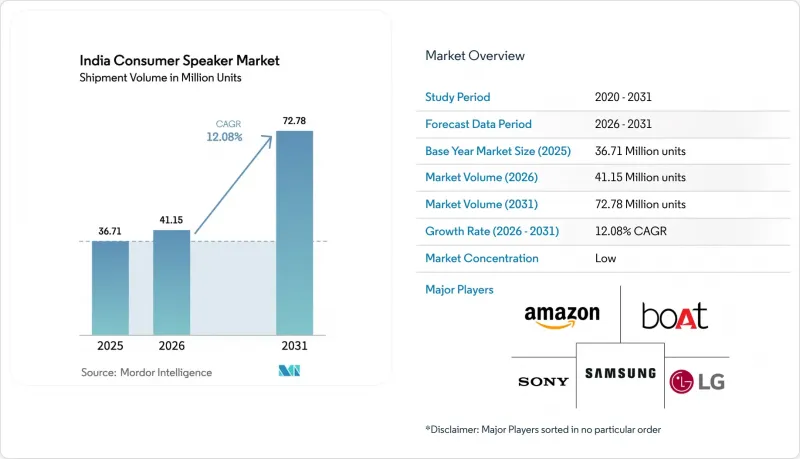
This report is Segmented by Device Type (Wireless Speakers, Soundbars, and Hi-Fi and Party Speakers), Connectivity (Bluetooth, Wi-Fi, and More), Price Range (Entry-Level, Mid-Range, and More), Distribution Channel (Online, and More), and Geography (North India, South India, West India, and More). The Market Sizes and Forecasts are Provided in Terms of Volume (Units).
India Consumer Speaker Market Trends and Insights
Rapid 5G and fiber roll-out
Telecom operators continue to light up 5G in urban clusters, enabling low-latency audio streaming and multi-room synchronization. Fiber penetration into tier-2 cities stabilizes home-network bandwidth, which boosts demand for Wi-Fi-capable speakers that run voice assistants reliably. Consistent connectivity is helping first-time buyers bypass legacy wired systems and jump straight to wireless units, accelerating upgrade cycles for households that already own Bluetooth-only models.
Affordable "Made-in-India" SKUs
Production-linked incentives and a sharper focus on component localization have lowered bill-of-materials costs while trimming import duties. Domestic assembly now covers dust-resistant casings, higher-capacity batteries, and regional-language voice prompts tailored to Indian usage patterns. The availability of feature-rich devices at sub-INR 10,000 price points draws first-time users in tier-3 districts into the India consumer speaker market and shields local brands from currency-related import shocks.
Data-privacy and security concerns
Households increasingly question always-on microphones and cloud storage of voice recordings. Brands now highlight physical mute switches, on-device processing, and transparent data-retention policies. Delay in consumer adoption of smart speakers is most visible among professionals wary of corporate or family conversations being captured inadvertently.
Other drivers and restraints analyzed in the detailed report include:
- Surge in voice-assistant adoption
- OTT and gaming-led premium audio demand
- Counterfeit and grey-market products
For complete list of drivers and restraints, kindly check the Table Of Contents.
Segment Analysis
Wireless speakers hold a 51.64% share of the India consumer speaker market in 2025, with smart sub-variants posting a significant CAGR through 2031. The cut-the-cord mindset matches a mobile-first culture where a smartphone acts as the primary audio source. Portable Bluetooth cylinders remain weekend companions, yet smart speakers are taking center stage as living-room gateways for home automation. Soundbars, although with a smaller base, benefit from smart TV proliferation; their forecast 13.05% CAGR places them as the fastest-expanding device class. Party speakers larger than 80 W maintain relevance for social events, sustaining a 27% volume slice. Hi-Fi towers, promoted as hybrid music-and-movie solutions, address listeners who seek better bass response without investing in multi-unit setups.
Mid-tier brands merge categories by adding detachable satellites to party speakers or voice assistants to traditional boomboxes. Samsung's 20.1% global soundbar share highlights technological trickle-down that now influences domestic buying decisions. Local challengers reply with value-engineered wireless bundles that ship with karaoke microphones and RGB lighting to match cultural preferences for group entertainment. The device spectrum therefore ranges from pocket-sized 5 W sticks to 400 W tower rigs, ensuring every income band finds a fitting proposition in the India consumer speaker market.
Bluetooth-only products accounted for 67.58% of the India consumer speaker market size in 2025, cementing their place as entry-level workhorses. Simplicity of pairing and ever-lower chip costs keep BOM structures lean. Yet dual BT + Wi-Fi units are arching upward at a 12.12% CAGR as households appreciate lossless streaming, multi-room grouping, and voice-command responsiveness. Pure Wi-Fi speakers serve a niche of audiophiles who prize uncompressed codecs, but they anchor brand portfolios as halo offerings.
Automatic source switching is becoming standard, allowing a speaker to prioritize Wi-Fi when available and revert to Bluetooth outdoors. Amazon Echo and Google Nest families exemplify this versatility, using tri-band antennas to sustain connectivity in congested urban homes. OEMs now bundle companion apps that map Wi-Fi coverage and suggest optimal placement, driving incremental upgrades for mesh routers. Connectivity diversification, therefore, accelerates ASP growth while future-proofing devices against protocol obsolescence.
Complete Report Scope:
- By Device Type
- Wireless Speakers
- Smart Speakers
- Traditional Bluetooth Speakers
- Soundbars
- Hi-Fi and Party Speakers
- Wireless Speakers
- By Connectivity
- Bluetooth
- Wi-Fi
- Dual (BT + Wi-Fi) / Multi-room
- By Price Range
- Entry-level (<= INR 5,000)
- Mid-range (INR 5,001-15,000)
- Premium (>= INR 15,001)
- By Distribution Channel
- Online (E-commerce and D2C)
- Offline Organised Retail
- Specialty Audio Stores
- By Region
- North India
- South India
- West India
- East India
- Central India
- North-East India
List of Companies Covered in this Report:
- Amazon.com, Inc.
- Boat Ltd.(Imagine Marketing Limited)
- Sony Group Corporation
- Samsung Electronics Co., Ltd.
- LG Electronics Inc.
- Apple Inc.
- Sonos, Inc.
- Harman International Industries, Inc. (JBL)
- Bose Corporation
- Alphabet Inc. (Google Nest)
- Xiaomi Corporation
- Imagine Marketing Limited (boAt)
- Anker Innovations Co., Ltd. (Soundcore)
- Bang & Olufsen A/S
- Denon Holdings Inc.
- Yamaha Corporation
- Panasonic Corporation
- Marshall Group AB
- Skullcandy, Inc.
- Sound United LLC (Polk Audio)
- Creative Technology Ltd.
- V-Moda LLC
- Sennheiser electronic GmbH & Co. KG
- Blaupunkt GmbH
- Fenda Audio (India) Pvt. Ltd.
- Zebronics India Pvt. Ltd.
- Inbase Tech Inc. (Brand Urban Inc.)
Additional Benefits:
- The market estimate (ME) sheet in Excel format
- 3 months of analyst support
TABLE OF CONTENTS
1 INTRODUCTION
- 1.1 Study Assumptions and Market Definition
- 1.2 Scope of the Study
2 RESEARCH METHODOLOGY
3 EXECUTIVE SUMMARY
4 MARKET LANDSCAPE
- 4.1 Market Overview
- 4.2 Market Drivers
- 4.2.1 Rapid 5G and Fiber Roll-out
- 4.2.2 Affordable "Made-in-India" SKUs
- 4.2.3 Surge in Voice-assistant Adoption
- 4.2.4 OTT and Gaming-led Premium Audio Demand
- 4.2.5 Government PLI and Manufacturing Incentives
- 4.2.6 Expansion of Tier-2/3 Online Retail
- 4.3 Market Restraints
- 4.3.1 Data-privacy and Security Concerns
- 4.3.2 Counterfeit and Grey-market Products
- 4.3.3 Semiconductor Supply-chain Volatility
- 4.3.4 Low Indian-language NLP Accuracy
- 4.4 Industry Value Chain Analysis
- 4.5 Regulatory Landscape
- 4.6 Technological Outlook
- 4.7 Porter's Five Forces Analysis
- 4.7.1 Bargaining Power of Suppliers
- 4.7.2 Bargaining Power of Buyers
- 4.7.3 Threat of New Entrants
- 4.7.4 Threat of Substitutes
- 4.7.5 Intensity of Competitive Rivalry
- 4.8 Assessment of Macro-economic Trends on the Market
5 MARKET SIZE AND GROWTH FORECASTS (VOLUME)
- 5.1 By Device Type
- 5.1.1 Wireless Speakers
- 5.1.1.1 Smart Speakers
- 5.1.1.2 Traditional Bluetooth Speakers
- 5.1.2 Soundbars
- 5.1.3 Hi-Fi and Party Speakers
- 5.1.1 Wireless Speakers
- 5.2 By Connectivity
- 5.2.1 Bluetooth
- 5.2.2 Wi-Fi
- 5.2.3 Dual (BT + Wi-Fi) / Multi-room
- 5.3 By Price Range
- 5.3.1 Entry-level (<= INR 5,000)
- 5.3.2 Mid-range (INR 5,001-15,000)
- 5.3.3 Premium (>= INR 15,001)
- 5.4 By Distribution Channel
- 5.4.1 Online (E-commerce and D2C)
- 5.4.2 Offline Organised Retail
- 5.4.3 Specialty Audio Stores
- 5.5 By Region
- 5.5.1 North India
- 5.5.2 South India
- 5.5.3 West India
- 5.5.4 East India
- 5.5.5 Central India
- 5.5.6 North-East India
6 COMPETITIVE LANDSCAPE
- 6.1 Market Concentration
- 6.2 Strategic Moves
- 6.3 Market Share Analysis
- 6.4 Company Profiles (includes Global level Overview, Market level overview, Core Segments, Financials as available, Strategic Information, Market Rank/Share for key companies, Products and Services, and Recent Developments)
- 6.4.1 Amazon.com, Inc.
- 6.4.2 Boat Ltd.(Imagine Marketing Limited)
- 6.4.3 Sony Group Corporation
- 6.4.4 Samsung Electronics Co., Ltd.
- 6.4.5 LG Electronics Inc.
- 6.4.6 Apple Inc.
- 6.4.7 Sonos, Inc.
- 6.4.8 Harman International Industries, Inc. (JBL)
- 6.4.9 Bose Corporation
- 6.4.10 Alphabet Inc. (Google Nest)
- 6.4.11 Xiaomi Corporation
- 6.4.12 Imagine Marketing Limited (boAt)
- 6.4.13 Anker Innovations Co., Ltd. (Soundcore)
- 6.4.14 Bang & Olufsen A/S
- 6.4.15 Denon Holdings Inc.
- 6.4.16 Yamaha Corporation
- 6.4.17 Panasonic Corporation
- 6.4.18 Marshall Group AB
- 6.4.19 Skullcandy, Inc.
- 6.4.20 Sound United LLC (Polk Audio)
- 6.4.21 Creative Technology Ltd.
- 6.4.22 V-Moda LLC
- 6.4.23 Sennheiser electronic GmbH & Co. KG
- 6.4.24 Blaupunkt GmbH
- 6.4.25 Fenda Audio (India) Pvt. Ltd.
- 6.4.26 Zebronics India Pvt. Ltd.
- 6.4.27 Inbase Tech Inc. (Brand Urban Inc.)
7 MARKET OPPORTUNITIES AND FUTURE OUTLOOK
- 7.1 White-Space and Unmet-Need Assessment

