PUBLISHER: Mordor Intelligence | PRODUCT CODE: 2115169

PUBLISHER: Mordor Intelligence | PRODUCT CODE: 2115169
Steam Boiler System - Market Share Analysis, Industry Trends & Statistics, Growth Forecasts (2026 - 2031)
According to Mordor Intelligence, the steam boiler system market size is expected to grow from USD 22.57 billion in 2025 to USD 23.5 billion in 2026 and is forecast to reach USD 28.75 billion by 2031 at 4.12% CAGR over 2026-2031.
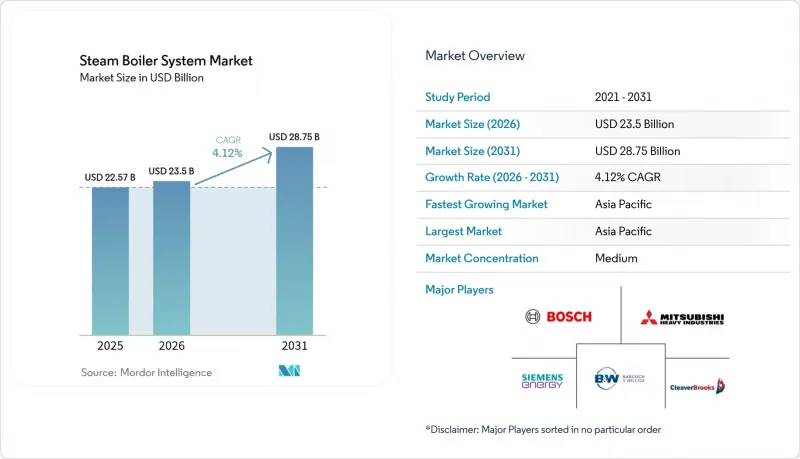
This report is Segmented by Boiler Type (Water-Tube, Electrode/Electric, and More), Fuel Type (Natural Gas and Biomass, Hydrogen and Synthetic Fuels, and More), Capacity (10 To 150 BHP, Above 600 BHP/Utility-Scale, and More), Technology (Condensing and Non-Condensing), End-Use Industry (Power Generation, Pharmaceuticals, Chemicals, and More), and Geography (North America, Europe, Asia-Pacific, and More).
Global Steam Boiler System Market Trends and Insights
Stringent Emission-Control Regulations
The U.S. EPA's NESHAP mandate compels biennial tune-ups and continuous monitoring for boilers above 10 MMBtu/h, driving investment in low-NOx burners, selective catalytic reduction, and alternative fuels. Similar tightening is underway in India, where the pending Boilers Bill 2024 raises inspection frequency for roughly 4 million units, prompting demand for self-diagnostic control systems. Compliance outlays can reach 15% of total project budgets, so operators gravitate toward bundled solutions that integrate emission hardware, controls, and service contracts. These rules favor water-tube and electrode designs that inherently accommodate cleaner combustion or all-electric heating. By linking compliance dashboards to enterprise software, suppliers position digital twins as the least-cost pathway to verify real-time performance and avoid non-compliance penalties.
Surging Food & Beverage Processing Capacity
Cold-chain investments and stricter sanitation protocols have sharpened demand for culinary-grade steam that matches pharmaceutical purity benchmarks. Skid-mounted packages appeal because they curb installation time by up to 50% compared with central boiler rooms, letting processors align capacity with seasonal peaks. IoT probes now stream live-stream-quality data to line operators, cutting product-spoilage risk and simplifying regulatory audits. Rising utility bills amplify interest in condensing fire-tube units for packaging halls, whereas electrode systems supply near-instantaneous clean steam for SIP lines without combustion-related contaminants. These features collectively enlarge the food sector's steam boiler system market footprint.
High Upfront Capex & O&M Costs
Standard utility builds cost USD 6,000-13,000 per ton-hour, with water treatment, economizers, and cybersecure controls lifting lifecycle spend by 40-60%. Smaller firms struggle to finance such outlays, so OEMs now pitch steam-as-a-service contracts in which clients pay a per-ton tariff while suppliers retain asset ownership and maintenance obligations. Digital twins cut unscheduled outages, but their development and data-integration fees add 3-5% to project capital, a hurdle in emerging markets where the cost of capital hovers in double digits.
Other drivers and restraints analyzed in the detailed report include:
- Power-Plant Capacity Additions in Emerging Asia & Africa
- Hydrogen-Ready Boiler Retrofits in Refineries
- Volatile Natural-Gas & Coal Prices
For complete list of drivers and restraints, kindly check the Table Of Contents.
Segment Analysis
Water-tube units generated 57.86% of 2025 revenue, a commanding steam boiler system market lead. Their large surface area handles 600 °C and 270 bar service, a power and petrochemical complexes. Fire-tube designs remain popular in mid-range duties up to 250 psig due to simpler fabrication and lower upfront cost, while coil/once-through variants excel where footprint trumps capacity.
Electrode/electric boilers outpace every other type at a 6.08% CAGR. They deliver 99.9% electrical-to-thermal efficiency and instant modulation, prized in district energy and pharma sterilization. Vicinity Energy's 42 MW Cambridge installation exemplifies scale possibilities, supplying carbon-free steam to 30 million ft2 of real estate. As renewable electricity cheapens, electric penetration deepens, broadening the steam boiler system market.
Natural gas and biomass retained 41.62% of 2025 sales, thanks to pipeline reach and renewable credentials. Shale output underpins North American gas security, while biomass rollers benefit from circular-economy incentives in pulp and paper lines. Oil burners fade amid air-quality rules, and coal units retire under 2030-2035 phase-out edicts.
Hydrogen and synthetic fuels clock the fastest 5.63% CAGR. Viessmann shipped its first 100% H2-ready condensing boiler line in 2024. Refineries already produce off-gas hydrogen, offering low-cost feedstock for on-site steam. Hybrid burners that swap between H2, nat-gas, and bio-syngas mitigate supply volatility, reinforcing the steam boiler system market appeal of multi-fuel flexibility.
Complete Report Scope:
- By Boiler Type
- Water-Tube
- Fire-Tube
- Coil/Once-Through
- Electrode/Electric
- By Fuel Type
- Natural Gas and Biomass
- Oil
- Coal
- Hydrogen and Synthetic Fuels
- By Capacity (BHP)
- 10 to 150 BHP
- 151 to 300 BHP
- 301 to 600 BHP
- Above 600 BHP/Utility-Scale
- By Technology
- Condensing
- Non-condensing
- By End-Use Industry
- Power Generation
- Oil Refineries and Petrochemicals
- Food and Beverage
- Chemicals
- Pulp and Paper
- Pharmaceuticals
- Others (Textile, Rubber, etc.)
- By Geography
- North America
- United States
- Canada
- Mexico
- Europe
- Germnay
- United Kingdom
- France
- Italy
- Spain
- Russia
- Rest of Europe
- Asia Pacific
- China
- India
- Japan
- South Korea
- Australia
- ASEAN Countries
- Rest of Asia Pacific
- South America
- Argentina
- Brazil
- Rest of South America
- Middle East and Africa
- Saudi Arabia
- United Arab Emirates
- South Africa
- Egypt
- Rest of Middle East and Africa
- North America
Geography Analysis
Asia-Pacific generated 39.05% of global revenue in 2025 and expanded at a 4.74% CAGR through 2031. China's refinery, cement, and chemicals complexes fuel base-load steam, while India's Make-in-India program spurs mid-range package sales. Japan and South Korea invest in hydrogen-ready combustion and ultra-efficient condensing arrays, exporting those innovations across ASEAN sites.
North America shows mature replacement demand. Cheap shale gas sustains water-tube retrofits, but decarbonization policies in California and the Northeast propel electric and hydrogen pilots. Digital-twin service contracts gain traction as utilities monetize operational data.
Europe hastens away from coal, reallocating funds to biomass CHP and H2-blend gas boilers. The Middle East & Africa region charts a 5%-plus trajectory on the back of Saudi industrial diversification and African industrialization corridors. South America's pulp, mining, and agro-processing plants deliver steady orders, though currency volatility nudges buyers toward modular, pay-as-you-grow packages. Collectively, these currents keep the steam boiler system market in balanced expansion.
- Bosch Industriekessel
- Babcock & Wilcox Enterprises
- Mitsubishi Heavy Industries
- Siemens Energy
- Cleaver-Brooks
- Fulton Boiler Works
- Hurst Boiler & Welding
- General Electric
- ANDRITZ AG
- Forbes Marshall
- Thermax Ltd.
- Miura Co., Ltd.
- IHI Corporation
- Johnston Boiler Company
- Harbin Electric Boiler Co.
- Zhangjiagang Future Boiler
- Viessmann Group
- Superior Boiler
- Liming Energy Equipment
- Dongfang Boiler Group
Additional Benefits:
- The market estimate (ME) sheet in Excel format
- 3 months of analyst support
TABLE OF CONTENTS
1 Introduction
- 1.1 Study Assumptions & Market Definition
- 1.2 Scope of the Study
2 Research Methodology
3 Executive Summary
4 Market Landscape
- 4.1 Market Overview
- 4.2 Market Drivers
- 4.2.1 Stringent emission?control regulations
- 4.2.2 Surging food & beverage processing capacity (post-COVID cold-chain boom)
- 4.2.3 Power?plant capacity additions in emerging Asia & Africa
- 4.2.4 Hydrogen-ready boiler retrofits in refineries
- 4.2.5 Digital-twin enabled predictive maintenance
- 4.2.6 Modular offshore steam generators for FPSOs
- 4.3 Market Restraints
- 4.3.1 High upfront capex & O&M costs
- 4.3.2 Volatile natural-gas & coal prices
- 4.3.3 Shortage of certified boilermakers in OECD
- 4.3.4 Nickel & chromium supply risk for high-alloy tubing
- 4.4 Supply-Chain Analysis
- 4.5 Regulatory Landscape
- 4.6 Technological Outlook (AI, IoT, hydrogen-ready materials)
- 4.7 Porter's Five Forces
- 4.7.1 Bargaining Power of Suppliers
- 4.7.2 Bargaining Power of Buyers
- 4.7.3 Threat of New Entrants
- 4.7.4 Threat of Substitutes
- 4.7.5 Competitive Rivalry
5 Market Size & Growth Forecasts
- 5.1 By Boiler Type
- 5.1.1 Water-Tube
- 5.1.2 Fire-Tube
- 5.1.3 Coil/Once-Through
- 5.1.4 Electrode/Electric
- 5.2 By Fuel Type
- 5.2.1 Natural Gas and Biomass
- 5.2.2 Oil
- 5.2.3 Coal
- 5.2.4 Hydrogen and Synthetic Fuels
- 5.3 By Capacity (BHP)
- 5.3.1 10 to 150 BHP
- 5.3.2 151 to 300 BHP
- 5.3.3 301 to 600 BHP
- 5.3.4 Above 600 BHP/Utility-Scale
- 5.4 By Technology
- 5.4.1 Condensing
- 5.4.2 Non-condensing
- 5.5 By End-Use Industry
- 5.5.1 Power Generation
- 5.5.2 Oil Refineries and Petrochemicals
- 5.5.3 Food and Beverage
- 5.5.4 Chemicals
- 5.5.5 Pulp and Paper
- 5.5.6 Pharmaceuticals
- 5.5.7 Others (Textile, Rubber, etc.)
- 5.6 By Geography
- 5.6.1 North America
- 5.6.1.1 United States
- 5.6.1.2 Canada
- 5.6.1.3 Mexico
- 5.6.2 Europe
- 5.6.2.1 Germnay
- 5.6.2.2 United Kingdom
- 5.6.2.3 France
- 5.6.2.4 Italy
- 5.6.2.5 Spain
- 5.6.2.6 Russia
- 5.6.2.7 Rest of Europe
- 5.6.3 Asia Pacific
- 5.6.3.1 China
- 5.6.3.2 India
- 5.6.3.3 Japan
- 5.6.3.4 South Korea
- 5.6.3.5 Australia
- 5.6.3.6 ASEAN Countries
- 5.6.3.7 Rest of Asia Pacific
- 5.6.4 South America
- 5.6.4.1 Argentina
- 5.6.4.2 Brazil
- 5.6.4.3 Rest of South America
- 5.6.5 Middle East and Africa
- 5.6.5.1 Saudi Arabia
- 5.6.5.2 United Arab Emirates
- 5.6.5.3 South Africa
- 5.6.5.4 Egypt
- 5.6.5.5 Rest of Middle East and Africa
- 5.6.1 North America
6 Competitive Landscape
- 6.1 Market Concentration
- 6.2 Strategic Moves (M&A, Partnerships, PPAs)
- 6.3 Market Share Analysis (Market Rank/Share for key companies)
- 6.4 Company Profiles (includes Global level Overview, Market level overview, Core Segments, Financials as available, Strategic Information, Products & Services, and Recent Developments)
- 6.4.1 Bosch Industriekessel
- 6.4.2 Babcock & Wilcox Enterprises
- 6.4.3 Mitsubishi Heavy Industries
- 6.4.4 Siemens Energy
- 6.4.5 Cleaver-Brooks
- 6.4.6 Fulton Boiler Works
- 6.4.7 Hurst Boiler & Welding
- 6.4.8 General Electric
- 6.4.9 ANDRITZ AG
- 6.4.10 Forbes Marshall
- 6.4.11 Thermax Ltd.
- 6.4.12 Miura Co., Ltd.
- 6.4.13 IHI Corporation
- 6.4.14 Johnston Boiler Company
- 6.4.15 Harbin Electric Boiler Co.
- 6.4.16 Zhangjiagang Future Boiler
- 6.4.17 Viessmann Group
- 6.4.18 Superior Boiler
- 6.4.19 Liming Energy Equipment
- 6.4.20 Dongfang Boiler Group
7 Market Opportunities & Future Outlook
- 7.1 White-space & Unmet-need Assessment

