PUBLISHER: Mordor Intelligence | PRODUCT CODE: 2115223

PUBLISHER: Mordor Intelligence | PRODUCT CODE: 2115223
Europe Fruits And Vegetables Juice - Market Share Analysis, Industry Trends & Statistics, Growth Forecasts (2026 - 2031)
According to Mordor Intelligence, the European fruit and vegetable juice market size was valued at USD 24.32 billion in 2025 and estimated to grow from USD 25.6 billion in 2026 to reach USD 33.09 billion by 2031, at a CAGR of 5.27% during the forecast period (2026-2031).
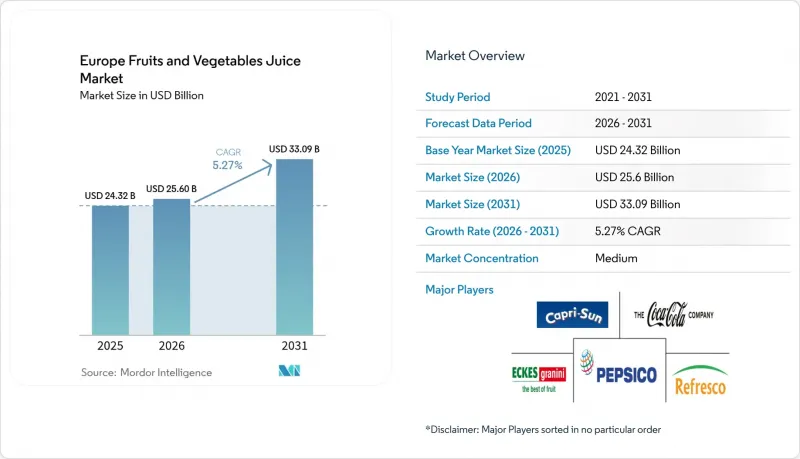
This report is Segmented by Category (Fruit Juice and Vegetable Juice), Type (100% Juice, Nectar, and More), Nature (Conventional, Organic), Packaging Type (Tetra Pak Cartons, Cans, and More), Distribution Channel (Supermarkets/Hypermarkets, Online Retail, and More), and Geography (United Kingdom, Germany, France, Italy, and More). The Market Forecasts are Provided in Terms of Value (USD).
Europe Fruits And Vegetables Juice Market Trends and Insights
Product Innovation and Flavor Diversification
European juice manufacturers are using advanced processing technologies, including high-pressure processing, ultrafiltration, cold-press extraction, and aseptic packaging systems, to develop products that address specific consumer health needs beyond traditional vitamin content. They are incorporating functional ingredients such as probiotics for digestive health and immune support, adaptogens like ashwagandha and rhodiola for stress management and mental clarity, and plant-based proteins derived from pea, hemp, and rice for muscle recovery and satiety to transform juice from a refreshment into a wellness product. Moreover, 100% fruit and vegetable juices are proven to benefit cardiometabolic health by reducing blood pressure, managing cholesterol levels, and improving circulation, enhance cognitive function through flavonoid compounds and omega-3 fatty acids, and optimize exercise performance by providing natural electrolytes, antioxidants, and essential minerals, providing scientific support for functional juice development. This research-based approach allows manufacturers to make validated health claims while distinguishing their products in the market. The growing focus on personalized nutrition is increasing demand for specialized formulations for different consumer groups, including immunity-boosting blends with elderberry, echinacea, zinc, and vitamin C for children and antioxidant-rich combinations with pomegranate, blueberry, acai, and green tea extracts for older consumers.
Growing Demand for Functional Beverages
The functional beverage market in Europe is growing as consumers seek drinks that offer specific health benefits beyond hydration. The United Kingdom and EU markets show increasing demand for beverages that combine health functionality with enjoyable taste. This shift reflects a broader consumer movement toward products that support overall wellness while maintaining convenience and palatability. The trend aligns with increasing health consciousness and preventive healthcare approaches among European consumers, particularly in urban areas where lifestyle-related health concerns are prevalent. Millennials and Gen Z consumers are driving this trend, showing a preference for premium-priced drinks that support mental wellness, digestive health, and immunity. These demographic groups prioritize products with scientifically backed ingredients and transparent labeling, often researching product benefits before purchase and sharing recommendations through social media platforms. European beverage manufacturers have adapted by integrating functional ingredients such as CBD, turmeric, and probiotics into their juice products, developing beverages that combine nutritional and therapeutic properties. The incorporation of these ingredients represents a strategic response to consumer demand for products that bridge the gap between conventional beverages and health supplements. This evolution in the beverage industry demonstrates the growing intersection between daily consumption habits and proactive health management, reflecting a fundamental shift in how Europeans approach their daily drink choices and overall wellness routines.
High Sugar Content in Juice Products
High sugar content in commercial juice products is limiting market growth as European consumers increasingly examine nutritional labels and seek lower-sugar alternatives. The trend is particularly evident in markets like Germany, France, and the UK, where health awareness is driving purchasing decisions. The European Union's revised Breakfast Directive (May 2024) allows manufacturers to produce "reduced-sugar fruit juice" products with 30% less natural sugar while preserving fruit content. This directive specifically addresses consumer demands for healthier options while maintaining product authenticity. Major manufacturers like Innocent Drinks and Tropicana have invested significantly in research and development to develop sugar-reduction technologies. However, manufacturers face technical difficulties in reducing sugar levels without affecting taste and nutritional value, including challenges in enzyme processing and maintaining shelf stability. The cost of sugar-reduction processes has increased production expenses by 15-20% on average. While consumer education initiatives emphasize the difference between natural and added sugars through retail partnerships and digital campaigns, public health campaigns' broad categorization of all sugar types creates market uncertainty. New regulations enable manufacturers to label products with "only naturally occurring sugars," though consumer skepticism remains prevalent across European markets, particularly among millennials and health-focused demographic segments, with consumers aged 25-34 expressing concerns about sugar content in fruit juices.
Other drivers and restraints analyzed in the detailed report include:
- Demand for Sustainable Juices
- Growing Urbanization and On-the-Go Consumption
- Increasing Popularity of Low/No Sugar RTD Beverages
For complete list of drivers and restraints, kindly check the Table Of Contents.
Segment Analysis
Fruit juices led the European Fruits and Vegetable Juice Market with an 80.67% share in 2025, whereas vegetable juices demonstrated robust growth potential with a projected CAGR of 5.44% through 2031. Juices based on carrots, beets, and tomatoes gain market traction due to research from Cambridge Core establishing connections between nitrates and carotenoids with improved endurance and blood pressure regulation. Companies position these products as savory alternatives to traditional sweet beverages, addressing sugar concerns while targeting meal-replacement opportunities. In German e-commerce platforms, premium glass-packaged cold-pressed beetroot mint varieties command a price premium compared to conventional orange juice. Manufacturers combine beet with berry and carrot with mango to create balanced flavor profiles that appeal to younger demographics. The higher fiber content in these beverages supports satiety and aligns with consumer weight management goals.
The market expansion includes vegetable-based recipes in smoothie kits and High-Pressure Processing (HPP) chilled products available through the United Kingdom's click-and-collect services. Health-focused cafes incorporate ready-to-drink beet and kale bases in immunity-boosting beverages. Manufacturers enhance their production capabilities with advanced extraction systems that reduce oxidation and improve color retention, creating distinct product differentiation. In Spain, agricultural cooperatives establish fixed-price contracts for beet supply, adapting to shifts from sugar beet to table beet cultivation following European Union quota modifications. These operational improvements help maintain profit margins despite increasing market competition.
The market for 100% juice accounted for a 48.82% share in 2025, maintaining market leadership due to consumer perception of purity and natural ingredients. The nectar segment is growing at a 4.79% CAGR, as manufacturers adjust fruit concentration between 25% and 99% to optimize sugar content, pricing, and nutritional value. Apple-mango nectars with vitamin C fortification appeal to parents seeking school-compliant beverage options for their children's daily nutrition requirements. The controlled dilution process enables manufacturers to incorporate calcium and botanical extracts while maintaining balanced flavors and ensuring optimal taste profiles.
Not-from-concentrate (NFC) products continue to expand in the premium segment, driven by increasing consumer demand for minimally processed beverages. Consumer education initiatives emphasize NFC's reduced thermal processing time, which preserves essential aromatic compounds and delivers superior fresh taste characteristics. This positioning supports price premiums up to 30% higher than reconstituted 100% juice products, aligning with European consumer preferences for authentic, artisanal products and traditional production methods.
Complete Report Scope:
- By Category
- Fruit Juice
- Vegetable Juice
- By Type
- 100 % Juice
- Nectar (25-99 % Juice)
- Juice Drinks (<25 % Juice)
- By Nature
- Conventional
- Organic
- By Packaging Type
- Tetra Pak Cartons
- PET Bottles
- Glass Bottles
- Cans
- Pouches and Others
- By Distribution Channel
- Supermarkets/Hypermarkets
- Convenience/Grocery Stores
- Online Retail
- Other Distribution Channels
- By Geography
- United Kingdom
- Germany
- France
- Italy
- Spain
- Netherlands
- Rest of Europe
List of Companies Covered in this Report:
- PepsiCo Inc.
- The Coca-Cola Company
- Eckes-Granini Group GmbH
- Capri Sun Group Holding AG
- Refresco Group
- Rauch Fruchtsafte GmbH
- Britvic Plc
- Erbak-Uludag Mesrubatlari AS
- Del Monte Foods Inc.
- Gerber Products Company
- Ocean Spray Cranberries Inc.
- Riedel BV
- Hain Celestial Group
- Nestle SA
- SunOpta Inc.
- David Berryman Ltd.
- Cambridge Juice Company
- Namar Limited(London Fruit Juice Company)
- Austria Juice
- Kiril Mischeff
Additional Benefits:
- The market estimate (ME) sheet in Excel format
- 3 months of analyst support
TABLE OF CONTENTS
1 INTRODUCTION
- 1.1 Study Assumptions and Market Definition
- 1.2 Scope of the Study
2 RESEARCH METHODOLOGY
3 EXECUTIVE SUMMARY
4 MARKET LANDSCAPE
- 4.1 Market Overview
- 4.2 Market Drivers
- 4.2.1 Product innovation and flavor diversification
- 4.2.2 Growing demand for functional beverages
- 4.2.3 Demand for sustainable juices
- 4.2.4 Growing urbanization and on-the-go consumption
- 4.2.5 Growing demand for natural juices and clean label trends
- 4.2.6 Expansion of retail and e-commerce channels
- 4.3 Market Restraints
- 4.3.1 High sugar content in juice products
- 4.3.2 Increasing popularity of low/no sugar RTDbeverages
- 4.3.3 High sugar content in commercial juices
- 4.3.4 Rising preference for whole fruits and vegetables
- 4.4 Consumer Behavior Analysis
- 4.5 Regulatory Outlook
- 4.6 Porter's Five Forces Analysis
- 4.6.1 Threat of New Entrants
- 4.6.2 Bargaining Power of Buyers
- 4.6.3 Bargaining Power of Suppliers
- 4.6.4 Threat of Substitutes
- 4.6.5 Intensity of Competitive Rivalry
5 MARKET SIZE AND GROWTH FORECASTS (VALUE)
- 5.1 By Category
- 5.1.1 Fruit Juice
- 5.1.2 Vegetable Juice
- 5.2 By Type
- 5.2.1 100 % Juice
- 5.2.2 Nectar (25-99 % Juice)
- 5.2.3 Juice Drinks (<25 % Juice)
- 5.3 By Nature
- 5.3.1 Conventional
- 5.3.2 Organic
- 5.4 By Packaging Type
- 5.4.1 Tetra Pak Cartons
- 5.4.2 PET Bottles
- 5.4.3 Glass Bottles
- 5.4.4 Cans
- 5.4.5 Pouches and Others
- 5.5 By Distribution Channel
- 5.5.1 Supermarkets/Hypermarkets
- 5.5.2 Convenience/Grocery Stores
- 5.5.3 Online Retail
- 5.5.4 Other Distribution Channels
- 5.6 By Geography
- 5.6.1 United Kingdom
- 5.6.2 Germany
- 5.6.3 France
- 5.6.4 Italy
- 5.6.5 Spain
- 5.6.6 Netherlands
- 5.6.7 Rest of Europe
6 COMPETITIVE LANDSCAPE
- 6.1 Market Concentration
- 6.2 Strategic Moves
- 6.3 Market Share Analysis
- 6.4 Company Profiles (includes Global Level Overview, Market Level Overview, Core Segments, Financials (if available), Strategic Information, Market Rank/Share for key companies, Products and Services, and Recent Developments)
- 6.4.1 PepsiCo Inc.
- 6.4.2 The Coca-Cola Company
- 6.4.3 Eckes-Granini Group GmbH
- 6.4.4 Capri Sun Group Holding AG
- 6.4.5 Refresco Group
- 6.4.6 Rauch Fruchtsafte GmbH
- 6.4.7 Britvic Plc
- 6.4.8 Erbak-Uludag Mesrubatlari AS
- 6.4.9 Del Monte Foods Inc.
- 6.4.10 Gerber Products Company
- 6.4.11 Ocean Spray Cranberries Inc.
- 6.4.12 Riedel BV
- 6.4.13 Hain Celestial Group
- 6.4.14 Nestle SA
- 6.4.15 SunOpta Inc.
- 6.4.16 David Berryman Ltd.
- 6.4.17 Cambridge Juice Company
- 6.4.18 Namar Limited(London Fruit Juice Company)
- 6.4.19 Austria Juice
- 6.4.20 Kiril Mischeff
7 MARKET OPPORTUNITIES AND FUTURE OUTLOOK

