PUBLISHER: Mordor Intelligence | PRODUCT CODE: 2115114

PUBLISHER: Mordor Intelligence | PRODUCT CODE: 2115114
GCC Juice - Market Share Analysis, Industry Trends & Statistics, Growth Forecasts (2026 - 2031)
According to Mordor Intelligence, the gulf cooperation council (GCC) juice market size in 2026 is estimated at USD 6.5 billion, growing from 2025 value of USD 6.13 billion with 2031 projections showing USD 8.69 billion, growing at 5.98% CAGR over 2026-2031.
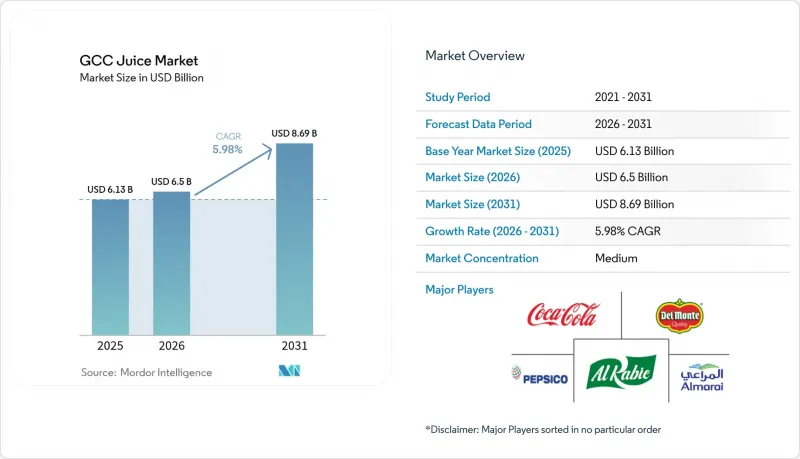
This report is Segmented by Category (Fruit Juice, Vegetable Juice, and More), Type (100% Juice, Juice Drinks, and More), Packaging Type (Tetra Pak Cartons, PET Bottles, Cans, and More), Distribution Channel (On-Trade and Off-Trade), and Geography (United Arab Emirates, Saudi Arabia, Qatar, Kuwait, and Oman). The Market Forecasts are Provided in Terms of Value (USD) and Volume (Tonnes).
GCC Juice Market Trends and Insights
Increasing popularity of fortified and functional juices
Urban consumers in cities like Dubai, Abu Dhabi, and Riyadh are increasingly viewing juice as more than just a refreshing drink; it is now seen as a functional wellness product. According to the United Nations Development Programme (UNDP), the urban population in the Gulf Cooperation Council (GCC) region is steadily growing and is expected to reach 54.6 million by 2030 . This growing urbanization is driving demand for healthier and more functional beverages. In 2024, there was a noticeable rise in interest in fortified juices enriched with nutrients like vitamin C, zinc, probiotics, and omega-3s, which performed exceptionally well across the region. For instance, Almarai introduced its "Super Juice" range, which includes 100% not-from-concentrate pomegranate and berry juices. These juices are processed using ultra-heat treatment to retain nutrients and are packaged in premium, shelf-stable containers. The company also reported significant growth in its "Better for You" product portfolio during the year.
Tourism and HoReCa sector growth
The tourism and hospitality sector in the Gulf Cooperation Council (GCC) is growing rapidly, creating new opportunities for juice products, especially in the United Arab Emirates and Qatar, where significant investments are being made in tourism infrastructure. For example, Dubai welcomed 8.68 million overnight visitors between January and May 2025, marking a 7% increase compared to the same period in 2024, according to the Dubai Department of Economy and Tourism . The Dubai Gastronomy Industry Report, published in April 2025, highlighted that nearly 1,200 new restaurant licenses were issued in the city, showcasing the sector's remarkable growth . This expansion is driving demand for high-quality juice products that cater to the hospitality industry's focus on premium experiences. Juice manufacturers are responding by creating specialized products and packaging formats designed for food service needs. For example, Barakat Quality Plus in the United Arab Emirates offers freshly squeezed juices in 2-liter and 5-liter foodservice packs specifically tailored for hotels, restaurants, and catering outlets.
High sugar taxes and regulatory challenges
The introduction of high excise taxes on sugar-sweetened beverages in Gulf Cooperation Council (GCC) countries has created significant challenges for juice manufacturers. Both Saudi Arabia and the United Arab Emirates have implemented a 50% excise tax on drinks with added sugars, which includes many juice products. This tax has directly increased retail prices, leading to changes in consumer buying habits. For instance, in Saudi Arabia, soft drink consumption dropped by 19% after the tax was introduced, as reported by a study conducted by Jallouna and Qurban. To adapt, some companies have focused on developing juices with reduced sugar or no added sugar, leveraging their research and development capabilities. However, smaller manufacturers or those with limited resources are struggling with the high costs and complexities of reformulating their products. The World Health Organization (WHO) has highlighted that these tax rates are among the highest in the world, making the Gulf Cooperation Council (GCC) a particularly challenging region for juice producers.
Other drivers and restraints analyzed in the detailed report include:
- Rising preference for convenient, ready-to-drink (RTD) formats
- Health and wellness trends
- Increasing prevalence of overweight and obesity among children and adults
For complete list of drivers and restraints, kindly check the Table Of Contents.
Segment Analysis
In 2025, the Gulf Cooperation Council (GCC) juice market saw fruit juice dominate, claiming a substantial 77.62% of total revenue. This stronghold can be attributed to consumers' familiarity with the product, a diverse range of flavors, and its prominent presence in both traditional and modern retail formats. Mainstream retailers are actively promoting popular flavors, notably mango and orange, often through multipack deals aimed at family consumption. Leading brands, including Al Rabie and Del Monte, boast extensive portfolios tailored to both value-conscious and brand-loyal consumers. The category's robustness is further enhanced by its adaptability to ambient and long-life packaging formats, which not only ensure cost-efficient storage but also facilitate broad regional distribution.
While vegetable juice currently occupies a smaller niche, it's poised for rapid growth, outpacing its fruit counterpart with a projected CAGR of 7.31%. This momentum is driven by a burgeoning demand for low-sugar and nutrient-rich options, particularly among health-conscious consumers. Responding to this trend, companies like Almarai are introducing blended products, such as beet-carrot juice, prominently showcased in premium outlets and wellness sections. These blends, perceived for their functional benefits like enhanced digestion and antioxidant properties, command a premium price. As retailers allocate more refrigerated shelf space, suppliers who effectively highlight the nutritional advantages and vitamin retention of their vegetable juices stand to gain significantly in this expanding market.
In 2025, the 100% juice category captured 51.55% of the Gulf Cooperation Council (GCC) juice market share, bolstered by its strong reputation as a natural and healthy choice. As consumers increasingly opt for juices devoid of added sugars and artificial ingredients, this segment has surged in popularity across both mainstream and premium retail channels. For example, Almarai's 100% juice range boasts robust sales in supermarkets throughout Saudi Arabia and the United Arab Emirates, underscoring the trust consumers place in established regional brands. This trend underscores a wider movement towards clean-label, minimally processed beverages, resonating with today's wellness-oriented consumption habits.
Meanwhile, the nectar segment is rapidly gaining traction within the GCC juice market, projected to achieve a strong CAGR of 7.52% starting in 2026. This growth is primarily driven by increasing consumer health awareness and continuous product innovation. Key players, such as Al Rawabi, are introducing cocktail nectar blends featuring tropical flavors like pineapple, mango, and orange, which cater to urban consumers seeking fruit-based refreshment. With its moderate fruit content, nectar is strategically positioned between juice drinks and pure juice, offering a flavorful and convenient option for daily consumption. The demand is particularly robust for premium, organic, and blended nectar formats, distributed through established supermarket chains and expanding online retail platforms.
Complete Report Scope:
- By Category
- Fruit Juice
- Vegetable Juice
- Fruit and Vegetable Blends
- By Type
- 100% Juice
- Juice Drinks (25-99% juice content)
- Nectar
- By Packaging Type
- Tetra Pak Cartons
- PET Bottles
- Glass Bottles
- Cans
- Others
- By Distribution Channel
- On-Trade
- Off-Trade
- Supermarkets/Hypermarkets
- Convenience/Grocery Stores
- Online Retailers
- Other Off-Trade Channel
- By Geography
- Saudi Arabia
- United Arab Emirates
- Qatar
- Kuwait
- Oman
List of Companies Covered in this Report:
- Almarai Company
- Al Rabie Saudi Foods Co.
- Del Monte Pacific Limited
- The Coca-Cola Company
- The Berry Company, LLC
- National Agricultural Development Co.
- National Food Products Co.
- PepsiCo Inc.
- Barakat Group
- Masafi Co. LLC
- Al Ain National for Juice
- Aujan Coca-Cola Beverages Company
- Co-Ro
- Unikai Foods PJSC
- Alokozay Group of Companies (AGC)
- Alesayi Beverages Co. Ltd.
- Juhayna Food Industries
- Union Beverages Factory
- Arrow Juice Factory (AJF)
- Al Rawabi Dairy Company
Additional Benefits:
- The market estimate (ME) sheet in Excel format
- 3 months of analyst support
TABLE OF CONTENTS
1 INTRODUCTION
- 1.1 Study Assumptions and Market Definition
- 1.2 Scope of the Study
2 RESEARCH METHODOLOGY
3 EXECUTIVE SUMMARY
4 MARKET LANDSCAPE
- 4.1 Market Overview
- 4.2 Market Drivers
- 4.2.1 Premiumization and Demand for Functional Juices
- 4.2.2 Increasing Popularity of Fortified and Functional Juices
- 4.2.3 Growing Demand for Natural and Organic Juices
- 4.2.4 Rising preference for Convenient, Ready-to-drink (RTD) formats
- 4.2.5 Tourism and HORECA Sector Growth
- 4.2.6 Health and Wellness Trends
- 4.3 Market Restraints
- 4.3.1 High Sugar Taxes and Regulatory Challenges
- 4.3.2 Increasing Prevalence of Overweight and Obesity Among Children and Adults
- 4.3.3 Short Shelf Life of Fresh and Cold-Pressed Juices
- 4.3.4 Packaging Waste and Environmental Concerns
- 4.4 Value/Supply-Chain Analysis
- 4.5 Regulatory Outlook
- 4.6 Technological Outlook
- 4.7 Porter's Five Forces Analysis
- 4.7.1 Threat of New Entrants
- 4.7.2 Bargaining Power of Buyers/Consumers
- 4.7.3 Bargaining Power of Suppliers
- 4.7.4 Threat of Substitute Products
- 4.7.5 Intensity of Competitive Rivalry
5 MARKET SIZE AND GROWTH FORECASTS (VALUE AND VOLUME)
- 5.1 By Category
- 5.1.1 Fruit Juice
- 5.1.2 Vegetable Juice
- 5.1.3 Fruit and Vegetable Blends
- 5.2 By Type
- 5.2.1 100% Juice
- 5.2.2 Juice Drinks (25-99% juice content)
- 5.2.3 Nectar
- 5.3 By Packaging Type
- 5.3.1 Tetra Pak Cartons
- 5.3.2 PET Bottles
- 5.3.3 Glass Bottles
- 5.3.4 Cans
- 5.3.5 Others
- 5.4 By Distribution Channel
- 5.4.1 On-Trade
- 5.4.2 Off-Trade
- 5.4.2.1 Supermarkets/Hypermarkets
- 5.4.2.2 Convenience/Grocery Stores
- 5.4.2.3 Online Retailers
- 5.4.2.4 Other Off-Trade Channel
- 5.5 By Geography
- 5.5.1 Saudi Arabia
- 5.5.2 United Arab Emirates
- 5.5.3 Qatar
- 5.5.4 Kuwait
- 5.5.5 Oman
6 COMPETITIVE LANDSCAPE
- 6.1 Market Concentration
- 6.2 Strategic Moves
- 6.3 Market Share Analysis
- 6.4 Company Profiles (includes Global-level Overview, Market-level Overview, Core Segments, Financials, Strategic Information, Market Rank/Share, Products and Services, Recent Developments)
- 6.4.1 Almarai Company
- 6.4.2 Al Rabie Saudi Foods Co.
- 6.4.3 Del Monte Pacific Limited
- 6.4.4 The Coca-Cola Company
- 6.4.5 The Berry Company, LLC
- 6.4.6 National Agricultural Development Co.
- 6.4.7 National Food Products Co.
- 6.4.8 PepsiCo Inc.
- 6.4.9 Barakat Group
- 6.4.10 Masafi Co. LLC
- 6.4.11 Al Ain National for Juice
- 6.4.12 Aujan Coca-Cola Beverages Company
- 6.4.13 Co-Ro
- 6.4.14 Unikai Foods PJSC
- 6.4.15 Alokozay Group of Companies (AGC)
- 6.4.16 Alesayi Beverages Co. Ltd.
- 6.4.17 Juhayna Food Industries
- 6.4.18 Union Beverages Factory
- 6.4.19 Arrow Juice Factory (AJF)
- 6.4.20 Al Rawabi Dairy Company
7 MARKET OPPORTUNITIES AND FUTURE OUTLOOK

