PUBLISHER: Mordor Intelligence | PRODUCT CODE: 2097355

PUBLISHER: Mordor Intelligence | PRODUCT CODE: 2097355
Middle East and Africa Fruits and Vegetables Juice - Market Share Analysis, Industry Trends & Statistics, Growth Forecasts (2026 - 2031)
According to Mordor Intelligence, the Middle East and Africa fruit and vegetable juice market size was USD 8.03 billion in 2025 and is forecast to reach USD 11.47 billion by 2031 at a CAGR of 6.16% from 2026 to 2031.
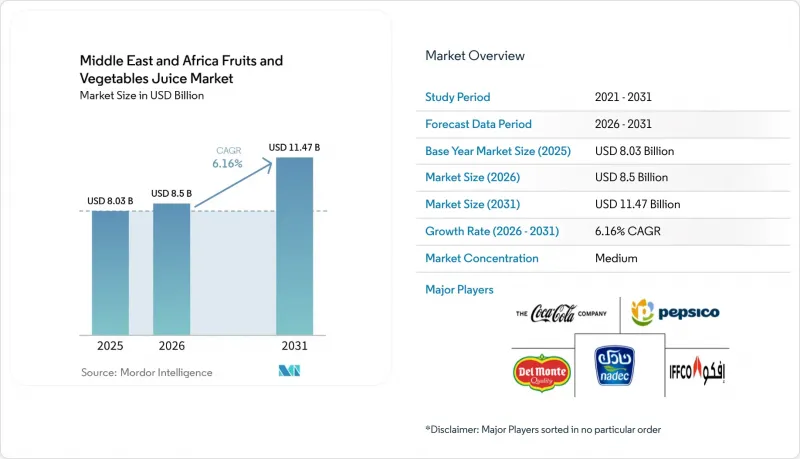
This report is Segmented by Category (Fruit, Vegetable), Product Types (100% Juice, and More), Nature (Conventional, Organic), Packaging Material (Tetra Pak, PET, Glass, and More), Distribution Channel (Supermarkets/Hypermarkets, and More), and Geography (UAE, South Africa, and More). The Market Forecasts are Provided in Terms of Value (USD) and Volume (Liters).
Middle East and Africa Fruits and Vegetables Juice Market Trends and Insights
Growing Influence of Fitness and Wellness Lifestyles
Health and wellness priorities are changing beverage buying patterns across the GCC, where public programs tied to quality of life, fitness, and nutrition are shaping consumer expectations for packaged drinks. In the Middle East and Africa fruit and vegetable juice market, juice is increasingly judged on perceived functional value rather than only on refreshment, which is supporting demand for cleaner ingredient lists and added nutrition claims. In the Middle East and Africa (MEA), intensified health awareness campaigns are driving a significant transition from carbonated beverages to pure fruit juices. According to the Saudi Food and Drug Authority, Saudi Arabia's government initiatives targeting 85% localization in food production by 2030 emphasize nutritional quality standards, favoring 100% juice products over artificially sweetened alternatives. This shift is particularly prominent among urban millennials and Generation Z, who are willing to pay a premium for perceived health benefits. The Middle East and Africa fruit and vegetable juice market is therefore seeing stronger support for products that combine familiar taste profiles with clearer nutrition messaging and better label credibility
Demand for Convenient On-the-Go Beverages Grows
Urban lifestyles across the UAE, Saudi Arabia, Nigeria, and South Africa continue to favor portable juice formats that suit commuting, workplace, school, and quick-purchase occasions. In the Gulf, this demand is showing up in premium single-serve packs sold through convenience-led locations, while African cities are supporting more affordable formats that move through dense neighborhood retail networks. Extreme temperatures and water scarcity in the MENA region are significantly influencing beverage consumption patterns, with on-the-go options becoming increasingly popular. Juice products, valued for their hydration and nutritional properties, are gaining prominence due to convenient packaging. In 2023, the Federal Competitiveness and Statistics Centre recorded an average maximum temperature of 34.4 degrees Celsius in the United Arab Emirates . To address climate-induced nutritional gaps, consumers are increasingly opting for functional juice formulations fortified with electrolytes and vitamins. The Middle East and Africa fruit and vegetable juice market is also benefiting because the same investment in last-mile distribution that helps e-commerce is improving replenishment speed for broader retail channels. This makes portable ambient products easier to scale than cold chain-dependent concepts in many parts of the region.
High Sugar Content Concerns Reduce Consumption
Sugar-related regulation is becoming a more direct headwind for nectar and juice drink producers across the Gulf, especially after the shift to tiered excise structures in 2026. The Middle East and Africa fruit and vegetable juice market is feeling this pressure most clearly in products that sit between pure juice and sweeter value formats, because those recipes face the greatest reformulation burden. Producers now have to manage sugar levels, labeling, ingredient substitution, and portfolio architecture at the same time. This raises compliance costs even before any demand effect is measured at the shelf. The same regulatory direction is spreading beyond the GCC, which means sugar management will remain a lasting operating issue rather than a short policy event
Other drivers and restraints analyzed in the detailed report include:
- Product Innovation Attracts Health-Conscious Consumers
- Growing Organic Juice Consumption Across Developed Markets
- Rising Raw Material Costs Affect Profitability
For complete list of drivers and restraints, kindly check the Table Of Contents.
Segment Analysis
100% juice held 55.67% of the Middle East and Africa fruit and vegetable juice market share in 2025, which reflected strong demand for cleaner ingredient positioning and minimally processed formats in premium retail channels. The region's high fruit production further supports this market. For example, Africa's fruit production reached 137.15 million metric tons in 2023, according to the Food and Agriculture Organization . Juice drinks remained important in mass market and food service settings where affordability still shaped purchase behavior. Nectar is projected to expand at a 6.28% CAGR through 2031, which makes it the fastest-growing product type despite its heavier exposure to new sugar-focused rules. Its growth is tied to the role it plays as an affordable premium option in African markets, where 100% juice has a narrower audience because of price.
That creates a mixed outlook for Nectar because demand remains real, but compliance and sugar reduction work are becoming harder to manage across country markets. The Middle East and Africa fruit juice industry is therefore pushing more strongly into hybrid products that can deliver health cues without moving too far from familiar juice taste profiles. Standards for fruit content declarations and labeling are also reinforcing consumer trust in the 100% juice segment. Producers with high pressure processing capability are better placed to grow premium 100% juice because they can preserve clean label positioning while still supporting commercial shelf life.
Fruit juice accounted for 76.11% of category revenue in 2025, which kept it far ahead of vegetable juice across the regional shelf. Citrus, mango, and other tropical flavors continued to anchor this leadership because they fit established taste preferences across many MEA countries. Vegetable juice is forecast to grow at a 5.85% CAGR through 2031, which is faster than the category average even though it starts from a smaller base. This growth is clustering in premium retail in the UAE and South Africa, where cold-pressed greens and mixed vegetable blends are gaining more shelf space.
The real movement in this segment is coming from blended products that soften the taste barrier of vegetables by keeping fruit at the center of the flavor profile. That helps brands introduce added nutrition without forcing a sharp shift in consumer habits. The Middle East and Africa fruit juice industry also faces a cost risk here because fruit-led portfolios remain exposed to volatile citrus and tropical concentrate pricing. Producers with stronger sourcing contracts or better access to the domestic fruit supply are in a better position to defend margins while still supporting category innovation.
Complete Report Scope:
- Product Type
- 100% Juice
- Nectar (25-99% Juice)
- Juice Drinks (Below 25% Juice)
- Category
- Fruit Juice
- Vegetable Juice
- Nature
- Conventional
- Organic
- Packaging Material
- Tetra Pak Cartons
- PET Bottles
- Glass Bottles
- Cans
- Pouches and Others
- Distribution Channel
- Supermarkets/Hypermarkets
- Convenience/Grocery Stores
- Online Retail Stores
- Others
- Geography
- United Arab Emirates
- South Africa
- Saudi Arabia
- Nigeria
- Egypt
- Morocco
- Turkey
- Rest of Middle East and Africa
List of Companies Covered in this Report:
- Almarai Company
- Al Rabie Saudi Foods Co.
- Del Monte Foods Inc.
- The Coca-Cola Company
- PepsiCo Inc.
- Aujan Coca-Cola Beverages
- National Agricultural Development Company (NADEC)
- Juhayna Food Industries
- Al Ain National for Juice
- Masafi Co. LLC
- Gulf Union Foods Co.
- Al Safi Farm
- Unikai Foods PJSC
- Barakat Group
- National Food Products Co.
- Alesayi Beverages Co. Ltd.
- Co-Ro A/S
- Arrow Juice Factory (AJF)
- Al Rawabi Dairy Company
- PRAN Foods Ltd.
Additional Benefits:
- The market estimate (ME) sheet in Excel format
- 3 months of analyst support
TABLE OF CONTENTS
1 INTRODUCTION
- 1.1 Study Assumptions and Market Definition
- 1.2 Scope of the Study
2 RESEARCH METHODOLOGY
3 EXECUTIVE SUMMARY
4 MARKET LANDSCAPE
- 4.1 Market Overview
- 4.2 Market Drivers
- 4.2.1 Growing influence of fitness and wellness lifestyles
- 4.2.2 Demand for convenient on-the-go beverages grows
- 4.2.3 Product innovation attracts health-conscious consumers
- 4.2.4 Growing organic juice consumption across developed markets
- 4.2.5 Strong advertising investments by leading juice manufacturers
- 4.2.6 Increasing investment in juice processing technologies
- 4.3 Market Restraints
- 4.3.1 High sugar content concerns reduce consumption
- 4.3.2 Short shelf life challenges distribution efficiency
- 4.3.3 Rising raw material costs affect profitability
- 4.3.4 Seasonal fruit supply fluctuations impact production
- 4.4 Supply Chain Analysis
- 4.5 Regulatory Landscape
- 4.6 Porter's Five Forces Analysis
- 4.6.1 Bargaining Power of Suppliers
- 4.6.2 Bargaining Power of Buyers
- 4.6.3 Threat of New Entrants
- 4.6.4 Threat of Substitutes
- 4.6.5 Degree of Competition
5 MARKET SIZE AND GROWTH FORECASTS (VALUE and VOLUME)
- 5.1 Product Type
- 5.1.1 100% Juice
- 5.1.2 Nectar (25-99% Juice)
- 5.1.3 Juice Drinks (Below 25% Juice)
- 5.2 Category
- 5.2.1 Fruit Juice
- 5.2.2 Vegetable Juice
- 5.3 Nature
- 5.3.1 Conventional
- 5.3.2 Organic
- 5.4 Packaging Material
- 5.4.1 Tetra Pak Cartons
- 5.4.2 PET Bottles
- 5.4.3 Glass Bottles
- 5.4.4 Cans
- 5.4.5 Pouches and Others
- 5.5 Distribution Channel
- 5.5.1 Supermarkets/Hypermarkets
- 5.5.2 Convenience/Grocery Stores
- 5.5.3 Online Retail Stores
- 5.5.4 Others
- 5.6 Geography
- 5.6.1 United Arab Emirates
- 5.6.2 South Africa
- 5.6.3 Saudi Arabia
- 5.6.4 Nigeria
- 5.6.5 Egypt
- 5.6.6 Morocco
- 5.6.7 Turkey
- 5.6.8 Rest of Middle East and Africa
6 COMPETITIVE LANDSCAPE
- 6.1 Market Concentration
- 6.2 Strategic Moves
- 6.3 Market Ranking Analysis
- 6.4 Company Profiles (Includes Global-level Overview, Market-level Overview, Core Segments, Financials, Strategic Info, Market Rank/Share, Products and Services, Recent Developments)
- 6.4.1 Almarai Company
- 6.4.2 Al Rabie Saudi Foods Co.
- 6.4.3 Del Monte Foods Inc.
- 6.4.4 The Coca-Cola Company
- 6.4.5 PepsiCo Inc.
- 6.4.6 Aujan Coca-Cola Beverages
- 6.4.7 National Agricultural Development Company (NADEC)
- 6.4.8 Juhayna Food Industries
- 6.4.9 Al Ain National for Juice
- 6.4.10 Masafi Co. LLC
- 6.4.11 Gulf Union Foods Co.
- 6.4.12 Al Safi Farm
- 6.4.13 Unikai Foods PJSC
- 6.4.14 Barakat Group
- 6.4.15 National Food Products Co.
- 6.4.16 Alesayi Beverages Co. Ltd.
- 6.4.17 Co-Ro A/S
- 6.4.18 Arrow Juice Factory (AJF)
- 6.4.19 Al Rawabi Dairy Company
- 6.4.20 PRAN Foods Ltd.
7 MARKET OPPORTUNITIES AND FUTURE OUTLOOK

