PUBLISHER: Mordor Intelligence | PRODUCT CODE: 2115802

PUBLISHER: Mordor Intelligence | PRODUCT CODE: 2115802
North America Canned Seafood - Market Share Analysis, Industry Trends & Statistics, Growth Forecasts (2026 - 2031)
According to Mordor Intelligence, North America canned seafood market size in 2026 is estimated at USD 9.43 billion, growing from 2025 value of USD 8.91 billion with 2031 projections showing USD 12.53 billion, growing at 5.85% CAGR over 2026-2031.
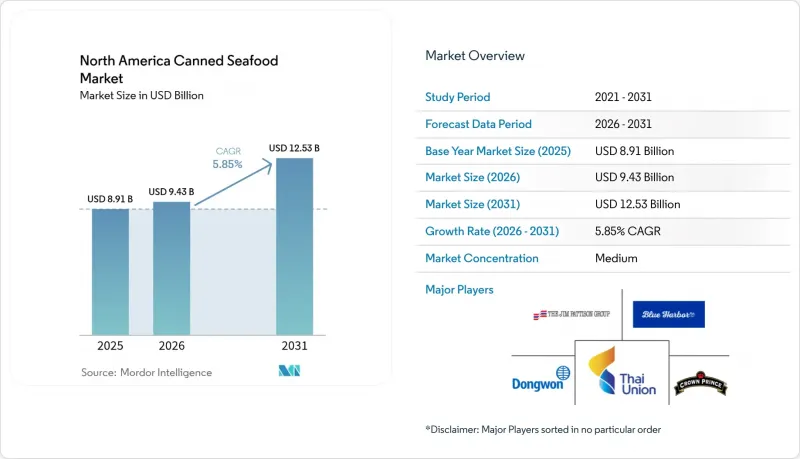
This report is Segmented by Species/Type (Canned Fish, Canned Shrimp, and More), Packaging Material (Steel Cans, Aluminum Cans, and More), Product Form (Whole and Chunks/Pieces), Distribution Channel (Off-Trade, and On-Trade), and Geography (United States, Canada, Mexico, and Rest of North America). The Market Forecasts are Provided in Terms of Value (USD).
North America Canned Seafood Market Trends and Insights
Enhanced Convenience Features and Preservation Benefits
Market expansion is being significantly influenced by the increasing consumer demand for ready-to-eat protein sources that require minimal preparation. The Food Industry Association's Power of Seafood 2024 report indicates that 59% of seafood consumption now occurs at home, compared to 41% at restaurants. This shift highlights a growing preference for cost-effective meal solutions, driven by inflationary pressures and changing consumer behavior. Technological advancements in preservation methods have further supported this trend by enabling seafood to maintain an extended shelf life without refrigeration. These innovations have addressed critical supply chain vulnerabilities that were exposed during recent disruptions, ensuring greater product availability and reliability. Manufacturers are strategically utilizing these advancements to diversify their market reach, targeting not only traditional meal occasions but also emerging segments such as emergency preparedness and outdoor recreation. In densely populated urban markets, where time constraints heavily influence purchasing decisions, the demand for shelf-stable protein alternatives has become increasingly prominent, further driving market growth.
Increasing Urban Population and Modern Lifestyle Changes Driving Market Growth
The urbanization trend in North America continues to grow, concentrating purchasing power within densely populated trade areas. In these urban settings, smaller household sizes often result in limited freezer space, influencing consumer purchasing behavior. Additionally, the prevalence of dual-income families and extended commuting hours has significantly reduced the time available for meal preparation, driving a stronger preference for convenient protein options. To address concerns about food waste and align with sustainability objectives, manufacturers are increasingly offering packaging designed for single or two-person servings. Among young professionals, canned seafood has gained popularity as a convenient and nutritious choice for lunchboxes and post-work snacks, reflecting a growing connection between health and convenience. Urban-focused retailers are responding to these shifts by enhancing in-store merchandising strategies, including the use of recipe cards and cross-aisle promotions that feature complementary products such as pasta, rice, and salad kits. These evolving consumer preferences and retail strategies provide a strong and sustainable foundation for the North American canned seafood market.
Raw Material Price Volatility affects Market Growth
Commodity price fluctuations continue to exert significant margin pressure on the seafood industry, driven by factors such as seasonal variations, climate-related disruptions, and geopolitical events that impact global fishing operations. NOAA Fisheries reported that the Alaska seafood industry incurred a substantial loss of USD 1.8 billion in 2023, accompanied by a sharp 50% decline in profitability. This highlights the sector's pronounced vulnerability to price volatility. Additionally, North American processors, particularly those with considerable reliance on imported seafood, face compounded challenges due to currency fluctuations when sourcing from international suppliers. The unpredictability of prices further complicates long-term contract negotiations with retail partners, who prioritize stable and predictable cost structures for private label programs. Beyond raw seafood inputs, the effects of price volatility extend to packaging materials, with fluctuations in aluminum and steel prices significantly influencing overall production costs.
Other drivers and restraints analyzed in the detailed report include:
- Growing Demand for Premium Portable Seafood Snacks
- Expanding Consumer Preference for Protein-rich Seafood Convenience Foods in the United States
- Regulatory Compliance Costs for BPA and PFAS Packaging Standards
For complete list of drivers and restraints, kindly check the Table Of Contents.
Segment Analysis
In 2025, canned fish accounted for a significant 68.20% share of the North American canned seafood market, driven by the widespread consumer preference for tuna, salmon, and sardine varieties. This substantial share establishes canned fish as the largest single contributor to the market, underscoring the operational efficiencies achieved in procurement and production processes. The market is witnessing a notable shift toward canned shrimp, which is projected to grow at a robust CAGR of 6.62% through 2031. This growth reflects an increasing consumer inclination toward premium products that offer superior texture and a sense of indulgence.
Canned shrimp products are leveraging global flavor combinations and incorporating resealable plastic lids to enhance convenience and cater to snacking occasions. Additionally, a smaller segment focusing on prawns is exploring gourmet positioning by integrating Caribbean and South Asian spice profiles to appeal to niche markets. Manufacturers are also innovating by introducing mixed-species medleys, such as blends of tuna and octopus, to create unique offerings while optimizing the use of existing canning infrastructure. This strategic diversification of species not only opens new revenue streams but also ensures the core offerings of the North America canned seafood market remain unaffected.
In 2025, steel cans constituted 62.80% of the market volume, supported by an established recycling infrastructure and widespread consumer familiarity. Despite ongoing efforts within the industry to achieve lightweighting objectives, steel cans have retained their characteristic rigidity, making them a preferred choice for packaging. Concurrently, the North American canned seafood market is experiencing a significant shift towards retort pouches, which are anticipated to grow at a compound annual growth rate (CAGR) of 7.05%. Retailers are increasingly adopting these pouches due to their reduced logistics costs, while consumers value their convenience, particularly the easy-open tear notches.
Aluminum cans present a balanced solution by combining high recyclability with effective barrier properties. Companies such as B and G Foods, which has pledged to achieve full recyclability by 2027, are leveraging can-to-can closed-loop recycling narratives to emphasize their commitment to sustainability and circular economy principles. Furthermore, innovative packaging formats, including transparent glass jars designed for premium fillets, are gaining traction. These formats cater to gifting occasions and are also being utilized in pilot programs for reusable packaging solutions. The ongoing evolution in packaging formats is largely driven by regulatory mandates to phase out harmful substances such as PFAS and BPA, prompting increased capital investments across the North American canned seafood sector.
Complete Report Scope:
- By Species/Type
- Canned Fish
- Tuna
- Salmon
- Sardines
- Mackerel
- Other Canned Fish
- Canned Shrimp
- Canned Prawns
- Other Types
- Canned Fish
- By Packaging Material
- Steel Cans
- Aluminum Cans
- Retort Pouches
- Others
- By Product Form
- Whole
- Chunks/Pieces
- By Distribution Channel
- Off-Trade
- Supermarkets/Hypermarkets
- Convenience Stores
- Online Retail
- Specialty Stores
- Other Distribution Channels
- On-Trade (HoReCa)
- Off-Trade
- By Geography
- United States
- Canada
- Mexico
- Rest of North America
List of Companies Covered in this Report:
- Dongwon Enterprise Co., Ltd.
- Thai Union Group PCL
- The Jim Pattison Group
- Blue Harbor Fish Co.
- Crown Prince, Inc.
- Goya Foods, Inc.
- Grace foods
- Grupo PINSA
- Grupo Maritimo Industrial SA de CV
- Season Brand LLC
- American Tuna Inc.
- Trident Seafoods Corp.
- Cento Fine Foods
- Pacific Seafood Group
- Performance Food Group (Bar Harbor Foods)
- Cooke Seafood USA Inc
- Clover Leaf Seafoods Corp.
- Lummi Island Wild
- FCF Co., Ltd.
- Wild Planet Foods, Inc
Additional Benefits:
- The market estimate (ME) sheet in Excel format
- 3 months of analyst support
TABLE OF CONTENTS
1 INTRODUCTION
- 1.1 Study Assumptions and Market Definition
- 1.2 Scope of the Study
2 RESEARCH METHODOLOGY
3 EXECUTIVE SUMMARY
4 MARKET LANDSCAPE
- 4.1 Market Overview
- 4.2 Market Drivers
- 4.2.1 Enhanced convenience features and preservation benefits
- 4.2.2 Increasing urban population and modern lifestyle changes driving market growth
- 4.2.3 Growing demand for premium portable seafood snacks
- 4.2.4 Expanding consumer preference for protein-rich seafood convenience foods in the united states
- 4.2.5 Room temperature storage advantages in regions with underdeveloped cold chain networks
- 4.2.6 Sustainability certifications and product origin transparency influencing consumer purchasing behavior
- 4.3 Market Restraints
- 4.3.1 Raw material price volatility affects market growth
- 4.3.2 Regulatory compliance costs for BPA and PFAS packaging standards
- 4.3.3 Consumer health concerns regarding sodium and preservative content
- 4.3.4 Consumer preference for fresh seafood limits market growth
- 4.4 Value/Supply-Chain Analysis
- 4.5 Regulatory and Technological Outlook
- 4.6 Porter's Five Forces
- 4.6.1 Threat of New Entrants
- 4.6.2 Bargaining Power of Buyers
- 4.6.3 Bargaining Power of Suppliers
- 4.6.4 Threat of Substitutes
- 4.6.5 Competitive Rivalry
5 MARKET SIZE AND GROWTH FORECASTS (VALUE)
- 5.1 By Species/Type
- 5.1.1 Canned Fish
- 5.1.1.1 Tuna
- 5.1.1.2 Salmon
- 5.1.1.3 Sardines
- 5.1.1.4 Mackerel
- 5.1.1.5 Other Canned Fish
- 5.1.2 Canned Shrimp
- 5.1.3 Canned Prawns
- 5.1.4 Other Types
- 5.1.1 Canned Fish
- 5.2 By Packaging Material
- 5.2.1 Steel Cans
- 5.2.2 Aluminum Cans
- 5.2.3 Retort Pouches
- 5.2.4 Others
- 5.3 By Product Form
- 5.3.1 Whole
- 5.3.2 Chunks/Pieces
- 5.4 By Distribution Channel
- 5.4.1 Off-Trade
- 5.4.1.1 Supermarkets/Hypermarkets
- 5.4.1.2 Convenience Stores
- 5.4.1.3 Online Retail
- 5.4.1.4 Specialty Stores
- 5.4.1.5 Other Distribution Channels
- 5.4.2 On-Trade (HoReCa)
- 5.4.1 Off-Trade
- 5.5 By Geography
- 5.5.1 United States
- 5.5.2 Canada
- 5.5.3 Mexico
- 5.5.4 Rest of North America
6 COMPETITIVE LANDSCAPE
- 6.1 Market Concentration
- 6.2 Strategic Moves
- 6.3 Market Share Analysis
- 6.4 Company Profiles (includes Global level Overview, Market level overview, Core Segments, Financials as available, Strategic Information, Market Rank/Share for key companies, Products and Services, and Recent Developments)
- 6.4.1 Dongwon Enterprise Co., Ltd.
- 6.4.2 Thai Union Group PCL
- 6.4.3 The Jim Pattison Group
- 6.4.4 Blue Harbor Fish Co.
- 6.4.5 Crown Prince, Inc.
- 6.4.6 Goya Foods, Inc.
- 6.4.7 Grace foods
- 6.4.8 Grupo PINSA
- 6.4.9 Grupo Maritimo Industrial SA de CV
- 6.4.10 Season Brand LLC
- 6.4.11 American Tuna Inc.
- 6.4.12 Trident Seafoods Corp.
- 6.4.13 Cento Fine Foods
- 6.4.14 Pacific Seafood Group
- 6.4.15 Performance Food Group (Bar Harbor Foods)
- 6.4.16 Cooke Seafood USA Inc
- 6.4.17 Clover Leaf Seafoods Corp.
- 6.4.18 Lummi Island Wild
- 6.4.19 FCF Co., Ltd.
- 6.4.20 Wild Planet Foods, Inc
7 MARKET OPPORTUNITIES AND FUTURE OUTLOOK

