PUBLISHER: Mordor Intelligence | PRODUCT CODE: 2115803

PUBLISHER: Mordor Intelligence | PRODUCT CODE: 2115803
Middle East And Africa Canned Seafood - Market Share Analysis, Industry Trends & Statistics, Growth Forecasts (2026 - 2031)
According to Mordor Intelligence, the Middle East and Africa canned seafood market size is expected to grow from USD 3.20 billion in 2025 to USD 3.40 billion in 2026 and is forecast to reach USD 4.63 billion by 2031 at 6.34% CAGR over 2026-2031.
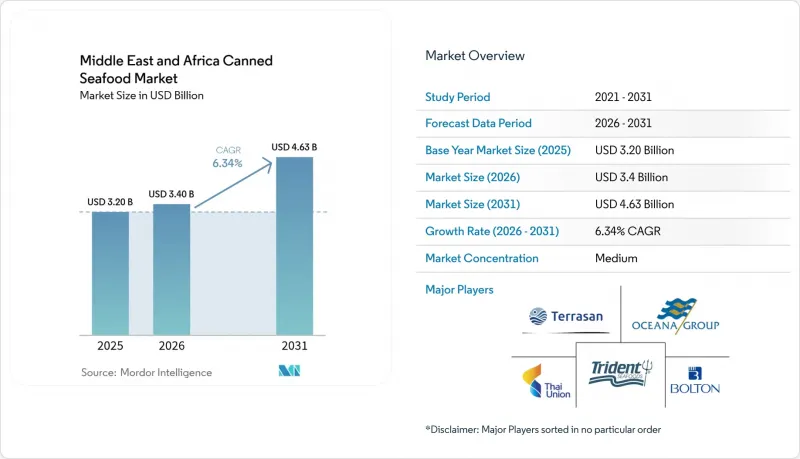
This report is Segmented by Product Type (Canned Fish, Canned Shrimp, Canned Prawns, and Others), Distribution Channel (On Trade, and Off Trade), and Geography (Saudi Arabia, UAE, Qatar, Kuwait, Oman, Bahrain, South Africa, Nigeria, Turkey, and Rest of Middle East Africa). The Market Forecasts Provided in Value(USD) and Volume(Tons).
Middle East And Africa Canned Seafood Market Trends and Insights
Rising demand for convenient protein sources
Urbanization, the rise of nuclear households, and a growing female workforce are reshaping meal planning, with ready-to-eat seafood taking center stage. These demographic and lifestyle shifts are driving demand for convenient, nutritious, and shelf-stable food options. Canned fish, rich in omega-3, protein, and iron, sidesteps the perishability issues of fresh catches, offering a practical solution for busy households. This makes it especially appealing during Ramadan, a time when households stock up on non-perishable staples to meet increased meal preparation needs. These now boast convenient, easy-open lids and healthier reduced-sodium formulations, catering to health-conscious consumers. In both Lagos and Riyadh, the inclusion of canned mackerel in school lunch programs highlights its growing institutional acceptance, as schools prioritize affordable and nutritious meal options for students. With rising purchasing power, consumers are leaning towards premium, ready-to-serve options that promise consistent taste, high nutritional value, and time-saving benefits.
Expanding modern retail and e-commerce footprint
In Abu Dhabi, Riyadh, and Accra, hypermarket giants Carrefour and LuLu, among others, unveil new outlets boasting broader selections and specialized seafood sections, catering to the growing demand for diverse product offerings. While private label canned sardines carve a niche by pricing lower than their branded counterparts, they also appeal to cost-conscious consumers seeking value without compromising on quality. However, it's the digital realm that witnesses the most pronounced growth. Egypt's online retail value is set to double from 2024 to 2029, driven by increasing internet penetration and consumer preference for convenience. Capitalizing on this trend, Talabat and Noon Grocery harness same-day delivery, positioning shelf-stable seafood as a convenient add-on for last-minute purchases. Meanwhile, subscription services facilitate monthly tuna multipack restocks, ensuring consistent availability for regular consumers. Retail analytics spotlight a trend: bundling canned seafood with pasta and tomato paste elevates average order values, signaling potential for cross-category promotions that could further enhance customer engagement and drive sales.
Volatile wild-catch volumes and over-fishing limits
Europe quota cuts for mackerel and sardines, combined with NOAA's restrictions on Pacific cod, are tightening the raw-material supply for regional canneries, leading to increased competition for limited resources and higher procurement costs. Ghana's annual closed season significantly reduces coastal landings, compelling processors to depend on more expensive frozen imports to sustain production levels.. El Nino conditions have curtailed Peruvian anchovy harvests, significantly driving up fishmeal costs, which subsequently inflate sardine prices and strain profit margins for processors. This supply volatility not only complicates annual procurement planning by introducing unpredictability in raw material availability and costs but can also lead to temporary dips in plant utilization rates, falling short of optimal levels and negatively impacting overall operational efficiency and output consistency.
Other drivers and restraints analyzed in the detailed report include:
- Growing domestic fish-processing capacity
- Government food-security stock-piling
- Rising consumer preference for fresh and frozen seafood
For complete list of drivers and restraints, kindly check the Table Of Contents.
Segment Analysis
In 2025, canned fish commands a dominant 45.78% share of the canned seafood market in the Middle East and Africa. This stronghold is bolstered by deep-rooted culinary traditions, competitive pricing, and heightened promotional efforts during peak retail seasons. Tuna stands out as the favored choice, seamlessly fitting into salads, stews, and school lunches, making it a staple in many households. Meanwhile, sardines and mackerel enrich North African diets, harmonizing with local recipes that emphasize tomato-based sauces, which are widely popular in the region. Although salmon occupies a niche position, it boasts impressive double-digit volume growth in UAE's duty-free and premium supermarket sectors, underscoring a growing health consciousness and a readiness to invest in omega-3-rich foods. This trend reflects a shift in consumer preferences toward healthier and more premium options.
Canned prawns are set to lead the market with a 7.41% CAGR through 2031. Their premium status and popularity among expatriates recreating Asian and Mediterranean dishes at home drive this growth. Their versatility across cuisines and appeal to consumers seeking high-quality seafood further boost demand. Halal-compliant processing assures Muslim consumers of religious adherence, broadening the product's accessibility. Canned shrimp, with steady mid-single-digit growth, is popular in fried rice and instant noodles, especially among college students valuing convenience and affordability. Niche offerings like canned octopus and squid, though starting from a modest base, are gaining traction as food-service operators in cities like Dubai and Cape Town incorporate them into tapas-style menus to meet evolving dining trends. Thai Union has introduced an algae-based tuna substitute, targeting the flexitarian market and signaling potential category expansions. This innovation highlights the industry's focus on sustainability and meeting the demands of health-conscious, environmentally aware consumers.
Complete Report Scope:
- By Product Type
- Canned Fish
- Tuna
- Salmon
- Sardines
- Mackerel
- Canned Shrimp
- Canned Prawns
- Others(Octopus, Squid, Crab etc)
- Canned Fish
- Distribution Channel
- On trade
- Off trade
- Supermarkets/Hypermarkets
- Convenience Stores
- Online Retail Retails
- Others
- By Geography
- Saudi Arabia
- United Arab Emirates
- Qatar
- Kuwait
- Oman
- Bahrain
- South Africa
- Nigeria
- Turkey
- Rest of Middle East and Africa
List of Companies Covered in this Report:
- Thai Union Group PCL
- Bolton Food (Bolton Group B.V.)
- Oceana Group Ltd.
- Terrasan Group of Companies
- Trident Seafoods Corp.
- Bidvest Namibia Fisheries Holdings
- American Tuna Inc.
- Kawasho Foods Corporation
- Al-Alali (Savola Group)
- Shrimp Nation
- Princes Group
- Century Pacific Food Inc.
- S-Ocean Holding (Dongwon)
- Bumble Bee Foods LLC
- Wild Planet Foods
- Ayam Brand
- Westfalia Seafoods
- Sea Harvest Group
- Pacific Andes International Holdings
- PT Austindo Nusantara Jaya Tbk
Additional Benefits:
- The market estimate (ME) sheet in Excel format
- 3 months of analyst support
TABLE OF CONTENTS
1 INTRODUCTION
- 1.1 Study Assumptions and Market Definition
- 1.2 Scope of the Study
2 RESEARCH METHODOLOGY
3 EXECUTIVE SUMMARY
4 MARKET LANDSCAPE
- 4.1 Market Overview
- 4.2 Market Drivers
- 4.2.1 Rising demand for convenient protein sources
- 4.2.2 Expanding modern retail and e-commerce footprint
- 4.2.3 Growing domestic fish-processing capacity
- 4.2.4 Government food-security stock-piling
- 4.2.5 Halal-certified export opportunities
- 4.2.6 Climate-driven shift from chilled to shelf-stable seafood
- 4.3 Market Restraints
- 4.3.1 Volatile wild-catch volumes/over-fishing limits
- 4.3.2 Rising consumer preference for fresh and frozen seafood
- 4.3.3 Fragmented import tariffs across Gulf Cooperation Council and African blocs
- 4.3.4 Escalating sustainability-certification costs
- 4.4 Consumer Behaviour Analysis
- 4.5 Regulatory Landscape
- 4.6 Technological Outlook
- 4.7 Porter's Five Forces
- 4.7.1 Bargaining Power of Suppliers
- 4.7.2 Bargaining Power of Buyers
- 4.7.3 Threat of New Entrants
- 4.7.4 Threat of Substitutes
- 4.7.5 Competitive Rivalry
5 MARKET SIZE AND GROWTH FORECASTS (VALUE and VOLUME)
- 5.1 By Product Type
- 5.1.1 Canned Fish
- 5.1.1.1 Tuna
- 5.1.1.2 Salmon
- 5.1.1.3 Sardines
- 5.1.1.4 Mackerel
- 5.1.2 Canned Shrimp
- 5.1.3 Canned Prawns
- 5.1.4 Others(Octopus, Squid, Crab etc)
- 5.1.1 Canned Fish
- 5.2 Distribution Channel
- 5.2.1 On trade
- 5.2.2 Off trade
- 5.2.2.1 Supermarkets/Hypermarkets
- 5.2.2.2 Convenience Stores
- 5.2.2.3 Online Retail Retails
- 5.2.2.4 Others
- 5.3 By Geography
- 5.3.1 Saudi Arabia
- 5.3.2 United Arab Emirates
- 5.3.3 Qatar
- 5.3.4 Kuwait
- 5.3.5 Oman
- 5.3.6 Bahrain
- 5.3.7 South Africa
- 5.3.8 Nigeria
- 5.3.9 Turkey
- 5.3.10 Rest of Middle East and Africa
6 COMPETITIVE LANDSCAPE
- 6.1 Market Concentration
- 6.2 Strategic Moves
- 6.3 Market Share Analysis
- 6.4 Company Profiles (includes Global level Overview, Market level overview, Core Segments, Financials as available, Strategic Information, Market Rank/Share for key companies, Products and Services, and Recent Developments)
- 6.4.1 Thai Union Group PCL
- 6.4.2 Bolton Food (Bolton Group B.V.)
- 6.4.3 Oceana Group Ltd.
- 6.4.4 Terrasan Group of Companies
- 6.4.5 Trident Seafoods Corp.
- 6.4.6 Bidvest Namibia Fisheries Holdings
- 6.4.7 American Tuna Inc.
- 6.4.8 Kawasho Foods Corporation
- 6.4.9 Al-Alali (Savola Group)
- 6.4.10 Shrimp Nation
- 6.4.11 Princes Group
- 6.4.12 Century Pacific Food Inc.
- 6.4.13 S-Ocean Holding (Dongwon)
- 6.4.14 Bumble Bee Foods LLC
- 6.4.15 Wild Planet Foods
- 6.4.16 Ayam Brand
- 6.4.17 Westfalia Seafoods
- 6.4.18 Sea Harvest Group
- 6.4.19 Pacific Andes International Holdings
- 6.4.20 PT Austindo Nusantara Jaya Tbk
7 MARKET OPPORTUNITIES AND FUTURE OUTLOOK

