PUBLISHER: Mordor Intelligence | PRODUCT CODE: 2123798

PUBLISHER: Mordor Intelligence | PRODUCT CODE: 2123798
Canned Seafood - Market Share Analysis, Industry Trends & Statistics, Growth Forecasts (2026 - 2031)
According to Mordor Intelligence, the canned seafood market size was valued at USD 31.5 billion in 2025 and estimated to grow from USD 33.3 billion in 2026 to reach USD 43.98 billion by 2031, at a CAGR of 5.72% during the forecast period (2026-2031).
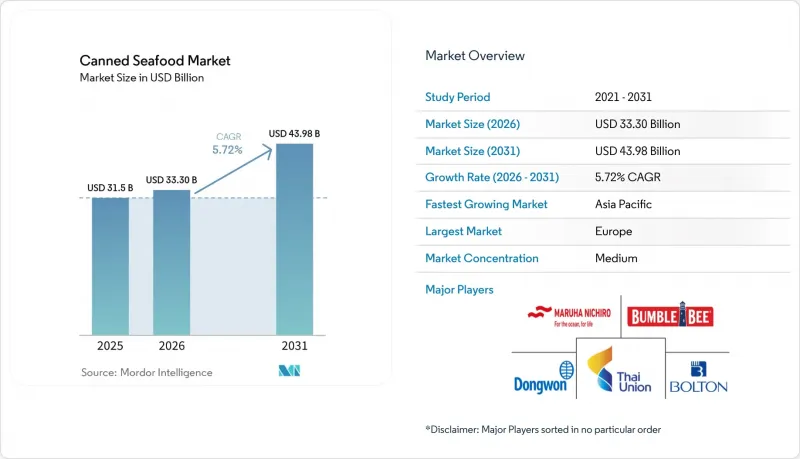
This report Segments the Industry Into Type (Canned Fish, Canned Shrimp, Canned Prawns, Other Types), Packaging Material (Steel Cans, Aluminum Cans, Retort Pouches, Others), Product Form (Whole, Chunks/Pieces) Distribution Channel (On-Trade, Off-Trade), and Geography (North America, Europe, Asia-Pacific, South America, Middle East, Africa). The Market Forecasts are Provided in Terms of Value (USD).
Global Canned Seafood Market Trends and Insights
Convenience Attributes and Extended Shelf life Capabilities in Canned Seafood
The combination of busy lifestyles and supply chain reliability concerns has established canned seafood as a key pantry staple in global food markets. Consumers increasingly seek protein sources that reduce preparation time while maintaining essential nutritional value, including omega-3 fatty acids, protein, vitamins B12 and D, and minerals such as zinc, iron, and selenium. The extended shelf life of 2-5 years provides significant food security benefits that fresh alternatives cannot match, particularly in regions with limited or inconsistent cold chain infrastructure. During supply chain disruptions, such as natural disasters, transportation challenges, or global health crises, canned seafood functions as a reliable protein reserve for households, emergency response organizations, food banks, military operations, and institutional buyers. The ability to store at room temperature eliminates refrigeration costs and reduces food waste throughout the distribution chain, offering substantial economic benefits to both retailers and consumers. This storage flexibility also enables retailers to maintain larger inventories without additional cold storage investments, while providing consumers with a convenient, long-lasting protein source that requires minimal preparation and storage space.
Premium "on-the-go" Seafood Snacking Trend
The influence of social media, particularly among Generation Z consumers, has transformed canned seafood from a basic commodity into a lifestyle product, increasing demand for premium products with higher profit margins. This shift has expanded the market beyond traditional consumer segments, reaching younger, urban professionals, food enthusiasts, and health-conscious individuals seeking convenient protein sources. Companies can now position their products as artisanal offerings rather than emergency food items, as demonstrated by Fishwife's revenue growth through premium positioning and direct-to-consumer sales. Premium brands capitalize on this by offering diverse species like sardines, mackerel, and specialty tuna, along with distinct flavors such as smoked paprika, lemon herb, and chili oil, complemented by refined packaging that attracts both food enthusiasts and health-conscious buyers. The market growth potential is supported by increasing seafood consumption among younger consumers, social media-driven food education, sustainability concerns, nutritional awareness, and developing brand loyalty that persists beyond social media trends, establishing canned seafood as a permanent part of modern dining habits and meal preparation routines.
Market growth Potential Impacted by Raw Material Price Fluctuations
Raw material price fluctuations significantly impact profit margins, requiring processors to balance profitability against market share. Small processors are particularly vulnerable due to limited vertical integration capabilities and inadequate hedging mechanisms for commodity risk management. European processors face challenges from supply chain disruptions and geopolitical tensions, which increase input costs while energy prices rise. The industry's dependence on imports in key markets like Europe increases its vulnerability. According to the European Commission, higher prices led to a decreased in at-home fresh seafood consumption in 2023. Moreover, Vietnam's seafood industry exemplifies challenges, with raw material shortages in shrimp and tuna production due to disease outbreaks and regulatory requirements affecting export growth despite strong international demand. Price fluctuations impact species segments differently, with premium products like salmon experiencing higher price sensitivity compared to commodity species like sardines, affecting portfolio management strategies.
Other drivers and restraints analyzed in the detailed report include:
- Urbanization and Fast-paced Lifestyles
- Protein-rich Food Products Driven by Health Consciousness
- Market Expansion Challenged by Fresh Seafood Preferences
For complete list of drivers and restraints, kindly check the Table Of Contents.
Segment Analysis
Canned tuna maintains a dominant 52.62% market share in 2025, supported by decades of established brand presence, sophisticated distribution networks, and optimized supply chains. The segment's leadership position stems from widespread consumer acceptance, competitive pricing strategies, and versatile product applications. However, canned shrimp is emerging as the fastest-growing segment with a projected CAGR of 6.23% during 2026-2031. This trend indicates evolving consumer preferences toward premium seafood options that provide diverse culinary applications across multiple cuisine types and meal occasions. Canned salmon continues to show stable demand due to its recognized health benefits, high omega-3 content, and increasing consumer awareness of nutritional value, while sardines maintain their market position through sustainable fishing practices, competitive pricing, and appeal during economic uncertainty. Mackerel and other fish varieties cater to specific regional markets, particularly in Europe and Asia, where these species are deeply embedded in traditional cuisine and cultural preferences.
The market segmentation by species significantly influences supply chain operations and vertical integration strategies, as each species requires specialized sourcing networks, specific processing methods, quality control measures, and targeted marketing approaches. The growth in the shrimp segment demonstrates successful premium positioning strategies, transforming canned seafood from a basic protein source to a premium convenience product. This strategic shift creates opportunities for processors to increase profit margins through enhanced quality standards, innovative packaging solutions, and comprehensive brand development initiatives.
Steel cans hold a dominant 77.65% market share in 2025, due to their effective barrier properties against moisture, light, and oxygen, supported by well-established global recycling systems. Retort pouches are experiencing the fastest growth at 7.25% CAGR, benefiting from enhanced portability, reduced storage requirements, and improved convenience for retailers and consumers. The market shows a clear shift toward flexible packaging options that reduce transportation costs, storage space needs, and environmental impact while preserving product quality and shelf life. Aluminum cans serve premium market segments, with their light weight, temperature resistance, and recyclability offsetting higher material costs, particularly for sustainability-focused brands. Glass jars and composite materials maintain specific market positions where product visibility, premium presentation, or preservation requirements offer competitive benefits.
The variety of packaging materials shapes investment decisions and technological advancement, as each material type requires specific manufacturing processes, equipment, and supplier relationships. Sonoco's USD 3.9 billion acquisition of Eviosys in December 2024 reflects ongoing metal packaging consolidation, as companies seek operational efficiency and scale advantages in the expanding canned food market. The industry's shift to BPA-free linings in metal packaging addresses regulatory requirements and consumer health concerns, with companies like Sherwin-Williams developing protective coatings that enhance product safety through improved material science and manufacturing methods.
Complete Report Scope:
- By Species/Type
- Canned Fish
- Tuna
- Salmon
- Sardines
- Mackerel
- Other Canned Fish
- Canned Shrimp
- Canned Prawns
- Other Types
- Canned Fish
- By Packaging Material
- Steel Cans
- Aluminum Cans
- Retort Pouches
- Other Packaging Material
- By Product Form
- Whole
- Chunks/Pieces
- By Distribution Channel
- On- Trade
- Off-Trade
- Supermarkets/Hypermarkets
- Convenience Stores
- Online Retail
- Specialty Stores
- Other Off-Trade Distribution Channels
- By Geography
- North America
- United States
- Canada
- Mexico
- Rest of North America
- Europe
- United Kingdom
- Germany
- France
- Spain
- Italy
- Russia
- Norway
- Sweden
- Denmark
- Belgium
- Rest of Europe
- Asia-Pacific
- China
- Japan
- India
- South Korea
- Indonesia
- Thailand
- Vietnam
- Malaysia
- Philippines
- Rest of Asia-Pacific
- South America
- Brazil
- Argentina
- Chile
- Peru
- Rest of South America
- Middle East and Africa
- Saudi Arabia
- United Arab Emirates
- Oman
- South Africa
- Nigeria
- Kenya
- Egypt
- Rest of Middle East and Africa
- North America
Geography Analysis
Europe accounts for 33.85% of global revenue in 2025, supported by Mediterranean fish preservation traditions, strict sustainability regulations, and high consumer purchasing power. Spain processes a significant amount of the region's canned tuna through its fishing fleets operating in the Atlantic, Indian, and Pacific Oceans. The country's processing facilities and supply chains enable efficient production and distribution. Norway continues its premium sardine production, combining traditional preservation methods with modern processing techniques, which strengthens its tourism appeal and export market position.
Asia-Pacific exhibits the highest growth rate at 5.88% CAGR. China's growing urban middle class incorporates canned fish into lunchboxes and daily meals, while India's coastal states increase domestic processing capabilities to serve inland markets. Vietnam experiences raw material limitations and aquaculture disease issues, but implements government-supported hatchery modernization programs to maintain export stability. Asian Development Bank-funded cold chain infrastructure improvements, including refrigerated transportation and storage facilities, enhance product distribution to tier-2 cities, increasing per capita consumption.
North America shows moderate growth with strong brand loyalty, supported by established distribution networks and consumer preferences. Product innovation centers on flavored snack kits, low-sodium options, and convenient pouch formats. FDA container inspection requirements drive investments in automated seam testing equipment and x-ray inspection systems, raising operational costs while ensuring safety standards. South America and the Middle East see consumption growth from urbanization and expanding tourism. In Africa, population growth impacts local fish resources, making canned fish imports a vital protein source in areas with limited cold storage infrastructure, particularly in rural and semi-urban regions.
- Thai Union Group PCL
- Bolton Group S.p.A.
- Dongwon Industries Co. Ltd. (StarKist)
- Bumble Bee Foods, LLC.
- Maruha Nichiro Corp.
- Nippon Suisan Kaisha Ltd.
- Century Pacific Food Inc.
- Trident Seafoods Corp.
- Alimentos Prosalud
- Princes Group
- Ocean Brands GP
- Clover Leaf Seafoods Corp.
- Wild Planet Foods Inc.
- Conservas Ortiz
- Mowi ASA
- Oman Fisheries Co. SAOG
- Dhofar Fisheries and Food Co. SAOG
- Safe Catch
- Calvo Group
- Ekone Seafood
Additional Benefits:
- The market estimate (ME) sheet in Excel format
- 3 months of analyst support
TABLE OF CONTENTS
1 INTRODUCTION
- 1.1 Study Assumptions and Market Definition
- 1.2 Scope of the Study
2 RESEARCH METHODOLOGY
3 EXECUTIVE SUMMARY
4 MARKET LANDSCAPE
- 4.1 Market Overview
- 4.2 Market Drivers
- 4.2.1 Convenience Attributes and Extended Shelf Life Capabilities in Canned Seafood
- 4.2.2 Premium "On-the-Go" Seafood Snacking Trend
- 4.2.3 Demand Generation Through Urbanization and Fast-paced Lifestyles
- 4.2.4 Protein-rich Food Products Driven by Health Consciousness
- 4.2.5 Ambient Storage Capability in Markets with Limited Cold Chain Infrastructure
- 4.2.6 Consumer Purchase Decisions Influenced by Sustainability Certifications and Product Traceability
- 4.3 Market Restraints
- 4.3.1 Market Growth Potential Impacted by Raw Material Price Fluctuations
- 4.3.2 BPA-Free Can-Lining Mandates Raising Conversion Costs
- 4.3.3 Purchase Decisions Affected by Sodium Content and Preservative Concerns
- 4.3.4 Market Expansion Challenged by Fresh Seafood Preferences
- 4.4 Value/Supply-Chain Analysis
- 4.5 Regulatory and Technological Outlook
- 4.6 Porter's Five Forces
- 4.6.1 Threat of New Entrants
- 4.6.2 Bargaining Power of Buyers
- 4.6.3 Bargaining Power of Suppliers
- 4.6.4 Threat of Substitutes
- 4.6.5 Competitive Rivalry
5 MARKET SIZE AND GROWTH FORECASTS (VALUE)
- 5.1 By Species/Type
- 5.1.1 Canned Fish
- 5.1.1.1 Tuna
- 5.1.1.2 Salmon
- 5.1.1.3 Sardines
- 5.1.1.4 Mackerel
- 5.1.1.5 Other Canned Fish
- 5.1.2 Canned Shrimp
- 5.1.3 Canned Prawns
- 5.1.4 Other Types
- 5.1.1 Canned Fish
- 5.2 By Packaging Material
- 5.2.1 Steel Cans
- 5.2.2 Aluminum Cans
- 5.2.3 Retort Pouches
- 5.2.4 Other Packaging Material
- 5.3 By Product Form
- 5.3.1 Whole
- 5.3.2 Chunks/Pieces
- 5.4 By Distribution Channel
- 5.4.1 On- Trade
- 5.4.2 Off-Trade
- 5.4.2.1 Supermarkets/Hypermarkets
- 5.4.2.2 Convenience Stores
- 5.4.2.3 Online Retail
- 5.4.2.4 Specialty Stores
- 5.4.2.5 Other Off-Trade Distribution Channels
- 5.5 By Geography
- 5.5.1 North America
- 5.5.1.1 United States
- 5.5.1.2 Canada
- 5.5.1.3 Mexico
- 5.5.1.4 Rest of North America
- 5.5.2 Europe
- 5.5.2.1 United Kingdom
- 5.5.2.2 Germany
- 5.5.2.3 France
- 5.5.2.4 Spain
- 5.5.2.5 Italy
- 5.5.2.6 Russia
- 5.5.2.7 Norway
- 5.5.2.8 Sweden
- 5.5.2.9 Denmark
- 5.5.2.10 Belgium
- 5.5.2.11 Rest of Europe
- 5.5.3 Asia-Pacific
- 5.5.3.1 China
- 5.5.3.2 Japan
- 5.5.3.3 India
- 5.5.3.4 South Korea
- 5.5.3.5 Indonesia
- 5.5.3.6 Thailand
- 5.5.3.7 Vietnam
- 5.5.3.8 Malaysia
- 5.5.3.9 Philippines
- 5.5.3.10 Rest of Asia-Pacific
- 5.5.4 South America
- 5.5.4.1 Brazil
- 5.5.4.2 Argentina
- 5.5.4.3 Chile
- 5.5.4.4 Peru
- 5.5.4.5 Rest of South America
- 5.5.5 Middle East and Africa
- 5.5.5.1 Saudi Arabia
- 5.5.5.2 United Arab Emirates
- 5.5.5.3 Oman
- 5.5.5.4 South Africa
- 5.5.5.5 Nigeria
- 5.5.5.6 Kenya
- 5.5.5.7 Egypt
- 5.5.5.8 Rest of Middle East and Africa
- 5.5.1 North America
6 COMPETITIVE LANDSCAPE
- 6.1 Market Concentration
- 6.2 Strategic Moves
- 6.3 Market Share Analysis
- 6.4 Company Profiles (includes Global level Overview, Market level overview, Core Segments, Financials as available, Strategic Information, Market Rank/Share for key companies, Products and Services, and Recent Developments)
- 6.4.1 Thai Union Group PCL
- 6.4.2 Bolton Group S.p.A.
- 6.4.3 Dongwon Industries Co. Ltd. (StarKist)
- 6.4.4 Bumble Bee Foods, LLC.
- 6.4.5 Maruha Nichiro Corp.
- 6.4.6 Nippon Suisan Kaisha Ltd.
- 6.4.7 Century Pacific Food Inc.
- 6.4.8 Trident Seafoods Corp.
- 6.4.9 Alimentos Prosalud
- 6.4.10 Princes Group
- 6.4.11 Ocean Brands GP
- 6.4.12 Clover Leaf Seafoods Corp.
- 6.4.13 Wild Planet Foods Inc.
- 6.4.14 Conservas Ortiz
- 6.4.15 Mowi ASA
- 6.4.16 Oman Fisheries Co. SAOG
- 6.4.17 Dhofar Fisheries and Food Co. SAOG
- 6.4.18 Safe Catch
- 6.4.19 Calvo Group
- 6.4.20 Ekone Seafood
7 MARKET OPPORTUNITIES AND FUTURE OUTLOOK

