PUBLISHER: Mordor Intelligence | PRODUCT CODE: 2115862

PUBLISHER: Mordor Intelligence | PRODUCT CODE: 2115862
Active Protection Systems - Market Share Analysis, Industry Trends & Statistics, Growth Forecasts (2026 - 2031)
According to Mordor Intelligence, the active protection systems market size was valued at USD 4.42 billion in 2025 and estimated to grow from USD 4.67 billion in 2026 to reach USD 6.14 billion by 2031, at a CAGR of 5.62% during the forecast period (2026-2031).
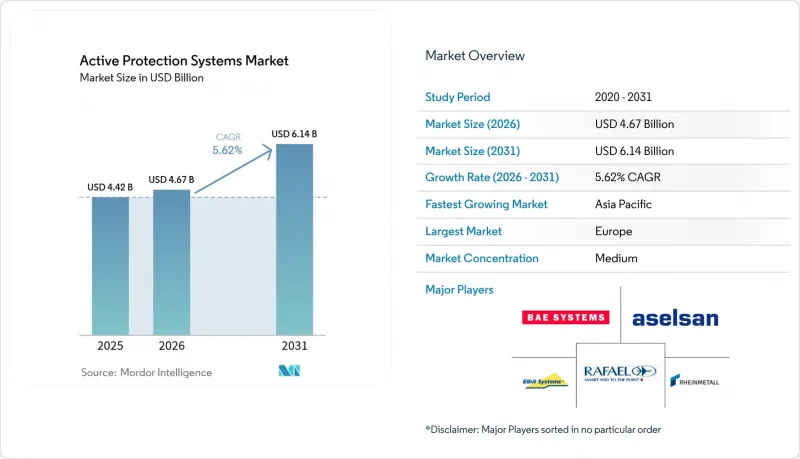
This report is Segmented by Kill-Mechanism (Hard-Kill Systems, Soft-Kill Systems, and Reactive Armor), Platform (Land, Marine, and Airborne), Range Class (Short-Range, and More), End-User (Defense Forces, and Homeland Security and Paramilitary), and Geography (North America, Europe, Asia-Pacific, South America, and More). The Market Forecasts are Provided in Terms of Value (USD).
Global Active Protection Systems Market Trends and Insights
NATO Mandate for APS-Equipped MBTs by 2030
NATO's STANAG 4686 sets unified performance baselines that have spurred member-state spending on common APS solutions, lowering per-unit costs and standardizing logistics across Leopard 2A8 and Challenger 3 fleets. Contract awards worth EUR 800 billion (USD 943.72 billion) under the ReArm Europe Plan earmark survivability upgrades as a top priority, pulling forward procurement to meet the 2030 deadline. The resulting scale advantages favour established vendors with combat-proven hardware and shorten certification cycles for incremental upgrades.
Rapid Integration of AI Sensor-Fusion Chips
Machine-learning models running on gallium nitride radar processors allow APS to predict projectile behaviour, trim false-positive alerts, and choose the least destructive countermeasure. Performance gains are tied to semiconductor supply, which remains vulnerable to Chinese gallium export limits that have already prompted US DARPA initiatives for alternative wafers.
Electromagnetic Compatibility Failures on Legacy Vehicles
Vintage armoured vehicles lack shielding for high-power radar bursts, forcing costly rewiring that can exceed APS price tags and delay fielding. Operators must trade off between partial capability loss during activations or full electrical refits, constraining retrofit addressability on pre-2000 platforms.
Other drivers and restraints analyzed in the detailed report include:
- US MAPS Open-Architecture Procurement Wave
- Ukrainian Conflict Lessons Accelerating Retrofits
- Export-Control Restrictions on GaN Radar Chips
For complete list of drivers and restraints, kindly check the Table Of Contents.
Segment Analysis
Hard-kill systems controlled 56.30% of 2025 revenue in the active protection systems market share, reflecting operator trust in interceptors that physically destroy shaped-charge and kinetic-energy penetrators mid-flight. Elbit Systems' Iron Fist demonstration against 120 mm sabot rounds proved that compact launchers can neutralize high-velocity projectiles, prompting armies to adopt layered defenses that mix explosive countermeasures with passive armor. Mature hard-kill designs such as Rafael's Trophy now integrate AI target prioritization, enabling vehicles to defeat multiple threats arriving within milliseconds of one another and to log telemetry that feeds continuous software updates. The ability to re-stock launch-tubes quickly on forward operating bases lowers downtime. It keeps combat units in theater, a logistical advantage that resonates with NATO planners tasked to keep mechanized brigades operational for extended rotations.
Soft-kill launchers remain the smaller revenue pool, yet their 7.28% CAGR underlines a strategic pivot toward non-lethal defeat modes that reduce collateral damage and meet urban-warfare rules of engagement. Electrically triggered multispectral smoke and IR dazzlers eliminate the need for explosive cartridges, cutting weight, boosting magazine depth, and lowering life-cycle costs. Neural-network classifiers now decide in real time whether to blind the seeker or spoof its guidance loop, trimming false activations that plagued first-generation jammers. These features make soft-kill suites attractive for peace-support missions, VIP convoys, and homeland-security fleets that operate close to civilian populations. As governments impose tighter restrictions on fragmentation risk, suppliers that can certify near-zero civilian harm are positioned to gain market share.
Land vehicles generated 72.90% of the active protection systems market size in 2025, buoyed by mass retrofit programs that place Trophy, Iron Fist, and StrikeShield on Leopard 2, Abrams, and Bradley fleets across Europe and the United States. These tracked platforms already carry sufficient power reserves and offer generous hull real estate, simplifying sensor mast placement and wiring runs. Program offices also benefit from decades of integration know-how, established depot-level maintenance, and a ready cadre of trainers who can certify crews within weeks. The result is a predictable acquisition pathway that lets ministries of defence obligate multi-year funds without excessive technical risk.
Airborne demand grows at an 8.05% CAGR as unmanned combat aerial vehicles and rotary-wing assets require protection from shoulder-launched missiles and kamikaze drones. Trophy-Light and similar derivatives trim radar aperture size and substitute explosive interceptors with directed-energy pulses to remain within stringent weight envelopes. Developers also pair compact AESA panels with conformal laser dazzlers to protect tiltro-tor craft during shipboard and austere-field take-offs, environments where man-portable threats are most acute. Early flight tests on UH-60 and V-280 prototypes show negligible impact on range or payload, removing a key objection from aviation program managers. As distributed-operations doctrine pushes helicopters into small, dispersed landing zones, the value proposition of airborne APS shifts from nice-to-have to mandatory.
Complete Report Scope:
- By Kill-Mechanism
- Hard-Kill Systems
- Soft-Kill Systems
- Reactive Armor
- By Platform
- Land
- Marine
- Airborne
- By Range Class
- Short-Range
- Medium-Range
- Long-Range
- By End-User
- Defense Forces
- Homeland Security and Paramilitary
- By Geography
- North America
- United States
- Canada
- Mexico
- Europe
- United Kingdom
- Germany
- France
- Russia
- Rest of Europe
- Asia-Pacific
- China
- Japan
- India
- South Korea
- Australia
- Rest of Asia-Pacific
- South America
- Brazil
- Rest of South America
- Middle East and Africa
- Middle East
- Israel
- United Arab Emirates
- Saudi Arabia
- Rest of Middle East
- Africa
- South Africa
- Rest of Africa
- Middle East
- North America
Geography Analysis
Europe retained leadership with 38.40% of 2025 revenue after Germany and the United Kingdom standardised on Trophy APS, catalysing follow-on buys across the Nordics, Italy, and Poland. The ReArm Europe Plan directs EUR 800 billion (USD 943.72 billion) to plug capability gaps, prioritising vehicle survivability kits that meet NATO interchangeability rules.
Asia-Pacific delivers the fastest 6.55% CAGR; Japan's Type 10 upgrades, South Korea's K2 enhancements, and India's in-house programmes reinforce regional supply chains that lower dependence on US Foreign Military Sales timelines. East Asia defence spending climbed 6.2% to USD 411 billion in 2023, providing a durable funding base for local sensor-fusion chip foundries.
North America profits from MAPS open-architecture rollouts and robust venture investment that incentivises microwave and laser start-ups, while the Middle East leverages high oil revenues to import kinetic and directed-energy layers; Saudi Arabia alone earmarked USD 78 billion for defence in 2025. Israel's export of Arrow 3 and Iron Beam variants underlines the region's appetite for bleeding-edge survivability beyond traditional armor.
- Rafael Advanced Defense Systems Ltd.
- Rheinmetall AG
- Elbit Systems Ltd.
- BAE Systems plc
- ASELSAN A.S.
- Leonardo S.p.A
- Saab AB
- Thales Group
- Hyundai Rotem Company
- Artis, L.L.C.
- KNDS N.V.
- QinetiQ Group plc
- Israel Aerospace Industries Ltd.
- Terma A/S
- Northrop Grumman Corporation
- HENSOLDT AG
- Indra Sistemas S.A.
- LACROIX Group
Additional Benefits:
- The market estimate (ME) sheet in Excel format
- 3 months of analyst support
TABLE OF CONTENTS
1 INTRODUCTION
- 1.1 Study Assumptions and Market Definition
- 1.2 Scope of the Study
2 RESEARCH METHODOLOGY
3 EXECUTIVE SUMMARY
4 MARKET LANDSCAPE
- 4.1 Market Overview
- 4.2 Market Drivers
- 4.2.1 NATO mandate for APS-equipped MBTs by 2030
- 4.2.2 Rapid integration of AI sensor-fusion chips
- 4.2.3 US MAPS open-architecture procurement wave
- 4.2.4 Electrically powered soft-kill launchers cut SWaP
- 4.2.5 Ukrainian conflict lessons accelerating retrofits
- 4.2.6 Venture-backed drone-swarm defeat modes
- 4.3 Market Restraints
- 4.3.1 Electromagnetic compatibility failures on legacy vehicles
- 4.3.2 Export-control restrictions on GaN radar chips
- 4.3.3 High false-positive rates in dense urban terrain
- 4.3.4 Fragmentation-injury liability risk for peace-keeping ops
- 4.4 Value Chain Analysis
- 4.5 Regulatory Landscape
- 4.6 Technological Outlook
- 4.7 Porter's Five Forces Analysis
- 4.7.1 Threat of New Entrants
- 4.7.2 Bargaining Power of Buyers
- 4.7.3 Bargaining Power of Suppliers
- 4.7.4 Threat of Substitute Products
- 4.7.5 Intensity of Competitive Rivalry
5 MARKET SIZE AND GROWTH FORECASTS (VALUE)
- 5.1 By Kill-Mechanism
- 5.1.1 Hard-Kill Systems
- 5.1.2 Soft-Kill Systems
- 5.1.3 Reactive Armor
- 5.2 By Platform
- 5.2.1 Land
- 5.2.2 Marine
- 5.2.3 Airborne
- 5.3 By Range Class
- 5.3.1 Short-Range
- 5.3.2 Medium-Range
- 5.3.3 Long-Range
- 5.4 By End-User
- 5.4.1 Defense Forces
- 5.4.2 Homeland Security and Paramilitary
- 5.5 By Geography
- 5.5.1 North America
- 5.5.1.1 United States
- 5.5.1.2 Canada
- 5.5.1.3 Mexico
- 5.5.2 Europe
- 5.5.2.1 United Kingdom
- 5.5.2.2 Germany
- 5.5.2.3 France
- 5.5.2.4 Russia
- 5.5.2.5 Rest of Europe
- 5.5.3 Asia-Pacific
- 5.5.3.1 China
- 5.5.3.2 Japan
- 5.5.3.3 India
- 5.5.3.4 South Korea
- 5.5.3.5 Australia
- 5.5.3.6 Rest of Asia-Pacific
- 5.5.4 South America
- 5.5.4.1 Brazil
- 5.5.4.2 Rest of South America
- 5.5.5 Middle East and Africa
- 5.5.5.1 Middle East
- 5.5.5.1.1 Israel
- 5.5.5.1.2 United Arab Emirates
- 5.5.5.1.3 Saudi Arabia
- 5.5.5.1.4 Rest of Middle East
- 5.5.5.2 Africa
- 5.5.5.2.1 South Africa
- 5.5.5.2.2 Rest of Africa
- 5.5.5.1 Middle East
- 5.5.1 North America
6 COMPETITIVE LANDSCAPE
- 6.1 Market Concentration
- 6.2 Strategic Moves
- 6.3 Market Share Analysis
- 6.4 Company Profiles (includes Global level Overview, Market level overview, Core Segments, Financials as available, Strategic Information, Market Rank/Share for key companies, Products and Services, and Recent Developments)
- 6.4.1 Rafael Advanced Defense Systems Ltd.
- 6.4.2 Rheinmetall AG
- 6.4.3 Elbit Systems Ltd.
- 6.4.4 BAE Systems plc
- 6.4.5 ASELSAN A.S.
- 6.4.6 Leonardo S.p.A
- 6.4.7 Saab AB
- 6.4.8 Thales Group
- 6.4.9 Hyundai Rotem Company
- 6.4.10 Artis, L.L.C.
- 6.4.11 KNDS N.V.
- 6.4.12 QinetiQ Group plc
- 6.4.13 Israel Aerospace Industries Ltd.
- 6.4.14 Terma A/S
- 6.4.15 Northrop Grumman Corporation
- 6.4.16 HENSOLDT AG
- 6.4.17 Indra Sistemas S.A.
- 6.4.18 LACROIX Group
7 MARKET OPPORTUNITIES AND FUTURE OUTLOOK
- 7.1 White-space and Unmet-Need Assessment

