PUBLISHER: Mordor Intelligence | PRODUCT CODE: 2115872

PUBLISHER: Mordor Intelligence | PRODUCT CODE: 2115872
India Desalination Systems - Market Share Analysis, Industry Trends & Statistics, Growth Forecasts (2026 - 2031)
According to Mordor Intelligence, the India desalination systems market size is expected to grow from USD 0.74 billion in 2025 to USD 0.79 billion in 2026 and is forecast to reach USD 1.12 billion by 2031 at 7.12% CAGR over 2026-2031.
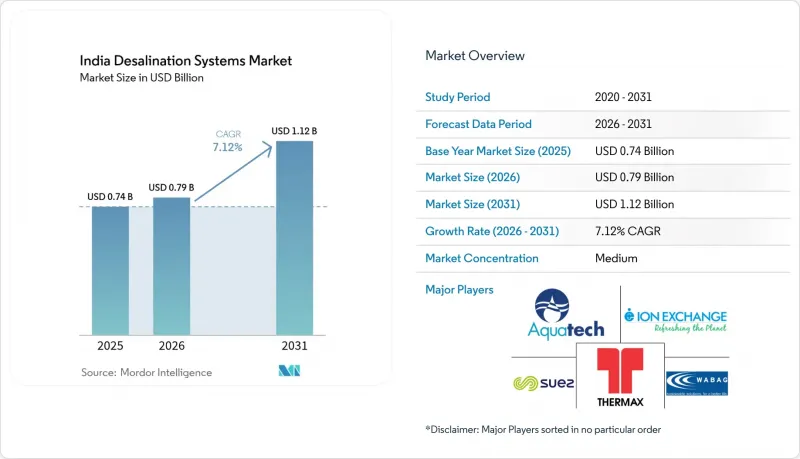
This report is Segmented by Technology (Thermal, Membrane), Application (Municipal, Industrial), Feed Water Source (Seawater, Brackish Groundwater, Industrial Wastewater/ZLD Reuse), and Plant Capacity (Small, Medium, Large). The Market Forecasts are Provided in Terms of Value (USD).
India Desalination Systems Market Trends and Insights
Chronic Water-Supply Deficit vs Demand
Groundwater extraction surpassed 245.64 billion m3 in 2024, while recharge hit 446.90 billion m3, masking severe local mismatches. Over-exploited units fell to 11.13%, yet saline intrusion persists along coasts and in arid belts. Consequently, state utilities are embedding desalination in long-term supply portfolios. NAQUIM-led aquifer mapping and artificial-recharge projects highlight that demand-side restraint alone is inadequate, cementing desalination's role as a structural supply augmenter. Revised approval norms now prioritize energy-efficient designs and brine-management plans, favoring developers that integrate energy-recovery devices and beneficial-reuse schemes.
Accelerated Coastal Urbanization & Smart-City Desal Mandates
Gujarat's five-plant blueprint and similar initiatives in Maharashtra and Tamil Nadu show how population shifts are outstripping river and groundwater sources. Smart-City frameworks bundle desalination with IoT metering, real-time leak detection, and predictive asset maintenance, lowering non-revenue water and operating costs. Experience from Chennai's Minjur plant drove newer designs towards high-pressure RO membranes and turbine-based energy recovery, trimming specific energy to 3.3 kWh/m3. Municipalities now view desalination as foundational infrastructure that unlocks industrial expansion and port-led growth.
Brine-Disposal Compliance Costs
Central Pollution Control Board draft norms mandate diffuser-equipped outfalls, salinity plume modeling, and marine-bio monitoring, pushing disposal spend to as high as 33% of total costs in some new bids. Coastal ZLD directives for chemicals and textiles amplify capex. On the upside, emerging crystallization and mineral-recovery technologies aim to monetize salts, gypsum, and magnesium, potentially offsetting compliance outlays if product-grade purity can be reached.
Other drivers and restraints analyzed in the detailed report include:
- Jal Jeevan Mission Tie-ins for Rural Brackish-Water RO Schemes
- Grid-Parity Solar PV Makes Renewable-Powered RO Bankable
- Local-Content Rules Inflate CAPEX for Advanced Membranes
For complete list of drivers and restraints, kindly check the Table Of Contents.
Segment Analysis
The membrane segment dominated the India desalination systems market with a 67.92% share in 2025 and is set for a 7.53% CAGR as membrane efficiency climbs and unit costs fall. Within the basket, reverse osmosis rules because of robust performance at salinities up to 45,000 ppm, while electrodialysis shines for brackish feeds below 10,000 ppm. Ion Exchange's Goa plant broadened local RO element supply, trimming lead times and foreign exchange risk. DuPont's ultra-high-pressure RO modules rated to 120 bar cut energy draw by up to 50% compared to thermal multis-age flash lines.
Thermal desal still finds niches where waste heat is free, notably in refineries and petrochemical parks. Multi-effect distillation retrofits into cogeneration loops in Jamnagar exemplify such synergies. Hybrid layouts pairing RO with vapor compression are emerging for refinery effluents where oil-bearing streams challenge conventional membranes. Advances in graphene-oxide coatings and zwitterionic surfaces are extending membrane life and slashing chemical cleaning frequency, strengthening long-term economics for membrane centric plants.
Municipal bodies commanded a 55.78% share in 2025, yet industrial demand is clocking the faster 7.28% CAGR. ZLD regulations for textiles, pharma, and dyes in states like Tamil Nadu and Gujarat are the prime spur. The India desalination systems market size for industrial users will widen as companies integrate water recycling within ESG roadmaps. Textile parks in Tirupur now operate common-effluent ZLD clusters featuring RO plus thermal concentrators, curbing freshwater withdrawals by over 80%. Petrochemical complexes such as CPCL's upcoming 60 MLD build-own-operate plant in Nagapattinam illustrate rising capex appetite for captive seawater intake and high-recovery trains. Municipal programs still underpin headline volumes, but protracted tender cycles and public-acceptance hurdles temper growth relative to nimble private projects.
Complete Report Scope:
- By Technology
- Thermal
- Multi-Stage Flash (MSF)
- Multi-Effect Distillation (MED)
- Vapor Compression Distillation
- Membrane
- Electrodialysis (ED)
- Reverse Osmosis (RO)
- Electrodialysis Reversal (EDR)
- Other Membrane Technologies (Nanofiltration, Ultrafiltration and Microfiltration)
- Thermal
- By Application
- Municipal
- Industrial
- By Feed Water Source
- Seawater
- Brackish Groundwater
- Industrial Wastewater/ZLD reuse
- By Plant Capacity
- Small (less than 10 MLD)
- Medium (10-100 MLD)
- Large (greater than 100 MLD)
List of Companies Covered in this Report:
- Abengoa
- ACCIONA
- Aquatech International LLC
- Concord Enviro Systems
- Doosan Enerbility
- DuPont
- Evoqua Water Technologies
- Hitachi Ltd
- IDE Technologies Ltd
- IEI
- LARSEN & TOUBRO LIMITED.
- Metito Utilities
- Pentair
- SHAPOORJI PALLONJI
- SUEZ SA
- Tata Projects Limited.
- Thermax Ltd
- Veolia Environnement SA
- WABAG
- Xylem
Additional Benefits:
- The market estimate (ME) sheet in Excel format
- 3 months of analyst support
TABLE OF CONTENTS
1 Introduction
- 1.1 Study Assumptions and Market Definition
- 1.2 Scope of the Study
2 Research Methodology
3 Executive Summary
4 Market Landscape
- 4.1 Market Overview
- 4.2 Market Drivers
- 4.2.1 Chronic water-supply deficit vs demand
- 4.2.2 Accelerated coastal urbanisation and Smart-City desal plant mandates
- 4.2.3 Jal Jeevan Mission tie-ins for rural brackish-water RO schemes
- 4.2.4 Grid-parity solar-PV makes renewable-powered RO bankable
- 4.2.5 Growing demand for green-hydrogen grade ultrapure water at coastal RE hubs
- 4.3 Market Restraints
- 4.3.1 High energy cost and tariff volatility
- 4.3.2 Brine-disposal compliance costs
- 4.3.3 Local-content rules inflate CAPEX for advanced membranes
- 4.4 Value Chain Analysis
- 4.5 Porter's Five Forces
- 4.5.1 Threat of New Entrants
- 4.5.2 Bargaining Power of Buyers
- 4.5.3 Bargaining Power of Suppliers
- 4.5.4 Threat of Substitutes
- 4.5.5 Degree of Competition
5 Market Size and Growth Forecasts (Value)
- 5.1 By Technology
- 5.1.1 Thermal
- 5.1.1.1 Multi-Stage Flash (MSF)
- 5.1.1.2 Multi-Effect Distillation (MED)
- 5.1.1.3 Vapor Compression Distillation
- 5.1.2 Membrane
- 5.1.2.1 Electrodialysis (ED)
- 5.1.2.2 Reverse Osmosis (RO)
- 5.1.2.3 Electrodialysis Reversal (EDR)
- 5.1.2.4 Other Membrane Technologies (Nanofiltration, Ultrafiltration and Microfiltration)
- 5.1.1 Thermal
- 5.2 By Application
- 5.2.1 Municipal
- 5.2.2 Industrial
- 5.3 By Feed Water Source
- 5.3.1 Seawater
- 5.3.2 Brackish Groundwater
- 5.3.3 Industrial Wastewater/ZLD reuse
- 5.4 By Plant Capacity
- 5.4.1 Small (less than 10 MLD)
- 5.4.2 Medium (10-100 MLD)
- 5.4.3 Large (greater than 100 MLD)
6 Competitive Landscape
- 6.1 Market Concentration
- 6.2 Strategic Moves
- 6.3 Market Share**/Ranking Analysis
- 6.4 Company Profiles (includes Global level Overview, Market level overview, Core Segments, Financials as available, Strategic Information, Market Rank/Share for key companies, Products and Services, Recent Developments)
- 6.4.1 Abengoa
- 6.4.2 ACCIONA
- 6.4.3 Aquatech International LLC
- 6.4.4 Concord Enviro Systems
- 6.4.5 Doosan Enerbility
- 6.4.6 DuPont
- 6.4.7 Evoqua Water Technologies
- 6.4.8 Hitachi Ltd
- 6.4.9 IDE Technologies Ltd
- 6.4.10 IEI
- 6.4.11 LARSEN & TOUBRO LIMITED.
- 6.4.12 Metito Utilities
- 6.4.13 Pentair
- 6.4.14 SHAPOORJI PALLONJI
- 6.4.15 SUEZ SA
- 6.4.16 Tata Projects Limited.
- 6.4.17 Thermax Ltd
- 6.4.18 Veolia Environnement SA
- 6.4.19 WABAG
- 6.4.20 Xylem
7 Market Opportunities and Future Outlook
- 7.1 White-space and Unmet-Need Assessment

