PUBLISHER: Mordor Intelligence | PRODUCT CODE: 2115876

PUBLISHER: Mordor Intelligence | PRODUCT CODE: 2115876
Calcium Nitrate - Market Share Analysis, Industry Trends & Statistics, Growth Forecasts (2026 - 2031)
According to Mordor Intelligence, the calcium nitrate market size is estimated at USD 13.90 billion in 2026, and is expected to reach USD 17.01 billion by 2031, at a CAGR of 4.12% during the forecast period (2026-2031).
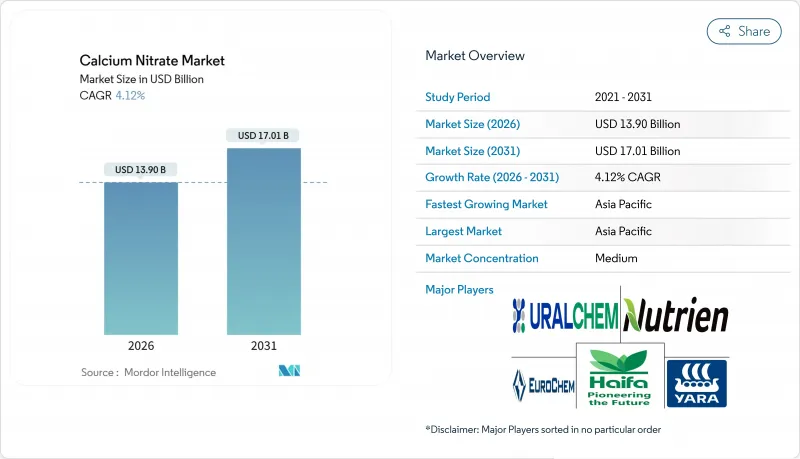
This report is Segmented by Product Type (Crystals, Liquid, and Melt), Application (Fertilizer, Wastewater Treatment, Concrete, Explosives, Refrigerant, and Other Applications), and Geography (Asia-Pacific, North America, Europe, South America, and Middle-East and Africa). The Market Forecasts are Provided in Terms of Value (USD).
Global Calcium Nitrate Market Trends and Insights
Specialty Water-Soluble Fertilizers Boom
Precision irrigation is replacing broadcast spreading in water-scarce regions. Because calcium nitrate dissolves completely and contains no chloride, it is the preferred source of nitrogen and calcium for fertigation. Commercial grades such as Haifa's Cal Prime deliver 17.0% total nitrogen-nearly all in nitrate form-and 23.5% water-soluble calcium, enabling concentrated stock solutions that lower freight costs and stabilize nutrient pH. Asia-Pacific governments subsidize micro-irrigation under China's 14th Five-Year Plan and India's Pradhan Mantri Krishi Sinchayee Yojana, lifting demand for fully soluble grades. Formulation innovation, exemplified by Croda Agriculture's PiNT technology that slows ureic nitrogen release, bolsters overall adoption of complementary calcium nitrate inputs.
Urban Vertical-Farm Fertigation Demand
Vertical farms, rooftop greenhouses, and plant factories operate closed-loop hydroponic or aeroponic systems that mandate ultra-pure nutrient salts. Calcium nitrate, typically supplied in two-part recipes to prevent phosphate or sulfate precipitation, is central to these formulations. Yara's greenhouse-grade Calcinit dissolves at 1,200 g L-1 at 20 °C, leaving no residue that could clog emitters. New facilities in Singapore, the Netherlands, and the United States consume 5-10 kg of calcium nitrate per cubic meter of nutrient solution per crop cycle, providing steady, season-independent demand. Venture capital funding and corporate investments in metropolitan food production amplify this structural pull.
Shift Toward Organic and Bio-Based Fertilizers
Policy incentives and consumer preferences are pushing land toward certified organic production in Europe and North America, where organic acreage grew by up to 10% annually in recent years. Organic standards prohibit synthetic nitrates, diverting demand to composts and microbial inoculants. The European Farm to Fork Strategy targets a 20% fertilizer-use reduction by 2030, with subsidies that reward low-input regimes. Although organic nutrient sources still account for a small slice of total nitrogen consumption, they displace calcium nitrate in premium vegetables, fruits, and wine grapes, particularly in Northern Europe and California.
Other drivers and restraints analyzed in the detailed report include:
- Calcium-Deficiency Disorders in High-Value Crops
- On-Site Anhydrous Ca-Nitrate for CSP Salts
- Denitrifying Bioreactors Replacing Nitrate Dosing
For complete list of drivers and restraints, kindly check the Table Of Contents.
Segment Analysis
Crystals held 46.22% of revenue in 2025, underscoring their role in broad-acre and orchard nutrition programs. Growers appreciate the cost-efficiency of crystalline calcium nitrate tetrahydrate delivered in moisture-resistant bags that dissolve quickly in mix tanks. The calcium nitrate market size for crystals is expected to expand steadily, supported by greenhouse operators that dissolve crystals in stock tanks. Liquid formulations, sold at 9%-11% nitrogen and 14%-19% calcium, are advancing at a 4.21% CAGR. Precision fertigation adopters value the labor savings and uniformity that pre-dissolved solutions provide, especially when injected through computerized dosing pumps. Norkem's 2024 launch of granular calcium nitrate illustrates continued innovation in the crystals category by offering a slower nutrient-release profile that mitigates leaching in high rainfall zones.
Industrial buyers form a niche but stable outlet. Anhydrous calcium nitrate melt blends into ternary CSP salts such as Hitec XL, enabling lower melting points but capping operating temperatures at 450 °C. Concrete admixture producers rely on calcium nitrate as a non-chloride set accelerator compliant with ASTM C494 Type C and Type E, a use reaffirmed in the Federal Highway Administration's 2024 technical brief. Collectively, these industrial channels diversify demand and cushion the calcium nitrate market against agricultural cycles.
Complete Report Scope:
- By Product Type
- Crystals
- Liquid
- Melt
- By Application
- Fertilizer
- Wastewater Treatment
- Concrete
- Explosives
- Refrigerant
- Other Applications
- By Geography
- Asia-Pacific
- China
- India
- Japan
- South Korea
- ASEAN Countries
- Rest of Asia Pacific
- North America
- United States
- Canada
- Mexico
- Europe
- Germany
- United Kingdom
- France
- Italy
- NORDIC Countries
- Rest of Europe
- South America
- Brazil
- Argentina
- Rest of South America
- Middle-East and Africa
- Saudi Arabia
- South Africa
- Rest of Middle-East and Africa
- Asia-Pacific
Geography Analysis
Asia-Pacific controlled 41.98% of the calcium nitrate market in 2025 and is forecast to grow at 5.41% through 2031. China's 1.2 million ha greenhouse base is pivoting toward soilless systems that rely on ultrapure calcium nitrate in hydroponic mixes. National subsidies for water-saving irrigation accelerate fertigation adoption. India's protected-cultivation acreage is rising under the National Horticulture Mission, with high uptake in Maharashtra and Rajasthan. Vertical-farm investment in Japan and South Korea, paired with expanding greenhouse clusters in Vietnam and Thailand, further underpins regional demand.
North America remains a core market. Greenhouse clusters in Arizona, California, and the Great Lakes region incorporate calcium nitrate in tomato and pepper nutrition programs to avert blossom-end rot. Municipalities in Florida and Texas continuously dose nitrate to manage hydrogen-sulfide odors in long sewer force mains. Canada's greenhouse belt in Ontario and British Columbia sources calcium nitrate both domestically and from European suppliers. Mexico's drip-irrigated vegetable exports from Sinaloa and Baja California increasingly rely on liquid grades that integrate easily with existing injection equipment.
Europe's market is characterized by advanced greenhouse technology and tightening carbon policy. Dutch growers demand high-purity calcium nitrate to maintain electrical-conductivity thresholds in recirculating nutrient systems, while German and French producers follow suit. The CBAM framework, enforced in 2026, advantages local low-carbon producers and encourages Nordic investment in green-ammonia projects that will supply future nitrate production. South America's emerging role is underscored by Yara's off-take agreement for renewable calcium ammonium nitrate from Paraguay, signaling Mercosur's potential as a low-carbon supply hub. In the Middle East and Africa, Saudi Arabia's Vision 2030 and South Africa's export-oriented greenhouse clusters are adopting calcium nitrate solutions to support water-efficient, high-yield cultivation.
- ADOB
- Acron
- Airedale Group
- CF Industries Holdings, Inc.
- Eastman Chemical Corporation
- EuroChem Group
- GFS Chemicals, Inc.
- Haifa Negev Technologies LTD
- Noah Chemicals
- Nutrien
- PJSC Acron
- Prathista Industries Limited
- ProChem, Inc.
- RLF AgTech
- SABIC
- Shanxi Jiaocheng Tianlong Chemical Industry Co., Ltd.
- Shanxi Leixin Chemical Co., Ltd.
- Sumitomo Chemical Co., Ltd.
- SWISS FORMULATIONS
- URALCHEM JSC
- Van Iperen International
- WEGO Chemical Group
- Yara
Additional Benefits:
- The market estimate (ME) sheet in Excel format
- 3 months of analyst support
TABLE OF CONTENTS
1 Introduction
- 1.1 Study Assumptions and Market Definition
- 1.2 Scope of the Study
2 Research Methodology
3 Executive Summary
4 Market Landscape
- 4.1 Market Overview
- 4.2 Market Drivers
- 4.2.1 Specialty Water-Soluble Fertilizers Boom
- 4.2.2 Urban Vertical-Farm Fertigation Demand
- 4.2.3 Calcium-Deficiency Disorders In High-Value Crops
- 4.2.4 EU CBAM-Ready Low-Carbon Nitrate Push
- 4.2.5 On-Site Anhydrous Ca-Nitrate for CSP Salts
- 4.3 Market Restraints
- 4.3.1 Shift Toward Organic and Bio-Based Fertilizers
- 4.3.2 Ammonia/Nitric-Acid Price Volatility
- 4.3.3 Denitrifying Bioreactors Replacing Nitrate Dosing
- 4.4 Value Chain Analysis
- 4.5 Porter's Five Forces
- 4.5.1 Bargaining Power of Suppliers
- 4.5.2 Bargaining Power of Buyers
- 4.5.3 Threat of New Entrants
- 4.5.4 Threat of Substitute Products
- 4.5.5 Degree of Competition
5 Market Size and Growth Forecasts (Value)
- 5.1 By Product Type
- 5.1.1 Crystals
- 5.1.2 Liquid
- 5.1.3 Melt
- 5.2 By Application
- 5.2.1 Fertilizer
- 5.2.2 Wastewater Treatment
- 5.2.3 Concrete
- 5.2.4 Explosives
- 5.2.5 Refrigerant
- 5.2.6 Other Applications
- 5.3 By Geography
- 5.3.1 Asia-Pacific
- 5.3.1.1 China
- 5.3.1.2 India
- 5.3.1.3 Japan
- 5.3.1.4 South Korea
- 5.3.1.5 ASEAN Countries
- 5.3.1.6 Rest of Asia Pacific
- 5.3.2 North America
- 5.3.2.1 United States
- 5.3.2.2 Canada
- 5.3.2.3 Mexico
- 5.3.3 Europe
- 5.3.3.1 Germany
- 5.3.3.2 United Kingdom
- 5.3.3.3 France
- 5.3.3.4 Italy
- 5.3.3.5 NORDIC Countries
- 5.3.3.6 Rest of Europe
- 5.3.4 South America
- 5.3.4.1 Brazil
- 5.3.4.2 Argentina
- 5.3.4.3 Rest of South America
- 5.3.5 Middle-East and Africa
- 5.3.5.1 Saudi Arabia
- 5.3.5.2 South Africa
- 5.3.5.3 Rest of Middle-East and Africa
- 5.3.1 Asia-Pacific
6 Competitive Landscape
- 6.1 Market Concentration
- 6.2 Strategic Moves
- 6.3 Market Share (%)/Ranking Analysis
- 6.4 Company Profiles (includes Global level Overview, Market level overview, Core Segments, Financials as available, Strategic Information, Products and Services, and Recent Developments)
- 6.4.1 ADOB
- 6.4.2 Acron
- 6.4.3 Airedale Group
- 6.4.4 CF Industries Holdings, Inc.
- 6.4.5 Eastman Chemical Corporation
- 6.4.6 EuroChem Group
- 6.4.7 GFS Chemicals, Inc.
- 6.4.8 Haifa Negev Technologies LTD
- 6.4.9 Noah Chemicals
- 6.4.10 Nutrien
- 6.4.11 PJSC Acron
- 6.4.12 Prathista Industries Limited
- 6.4.13 ProChem, Inc.
- 6.4.14 RLF AgTech
- 6.4.15 SABIC
- 6.4.16 Shanxi Jiaocheng Tianlong Chemical Industry Co., Ltd.
- 6.4.17 Shanxi Leixin Chemical Co., Ltd.
- 6.4.18 Sumitomo Chemical Co., Ltd.
- 6.4.19 SWISS FORMULATIONS
- 6.4.20 URALCHEM JSC
- 6.4.21 Van Iperen International
- 6.4.22 WEGO Chemical Group
- 6.4.23 Yara
7 Market Opportunities and Future Outlook
- 7.1 White-space and Unmet-Need Assessment

