PUBLISHER: Mordor Intelligence | PRODUCT CODE: 2115884

PUBLISHER: Mordor Intelligence | PRODUCT CODE: 2115884
Africa Heavy Equipment Lubricants - Market Share Analysis, Industry Trends & Statistics, Growth Forecasts (2026 - 2031)
According to Mordor Intelligence, the Africa heavy equipment lubricants market size is expected to grow from 416.49 Million liters in 2025 to 435.65 Million liters in 2026 and is forecast to reach 545.42 Million liters by 2031 at 4.60% CAGR over 2026-2031.
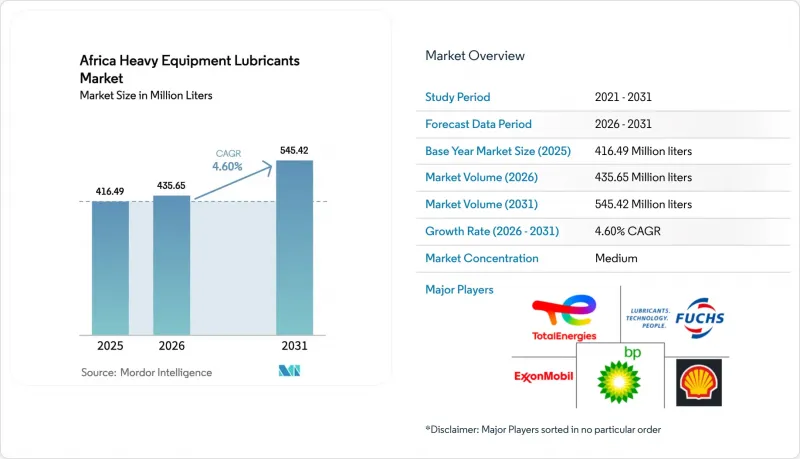
This report is Segmented by Product Type (Engine Oil, Transmission and Hydraulic Fluid, General Industrial Oil, Gear Oil, Grease, Process Oil, Other and Product Types), End-User Industry (Construction, Mining, Agriculture, and Oil and Gas), and Geography (Egypt, South Africa, Nigeria, Algeria, Morocco, and Rest of Africa). The Market Forecasts are Provided in Terms of Volume (Litres).
Africa Heavy Equipment Lubricants Market Trends and Insights
Rising Construction-Sector Spend Across Africa
Infrastructure investments in Africa have surged, focusing on roads, railways, and ambitious urban projects. These initiatives are heavily reliant on high-hour fleets, leading to increased lubricant usage at each site. In Egypt's Toshka agricultural expansion, Volvo EC300D and A45G units run for extended hours daily. Given the abrasive desert conditions, there's a heightened demand for high-viscosity-index hydraulic fluids. Ghana's District Road Improvement Program, which welcomed LiuGong machines in 2024, saw an immediate uptick in local engine oil consumption. Algeria's Western Mining Railway, a project under construction since 2024, has introduced a dedicated sleeper plant, further driving lubricant needs for rail-construction machinery. Mota-Engil's recent acquisition of Liebherr rail excavators for the Kano-Maradi line highlights a growing demand for specialty greases, essential for safeguarding dual road-rail systems. These expansive programs not only signify a commitment to national capital plans but also ensure a sustained demand for lubricants in Africa's heavy equipment market.
Expansion of Mining Activities and Commodity Upswing
Mining expansion emerges as the primary driver for the Africa heavy equipment lubricants market's CAGR. In Guinea, the Simandou project has placed orders for Komatsu PC5500-11 excavators and XCMG dumpers, establishing a strong demand for engine oils, hydraulic fluids, and EP greases. Algeria's Gara Djebilet mine secures lubricant volumes for both its mining operations and rail rolling stock. In March 2025, South Africa's Mogalakwena introduced the continent's inaugural Komatsu P&H 4800XPC shovel, a hefty unit, with its slewing bearings dependent on premium calcium-sulfonate grease. With commodity prices for copper and lithium stabilizing above long-term averages, capital expenditures and equipment utilization remain robust, subsequently bolstering lubricant throughput. Concurrently, DRC, Zambia, Zimbabwe, and Madagascar are ramping up their output of battery metals, expanding the geographical reach of mining-driven lubricant demand.
Counterfeit and Sub-Standard Lubricant Prevalence
Tanzania's January 2025 warning underscored the scale of fake products that fail to meet API or ACEA specs, causing premature wear and voiding OEM warranties. Despite strict Petroleum Lubricant Operations Rules, limited rural enforcement enables illicit trade in Nigeria and Kenya. Puma Energy's tamper-evident packaging and hologram authentication fight back, yet brand owners still fund raids, consumer education, and blockchain pilots, adding compliance costs. The drag is most acute over 2025-2027, after which harmonized AfCFTA standards are expected to tighten border checks and shrink counterfeit supply.
Other drivers and restraints analyzed in the detailed report include:
- Rapid Mechanisation in African Agriculture
- Mandatory Oil-Analysis Clauses in Government Fleet Tenders
- Global Group I Base-Oil Rationalisation Driving Price Spikes
For complete list of drivers and restraints, kindly check the Table Of Contents.
Segment Analysis
Engine oil accounted for 48.17% of the Africa heavy equipment lubricants market size in 2025, underpinned by diesel-powered earthmovers, haul trucks, and generators. Synthetic engine oil is tracking a 6.80% CAGR to 2031 as high ambient temperatures and dust accelerate oxidation, pushing fleets toward Group II/III formulations. At Dangote Refinery, XCMG XE470D excavators routinely clock extensive operating hours each day. To protect their turbochargers, these excavators rely on premium CK-4 oils, chosen for their elevated viscosity index. Meanwhile, at Egypt's Toshka site, Volvo EC480D units, equipped with advanced electro-hydraulic systems, depend on transmission and hydraulic fluids. These fluids, the second-largest segment in the market, are selected for their anti-wear additives and robust oxidation resistance. Lastly, on Komatsu's P&H 4800XPC rope shovel, which operates in continuous shifts, gear oils and greases play a crucial role. They safeguard the machine's final drives and slewing bearings.
In a move highlighting the evolving supply chain, Chevron has teamed up with Gapuma to distribute Group II base oils in Nigeria. This partnership underscores the synthetic growth trend in the region. Meanwhile, audits from Puma Energy's Total Fluid Management reveal that longer drain intervals lead to significant cost savings. This finding is driving a shift towards higher-value fluid formulations. Retail visibility for these premium products is on the rise. For instance, Makro South Africa now offers synthetic packs from brands like Castrol, Engen, and Total. This pricing strategy makes premium lubricants more accessible to smaller contractors. Consequently, the forecast suggests a steady annual increase in the market share of synthetic lubricants, bolstering the Africa heavy equipment lubricants market's emphasis on value over volume.
Complete Report Scope:
- By Product Type
- Engine Oil
- Transmission and Hydraulic Fluid
- General Industrial Oil
- Gear Oil
- Grease
- Process Oil
- Other Product Types
- By End-user Industry
- Construction
- Mining
- Agriculture
- Oil and Gas
- By Geography
- Egypt
- South Africa
- Nigeria
- Algeria
- Morocco
- Rest of Africa
List of Companies Covered in this Report:
- BP PLC
- Chevron Corporation
- Conoil PLC
- Cooperative Societe Des Petroleum (Co-op)
- Engen Petroleum Ltd
- Exxon Mobil Corporation
- FUCH
- Hasspetroleum
- KenolKobil Limited
- Lake Oil Group
- Misr Petroleum Co.
- Oando PLC
- Puma Energy
- Sasol
- Shell PLC
- TotalEnergies
- Valvoline Inc
Additional Benefits:
- The market estimate (ME) sheet in Excel format
- 3 months of analyst support
TABLE OF CONTENTS
1 Introduction
- 1.1 Study Assumptions and Market Definition
- 1.2 Scope of the Study
2 Research Methodology
3 Executive Summary
4 Market Landscape
- 4.1 Market Overview
- 4.2 Market Drivers
- 4.2.1 Rising construction-sector spend across Africa
- 4.2.2 Expansion of mining activities and commodity upswing
- 4.2.3 Rapid mechanisation in African agriculture
- 4.2.4 Mandatory oil-analysis clauses in government fleet tenders
- 4.2.5 Growth of predictive-maintenance telematics for off-highway fleets
- 4.3 Market Restraints
- 4.3.1 Counterfeit and sub-standard lubricant prevalence
- 4.3.2 Global Group I base-oil rationalisation driving price spikes
- 4.3.3 Chronic grid instability lowering equipment utilisation hours
- 4.4 Value Chain Analysis
- 4.5 Porter's Five Forces
- 4.5.1 Threat of New Entrants
- 4.5.2 Bargaining Power of Buyers
- 4.5.3 Bargaining Power of Suppliers
- 4.5.4 Threat of Substitute Products
- 4.5.5 Degree of Competition
- 4.6 Supply Scenario - Base Oils
5 Market Size and Growth Forecasts
- 5.1 By Product Type
- 5.1.1 Engine Oil
- 5.1.2 Transmission and Hydraulic Fluid
- 5.1.3 General Industrial Oil
- 5.1.4 Gear Oil
- 5.1.5 Grease
- 5.1.6 Process Oil
- 5.1.7 Other Product Types
- 5.2 By End-user Industry
- 5.2.1 Construction
- 5.2.2 Mining
- 5.2.3 Agriculture
- 5.2.4 Oil and Gas
- 5.3 By Geography
- 5.3.1 Egypt
- 5.3.2 South Africa
- 5.3.3 Nigeria
- 5.3.4 Algeria
- 5.3.5 Morocco
- 5.3.6 Rest of Africa
6 Competitive Landscape
- 6.1 Market Concentration
- 6.2 Strategic Moves
- 6.3 Market Share(%)/Ranking Analysis
- 6.4 Company Profiles (includes Global level Overview, Market level overview, Core Segments, Financials as available, Strategic Information,Products and Services, and Recent Developments)
- 6.4.1 BP PLC
- 6.4.2 Chevron Corporation
- 6.4.3 Conoil PLC
- 6.4.4 Cooperative Societe Des Petroleum (Co-op)
- 6.4.5 Engen Petroleum Ltd
- 6.4.6 Exxon Mobil Corporation
- 6.4.7 FUCH
- 6.4.8 Hasspetroleum
- 6.4.9 KenolKobil Limited
- 6.4.10 Lake Oil Group
- 6.4.11 Misr Petroleum Co.
- 6.4.12 Oando PLC
- 6.4.13 Puma Energy
- 6.4.14 Sasol
- 6.4.15 Shell PLC
- 6.4.16 TotalEnergies
- 6.4.17 Valvoline Inc
7 Market Opportunities and Future Outlook
- 7.1 White-space and Unmet-need Assessment
- 7.2 Development in Synthetic and Bio-based Lubricants

